
The Transcendentals of Civic Renewal
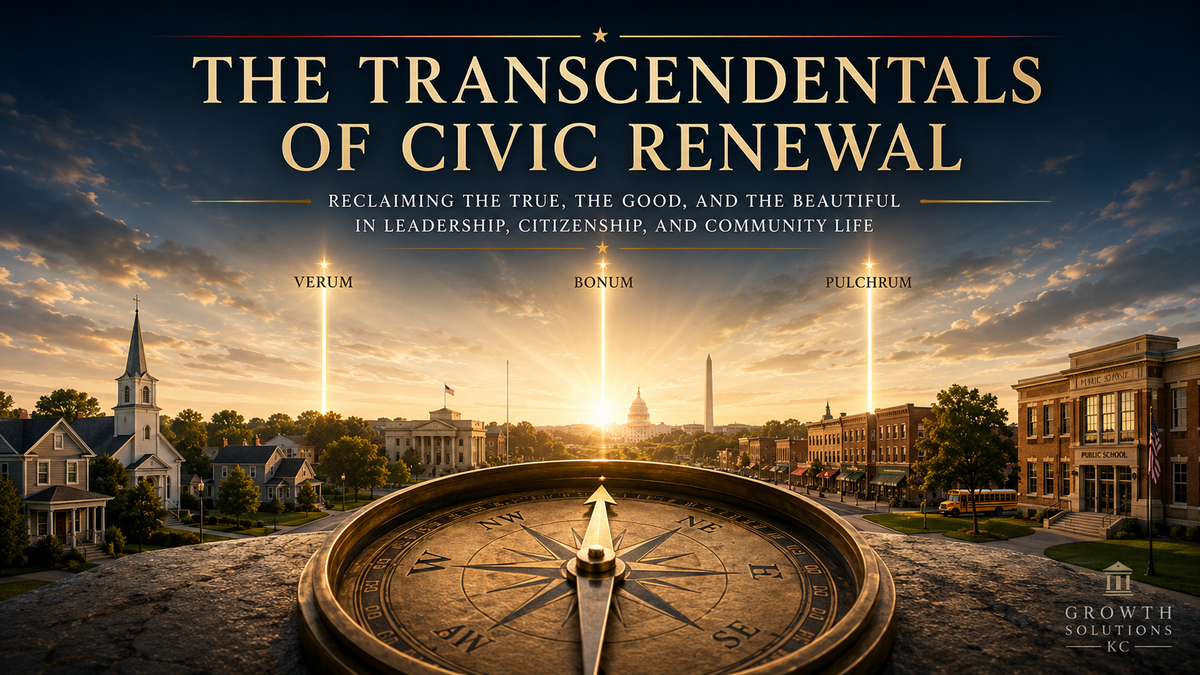
Reclaiming the True, the Good, and the Beautiful in Leadership, Citizenship, and Community Life.
Leadership feels manageable when conditions are stable.
When institutions are trusted, families are grounded, businesses are growing, and communities still share a basic moral vocabulary, leadership often looks like execution: make the decision, solve the problem, set the direction, and keep moving.
But the deeper test of leadership comes when trust begins to erode.
- When public life becomes louder than it is wiser.
- When institutions drift from their purpose.
- When people confuse information with understanding, winning with goodness, and appearance with beauty.
- When families, workplaces, schools, churches, civic groups, and communities all feel the strain of a culture losing its shared sense of reality, responsibility, and order.
That is when a leader’s compass matters most.
In The Leader’s Compass: Building a Personal Philosophy That Guides Every Decision, the central argument was simple: effective leadership requires more than instinct, personality, or situational judgment. It requires an anchored personal philosophy — a set of principles strong enough to guide decisions when pressure rises, incentives distort, and the easier path becomes compromise.
Learn more about the Leaders Compass by reviewing, "The Leader's Compass: Building a Personal Philosophy That Guides Every Decision."
But a compass still needs a fixed point.
A personal philosophy cannot be anchored merely in preference, emotion, image, or convenience. If it is going to sustain individuals, families, organizations, and communities over time, it must be connected to something deeper than the mood of the moment.
That deeper framework is found in three classical ideas often called the transcendentals: the True, the Good, and the Beautiful.
These are not museum-piece abstractions. They are not decorative words reserved for philosophers, theologians, or academic seminars. Properly understood, they are among the most practical leadership tools ever developed.
They teach us that a healthy life, a healthy institution, and a healthy nation must be anchored in three realities:
The True — alignment with reality.
The Good — fulfillment of purpose.
The Beautiful — harmony, order, and wholeness.
Reality. Purpose. Order.
These are not luxuries. They are the architecture of renewal.
When individuals lose contact with truth, they make poor decisions. When institutions lose sight of purpose, they become unstable. When communities lose beauty — not merely visual beauty, but harmony, trust, proportion, and civic order — they become anxious, cynical, and fragmented.
The reverse is also true.
When people return to reality, they can make wiser choices. When institutions recover their proper purpose, they can serve again. When communities rebuild order and trust, they begin to flourish.
That is why the transcendentals matter now.
The Modern Confusion: “My Truth,” “My Good,” and Image Without Beauty
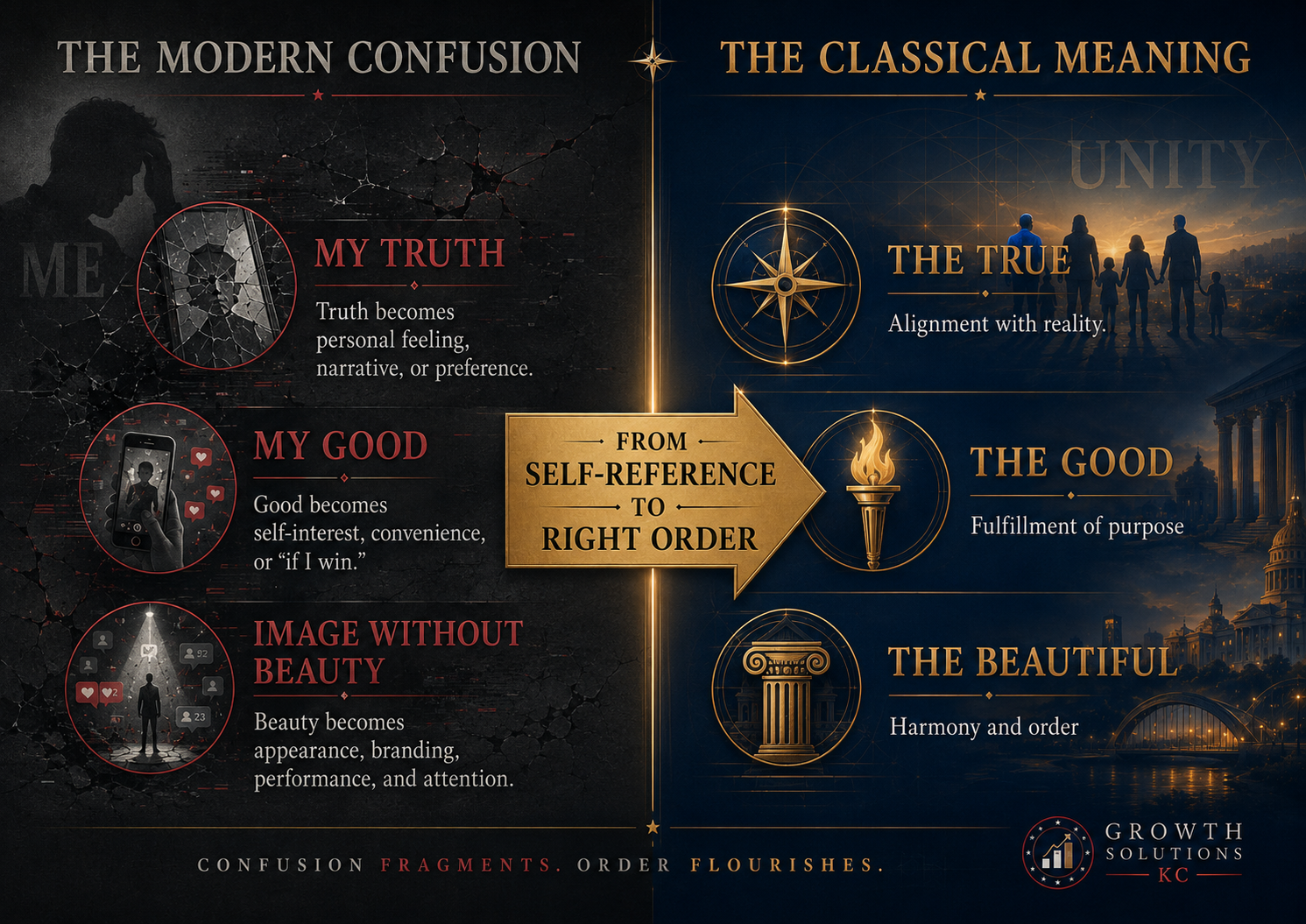
One reason the True, the Good, and the Beautiful must be reclaimed is that many people no longer understand what these words mean.
Truth is often reduced to personal perspective.
Goodness is often reduced to self-interest.
Beauty is often reduced to appearance, branding, or image.
The classical idea of Truth is different. It is what is real.
In the modern vocabulary, “truth” frequently means my truth — a private emotional reality that cannot be questioned, tested, challenged, or corrected. Experience matters, but experience is not the same thing as truth. A person’s perspective can be sincere and still incomplete. A narrative can feel powerful and still be false. A movement can be emotionally compelling and still be detached from reality.
The True is not whatever I prefer to believe. It is reality as it is. It is correspondence with facts, evidence, nature, history, consequences, and the actual structure of the world.
Goodness has suffered a similar distortion.
In a self-focused culture, “good” is often treated as whatever benefits me, advances my side, protects my status, or helps my team win. But winning is not the same thing as goodness. Efficiency is not the same thing as goodness. Popularity is not the same thing as goodness.
The classical idea of the Good is rooted in purpose.
A thing is good when it fulfills the purpose for which it exists. A family is good when it forms love, responsibility, discipline, sacrifice, and belonging. A school is good when it educates. A business is good when it creates value, serves customers, develops people, and sustains honest enterprise. A government is good when it protects ordered liberty, administers justice, preserves public safety, and secures the conditions in which citizens can build meaningful lives.
Beauty, too, has been flattened.
Modern culture often treats beauty as surface-level appearance — how something looks, how it photographs, how it performs on a screen, how well it projects status or influence. But classical beauty is not vanity. It is not cosmetic polish applied to disorder.
The Beautiful is the visible and experiential expression of truth and goodness working together.
It is harmony. Proportion. Order. Wholeness. Integrity. A well-run household has beauty. A trustworthy institution has beauty. A disciplined business has beauty. A community where citizens can disagree without dehumanizing one another has beauty. A republic where freedom is balanced by responsibility has beauty.
When the True, the Good, and the Beautiful are misunderstood, society does not become more liberated. It becomes more unstable. People begin to build lives on feelings detached from reality, institutions on missions detached from purpose, and communities on images detached from integrity.
That is not renewal. That is decay.
Defining the Crisis: The Untrue, the Bad, and the Ugly
To understand why the transcendentals matter, we must also understand what happens when their opposites take root.
A culture that rejects the True does not become neutral. It becomes vulnerable to the Untrue.
A culture that abandons the Good does not become free. It becomes vulnerable to the Bad.
A culture that loses the Beautiful does not become sophisticated. It becomes vulnerable to the Ugly.
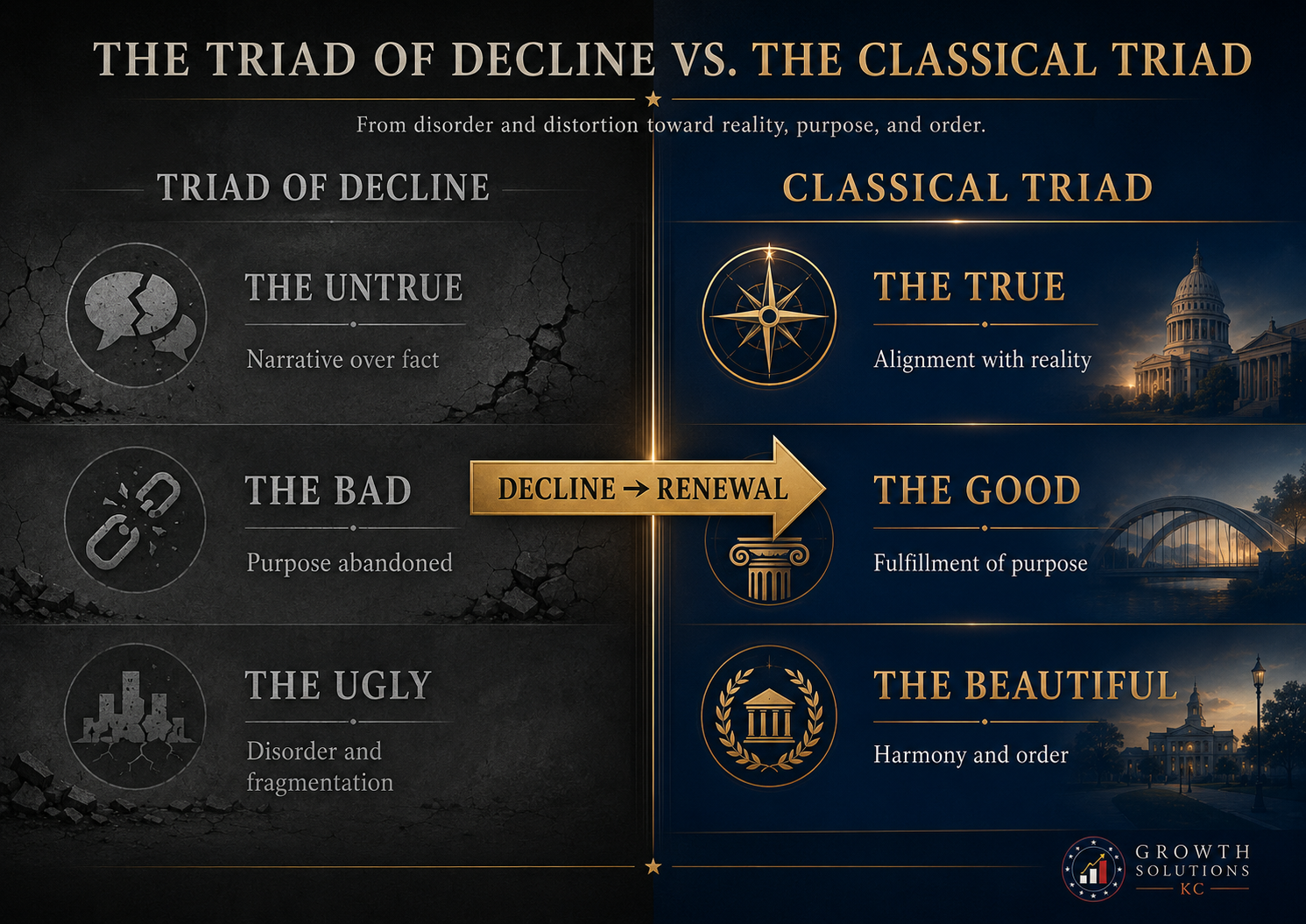
This destructive triad — the Untrue, the Bad, and the Ugly — is not merely philosophical language. It is visible in the daily life of modern institutions and communities.
The Untrue
The Untrue begins wherever reality is subordinated to narrative.
This happens when facts are selected only to serve a preferred conclusion, when emotional intensity replaces evidence, when language is manipulated to avoid hard realities, or when citizens are trained to ask first whether something helps their side rather than whether it is accurate.
The Untrue does not always arrive as an obvious lie. Often, it arrives as a distortion, an omission, a slogan, a half-truth, or a framing device that makes clear thinking more difficult.
- In personal life, the Untrue allows people to avoid responsibility.
- In organizations, it allows leaders to ignore structural problems.
- In public life, it allows institutions to trade credibility for short-term advantage.
The cost is always the same: decision-making becomes detached from reality.
And when decisions detach from reality, consequences eventually arrive.
The Bad
The Bad follows when institutions stop fulfilling their proper purpose.
A school that prioritizes ideology over education has drifted from the Good. A business that chases short-term optics while neglecting customers, employees, and long-term value has drifted from the Good. A civic institution that protects itself rather than serving the public has drifted from the Good.
It appears when systems become more concerned with appearance than effectiveness. It appears when leaders measure success by public relations rather than outcomes. It appears when organizations become reactive instead of responsible. It appears when winning the argument becomes more important than solving the problem.
At the civic level, the Bad takes root when people begin rooting for failure because failure would harm their opponents.
That is a dangerous habit.
A citizen who wants his country’s institutions to fail so his faction can benefit has confused politics with stewardship. A leader who weakens trust to gain advantage may win the moment while damaging the system he depends on. A culture that rewards institutional sabotage eventually inherits institutional weakness.
The Good requires more from us. It requires purpose, discipline, restraint, and responsibility.
The Ugly
The Ugly is the civic and human result of the Untrue and the Bad.
When truth erodes and institutions lose purpose, the public square becomes disordered. Trust declines. Cynicism rises. Families become strained by constant political and cultural tension. Workplaces become cautious and performative. Communities become less neighborly. Citizens become more isolated, more suspicious, and more easily manipulated by outrage.
This is ugliness in the classical sense.
Not simply something unattractive, but something disordered.
A fractured civic landscape is ugly. A dishonest institution is ugly. A household governed by resentment is ugly. A community that cannot speak across disagreement is ugly. A nation that forgets gratitude, responsibility, and shared inheritance becomes ugly — not because it lacks power or wealth, but because it lacks harmony.
Reframing the Issue: The Triad as an Operational Ecosystem
The True, the Good, and the Beautiful are often treated as separate ideals.
They are not. They are interconnected. You cannot damage one without weakening the others.
If a personal decision, business strategy, civic institution, or public policy is built on what is untrue, it cannot produce what is genuinely good. And if it does not produce what is good, it will not result in what is beautiful. The final outcome will be disorder, instability, resentment, or decline.
The same pattern works in reverse.
When individuals and institutions align themselves with reality, they make better decisions. Better decisions make it possible to fulfill proper purposes. Purpose fulfilled creates visible order, trust, confidence, and flourishing.
Truth makes goodness possible.
Goodness makes beauty visible.
Beauty strengthens trust in truth and goodness.
This is why the triad is not merely philosophical. It is operational.
It applies to leadership. It applies to families. It applies to business. It applies to education. It applies to local government. It applies to media. It applies to national life.
- A family cannot be healthy if it refuses to tell the truth.
- A business cannot be durable if it forgets its purpose.
- A school cannot be beautiful if its classrooms are disorderly, its standards are unclear, and its mission is confused.
- A nation cannot remain strong if its citizens become detached from reality, cynical about goodness, and indifferent to civic order.
The transcendentals are not optional decorations.
They are load-bearing walls.
From Personal Compass to Civic Responsibility
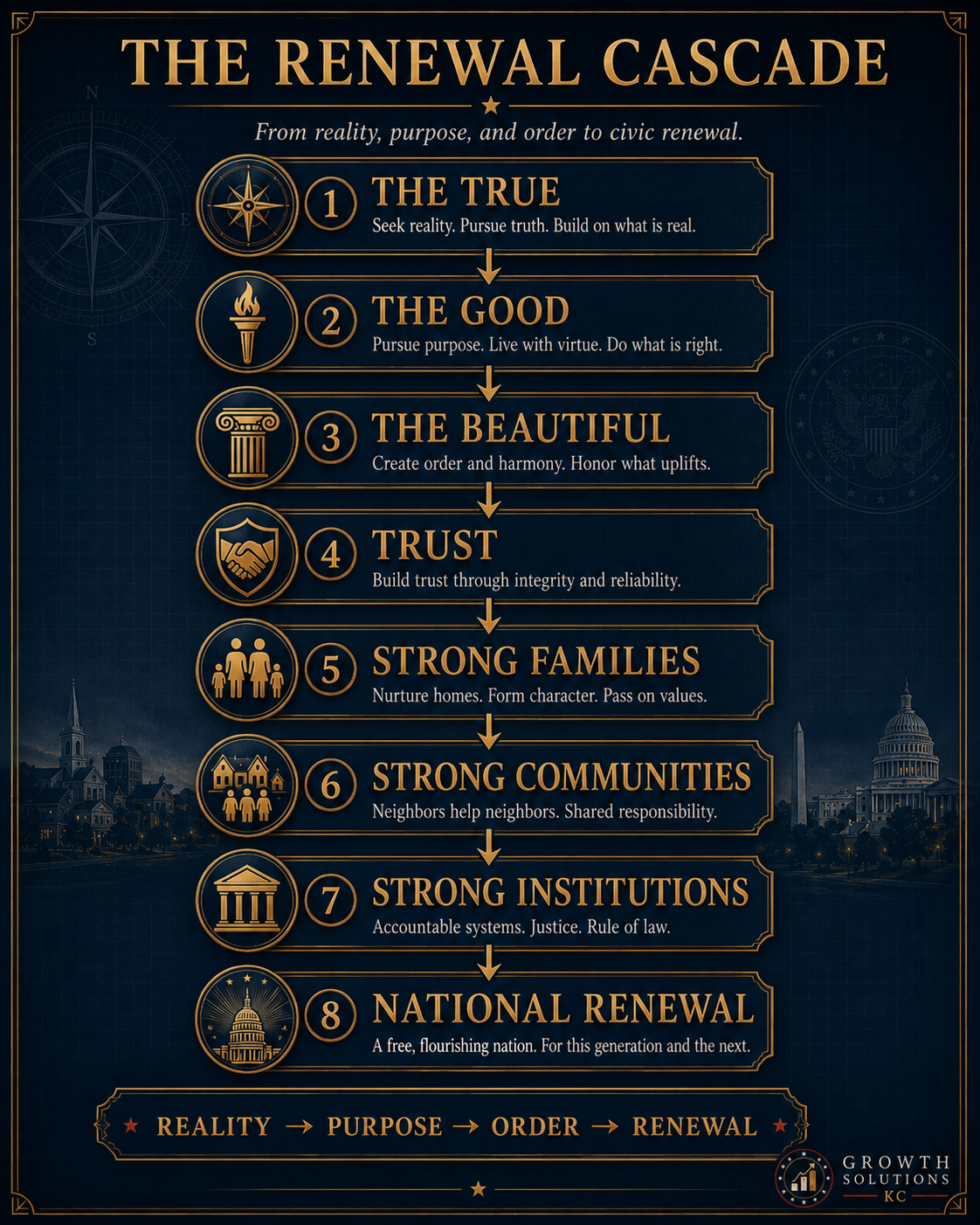
This is where leadership philosophy becomes civic responsibility. A personal compass is not meant to remain private. It is meant to guide action.
The individual who learns to live by truth becomes more trustworthy. The family that organizes itself around goodness becomes more stable. The business that pursues purpose with integrity becomes more valuable. The community that prizes order, respect, and responsibility becomes more resilient.
National renewal begins there.
Not with slogans. Not with outrage. Not with waiting for someone else to repair what has been neglected.
A strong nation is built from the bottom up by strong individuals, strong families, strong organizations, and strong communities.
This is not a rejection of national leadership or public policy. Laws matter. Institutions matter. Elections matter. Strategy matters. But none of them can substitute for the daily moral agency of citizens.
A republic cannot be healthier than the people who sustain it. That means civic responsibility begins close to home.
- It begins with telling the truth in your own household.
- It begins with honoring commitments.
- It begins with raising children who understand both liberty and duty.
- It begins with building businesses that serve rather than exploit.
- It begins with participating in local institutions rather than merely criticizing national ones.
- It begins with speaking to neighbors instead of performing for strangers online.
- It begins with asking what you can strengthen, not merely what you can condemn.
Agency is the hinge. A culture of responsibility does not emerge from passive spectators. It emerges from people who understand that their choices matter — not only for themselves, but for everyone connected to them.
The Transcendentals as a Leadership Framework
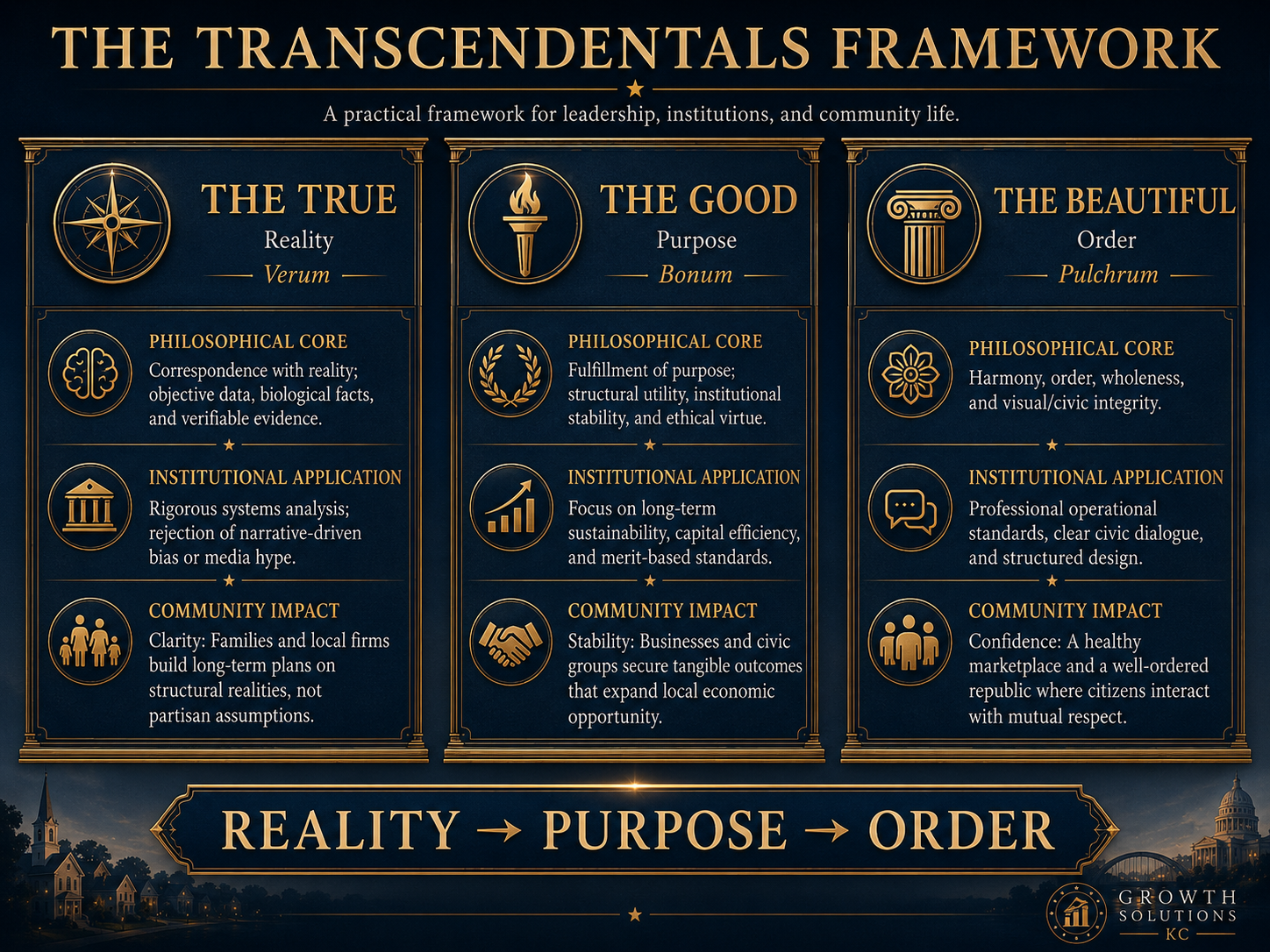
For leaders, the True, the Good, and the Beautiful provide a practical diagnostic tool. When facing a decision, the leader can ask:
Is this true?
Does this align with reality, evidence, facts, incentives, constraints, and consequences?
Is this good?
Does this fulfill the proper purpose of the person, family, institution, business, or community involved?
Is this beautiful?
Will this produce greater order, trust, harmony, integrity, and long-term confidence?
Those three questions clarify almost everything.
They expose shallow thinking. They reveal hidden trade-offs. They force leaders to look beyond immediate emotion and short-term advantage. They move the conversation from reaction to responsibility.
The framework can be summarized this way:
This is not complicated. But it is demanding. It requires leaders to resist the incentives of the age: exaggeration, tribalism, image management, short-term applause, and emotional escalation.
It requires a different posture:
- Clear thinking over noise.
- Strategic insight over outrage.
- Wisdom over reaction.
- Constructive analysis over cynicism.
- Evidence over assumption.
- Solutions over complaints.
That is not just an editorial standard.
It is a civic discipline.
Second-Order Consequences: What Happens When the Triad Breaks
When organizations, families, and communities treat the True, the Good, and the Beautiful as optional, the consequences are predictable.
At the individual level, people become exhausted.
A life detached from truth produces confusion. A life detached from goodness produces emptiness. A life detached from beauty produces anxiety and disorder. People cannot flourish indefinitely in environments where reality is constantly manipulated, purpose is unclear, and harmony is absent.
At the family level, trust weakens.
Families require truth because love cannot grow in deception. They require goodness because sacrifice, discipline, and duty are necessary for stability. They require beauty because homes are not merely economic units; they are formative environments where order, gratitude, affection, and belonging shape the next generation.
At the organizational level, mission drift accelerates.
Businesses, schools, nonprofits, churches, and civic institutions lose credibility when they stop telling the truth, stop fulfilling their purpose, or stop maintaining standards. The damage may not appear immediately, but over time it shows up in turnover, distrust, inefficiency, poor morale, declining performance, and institutional fragility.
At the community level, social trust erodes.
When local institutions lose credibility, citizens stop believing that participation matters. When citizens stop participating, the most committed voices are often replaced by the loudest ones. When the loudest voices dominate, reasonable people withdraw. When reasonable people withdraw, communities become easier to divide.
That is how civic decay compounds.
But renewal compounds too.
- Every honest conversation strengthens truth.
- Every responsible act strengthens goodness.
- Every ordered household, workplace, and civic institution strengthens beauty.
- Every person who chooses agency over cynicism helps rebuild the conditions for trust.
The scale may begin small.
The consequences are exponential.
Strategic Direction: Four Practical Steps for Civic Renewal
The point of the transcendentals is not simply to understand them.
The point is to live them.
If we want to restore truth, rebuild trust, and renew our nation, we must translate reality, purpose, and order into practical action.
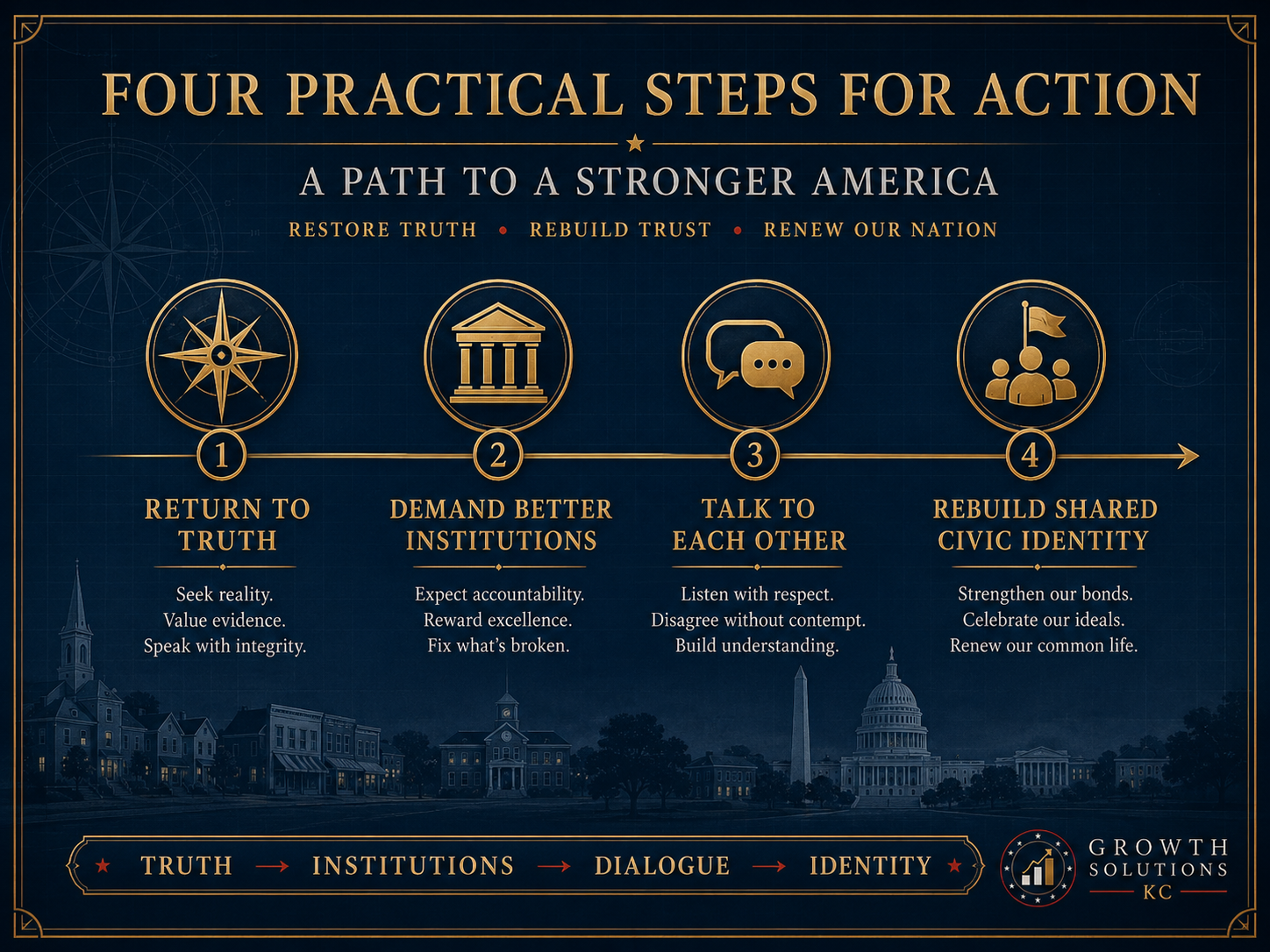
Step 1: Return to Truth and Honest Debate
The first responsibility is to recover respect for reality.
Audit your information inputs. Pay attention to what consistently makes you angrier but not wiser. Be cautious with sources that profit from keeping you emotionally activated. Separate evidence from assumption, reporting from commentary, and facts from framing.
This does not mean pretending neutrality is always possible. Everyone has principles. Everyone has assumptions. Everyone sees the world from somewhere.
But honest people can still discipline themselves to ask better questions.
- What is actually true?
- What evidence supports it?
- What evidence complicates it?
- What incentives are shaping this argument?
- What happens if this claim is wrong?
- What would change my mind?
Truthful debate is not weakness. It is strength.
A citizen who cannot examine his own assumptions is easy to manipulate. A leader who cannot tell the truth is unworthy of trust. A community that cannot debate honestly will eventually lose the ability to solve problems together.
The True comes first because reality matters — Always.
Step 2: Demand Better from Institutions
The second responsibility is to recover purpose.
Every institution should be evaluated according to the purpose it exists to fulfill.
Schools should educate.
Businesses should create value.
Families should form responsible people.
Local governments should protect basic order and serve the public good.
Media should inform rather than inflame.
Civic organizations should strengthen community life.
National institutions should preserve liberty, security, justice, and constitutional order.
When institutions drift from purpose, citizens should demand better — not through blind rage, but through disciplined engagement.
That means asking practical questions:
- Is this institution fulfilling its mission?
- Are its incentives aligned with its stated purpose?
- Are its leaders accountable for outcomes?
- Does it strengthen or weaken the people it serves?
- Does it build long-term trust or spend it for short-term advantage?
The Good requires standards. A society that refuses to judge institutions by purpose will eventually be governed by performance, image, and inertia.
Demanding better is not cynicism — It is stewardship.
Step 3: Talk to Each Other
The third responsibility is to recover civic beauty.
A fractured public square cannot be healed only through better arguments. It also requires better habits of relationship.
We need fewer performative arguments with strangers and more honest conversations with neighbors. Fewer digital reactions and more face-to-face dialogue. Less contempt. More courage. Less suspicion. More listening. Less theatrical certainty. More disciplined clarity.
This does not mean avoiding disagreement.
A healthy republic will always contain disagreement. Citizens will differ on policy, priorities, trade-offs, and moral judgments. The goal is not artificial consensus.
The goal is ordered disagreement.
The Beautiful appears when people can argue seriously without destroying the civic bonds that allow them to remain one people.
That requires self-command.
It requires refusing to reduce people to political categories. It requires remembering that the person across the table is more than his worst opinion, most careless statement, or most predictable affiliation. It requires recovering the basic civic habit of treating neighbors as people to persuade, not enemies to defeat.
A community becomes more beautiful when disagreement is governed by respect, truth, and shared responsibility.
Step 4: Rebuild Shared Civic Identity — The Triad in Action
The fourth responsibility is to rebuild shared civic identity from the bottom up.
This is where the True, the Good, and the Beautiful converge.
The True gives citizens shared reality.
The Good gives institutions shared purpose.
The Beautiful gives communities shared order, gratitude, and trust.
A nation cannot endure on politics alone. It needs memory, duty, affection, sacrifice, and shared inheritance. It needs citizens who understand that patriotism is not blind loyalty and criticism is not automatically virtue. It needs people capable of gratitude for what is good, honesty about what is broken, and responsibility for what must be rebuilt.
National pride, rightly understood, is not arrogance. It is stewardship.
It says: this inheritance is worth preserving, improving, and passing on stronger than we received it.
That work begins locally.
- Strengthen your household.
- Invest in your marriage and family.
- Mentor someone younger.
- Serve in your church, school, nonprofit, or civic organization.
- Support honest local enterprise.
- Show up for community responsibilities.
- Model the accountability you expect from leaders.
- Practice the integrity you want from institutions.
- Build the kind of trust you believe the nation needs.
The great mistake of modern civic life is believing responsibility belongs primarily to someone else.
But renewal does not begin somewhere far away — It begins with the people and places we can touch.
Restore Truth, Rebuild Trust, and Renew Our Nation
The renewal of a nation is not first a communications strategy. It is not a branding exercise. It is not a partisan victory lap. It is not a viral moment, a clever slogan, or a temporary emotional surge.
It is a moral and civic rebuilding project. That project requires people who are willing to live differently.
- People who tell the truth when distortion would be easier.
- People who pursue the good when selfishness would be more convenient.
- People who build beauty, order, and trust when cynicism would be more fashionable.
This is the real work of leadership.
It is not limited to executives, elected officials, pastors, principals, entrepreneurs, or public figures. Every person leads somewhere. Every person shapes the moral atmosphere of the rooms they enter. Every person either contributes to trust or withdraws from it. Every person either strengthens or weakens the institutions they touch.
- A father leads.
- A mother leads.
- A teacher leads.
- A business owner leads.
- A citizen leads.
- A neighbor leads.
- A friend leads.
Leadership begins with agency.
Agency begins with responsibility.
Responsibility begins with the decision to stop drifting.
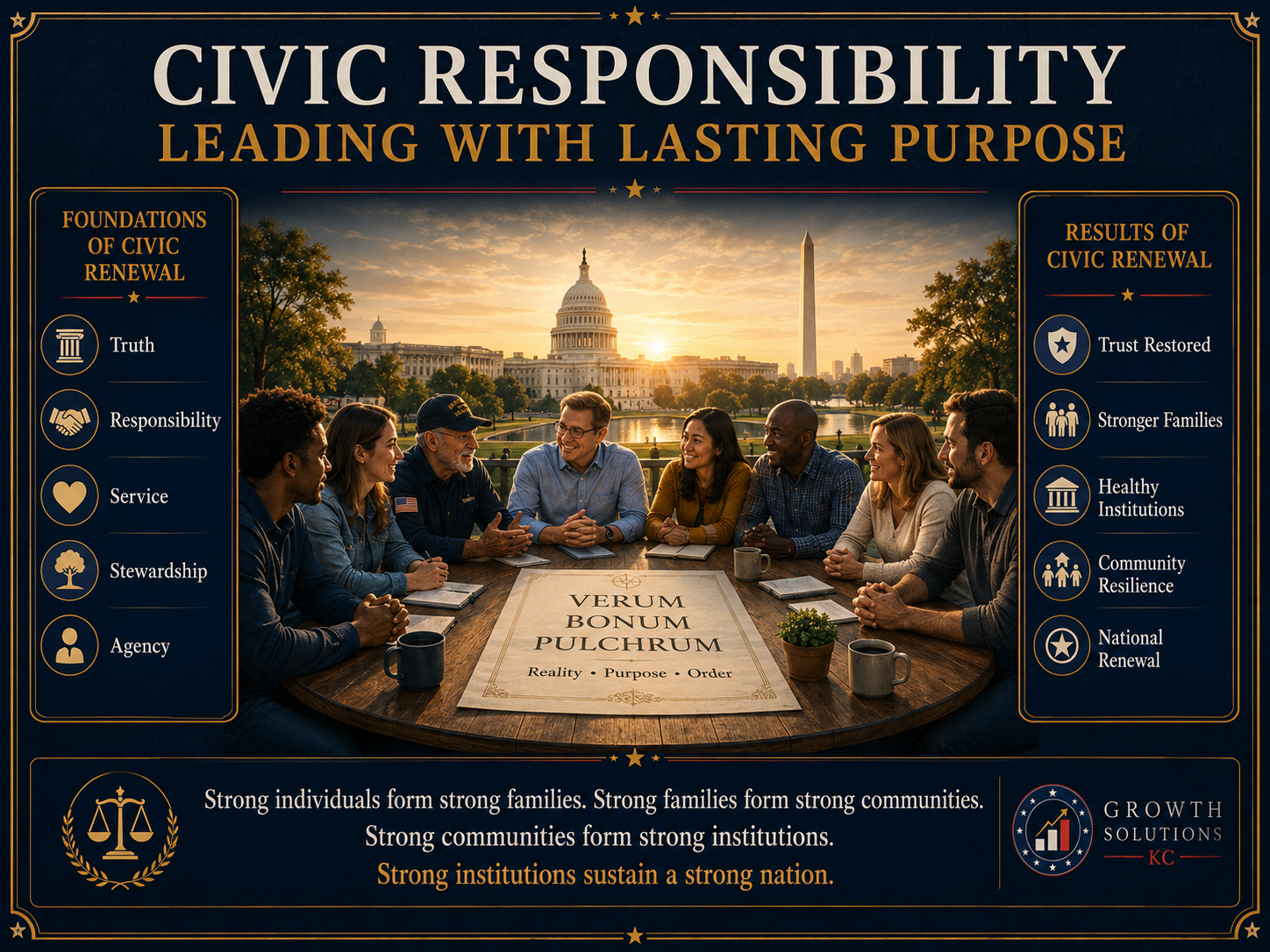
The True, the Good, and the Beautiful give us a way to stop drifting. They remind us that reality matters, purpose matters, and order matters. They teach us that strong individuals form strong families, strong families form strong communities, strong communities form strong institutions, and strong institutions help sustain a strong nation.
That is how renewal works.
From the inside out.
From the bottom up.
One decision, one household, one organization, one community at a time.
Conclusion: Leading with Lasting Purpose
The great temptation in an age of noise is to become reactive.
- To answer outrage with outrage.
- To answer distortion with distortion.
- To answer institutional failure with cynicism.
- To answer civic decay by retreating into private life and leaving the public square to whoever shouts the loudest.
But that is not leadership. Leadership requires a stronger posture.
The Leader’s Compass gives direction.
The transcendentals give the compass its fixed point.
The True reminds us to see clearly.
The Good reminds us to serve rightly.
The Beautiful reminds us to build faithfully.
Together, they form a practical framework for personal leadership and civic renewal.
Do not leave your leadership architecture or your community’s future to chance.
- Reclaim the classical tools of clear thinking.
- Embrace structural responsibility.
- Know what is true.
- Serve what is good.
- Build what is beautiful.
- And lead with the kind of purpose that restores truth, rebuilds trust, and renews our nation.
— Matt Cucinotta | Growth Solutions KC | Inspire · Inform · Ignite



Comments ()