

Festus Should Fix the Process — Not Forfeit a Generational Opportunity
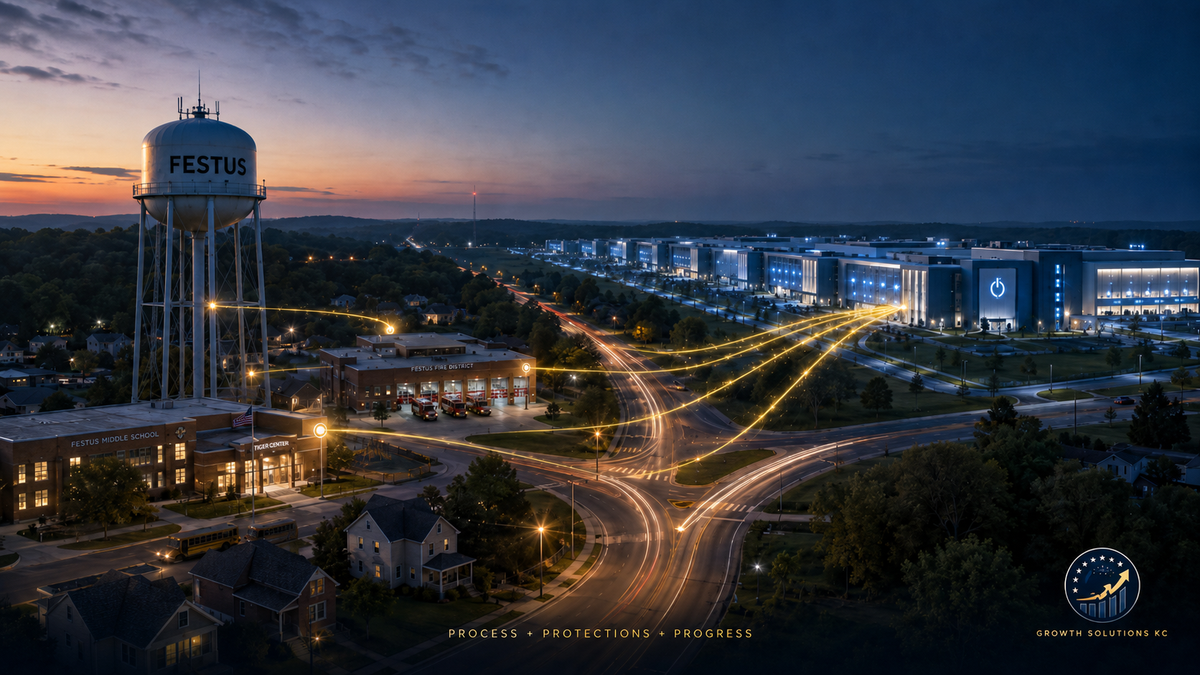
A $6 billion data center has exposed serious transparency failures. But Festus should correct the process, secure real protections, and think carefully before surrendering a rare opportunity.
A $6 billion data center has ignited a firestorm in a small Jefferson County city. The process was flawed. The outrage is understandable. But the economic stakes — for schools, infrastructure, and long-term community stability — demand a clearer head than the moment is producing.
On a Monday night in early April 2026, hundreds of Festus, Missouri residents packed a high school gymnasium and shouted down their city council. The target of their fury: a proposal to build a hyperscale data center on 360 wooded acres off Highway 67 — a $6 billion capital investment that could reshape the financial future of every school, fire district, and city service in Jefferson County for a generation.
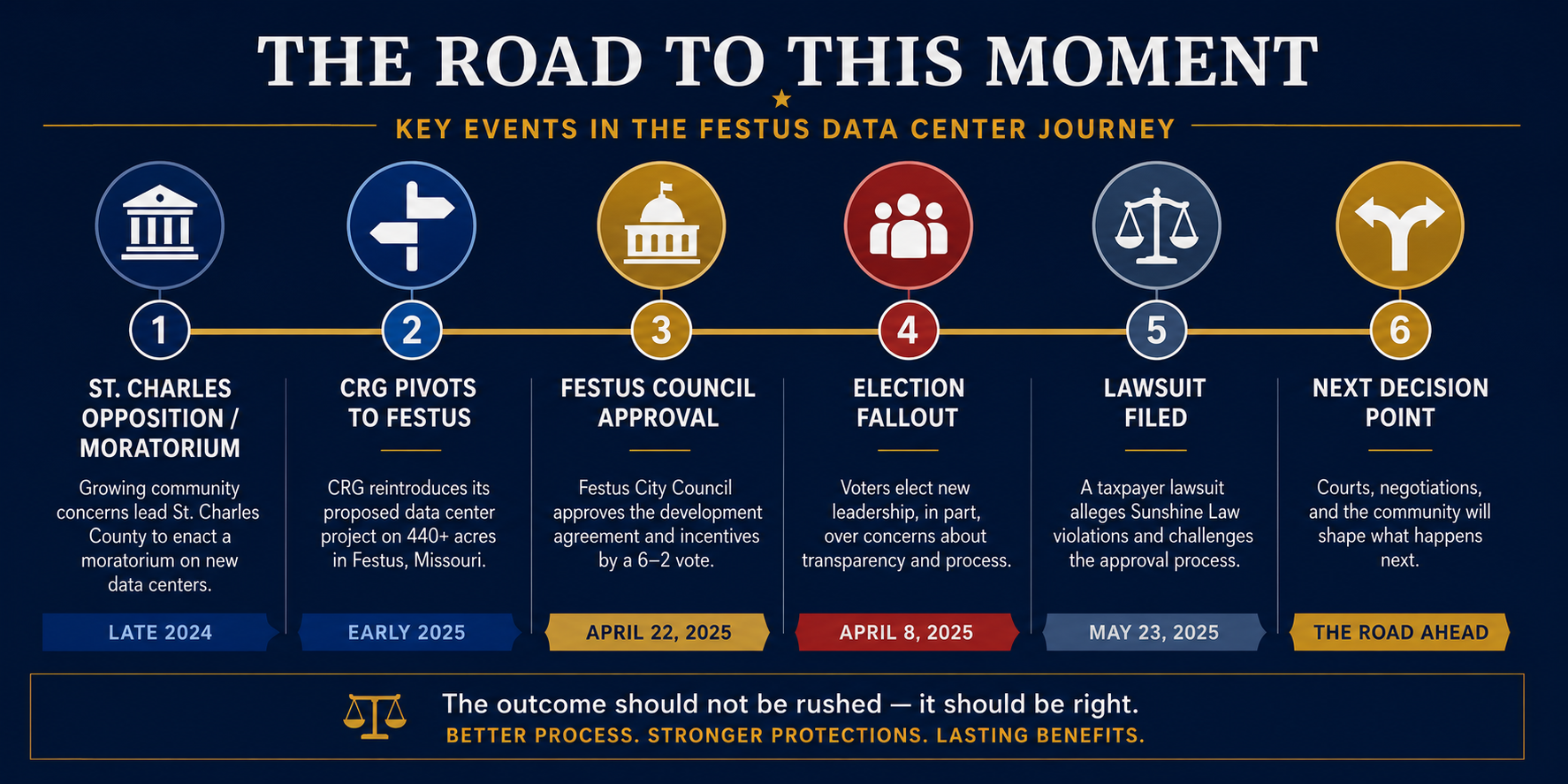
The council voted 6–2 to approve the development agreement anyway. Within weeks, four of those council members had been voted out of office, a community-led lawsuit had been filed alleging secret meetings and violations of Missouri's Sunshine Law, and the developer's founder was holding press conferences defending the project while the legal system prepared to weigh in.
|
~$40M City Annual Budget Current operating baseline |
$8–22M/yr Projected City Revenue Utility tax at start → full ops |
$1.3B 25-Year Total Taxes + payments to community |
"Their current budget is under $40 million a year. Once the data center starts operating, they'll have about $40 million a year of new revenue." — Bob Clark, Founder, Clayco/CRG.
Festus is at a crossroads. And the choice it makes — calmly, deliberately, with eyes open — will likely define the community for the next 25 years.
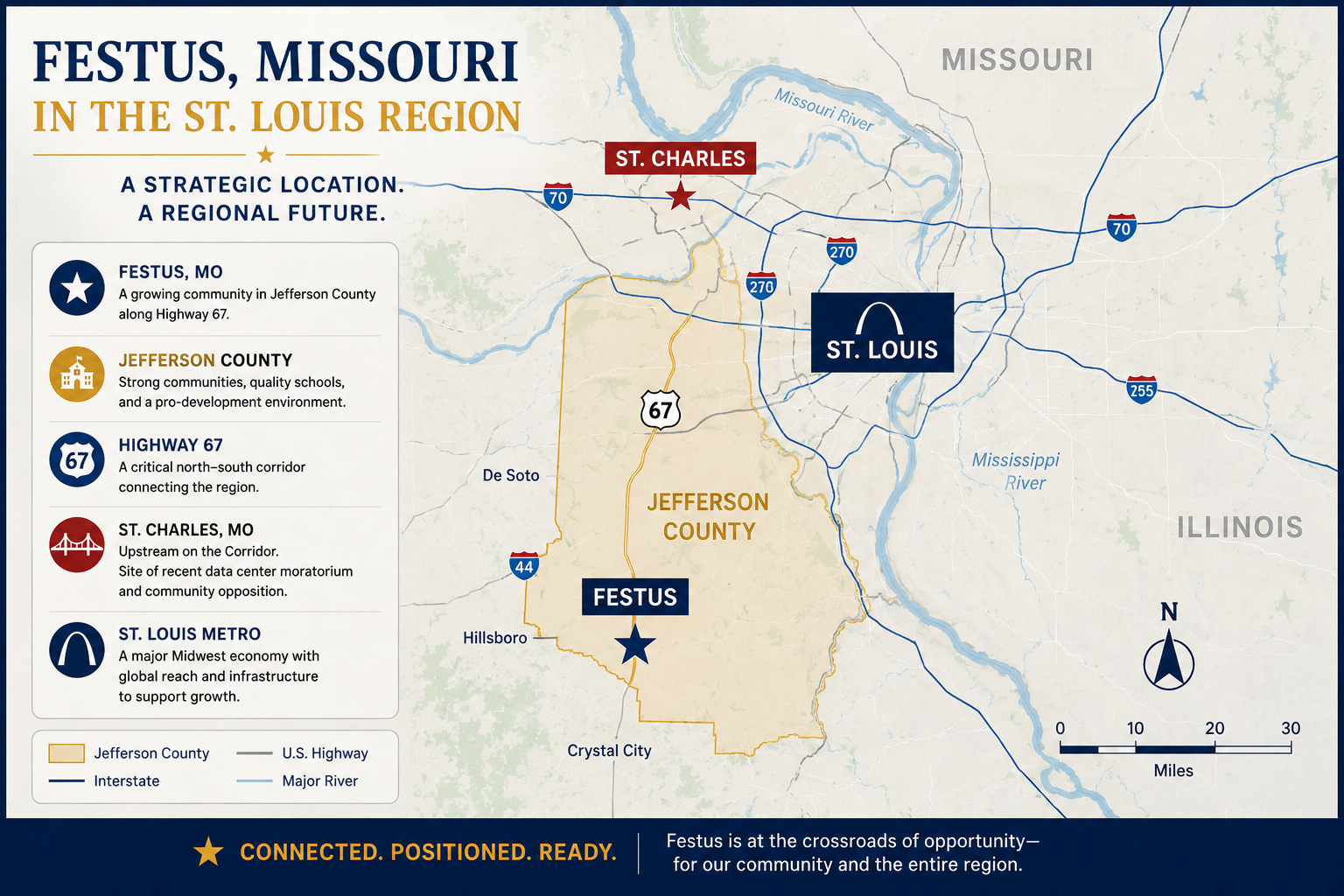
Before diving into the data, it helps to understand both where this decision is happening — and how it unfolded.
WHAT MATTERS: THE FACTS ON THE GROUND
Let's establish the baseline. Developer CRG, the data center subsidiary of area firm Clayco, wants to build a hyperscale data center campus on approximately 360 acres in Festus. The projected capital investment is $6 billion. The end user — the technology company that would actually occupy the facility — has not been publicly disclosed, which is itself a legitimate grievance.
The city council approved an ordinance and development framework that includes:
- CRG pays for all water, sewer, and street infrastructure upgrades.
- CRG funds its own energy use and any additional electrical infrastructure through Ameren Missouri.
- $45 million in direct community payments to the city over 10 years, including $5 million earmarked for a new firehouse.
- Voluntary buyouts offered to homeowners within 1,000 feet of an active data center building.
- Environmental commitments codified in the agreement.
A subsequent lawsuit — filed in St. Louis County Circuit Court — charges the city and CRG with 12 counts including unlawful spot zoning, Sunshine Law violations, civil conspiracy, and due process violations. Text messages entered as exhibits describe opponents as a 'sideshow of uneducated people' and reveal strategic discussions designed to avoid triggering public meeting requirements. These are serious allegations. They deserve serious legal scrutiny.
But the allegations about process should not be allowed to erase the question of substance: Is this project good for Festus and the surrounding community?
WHY IT MATTERS: THE ECONOMIC ANATOMY OF A SMALL TOWN WINDFALL
Festus is a city of roughly 12,000 people operating on an annual budget of under $40 million. The Festus R-VI School District — which serves the city's children — runs on approximately $39 million in total annual revenue. These are not large institutions with deep reserves. They operate the way most small-town governments do — carefully, with deferred maintenance, constrained hiring, and perpetual conversations about what the budget cannot cover.
Now consider what the data center's projected revenue stream actually means when distributed across the region's taxing entities:
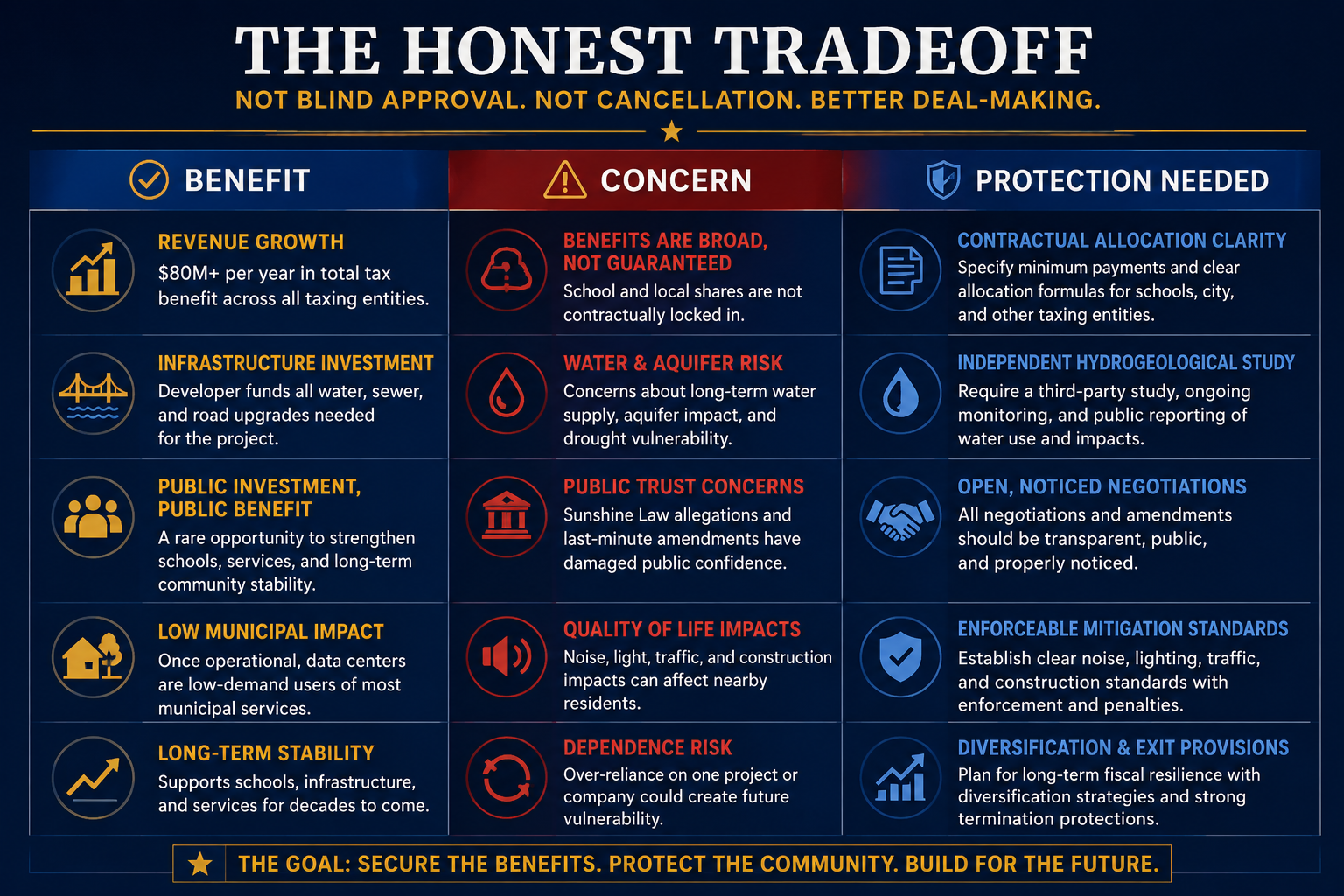
- Festus R-VI School District: Property tax and PILOT allocations from a project modeled as a $6 billion capital investment could approach or exceed the district's entire current annual revenue — a potential significant increase of school resources without a single new bond measure put to voters.
- City of Festus: Utility taxes alone are projected to generate $8 million annually at startup, growing to $22 million per year by 2031 as the center reaches full power usage.
- Jefferson County and Jefferson County Sheriff: County-level property tax distributions and public safety funding.
- Fire Protection Districts: Enhanced funding for equipment, staffing, and station infrastructure — including the already-negotiated new firehouse.
- Library and ambulance districts: Long-underfunded community services gain a stable, growing revenue base.
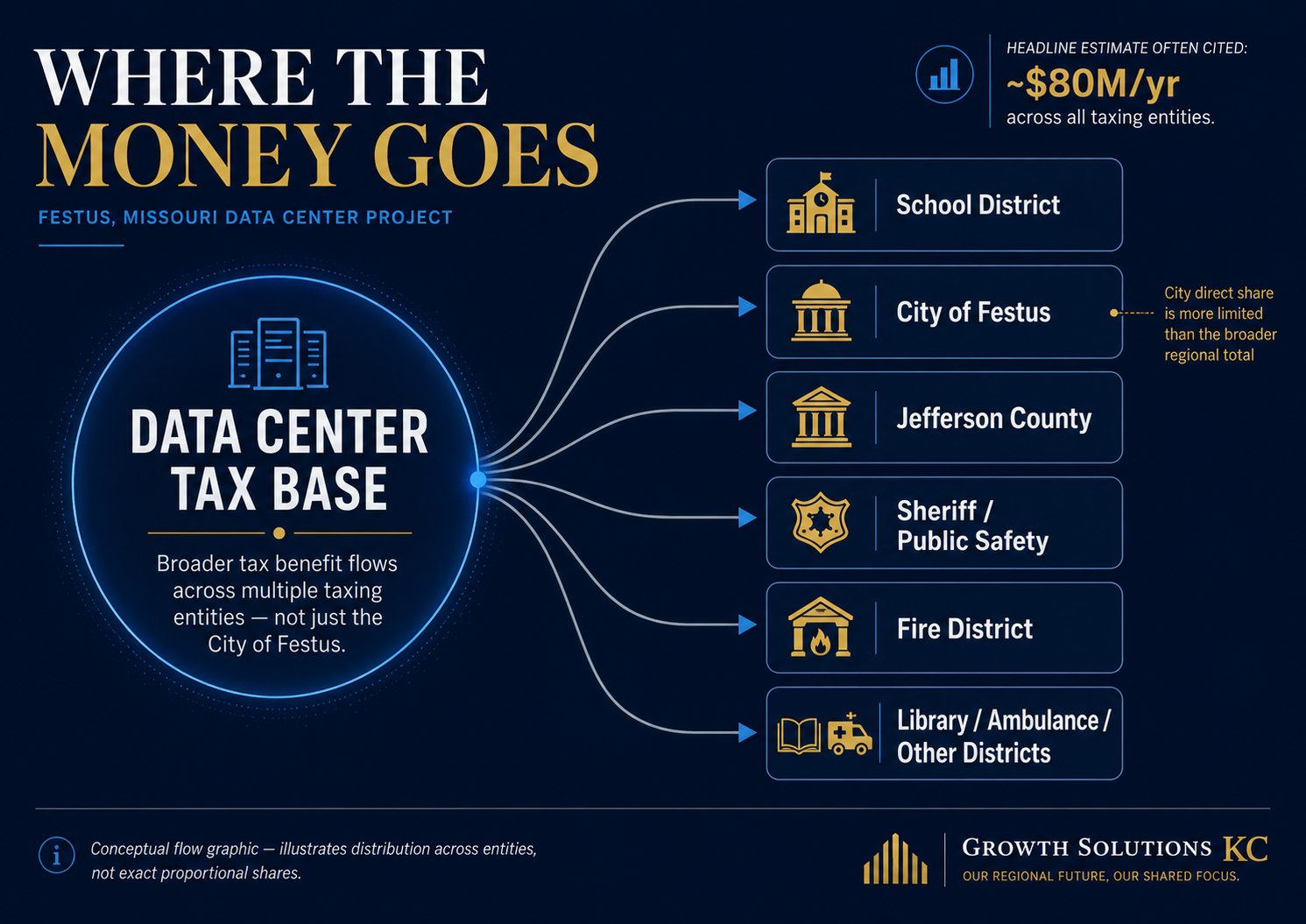
Over 25 years, the project is projected to generate $1.3 billion in property taxes, utility taxes, and community benefit payments — an average of more than $53 million annually flowing into the institutions that serve Festus residents. This is not a number that comes along twice.
WHAT HAPPENS NEXT: THE COMPOUNDING VALUE OF FINANCIAL STABILITY
Small communities face a well-documented funding doom loop. Aging infrastructure deferred becomes emergency repairs. Underpaid teachers leave for better-resourced districts. Young families follow the schools and the jobs. The tax base shrinks. The cycle deepens.
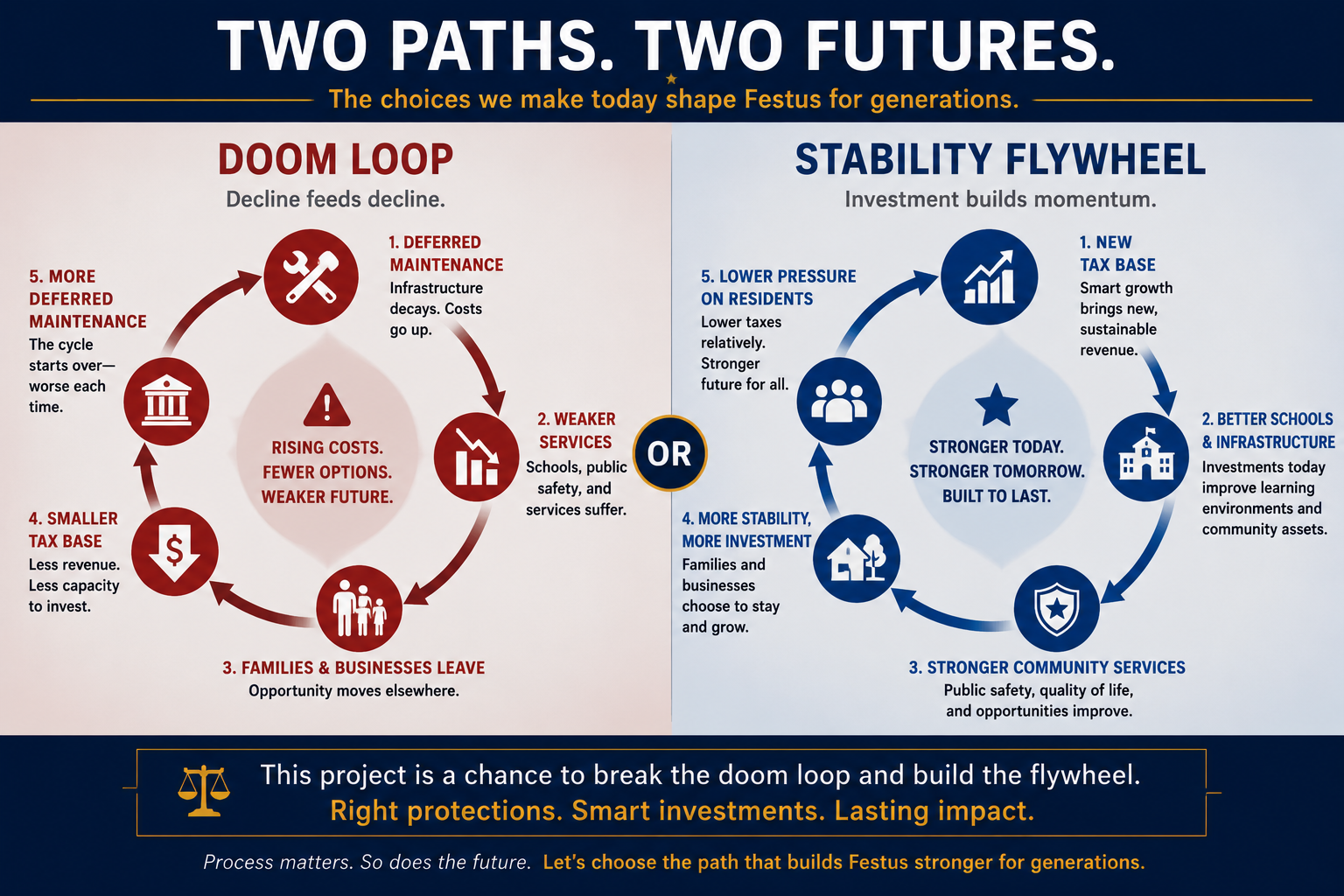
The Festus data center — handled correctly — breaks that cycle entirely. Consider what sustained, transformative revenue does over 15 years:
- Schools that don't require voters to approve emergency levies every few years — and can instead invest in competitive teacher salaries, updated technology, and modern facilities,
- Roads, water lines, and sewer systems built and maintained proactively, not reactively,
- Public safety infrastructure — the new firehouse is already on the table — funded through economic growth rather than increased property tax burden,
- Potential downward pressure on residential property tax rates as the commercial base grows,
- Thousands of construction jobs sustaining local restaurants, hardware stores, and service businesses for four to five years during build-out, followed by 100–200 permanent positions.
And critically, once operational, data centers are relatively low-demand users of municipal services. A hyperscale facility does not enroll children in schools, does not call 911 with frequency, and does not generate the residential traffic load of equivalent square footage in housing or retail. It pays — substantially — while asking for relatively little in return.
EXAMINE THE IMPLICATIONS: HISTORY DOESN'T FORGET
The pattern is clear and well-documented. Communities that resist transformative economic development — out of fear, distrust of process, or understandable attachment to the status quo — often watch the opportunity relocate two towns over. The competitor community gets the tax base, the schools, the jobs. The resistant community gets to be right about its concerns while its infrastructure continues to age.
Strategic Lesson
CRG was previously pursuing a similar project in St. Charles, Missouri. Faced with community opposition and a proposed moratorium, they pivoted — directly to Festus. That is not a coincidence. It is a signal. These facilities will be built. The AI and cloud computing infrastructure buildout is accelerating, not slowing. The only question is which communities will benefit.
New York City rejected Amazon's HQ2 in 2019. The decision is widely regarded as one of the costliest economic own-goals in the city's modern history — billions in investment and tens of thousands of jobs relocated to Northern Virginia, which has since become one of the most economically dynamic regions in the country. Northern Virginia, it is worth noting, is also the largest data center market in the world.
“The lesson is not that every project should be accepted. The lesson is that communities that reject major projects should be clear-eyed about what they are giving up.”
SOLUTIONS: A PATH THAT DOESN'T REQUIRE CHOOSING BETWEEN PROCESS AND PROGRESS
The residents of Festus who are angry about transparency are not wrong to be angry. Text messages describing opponents as 'uneducated,' officials deliberately meeting in groups of three to avoid triggering open-meeting requirements, annexation signs designed to be ignored at highway speed — this is not how a democratic community should make a once-in-a-generation decision. The lawsuit deserves to be taken seriously by the courts.
But the answer to bad process is better process — not no deal. The newly elected council members, who ran on transparency rather than categorical opposition, represent exactly the democratic correction a healthy community makes. The question now is whether Festus uses that democratic energy to extract a better, fairer, more transparent agreement — or to walk away from the table entirely.
A constructive path forward looks like this:
- Demand full public disclosure of the end user before any construction permit is issued — residents have a right to know who is moving into their community.
- Commission an independent hydrogeological study of aquifer and water impact — funded by CRG as a condition of the agreement.
- Contractually lock in the school district's tax revenue share — projections are not guarantees.
- Establish an independent community oversight board with real enforcement authority over noise, light, and environmental compliance.
- Strengthen and extend homeowner buyout protections for adjacent properties.
- Require open, publicly noticed negotiations for any future amendments to the development agreement.
These are not anti-development demands. They are the conditions under which a community can say yes — confidently, legally, and with its residents' long-term interests protected. They transform an agreement that felt like something done to the community into one that was built with it.
CLEARER THINKING = BETTER OUTCOMES
The Growth Solutions KC analytical framework asks four questions of every significant issue: What matters? Why does it matter? What happens next? What should people do about it?
In Festus, what matters is this: a community of 12,000 people has been offered a rare and genuine opportunity to escape the financial constraints that keep small towns perpetually behind — and the process by which that offer arrived was handled in a way that made distrust the rational response.
Both of those things are true. They do not cancel each other out.
The anger is legitimate. The transparency failures are real. The lawsuit may well have merit. And the economic opportunity — for schools, for infrastructure, for the next generation of Festus residents — is also genuine, and genuinely rare.
Communities that thrive over generations are the ones that can hold both realities in mind simultaneously — that demand better process without discarding transformative outcomes, that protect their citizens without surrendering their futures.
Secure the Benefits | Protect the Community | Build for the Future. That's the Goal.
— Matt Cucinotta | Growth Solutions KC | Inspire · Inform · Ignite
Data Note: Public estimates describe the project as a $6 billion capital investment, not a $6 billion assessed value. Tax projections are based on a cost-model approach and include property taxes, utility gross receipts taxes, PILOT payments, and community benefit payments. The County Assessor would determine actual taxable value.


Comments ()