

The Chip Gambit: How America's Attempt to Slow China May Have Accelerated It
A look at the unintended consequences of U.S. semiconductor export controls—and what we may have cost ourselves in the process.
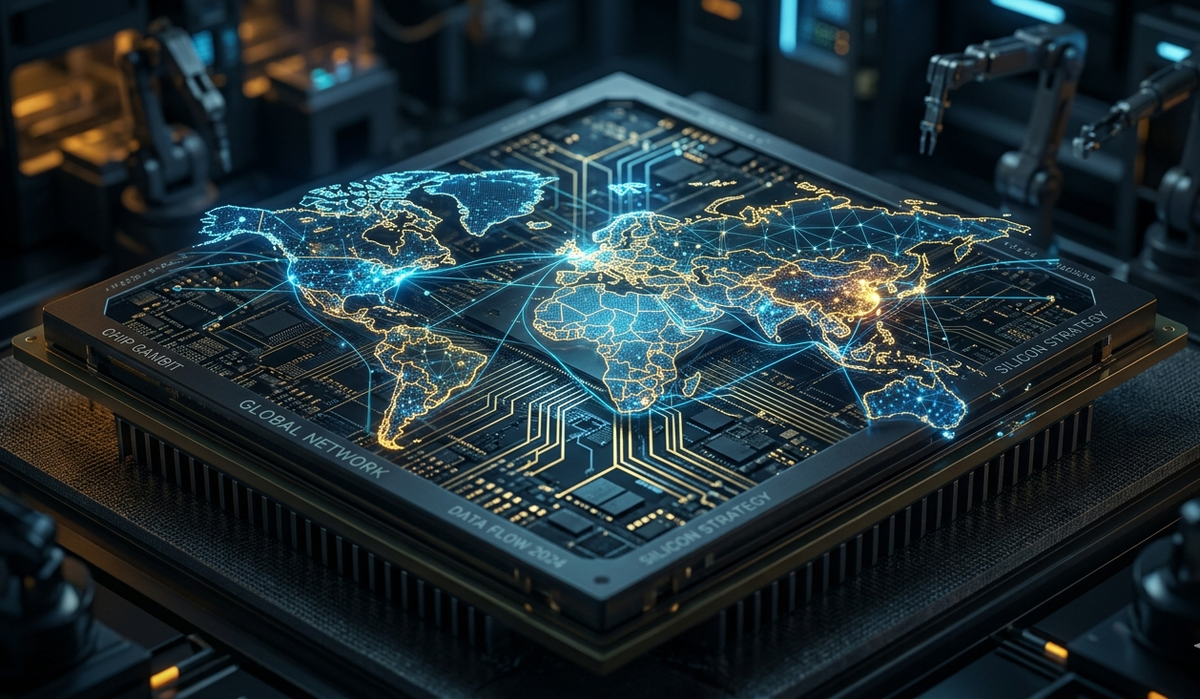
🔹The Backfire: Export controls compressed a decade of Chinese domestic chip development into just three years. We didn't disrupt a competitor; we forced them into an era of unprecedented national urgency.
🔹The Economic Toll: U.S. tech leaders lost billions in monopoly-pricing revenue that should have funded the next generation of American R&D.
🔹The Strategic Alternative: A targeted restriction on frontier military-grade hardware would have preserved vital commercial leverage and default global standards.
When the Biden administration moved to block advanced chip sales to China in October 2022, the logic seemed straightforward: keep the world's most powerful AI hardware out of the hands of a strategic competitor, and America maintains its edge. It was a bold move, and on the surface, a reasonable one.
But nearly three years later, it's worth asking an uncomfortable question: did it work? And more importantly, what did it cost us to find out?
A Dominant Position We Walked Away From
Before the restrictions took effect, NVIDIA held an extraordinary position in China's AI market — some estimates put its share of Chinese AI chip sales near 95%. Its CUDA software platform, the backbone of AI model training, was already deeply embedded across Chinese universities, research labs, and tech giants like Tencent, Alibaba, and ByteDance. AMD had a meaningful foothold too. These weren't just sales relationships — they were deep technological dependencies that had been built over years.
That kind of market entrenchment is extraordinarily hard to displace. Companies don't rip out the foundation of their AI infrastructure lightly. The CUDA ecosystem represents not just hardware, but workflows, tooling, and institutional knowledge baked into thousands of engineering teams. As of 2025, roughly 75% of chips powering AI model training in Chinese data centers still ran on NVIDIA's CUDA platform — even after years of restrictions and billions of dollars poured into domestic alternatives.
Pressure Didn't Slow China. It Motivated It.
Here's where the policy runs into its most serious problem. Between 2022 and 2024, Chinese AI companies genuinely struggled — they were forced to work with older hardware, to innovate under constraint, and to stretch the performance limits of chips never designed for frontier AI workloads. For a moment, the controls created real friction.
But friction, applied to a country with China's resources, industrial ambition, and national pride, doesn't produce surrender. It produces urgency.
Beijing responded by pouring unprecedented investment into domestic semiconductor development. Huawei's Ascend AI chips — particularly the 910B and 910C — are now reportedly training half of China's top large language models. Startup Biren Technology's BR100 GPU has emerged as a credible competitor to NVIDIA's A100. Cambricon Technologies posted its first quarterly profit in late 2024, with its latest chip nearing A100-level performance. And Beijing mandated that public computing hubs source more than 50% of their chips domestically — essentially creating a guaranteed captive market to accelerate the entire ecosystem.
China's semiconductor independence drive predates these restrictions under the "Made in China 2025" policy, but the export controls poured rocket fuel on it. The strategic goal of slowing China's AI development may well have compressed a decade of domestic chip development into three years.
The Bill Americans Are Paying
While all this was unfolding, NVIDIA and AMD were absorbing the costs. NVIDIA alone took an estimated $5.5 billion charge when the April 2025 restrictions expanded to cover the H20 chip — its last remaining product legally saleable in China. Its projected China market share fell from 66% in 2024 toward 54% in 2025, with further erosion expected as domestic Chinese alternatives mature.
That's not just lost revenue on a balance sheet. Those are dollars that could have funded the next generation of AI hardware, expanded R&D, created American jobs, and kept U.S. companies at the frontier of the technology they invented. Reinvested earnings are how technology leadership compounds. When you cut off a major revenue stream — especially one where you held near-monopoly pricing power — you don't just lose sales. You lose the fuel for future dominance.
There's also a broader trade dimension that rarely gets enough attention. U.S. chip sales to China were, in a very real sense, one of the few categories where America ran a meaningful trade surplus with China. Billions in annual chip exports represented exactly the kind of high-value, intellectual-property-intensive trade that balanced ledgers and created leverage. The export controls didn't just reduce sales — they removed one of America's strongest cards from the table in trade negotiations, while simultaneously giving China a legitimate grievance to justify its own retaliatory economic measures.
Policy Whiplash Made Everything Worse
If anything, what followed made matters worse. In April 2025, the Trump administration expanded restrictions to cover the H20 chip, creating major disruption and triggering NVIDIA's multi-billion dollar charge. Then, just three months later, the administration quietly reversed course, allowing H20 sales to resume — but now with a 15% revenue fee paid to the U.S. government. By December 2025, the far more powerful H200 chip was approved for export to China, with a 25% revenue share required.
Let that sink in. The United States spent three years restricting chip sales to China on national security grounds, cost its own companies billions, accelerated China's domestic chip industry — and then reversed course anyway, while adding a government tax on the resumed sales.
The result is, as one policy analyst described it, a vacuum: the Biden framework is gone, the promised replacement never came, and what fills the gap are ad hoc deals with no statutory foundation.
The Deeper Strategic Misjudgment
There's a principle worth naming plainly here: trying to weaken a determined adversary by restricting their access to something critical often does more to weaken yourself than it does to stop them.
History offers plenty of examples. Sanctions and technology restrictions can work — but primarily when the target lacks the resources, talent, or political will to adapt. Against a country with China's scale, those conditions don't hold. What restrictions more reliably produce is a motivated adversary who learns exactly where your leverage points are, builds around them, and emerges more self-sufficient on the other side.
By imposing and then relaxing restrictions, the U.S. forced China to accelerate its self-reliance strategies while simultaneously demonstrating to Beijing exactly where America's economic vulnerabilities lie. China now knows that U.S. chip policy is politically reversible. It knows which domestic industries it needs to protect. And it's building them.
Meanwhile, America signaled to allies and trading partners that its technology policy can shift dramatically with each administration — not exactly the foundation for the kind of coordinated multilateral approach that would actually be needed to contain a technology competitor of China's scale.
What a Better Tradeoff Might Have Looked Like
None of this is to say that national security considerations don't matter — they absolutely do. Advanced AI chips with military applications are genuinely dual-use technology, and some level of restriction on the most cutting-edge hardware is probably justified.
But there's a meaningful difference between targeted, narrowly-defined controls on the absolute frontier of military-grade AI hardware, and a sweeping, escalating clampdown that cuts off a market where America was already winning. The latter sacrifices real economic and strategic leverage in exchange for a slowdown that, by most evidence, lasted roughly two to three years before China engineered around it.
A more balanced approach might have preserved deep commercial relationships in the mid-tier chip market — keeping American platforms embedded in China's AI ecosystem as a form of soft leverage — while restricting only the absolute top-of-the-line hardware with the most direct military applications. That would have kept billions in revenue flowing to U.S. companies, maintained American technology standards as the global default, and arguably given the U.S. more economic negotiating power in the broader trade relationship.
The Bottom Line
The U.S. chip export controls were a high-stakes bet: sacrifice near-term revenue and market position to deny China the tools it needs to win the AI race. Looking at the evidence today, the bet looks like it's coming up short on both ends. China's AI chip industry is advancing faster than before 2022, American chip companies lost billions they could have reinvested in staying ahead, trade relations deteriorated, and the policy itself was partially reversed anyway.
The hardest lesson in competition — whether in business or geopolitics — is that trying to win by making your opponent weaker is a far less reliable strategy than winning by making yourself stronger. The billions in chip revenues that were foregone could have been NVIDIA's next breakthrough, AMD's next architecture, or the R&D that keeps American AI hardware five years ahead of anything China can produce.
Instead, we may have handed China the exact motivation it needed to stop depending on us entirely.
— Matt Cucinotta | Growth Solutions KC | Inspire · Inform · Ignite



Comments ()