

Trump Derangement Syndrome | Part 3: How America Can Lower the Temperature
Restore truth, rebuild trust, repair relationships, and renew national purpose and pride for a stronger America.
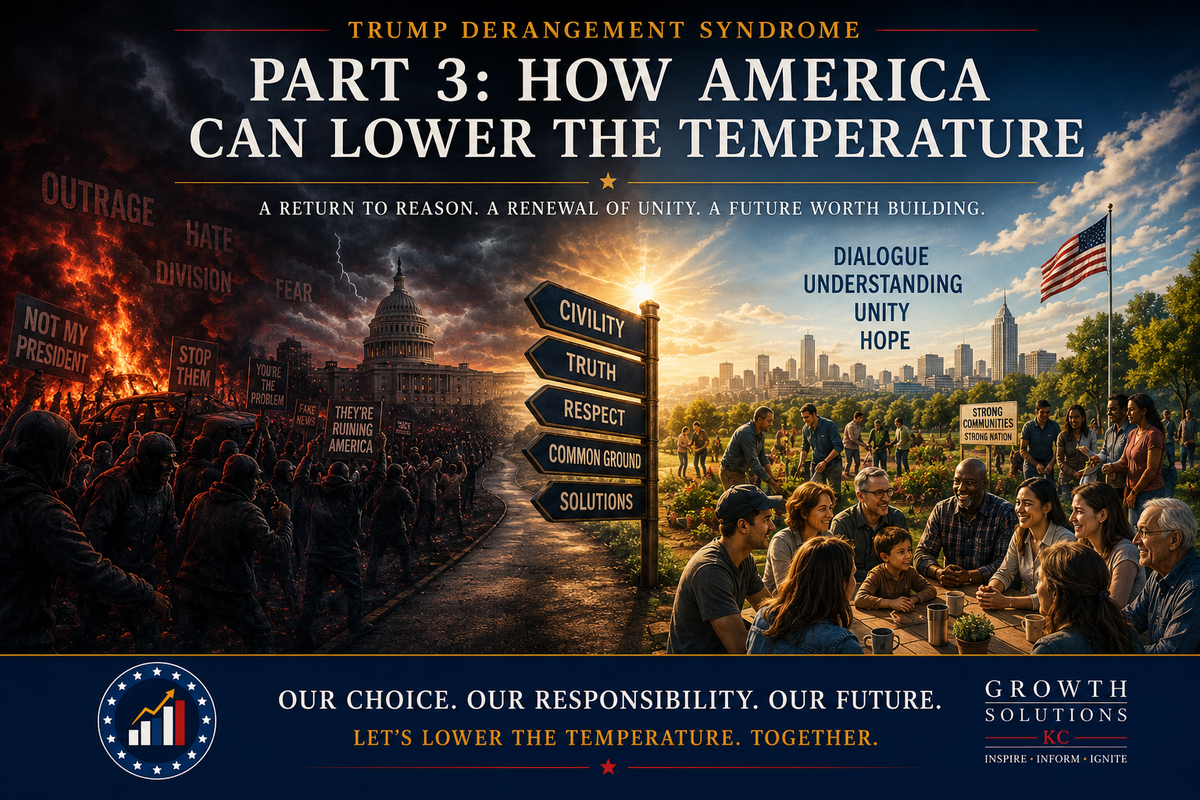
Lowering the Temperature Together.
America does not need less political debate.
It needs healthier political culture.
The growing polarization consuming the country did not emerge overnight, and it will not disappear overnight either. But if Americans want to reduce division, rebuild trust, and restore civic stability, the process must begin with a renewed commitment to truth, perspective, and constructive engagement.
The solution is not more outrage. Not more labeling. Not more permanent hostility. And not the belief that half the country is irredeemable.
Four Steps to Heal and Unify Our Nation
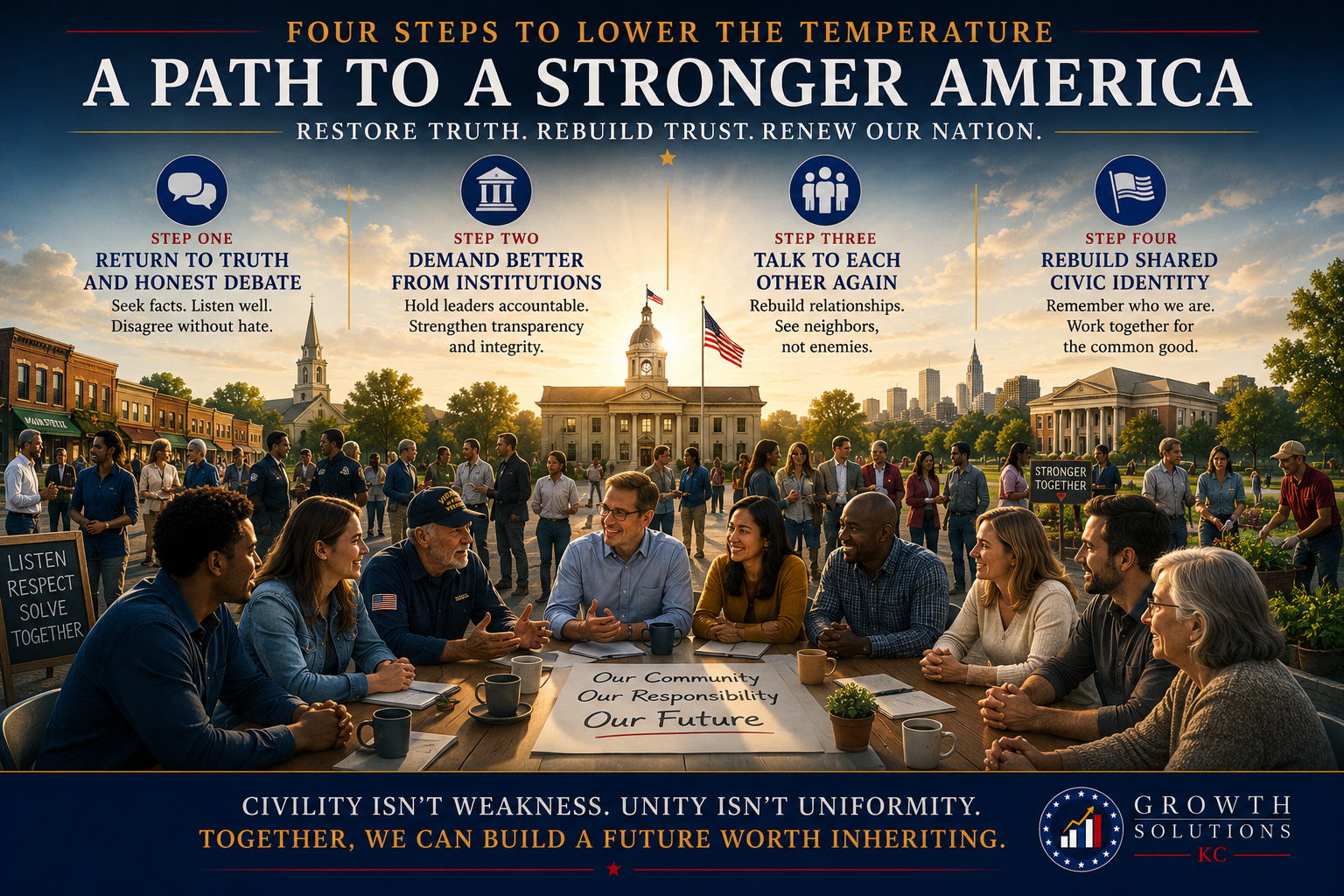
Step One: Return to Truth and Honest Debate
A healthy society should be able to handle disagreement without descending into hysteria or dehumanization.
Americans should be able to debate:
- immigration policy,
- economic priorities,
- foreign affairs,
- education,
- cultural issues,
- and the role of government
without automatically assuming evil motives from those who hold opposing views.
Disagreement is not the problem.
The inability to disagree constructively is the problem.
Increasingly, many Americans no longer debate to understand. They debate to defeat, shame, isolate, or emotionally destroy opponents.
That approach may generate viral moments online, but it weakens society over time.
Step Two: Demand Better from Institutions
Americans across the political spectrum have lost trust in many major institutions:
- media,
- government,
- academia,
- corporations,
- and even public health organizations.
Part of this distrust stems from the perception that many institutions increasingly operate through ideological or partisan frameworks rather than neutral standards.
Whether someone watches CNN, Fox News, NBC, ABC, CBS, or follows political commentary online, many Americans now believe information is filtered through narratives designed to reinforce political loyalties instead of objectively informing the public.
That erosion of trust is dangerous.
Citizens retreat into competing realities where persuasion becomes nearly impossible.
Healthy skepticism is necessary.
But permanent institutional distrust eventually destabilizes society itself.
America does not need propaganda from either political direction.
It needs institutions committed to accuracy, accountability, transparency, and intellectual honesty.
Step Three: Talk to Each Other Again
One of the greatest casualties of modern political culture has been ordinary conversation.
Americans increasingly live inside ideological bubbles:
- curated social media feeds,
- partisan news ecosystems,
- algorithm-driven outrage,
- and political echo chambers.
As a result, many people rarely engage seriously with perspectives outside their own.
That isolation fuels misunderstanding. And misunderstanding fuels resentment.
Real conversations between neighbors, coworkers, friends, families, and political opponents matter more.
Debate is not a threat to democracy. It is one of democracy’s greatest strengths.
Civil disagreement sharpens thinking.
Constructive dialogue builds understanding.
And understanding creates the possibility for practical solutions.
Step Four: Rebuild Shared Civic Identity
The United States was never meant to be united by absolute ideological agreement.
America has always contained different regions, cultures, beliefs, religions, economic interests, and political philosophies.
What historically held the country together was a shared civic identity:
- belief in constitutional government,
- commitment to free speech,
- respect for democratic institutions,
- and recognition that despite disagreements, Americans ultimately shared a common national project.
That shared identity has weakened.
Our national unity is eroding.
Increasingly, political affiliation has become a person’s primary identity marker — stronger than community, citizenship, or even national unity.
That trend is unsustainable long term.
What Matters
What matters is whether Americans can restore a culture that values truth, civic responsibility, and constructive disagreement over perpetual outrage and tribal hostility.
Why It Matters
No republic can remain stable if political hatred consistently overrides institutional trust, national cohesion, and shared civic identity.
A divided nation becomes easier to manipulate, weaker internationally, and increasingly incapable of solving serious problems internally.
What Happens Next
If polarization continues escalating unchecked, America risks entering a prolonged era of civic fragmentation where:
- trust collapses further,
- institutions lose legitimacy,
- political extremism intensifies,
- and national unity continues eroding.
But decline is not inevitable.
Political culture can improve if citizens consciously reject outrage addiction and recommit to serious, constructive engagement.
What People Should Consider
Most Americans — regardless of political affiliation — ultimately want similar foundational outcomes:
- safe communities,
- strong borders,
- economic opportunity,
- national stability,
- freedom,
- and a better future for their children.
Remembering that common ground matters.
Americans do not need to think identically to remain united.
But we do need enough shared perspective to debate honestly, disagree respectfully, and work toward solutions without violence and viewing one another as enemies.
— Matt Cucinotta | Growth Solutions KC | Inspire · Inform · Ignite



Comments ()