
What Happened to Pride in America?
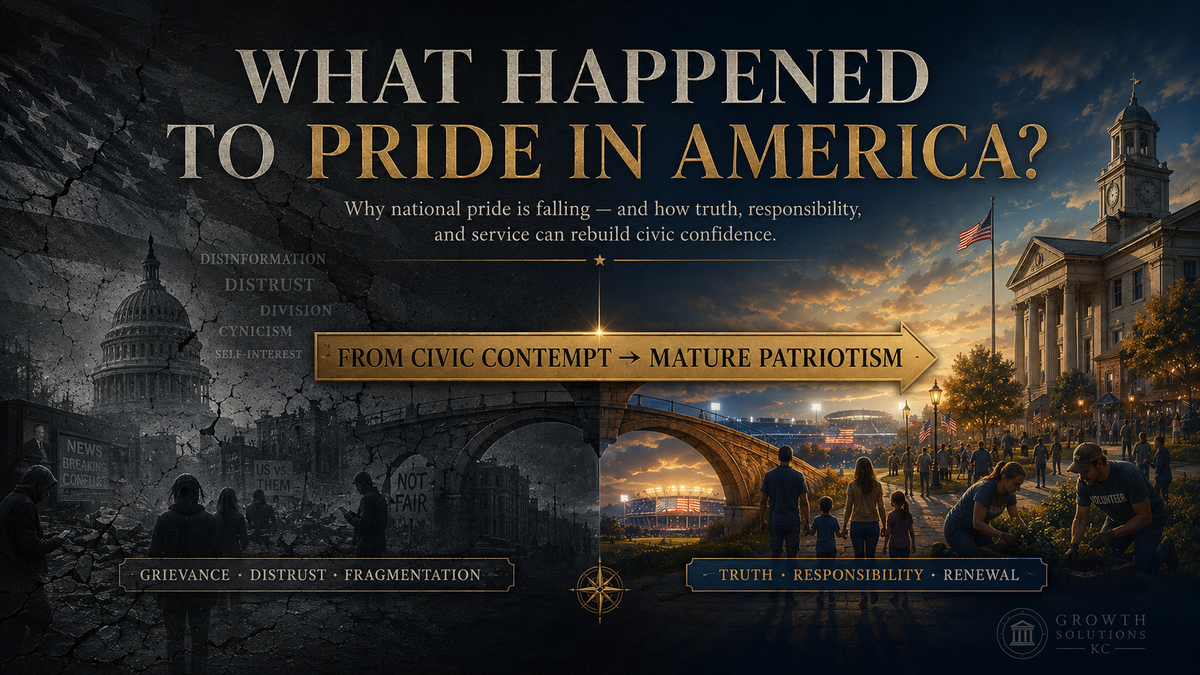
Why national pride is falling — and how mature patriotism can rebuild civic confidence
America just celebrated one of the most symbolic moments in its history: the 250th anniversary of the Declaration of Independence.
And yet, as the country marks that milestone, national pride has reached one of its weakest points in modern polling.
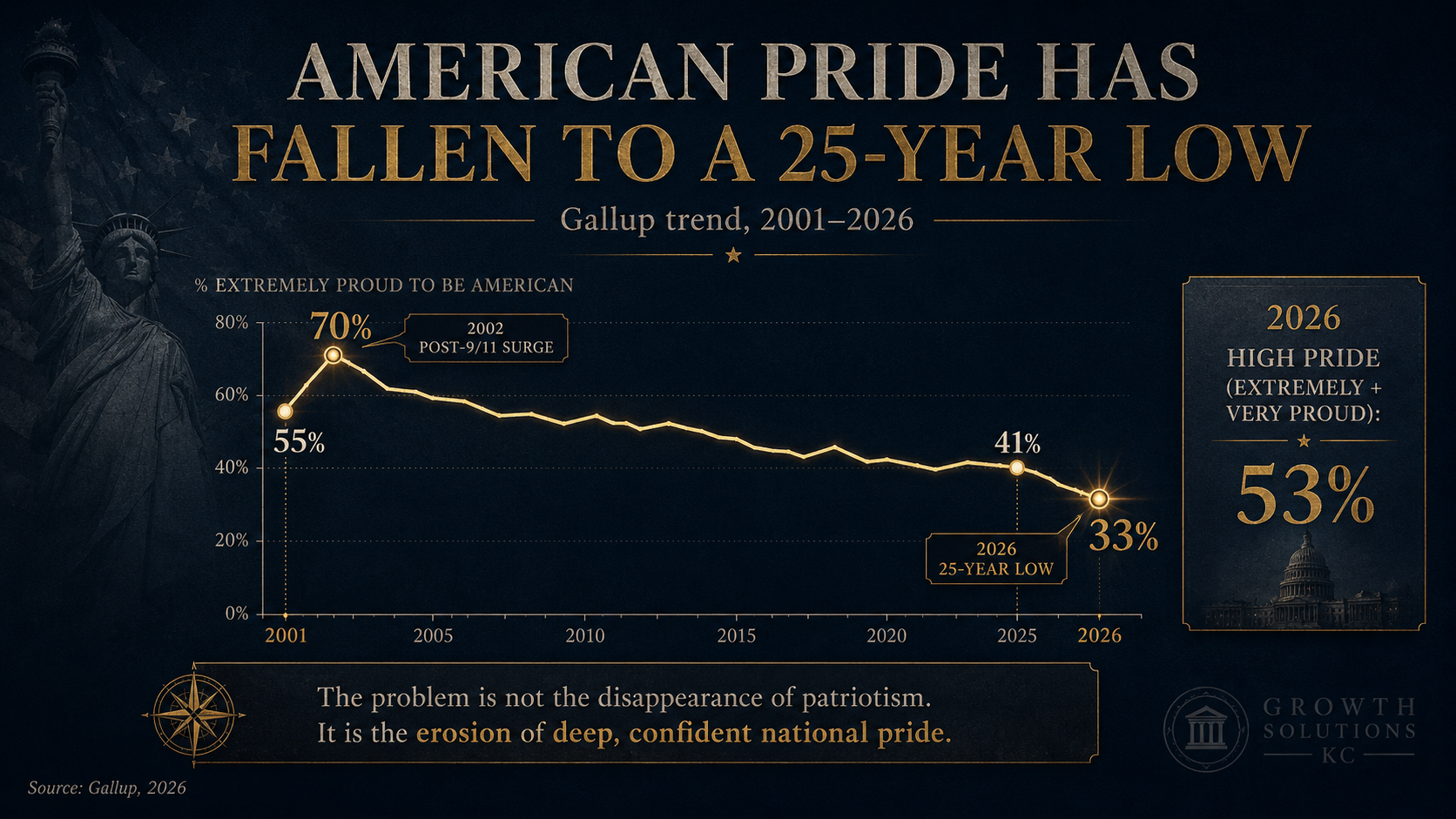
Gallup now finds that only 33% of U.S. adults say they are “extremely proud” to be American, the lowest reading in Gallup’s trend dating back to 2001. Another 20% say they are “very proud,” meaning just over half of Americans express high levels of national pride. When Gallup first asked the question in 2001, 55% were extremely proud. After 9/11, that number surged to between 65% and 70%.
That is the surface story. The deeper story is more important.
America is not simply becoming less patriotic. America is becoming less unified about what patriotism means, what the country is, and whether the American story is still worth preserving.
The decline of American pride is not simply a failure of patriotism. It is the result of a civic culture that has overfed grievance, underfed gratitude, weakened trust, chose entitlement over responsibility, and trained too many citizens to mistake resentment for insight.
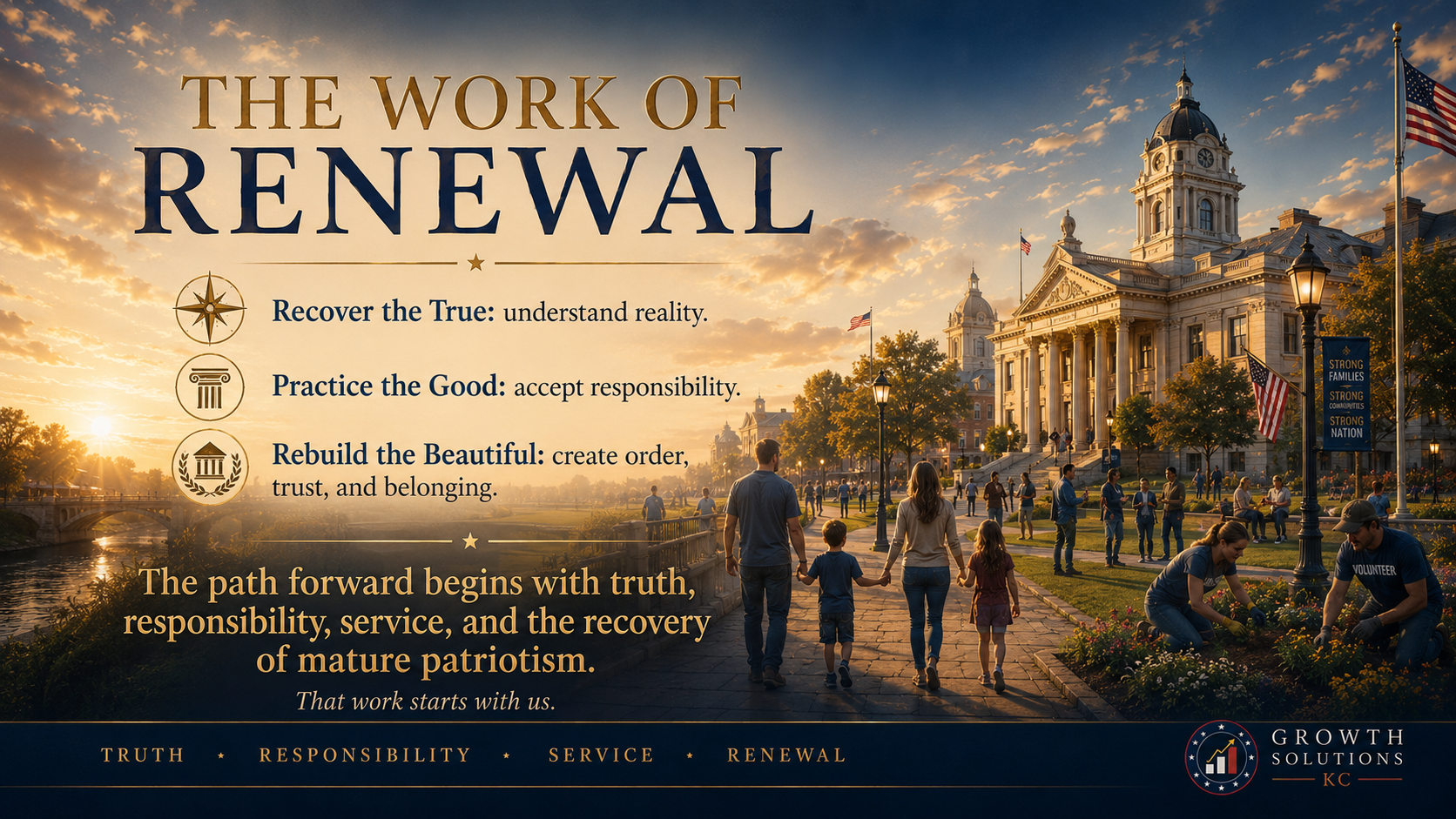
The path back begins with truth, responsibility, service, and the recovery of mature patriotism.
Pride Is Falling — But the Story Is More Complicated Than It Looks
The decline in American pride is real.
Gallup’s 2026 numbers show a long erosion from the post-9/11 period, when national unity surged, to today’s more fragmented civic environment. The decline is especially sharp among Democrats, independents, younger adults, women, and people of color.
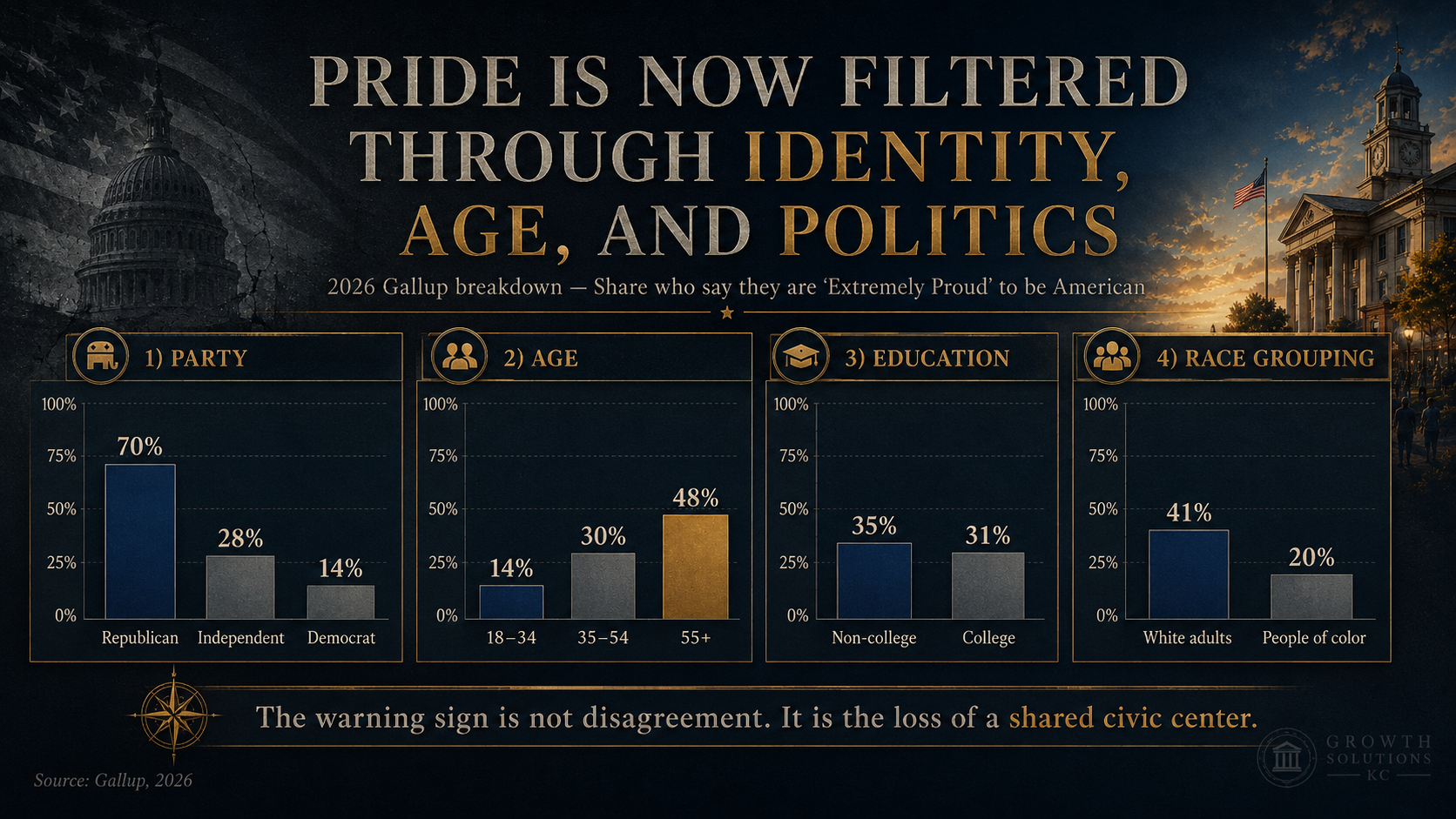
The partisan gap is especially striking. Gallup finds that 70% of Republicans, 28% of independents, and only 14% of Democrats say they are extremely proud to be American.
When “extremely proud” and “very proud” are combined, 93% of Republicans express high pride, compared with 51% of independents and 27% of Democrats.
PRRI’s 2026 data tells a similar story. Half of Americans say they are extremely or very proud of being American, with high pride among 83% of Republicans, 43% of independents, and 31% of Democrats.
But another set of polling adds important nuance.
YouGov finds that 70% of Americans still say they are proud to be Americans, including 96% of Republicans, 59% of independents, and 58% of Democrats. YouGov also finds that most Americans define patriotism not as unconditional support, but as “acknowledging problems in your country and seeking solutions.”
That matters.
Americans have not simply stopped caring about the country. Many are struggling to know how to love a country they are constantly told is broken, corrupt, divided, or morally compromised.
The crisis is not just the loss of pride. It is the erosion of shared civic confidence.
The Generational Warning Sign
The most concerning divide is generational.
Gallup finds that only 14% of adults ages 18 to 34 are extremely proud to be American, compared with 48% of adults 55 and older. Extreme pride also fell sharply among women, people of color, and adults under 55 in the latest Gallup data.
PRRI shows a related pattern in belief in the American Dream. Americans are now almost evenly divided on whether hard work still leads to getting ahead. Belief in the American Dream has declined since 2024, with the sharpest drops among young adults ages 18 to 29.
This is not only a political issue. It is a transmission issue.
Every nation depends on a story that one generation passes to the next. That story must explain why the nation exists, what it has achieved, what it has corrected, and why its future is worth building.
When young people inherit grievance without gratitude, they do not become reformers. They become detached.
When they inherit slogans without truth, they do not become patriots. They become cynical.
A healthy civic education must tell the whole truth: America’s ideals, America’s failures, America’s sacrifices, America’s corrections, and America’s unmatched capacity for renewal.
Institutions Must Serve Truth, Not Outrage
A healthy republic depends on institutions that help citizens see reality clearly. That includes government, schools, universities, civic organizations, churches, businesses, and the press.
But too often, the incentive structure of modern media rewards something very different.
Conflict travels faster than context. Outrage performs better than perspective. Failure receives more attention than improvement. Leaders are judged less by outcomes than by tribal affiliation. Even genuine progress can be reframed as failure if it serves the preferred narrative of the moment.
Public trust data shows why this matters. Gallup found media trust at a record low, with only 28% of Americans expressing a great deal or fair amount of trust in newspapers, television, and radio to report the news fully, accurately, and fairly.
Trust does not collapse in a vacuum. It collapses when citizens repeatedly experience institutions as selective, performative, partisan, incompetent, self-protective, or detached from reality.
That does not mean institutions should flatter America.
It means institutions should tell the truth — the whole truth.
The answer is not to shame the press or reject all institutions.
The answer is to demand better from these institutions — and to become more responsible citizens ourselves.
The Incentives of Civic Contempt
Part of the decline in American pride comes from what citizens are repeatedly taught to notice.
Modern media does not merely report national problems. Too often, it organizes public attention around contempt, hate, outrage, and mistruths.
Failure is amplified.
Progress is minimized.
National celebrations are reframed as hypocrisy.
Public figures are rapidly sorted into hero or villain categories depending less on what they do and more on whether they fit the preferred narrative of the group.
Many people do not independently reason their way into hatred and hostility. They absorb the emotional posture of the crowd.
The same pattern can happen with national identity.
People may not consciously decide to reject America. They may simply absorb a daily posture of contempt from media, social platforms, celebrities, institutions, and peer groups until gratitude feels naïve and cynicism feels intelligent.
That is how pride erodes. Not all at once, but through repetition.
If a husband or wife spent every day listing only what was wrong with their spouse, eventually affection would erode.
If a parent focused only on a child’s flaws, trust would weaken.
If a citizen is told every day that America is mostly shameful, corrupt, oppressive, hypocritical, or unworthy of celebration, national pride will eventually decline.
The reverse is also true. Someone who supports their spouse, encourages a child, serves their community, and acts responsibly discovers what is good.
That is not complicated psychology. It is the natural result of disciplined attention.
What we repeatedly notice shapes what we eventually believe.
The Triad of Decline
The collapse in national pride is not random. It reflects a deeper cultural pattern.
The Triad of Decline begins with The Untrue.
When narrative overshadows fact, people stop sharing reality. They no longer argue from common evidence. They argue from separate worlds. What is True no longer matters.
Then comes The Bad.
When purpose is abandoned, citizenship becomes passive. People begin to experience the country as consumers, spectators, victims, or political combatants rather than responsible participants. Rights remain important, but duties disappear. Freedom becomes detached from responsibility.
Finally comes The Ugly.
A society that loses truth and purpose becomes fragmented. Institutions weaken. Public life becomes performative. Neighbors become abstractions. Politics becomes identity warfare. Citizens stop asking, “What should we build?” and start asking, “Who should we blame?”
This is how national pride turns negative.
Not because people care too little, but because their care is redirected into resentment.
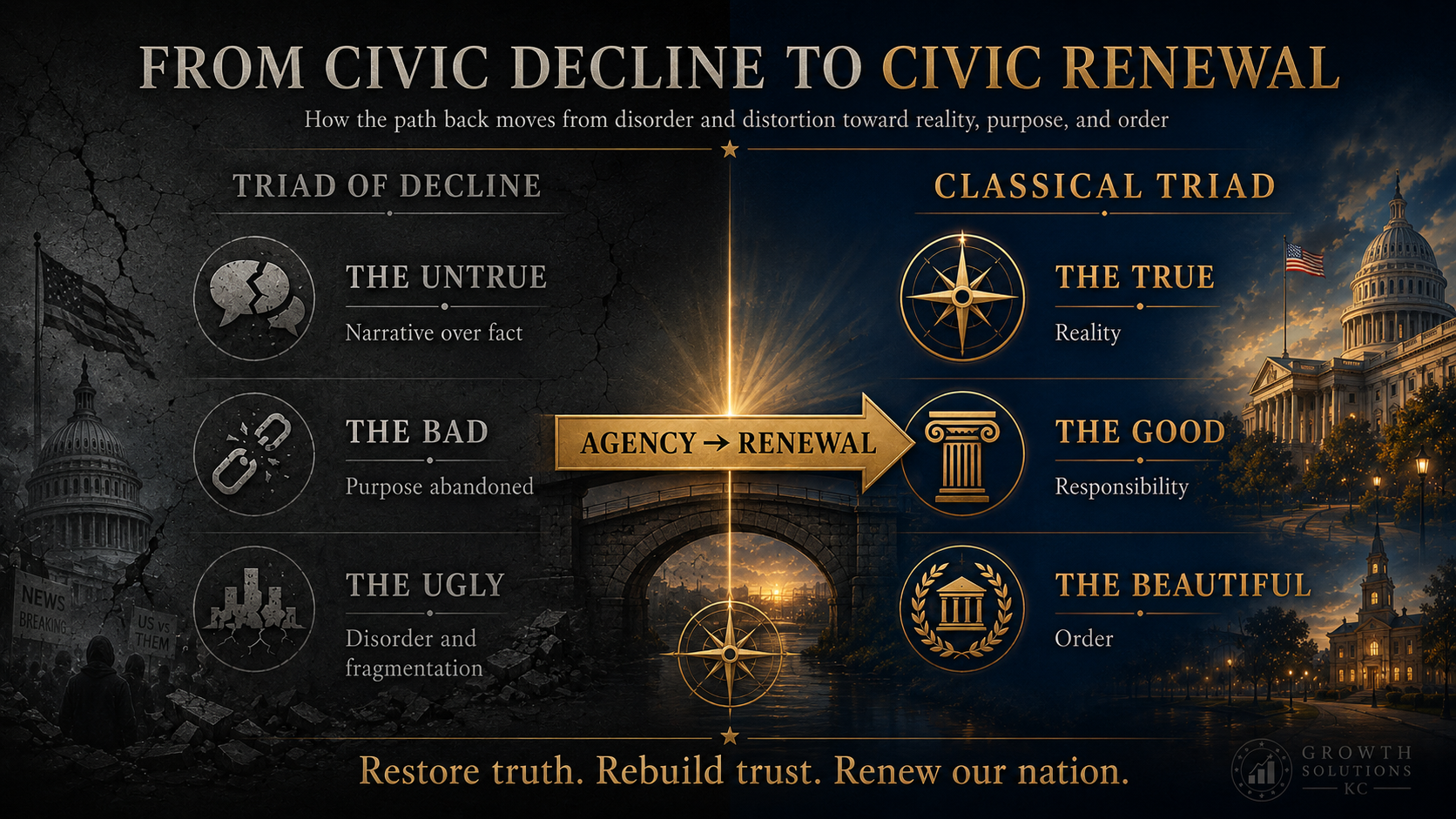
The Classical Triad: The Path Back
The answer is not blind patriotism. Blind patriotism asks people to ignore what is broken. That will not work, and it should not work.
The answer is not permanent cynicism either.
The healthier path is the Classical Triad: The True, The Good, and The Beautiful.
The True means alignment with reality — with what actually is.
Tell the truth about America and its founding ideals. Tell the truth about its achievements, innovations, challenges, sacrifices, freedoms, and the struggle to endure. Tell the truth about what a blessing it is to be an American.
The Good means recovering purpose.
Citizenship is not passive membership. It is a responsibility. It is voting, serving, mentoring, building, volunteering, raising strong families, supporting healthy institutions, and doing the difficult work of self-government.
The Beautiful means rebuilding harmony and order.
Beauty is not decoration. It is what a society looks like when truth and goodness take form: safe neighborhoods, strong families, trusted institutions, meaningful work, excellent schools, clean public spaces, local traditions, shared ceremonies, and communities that inspire people to belong.
The Foreign Visitor Paradox
Here is one of the most interesting parts of the story: many foreign visitors see America more positively after experiencing it firsthand.
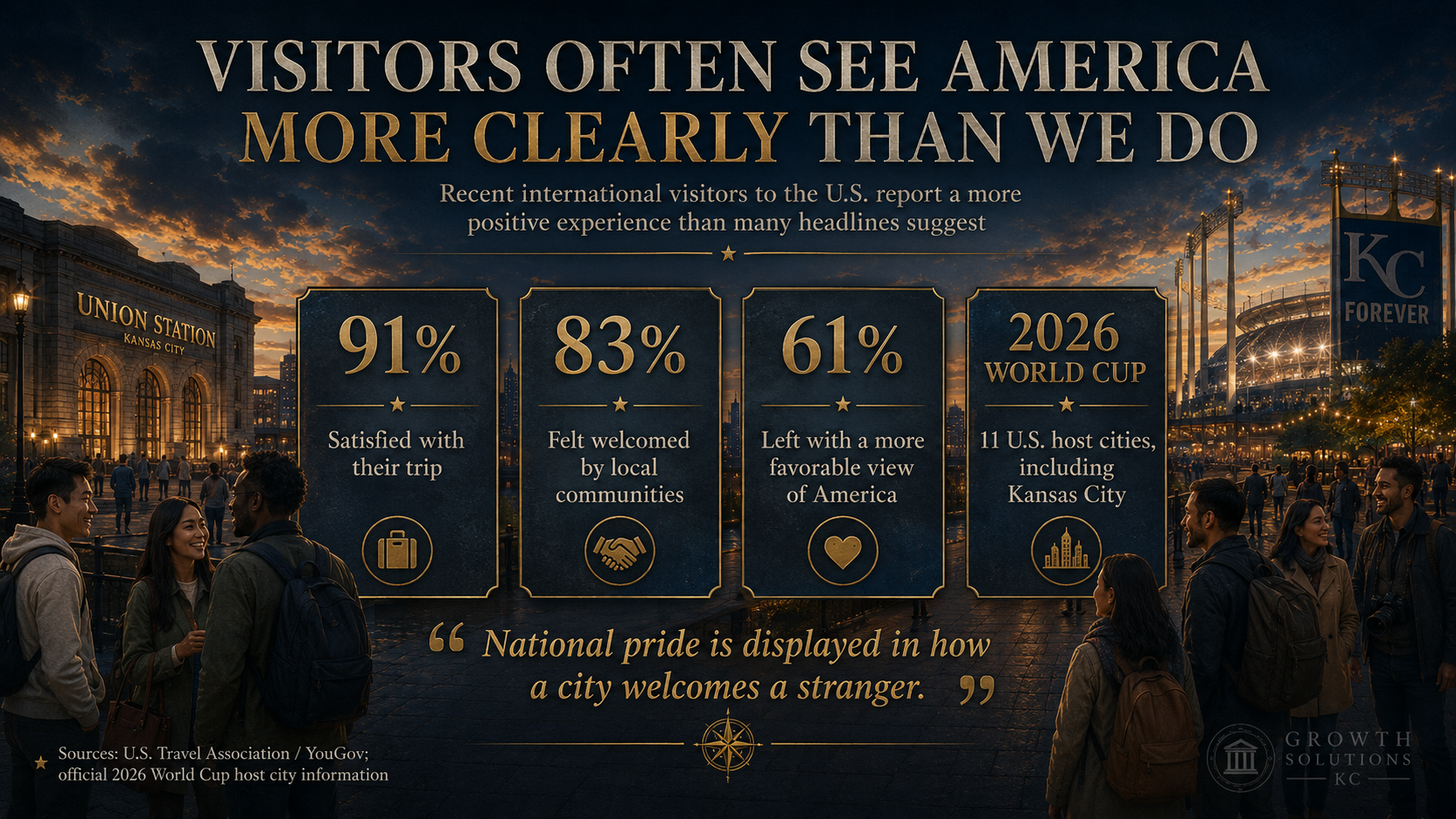
A 2026 U.S. Travel Association/YouGov survey of recent international visitors found that 91% were satisfied with their trip, 83% felt welcome, 61% left with a more favorable opinion of the United States, and 56% improved their perception of U.S. safety. The survey included more than 1,200 recent visitors from eight international markets.
That does not mean America has no problems.
It means America’s lived reality is often better than its media image.
Visitors experience local hospitality, small businesses, open space, cultural energy, innovation, consumer choice, religious diversity, entrepreneurial ambition, and the everyday decency of ordinary Americans.
That is the America many citizens forget to see because they encounter the country primarily through politics, news, and social media conflict.
The foreign visitor paradox reveals something important:
America may look worse through a screen than it does across a dinner table, a hotel lobby, a ballpark, a church service, a downtown street, a small business, or a neighborhood conversation.
The 2026 World Cup as Civic Opportunity
The 2026 FIFA World Cup has given America a rare opportunity to remember this.
U.S. Travel estimates that international World Cup visitors expect to spend more than $5,000 per person, with many planning longer stays and showing openness to visiting destinations beyond the largest gateway cities.
That makes the World Cup more than a sporting event.
It is a civic test.
It is a hospitality test.
It is a public diplomacy test.
Every restaurant owner, volunteer, police officer, Uber driver, hotel worker, small business owner, church member, teacher, student, and local resident becomes part of America’s public image.
National pride is not only displayed in Washington. It is displayed in how a city welcomes a stranger.
The World Cup created an opportunity to show the world something many Americans still experience at the local level: energy, generosity, competence, warmth, ambition, and civic pride.
Visitors will not judge America primarily by speeches, headlines, or political arguments. They will judge America by what they see, the hospitality they experience, and how they are treated.
What Individuals Can Do
The renewal of national pride will not begin with a federal messaging campaign. It will begin with individuals reclaiming agency.
Get closer to reality.
Read beyond headlines. Compare sources. Look for original documents, data, local experience, and historical context. Do not outsource your understanding of America to people who profit from your anger.
Ask better questions: Is this true? Is this proportional? What context is missing? Who benefits from my anger? What good is being left out? What responsibility do I have?
Reject passive victimhood.
Problems are real. Injustice is real. Institutional failure is real. Economic pressure is real. Cultural confusion is real.
Agency is also real.
A responsible citizen does not deny hardship. A responsible citizen refuses to let hardship become their identity.
The better question is not, “Who can I blame for everything?”
The better question is, “What will I do and where can I actually have influence?”
Serve before you complain.
Volunteer. Mentor. Coach. Join a civic group. Help at church. Support a school. Attend a local meeting. Pick up trash. Check on a neighbor. Help a young person build confidence.
Strengthen your family and community.
Civic renewal begins at home. It begins in how we raise children, care for parents, honor commitments, speak about our country, treat neighbors, and model gratitude, discipline, service, and responsibility.
A nation with weakened families will struggle to sustain trust. A nation with strong families has a better chance of producing strong citizens.
Practice civic hospitality.
Welcome visitors. Explain your city. Share your story. Ask about theirs.
Model the America that is generous, curious, confident, and decent.
Practice patriotic honesty.
Love of country does not require denial. It requires stewardship.
Tell the truth about America’s failures, but also tell the truth about its achievements, sacrifices, freedoms, and capacity for renewal.
The Work of Renewal
The decline of American pride is not simply a failure of patriotism. It is the result of a civic culture that has overfed grievance, underfed gratitude, weakened trust, and trained too many citizens to mistake resentment for insight.
America’s pride problem is ultimately a civic identity problem.
The answer is renewal.
Recover the True: understand reality.
Practice the Good: accept responsibility.
Rebuild the Beautiful: create order, trust, and belonging.
America does not need citizens who worship the country blindly. It needs citizens who love it maturely.
A mature patriot can see the cracks without despising the foundation.
A mature patriot can tell the truth without surrendering hope.
A mature patriot can criticize the country because the goal is not destruction, but preservation and renewal.
Every generation inherits America. No generation owns it.
The question before us is whether we will be passive heirs of decline or active stewards of renewal.
— Matt Cucinotta | Growth Solutions KC | Inspire · Inform · Ignite


Comments ()