

A Day Without the Cloud: How Much of Modern Life Depends on Data Centers?

The Modern World Runs on Data Centers
We notice data centers mostly when someone proposes building one. We rarely notice them the thousands of times a day they quietly make modern life work.
Most of us rely on data centers all day long without ever seeing a server rack. Our phones and computers reach them constantly, often in the background, before we open a single app. Modern life runs on an invisible digital foundation: nondescript warehouse facilities housing thousands — in the largest cases, tens of thousands — of interconnected servers that process, store, and transmit the world’s information around the clock.
You wake up and reach for your phone.
Before your feet touch the floor, you check the weather. A few messages arrived overnight. Your calendar syncs. Your smartwatch updates your sleep data. Maybe you glance at a bank balance, read the morning headlines, check the weather, or open a photo that was backed up to the cloud while you slept.
You have been awake for five minutes. You have probably already relied on multiple data centers. Most of us never think about that.
We see the phone. We see the app. We see a map, a balance, an email, a photograph, or a weather forecast. We do not see the buildings filled with servers, networking equipment, storage systems, electrical infrastructure, and cooling systems that make those services available. That invisibility is part of the reason data centers can feel strangely disconnected from the lives they support.
When one is proposed near a community, people see the building, the power lines, the land, the water requirements, or the construction. They rarely see themselves inside the story. So imagine something different for a few minutes.
What would an ordinary day look like if the cloud were suddenly unavailable?
No one is seriously proposing that America’s existing data centers simply disappear tomorrow. But imagining that world for a few minutes reveals something important: these buildings are no longer peripheral pieces of the technology economy. They are embedded in ordinary life.

6:30 A.M. — YOUR PHONE ISN’T REALLY JUST A PHONE
The alarm may still work. But much of what makes a smartphone “smart” depends on systems far beyond the device in your hand.
Email, messaging platforms, cloud backups, maps, application data, authentication systems, software updates, social media, video calls, and many other services depend on remote computing and storage. Even signing in is a data-center function. The systems that confirm it is really you when you log in to your bank, your email, or your workplace are run on remote servers.
Without access to those systems, your phone would not become a useless piece of glass. But it would become much less capable. Some information stored locally would remain. Certain functions could continue offline.
But the seamless experience we have come to expect—the ability to pick up a device anywhere and immediately retrieve information stored somewhere else—would begin to break down.
And the day has barely started.
7:30 A.M. — GETTING SOMEWHERE BECOMES HARDER
You leave home.
Normally, a navigation application checks your location, examines traffic conditions, evaluates several routes, and adjusts while you drive.
One distinction matters here. The GPS signal that locates your car comes from satellites, and your phone can find its position without any data center at all. What depends on data centers is everything built on top of that position: the maps, the routing, the live traffic, the arrival estimate, and critical 911 emergency location-based routing.
Transit systems coordinate schedules.
Airlines manage reservations, aircraft, crews, baggage, gates, weather information, and thousands of other moving pieces.
Cities increasingly use digital systems to monitor traffic, coordinate infrastructure and manage services.
Without the remote computing supporting those systems, transportation would not simply stop. But much of the real-time coordination we now take for granted would disappear or fall back to less capable local systems.
Navigation, flight scheduling, traffic optimization, and public-transit coordination are among functions heavily dependent on networked digital infrastructure.
The paper map would still work. The problem is that modern life has been designed around something far more dynamic.
9:00 A.M. — THE WORKDAY LOSES ITS INVISIBLE OFFICE
For millions of Americans, work no longer exists only inside the building where they sit. Files are stored remotely. Teams collaborate across cities and countries. Customers place orders online.
Companies run payroll, accounting, inventory, logistics, scheduling, customer databases, cybersecurity, analytics, and communications through cloud-based systems.
Government agencies depend on digital platforms for licensing, permitting, taxes, records, and public services.
Cloud computing, payroll systems, tax systems, corporate networks, logistics, licensing, and supply chains are part of this digital operating layer. Take away the data-center infrastructure and some businesses could fall back on local systems. Others could operate manually. The real disruption would not be losing a website. It would be losing the coordination behind the organization.
Many modern organizations have been built around the assumption that computing, storage, communication, and information will always be available.
NOON — YOU BUY LUNCH
You tap a card. For you, the transaction takes seconds. Behind the scenes, payment systems authenticate the transaction, communicate with financial institutions, update accounts, and help merchants track sales and inventory.
Multiply that by a nation. Visa alone processed about 257.5 billion transactions in its 2025 fiscal year, an average of roughly 700 million a day, and it is only one of several payment networks.
Banking systems, card authorization, online transfers, ATM networks, digital payment platforms, and point-of-sale systems all depend heavily on networked computing. Businesses with offline payment capabilities might continue operating. Others would struggle.
Without that infrastructure, cash would suddenly become much more important.
Then consider what is happening behind the lunch itself.
Restaurants, grocery stores, distributors, warehouses, trucking companies, and suppliers increasingly use digital inventory and logistics systems to decide what goes where and when.
That chain starts long before the grocery store. On many Midwest farms, decisions about planting, fertilizing, and harvesting now draw on farm-management platforms that combine equipment data, field sensors, satellite imagery, and weather forecasts. The grain itself is priced and sold through electronic markets
Modern supply chains are not simply trucks driving products from one building to another. They are information systems coordinating physical goods.
2:00 P.M. — SOMEONE NEEDS A DOCTOR
Perhaps you never enter a hospital that day. Someone else will.
Modern healthcare relies on electronic health records, medical imaging systems, scheduling, pharmacy platforms, insurance verification, telehealth, and many other digital services.
Those systems are not necessarily housed in one hospital basement. Increasingly, they rely on remote storage, computing, backup, and network infrastructure. Electronic health records, imaging archives, pharmacy systems, telehealth, and insurance verification all depend on that digital backbone.
Hospitals would not suddenly stop caring for patients.
Doctors and nurses would still know medicine.
Emergency procedures would still occur.
But losing access to digital systems would make modern healthcare slower, less coordinated, and more difficult.
The next generation of healthcare will depend on computing even more. AI-assisted diagnostics, drug discovery, medical research, genomics, and increasingly sophisticated imaging and analytics all require enormous computing capacity.
That makes the physical infrastructure behind medicine increasingly important even when patients never see it.
3:00 P.M. — SCHOOL LETS OUT
Across town, a school day is ending.
Assignments were posted, submitted, and graded on online learning platforms. Attendance was recorded digitally. A note to parents about tomorrow’s early dismissal reached every family at once. Bus routes were planned with routing software.
Teachers can still teach without any of it, and many remember when they did. But the scheduling, record-keeping, and communication that hold a modern school district together increasingly run through remote systems.
The classroom would continue. The coordination and communication systems around it would slow down.
5:00 P.M. — AN EMERGENCY HAPPENS SOMEWHERE
A family calls 911.
A storm approaches.
A traffic accident blocks a highway.
A utility detects a problem.
Public‑safety operations now run on a dense web of digital systems — communications networks, databases, mapping tools, GPS, weather feeds, emergency alerts, utility monitoring, and real‑time coordination platforms. Everything from dispatch software and caller‑location data to police, fire, and EMS services depends on networked computing housed in dedicated, highly redundant data‑center infrastructure.
Redundancy matters. Emergency agencies build backup systems precisely because failure is unacceptable. But redundancy does not make the underlying infrastructure unimportant. It demonstrates how important it is.
We invest in backup power, redundant networks, duplicate systems, and multiple facilities because modern society cannot easily tolerate losing access to its digital nervous system.
8:00 P.M. — THE PART WE ACTUALLY NOTICE
Now we reach the obvious things.
You stream a show.
You access social media.
Your children play an online game.
Someone uploads photographs.
You order something online.
A smart-home system adjusts the thermostat.
You video-call a relative.
These are the services people most readily associate with “the cloud.” Streaming platforms, online gaming, social media, messaging applications, and digital media libraries all depend on remote computing infrastructure.
They matter. But by this point in the day, they may actually be among the least consequential examples. Yet, each is part of how we interact in the modern world.
The data center has already helped you communicate, travel, work, buy things, move money, access healthcare, coordinate commerce, monitor infrastructure, and respond to emergencies. You just never saw it.
11:00 P.M. — WHILE YOU SLEEP
You go to bed. The data centers do not.
Overnight, your phone backs up the day’s photos. Software updates download and install. Banks settle the day’s card transactions and post deposits. Payroll systems prepare tomorrow’s direct deposits. Fraud-detection systems scan millions of transactions for patterns that don’t fit.
Distribution centers and carriers plan the routes that will put tomorrow’s packages on trucks before sunrise. Weather models run the forecast you will check at 6:30.
By the time your alarm goes off, much of the next day has already been prepared somewhere you will never see.
And the cycle starts again
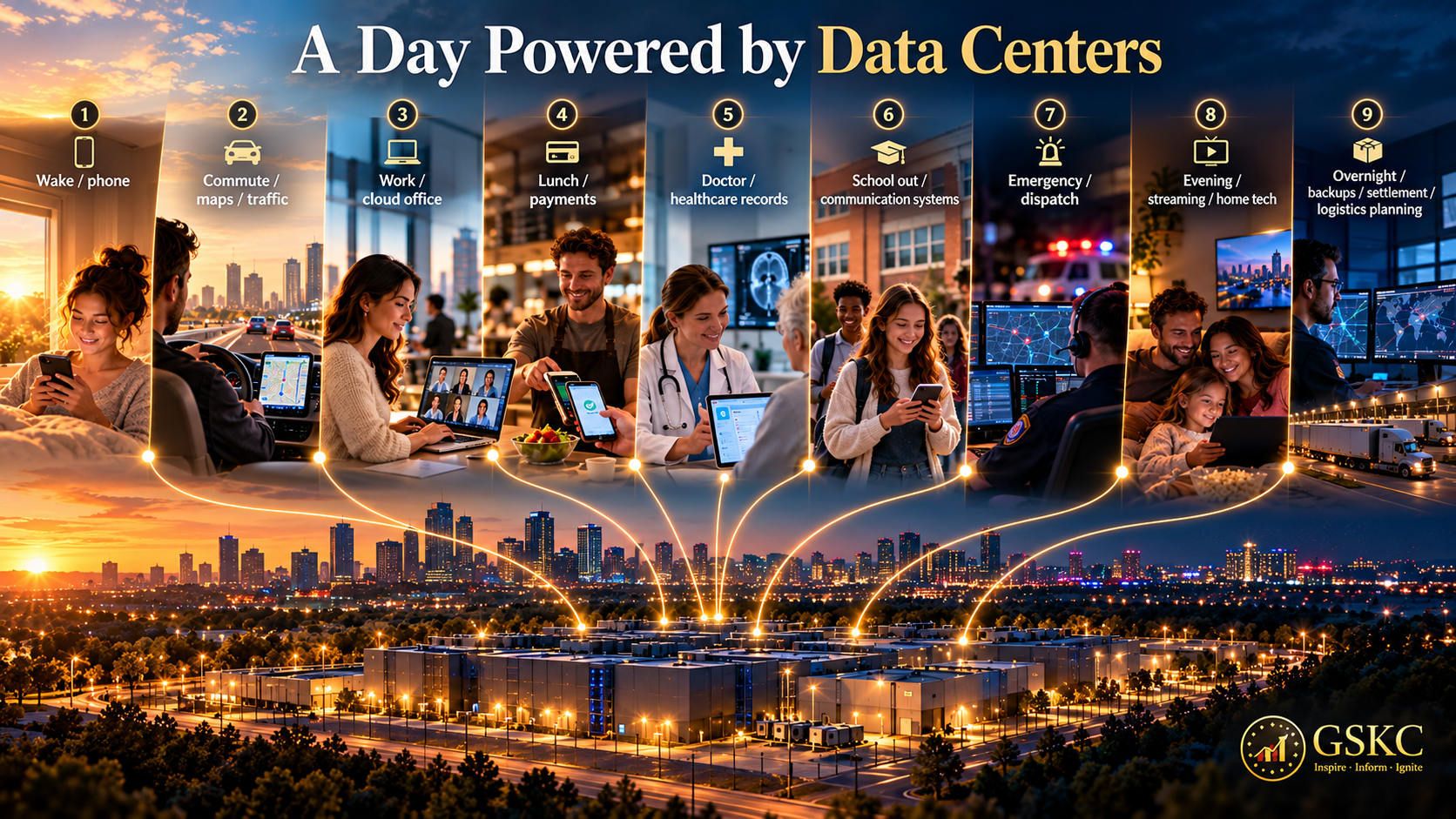
THIS ISN’T REALLY ABOUT LOSING CONVENIENCES
It would be easy to turn this thought experiment into a list of annoyances.
No streaming.
No online shopping.
No cloud photos.
No social media.
But that misses the point.
This is not really an article about losing conveniences. It is about how deeply physical society now depends on digital coordination.
Food arrives because inventory systems help determine what stores need.
Money moves because financial networks authenticate transactions.
Packages arrive because logistics systems coordinate warehouses, routes, vehicles, and deliveries.
Utilities monitor enormous systems in real time, largely through their own dedicated control centers and private computing infrastructure.
Businesses coordinate employees and customers across vast distances.
Emergency services use digital information to reach people faster.
The familiar consumer conveniences are only the surface layer; underneath them sits a digital foundation coordinating healthcare, commerce, transportation, utilities, and supply chains.
That is why data centers have become infrastructure rather than merely technology.

WE’VE ALREADY HAD A PREVIEW
This thought experiment is not entirely hypothetical. We have already seen what happens when a small part of the digital foundation fails.
On July 19, 2024, a faulty software update from cybersecurity firm CrowdStrike crashed about 8.5 million Windows computers worldwide. Airlines canceled more than 5,100 flights that Friday alone. Hospitals canceled surgeries and appointments and lost access to patient records. 911 and non-emergency call centers in several states were disrupted.
That was not a data-center failure. It was a single bad update that reached many critical systems at once. That is the point: modern systems are tightly connected, and a failure in one place spreads fast.
On October 20, 2025, a fault in Amazon Web Services’ US-EAST-1 region in Northern Virginia, traced to a DNS problem affecting a core database service, rippled across the internet. Payment apps, banks, messaging services, smart-home devices, and workplace tools went down or degraded for hours, and the effects reached customers on other continents.
Neither event came close to a world without the cloud. But together they showed two things.
First, how much now depends on this infrastructure.
Second, that dependency is also a vulnerability.
When many services lean on the same few providers, regions, or facilities, a single fault can reach millions of people. Resilience — redundancy, geographic diversity, and backup plans — is part of the infrastructure question, not separate from it.
TOMORROW’S LAYER: AI

Then there is what comes next.
Artificial intelligence is increasing the amount of computation society demands. But the significance of that demand will not be limited to chatbots. AI and advanced computing are moving into medical research, drug development, manufacturing, robotics, cybersecurity, scientific modeling, business analytics, logistics, education, and countless other applications.
Some will disappoint. Some will prove transformative. Either way, the digital world is becoming more compute-intensive rather than less.
That does not mean every proposed data center should be approved. It means the infrastructure question is becoming harder to avoid. Dependency explains why data centers are infrastructure. Whether a specific project serves a specific community is a separate question.
This article answers the first question. The rest of The Data-Center Divide series takes on the second.
FROM CONNECTION TO STEWARDSHIP
A world without data centers would not simply mean losing social media or video streaming. It would mean a cascading loss of coordination across supply chains, healthcare, finance, and public services. Understanding this hidden reliance is essential for evaluating the real-world trade-offs of digital infrastructure.
But understanding how much modern life depends on data centers does not erase the legitimate concerns surrounding them.
These concerns are no longer abstract in our region. Meta’s $1 billion Northland data center began serving traffic in August 2025. Google is building a data center campus at the Hunt Midwest Business Center and has confirmed a second campus in the Northland. South of St. Louis, Festus is weighing a proposed $6 billion project. The decisions communities make now will shape costs and benefits for decades.
Communities should continue asking difficult questions. But understanding dependency changes the nature of those questions. The choice is not between caring about communities and caring about technology. Nor is it between accepting every project and rejecting an entire category of infrastructure.
It is about stewardship.
Data centers have become part of the physical foundation supporting modern society, they deserve the same seriousness we apply to other essential infrastructure.
We notice roads because we drive on them.
We notice power lines because we see them.
We notice airports because we travel through them.
Data centers are different. Most of us can use one all day without ever seeing one. Perhaps that is why they are so easy to misunderstand.
The challenge is not choosing between modern life and responsible communities. It is learning how to support both.

— Matt Cucinotta | Growth Solutions KC | Inspire · Inform · Ignite
Sources & Notes
- Number of U.S. data centers. Cloudscene counts about 5,400 U.S. facilities (5,426 as of March 2025), as compiled by Apollo Academy. Counts vary with definitions: ABI Research lists 2,396 operational sites under a narrower definition. The article therefore says “more than 5,000 by common industry counts.”
- Visa transaction volume. 257.5 billion processed transactions in fiscal 2025 (twelve months ended Sept. 30, 2025). Visa Q4 FY2025 earnings release, SEC Form 8-K. Daily average (≈705 million) is our calculation: 257.5 billion ÷ 365.
- CrowdStrike outage, July 19, 2024. About 8.5 million Windows devices affected (Microsoft estimate); 5,100+ flight cancellations that Friday (FlightAware); canceled surgeries and restricted record access. PBS NewsHour / AP. Disruption to 911 and non-emergency call centers: Association of Health Care Journalists.
- AWS outage, October 20, 2025. US-EAST-1 (Northern Virginia) disruption tied to the DynamoDB API endpoint; affected apps included Venmo, Coinbase, Robinhood, Signal, Zoom, Alexa, and Ring, plus banks in the U.K. TechInformed.
- Meta Kansas City data center. $1 billion investment, now operational and serving traffic (announced August 2025). Meta Newsroom; KSHB 41.
- Google Kansas City campuses. $1 billion campus at Hunt Midwest Business Center: Hunt Midwest. Google confirmed a second Northland campus in February 2026, noting its first Missouri campus was still under construction: KCTV5.
- Festus. See GSKC, “Festus Should Fix the Process — Not Forfeit a Generational Opportunity”



Comments ()