

Retirement Starts Before You Retire
The two to three years before retirement are when you turn a collection of accounts and benefits into a coordinated income, tax, healthcare, and life plan.

The 3-Year Retirement Runway: What to Plan, Test, and Put in Place Before the Paycheck Stops
GSKC Retirement Planning Series
Retirement is often treated like a date on the calendar. One day you are working. The next day you are retired.
Financially, however, the transition is rarely that simple.
A successful retirement isn't created on your last day of work. The two to three years beforehand are when you test the plan, close gaps, make tax decisions, prepare healthcare, and begin turning a portfolio into a retirement income system.
Think of this period as your retirement runway.
The objective is not to predict every expense, eliminate every risk, or make one perfect set of decisions. It is to understand how the pieces of retirement fit together while you still have time, income, and flexibility to adjust them.
Retirement readiness is not simply having enough money. It is knowing how your money, taxes, healthcare, income, and life will work together after the paycheck stops.
Retirement means looking beyond your account balance and answering seven larger questions.
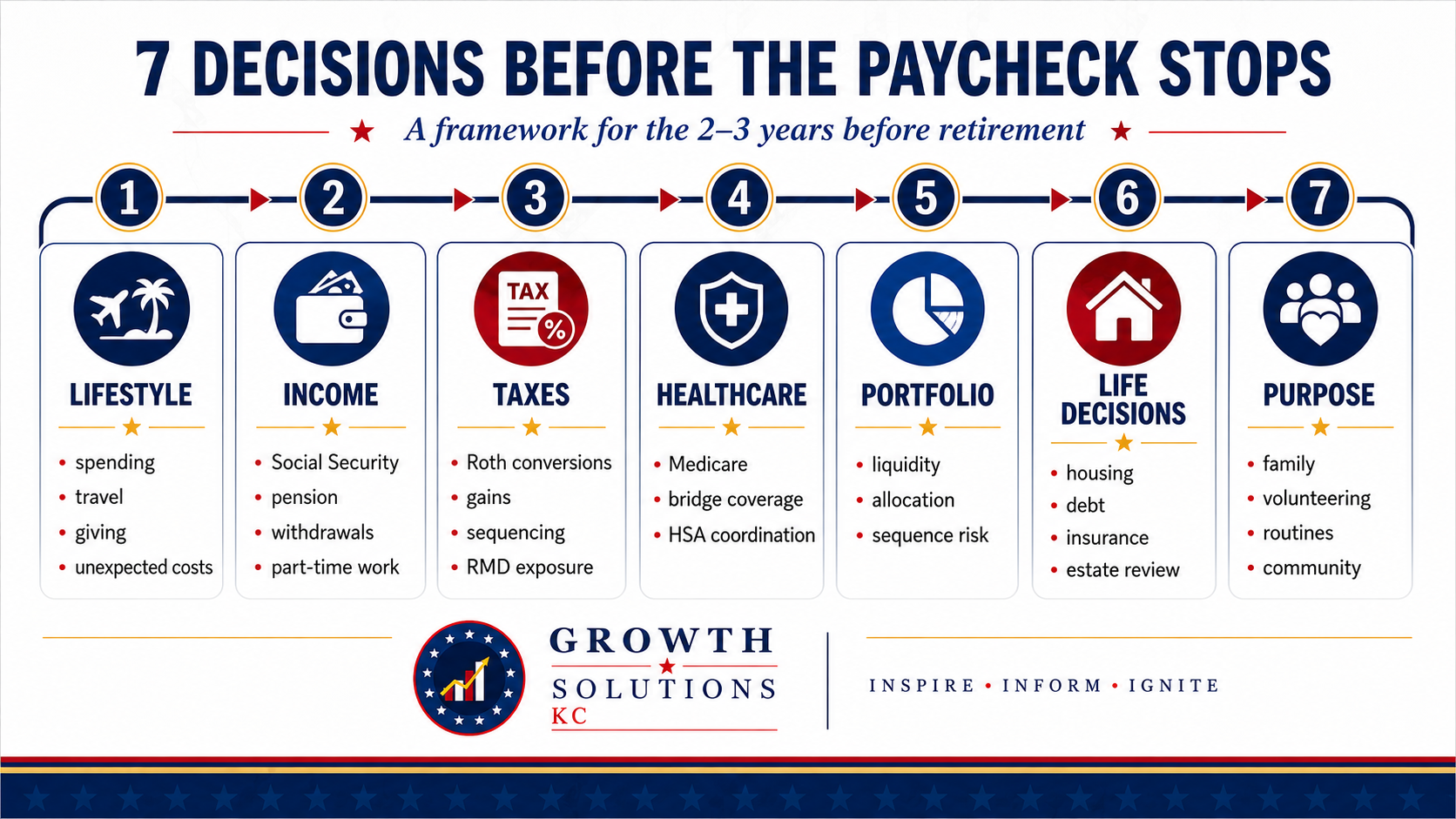
1. Know What Retirement Will Actually Cost
The first question is not, “How much do I have?”
It is, “What kind of retirement am I trying to fund?”
Housing, travel, healthcare, hobbies, family support, charitable giving and everyday living all compete for the same resources. Some expenses may fall when work ends. Others may rise.
Start by tracking what you actually spend today and then build a retirement version of that spending.
Separate expenses into categories such as:
- Essential monthly costs
- Discretionary lifestyle spending
- Healthcare
- Travel and major purchases
- Taxes
- Giving and family support
- A reserve for unexpected expenses
Then test different versions of retirement. What does the plan look like if markets struggle early? What if inflation remains elevated? What if you live into your 90s?
The goal is not precision to the dollar. It is to discover whether your expectations and your resources are aligned while you still have time to make adjustments.
2. Build Your Retirement Paycheck
During your working years, income generally arrives automatically.
Retirement reverses that relationship.
Instead of receiving a paycheck and deciding how much to save, you may have to decide which assets will produce the next paycheck.
That income might come from several sources:
Social Security + pension income + cash reserves + investment withdrawals + part-time work
Those sources do not all behave the same way. Social Security can generally begin as early as age 62, but claiming early reduces the monthly benefit. Waiting beyond full retirement age can increase the benefit through delayed retirement credits until age 70. Portfolio withdrawals introduce a different set of decisions. Do you spend from taxable accounts first? Traditional retirement accounts? Roth assets? Cash?
Rather than waiting until retirement to answer those questions, start building a preliminary retirement paycheck plan several years ahead.
Know where the first year of income will come from—and where the fifth or tenth year may come from as well.
3. Create the Tax Strategy Before Your Income Changes
Retirement can create some of the most valuable tax-planning years of your life. Your salary may disappear while Social Security has not yet started and required minimum distributions have not yet begun. Depending on birth year, current law generally begins RMDs at age 73 or later at age 75.
That transition can create opportunities—but only if you recognize them.
Possible decisions include:
- Roth conversions
- Capital-gain realization
- Withdrawal sequencing
- Charitable giving
- Managing future RMD exposure
- Coordinating taxable, tax-deferred and Roth assets
The important principle is to avoid looking at any one year's tax bill in isolation.
A Roth conversion, for example, may intentionally increase taxable income today if doing so creates greater long-term value later.
But tax decisions can also affect other costs. Medicare's income-related monthly adjustment amount—IRMAA—can increase Medicare Part B and Part D costs based on income reported on an earlier tax return. That means a retirement tax decision can eventually become a healthcare-cost decision too.
The lesson is broader than IRMAA:
Good retirement planning coordinates taxes across years instead of simply minimizing this year's tax bill.
We will explore that relationship more deeply in a separate article.
4. Solve Healthcare Before Employer Coverage Disappears
Healthcare deserves its own retirement plan. For most Americans, Medicare becomes part of that plan around age 65—but retirement and Medicare eligibility do not always occur at the same time.
Someone retiring at 62 may need several years of bridge coverage. Someone working beyond 65 may remain on an employer plan and enroll in parts of Medicare later.
Medicare's Initial Enrollment Period generally covers seven months around age 65. People covered through current employment may qualify for a Special Enrollment Period after that employment or coverage ends, but COBRA and retiree coverage do not necessarily operate the same way as active employer coverage.
Two or three years before retirement, begin answering questions such as:
- When will employer coverage end?
- Will Medicare begin before or after retirement?
- If retiring before 65, what will bridge coverage cost?
- Which doctors, hospitals and prescriptions matter?
- Will Original Medicare plus Medigap or Medicare Advantage better fit your circumstances?
- Are you contributing to an HSA, and how will Medicare enrollment affect those contributions?
That last question can be particularly important for people working beyond 65.
Healthcare planning is not something to solve during the final week of employment.
5. Prepare the Portfolio for Withdrawals—not Just Growth
For decades, the investment goal may have been relatively simple:
Save. Invest. Accumulate.
Retirement adds another job: Distribute.
That changes the problem.
A market decline during your working years can be painful, but continued contributions may allow you to purchase investments at lower prices.
A major decline early in retirement can be more damaging if you are simultaneously selling investments to fund living expenses. That is commonly called sequence-of-returns risk.
Before retirement, decide how you would fund spending during a difficult market. That may involve maintaining appropriate cash or short-term reserves, adjusting asset allocation, identifying which accounts will fund withdrawals, and determining which expenses could temporarily be reduced.
The objective is not to eliminate market risk. It is to avoid being forced into poor decisions because the plan lacked liquidity or flexibility.
6. Make the Big Life Decisions While You Still Have Options
Not every important retirement decision happens inside an investment account.
The final working years are also a good time to review:
- Mortgage and other debt
- Whether to stay, downsize or relocate
- Home modifications for aging in place
- Life and long-term-care insurance
- Estate documents
- Powers of attorney and healthcare directives
- Beneficiary designations
- Employer benefits that disappear at retirement
Beneficiary reviews deserve particular attention because retirement-account and insurance beneficiary designations may control how those assets transfer regardless of what a will says.
These decisions are easier when made deliberately rather than during a health event, market downturn or family crisis.
7. Prepare for the Life You're Retiring To
Perhaps the most overlooked retirement question has nothing to do with money: What are you retiring to?
Work provides more than income. It creates routine, relationships, goals, responsibility, identity and a reason to get up in the morning. Remove the job and some people discover that the financial plan was far more developed than the life plan.
The two or three years before retirement are a good time to begin building that next chapter. Test the travel you imagine doing. Develop hobbies now. Strengthen friendships outside work. Volunteer. Spend time with family. Consider mentoring, community service, part-time work or learning something new.
Retirement can last 20 or 30 years—or longer. A strong retirement therefore needs more than financial independence.
It needs purpose, relationships and meaningful ways to use the freedom that financial preparation helped create.
Build the Runway Before You Need It
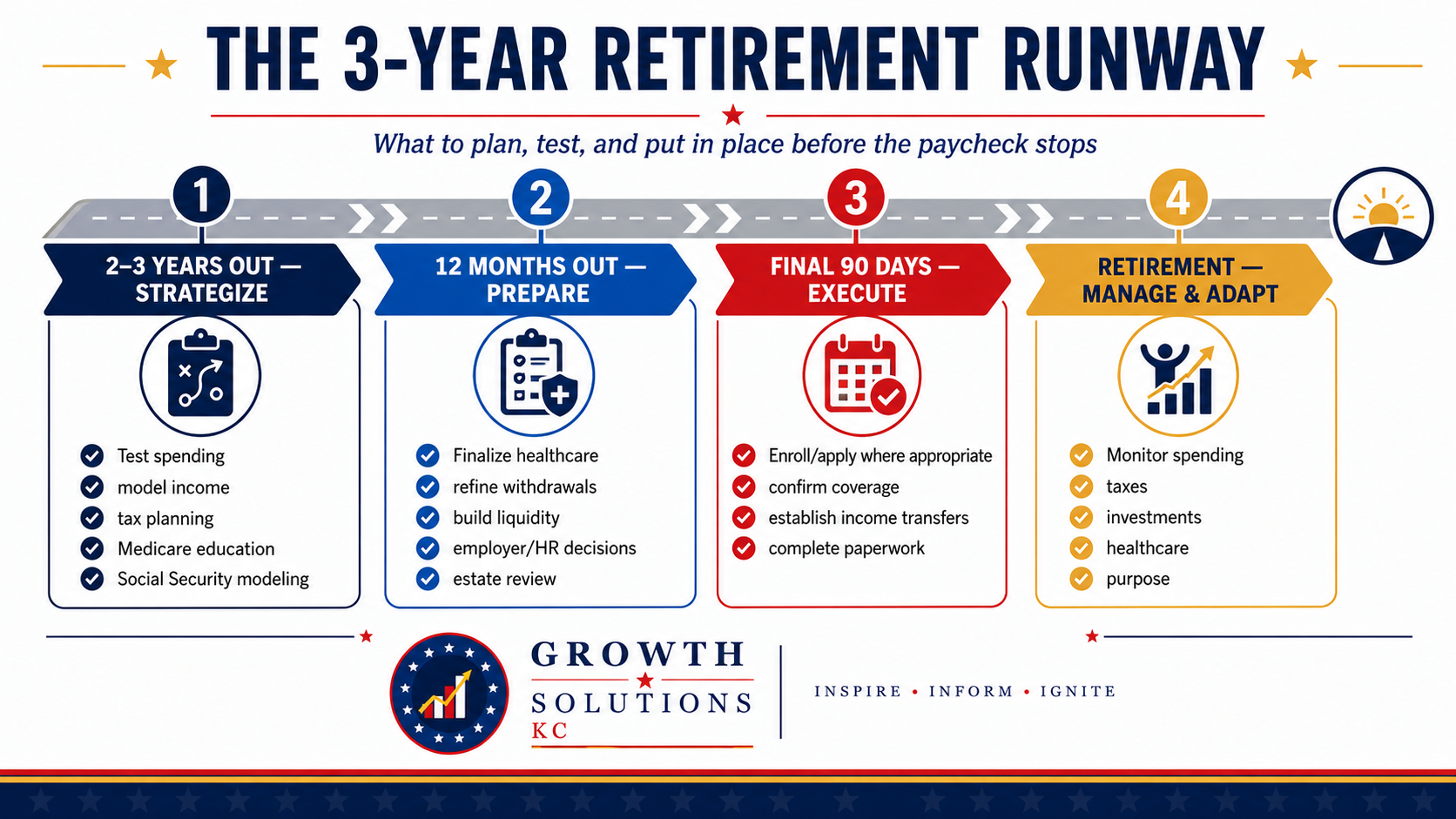
Two to three years before retirement is not too early. It may be one of the most valuable planning periods available to you.
Use it to understand your spending. Build the retirement paycheck. Plan taxes before your income changes. Coordinate Medicare and healthcare. Prepare the portfolio for withdrawals. Make major life and estate decisions while you still have flexibility. And begin building the life you want retirement to make possible.
Then, as retirement moves within roughly a year, the emphasis can increasingly shift from planning to execution—finalizing healthcare, adjusting cash reserves, making Social Security decisions, coordinating employer benefits and putting the income plan into motion. That strategy-to-execution progression is also reflected in the pre-retirement planning research underlying this article.
The objective isn't to optimize each decision independently.
It is to coordinate them.
Because retirement planning isn't about minimizing every tax, premium, or expense in isolation. It's about coordinating decisions to create the greatest long-term value, flexibility, security, and purpose.
That is what the three-year retirement runway is really for.
— Matt Cucinotta | Growth Solutions KC | Inspire · Inform · Ignite
This article provides general educational information and is not individualized tax, legal, or investment advice. Tax rules and their application can change; consult an appropriate professional about your circumstances.



Comments ()