

IRMAA Explained: The Medicare Surcharge You Can Trigger Two Years Early
IRMAA is not simply a Medicare surcharge to avoid—it is a reminder that tax, income, and healthcare decisions should be coordinated across the entire retirement plan.

How today’s income decisions can raise future Medicare premiums—and why the right goal is to optimize the whole retirement plan
GSKC Retirement Planning Series
A large Roth conversion can be a smart retirement-planning move. So can selling appreciated investments, taking a large distribution from a traditional IRA, or recognizing business income in a year when it makes long-term sense.
But those decisions can have a cost that does not appear on the tax return.
It may show up two years later in your Medicare premiums.
That cost is called IRMAA—the Income-Related Monthly Adjustment Amount. It is an additional amount some higher-income Medicare beneficiaries pay for Part B and Part D coverage.
The important planning lesson is not simply to avoid IRMAA.
It is to understand how Medicare premiums interact with taxes, retirement income, Roth conversions, investment gains, charitable giving, and other financial decisions—then evaluate the entire plan.
Don’t let the Medicare surcharge make the tax decision for you. Optimize the whole retirement plan.
What IRMAA Is
Most people enrolled in Medicare Part B pay the standard monthly premium.
For 2026, that standard Part B premium is $202.90 per month. But individuals with modified adjusted gross income above $109,000 and married couples filing jointly above $218,000 can pay an additional income-related amount. Part D can also carry a separate IRMAA surcharge on top of the premium charged by the drug plan. CMS estimates that roughly 8% of Medicare beneficiaries pay these income-related adjustments.
IRMAA is based on modified adjusted gross income, or MAGI.
For this purpose, Social Security generally starts with adjusted gross income from the federal tax return and adds tax-exempt interest income. That last point surprises many retirees: municipal-bond interest may be exempt from federal income tax, but it can still count toward IRMAA.
Why the Two-Year Lookback Matters
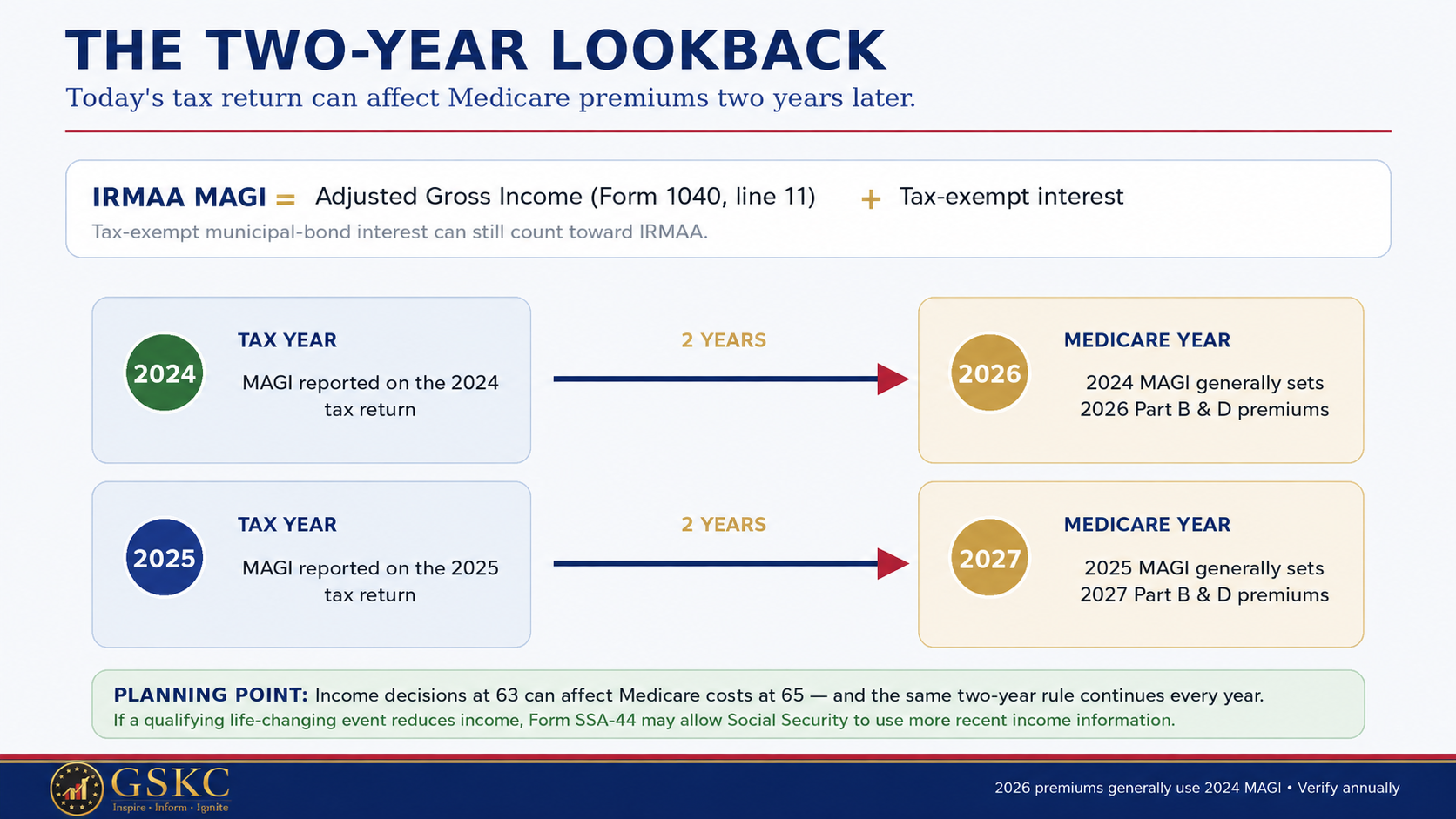
The unusual part of IRMAA is timing. Medicare generally looks back two years when determining the premium for the current year.
For example:
- 2024 MAGI → 2026 Medicare premiums
- 2025 MAGI → 2027 Medicare premiums
That means a financial decision made well before Medicare enrollment can affect what you later pay for Part B and Part D. The 2026 IRMAA brackets are therefore based on 2024 income.
This is one reason Medicare planning should begin before age 65.
For someone approaching retirement, age 63 may be a tax-planning year, a portfolio-planning year and a future Medicare-premium year at the same time.
The 2026 Brackets—and the “One Dollar Over” Effect
IRMAA uses income brackets rather than a gradual phase-in.
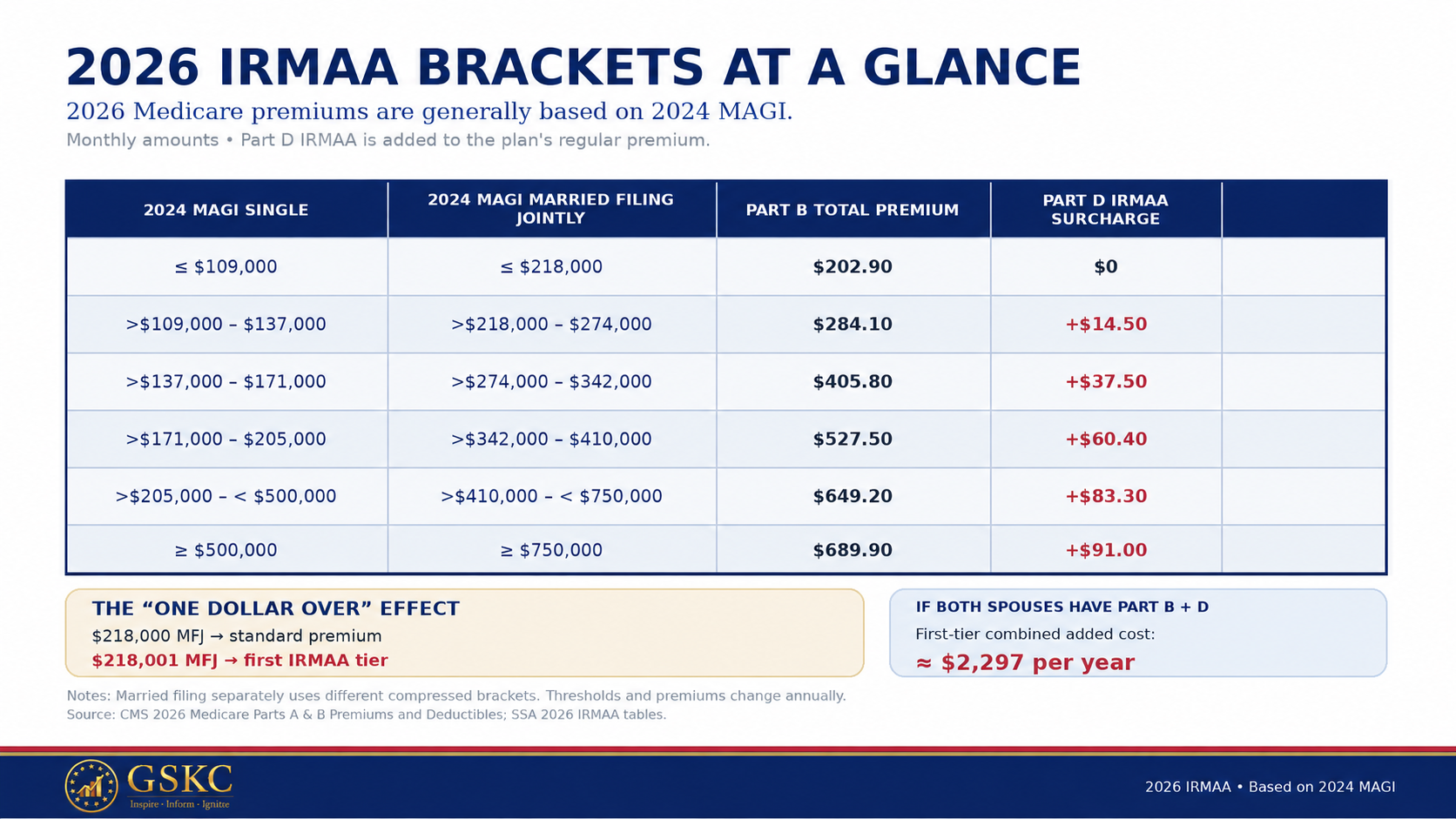
For 2026, an individual with MAGI of $109,000 or less—or a married couple filing jointly with MAGI of $218,000 or less—pays the standard Part B premium and no Part D IRMAA.
Move above the threshold, however, and the beneficiary enters the next premium tier. The first IRMAA tier raises Part B from $202.90 to $284.10 per month and adds $14.50 per month to the Part D premium. Higher income levels produce progressively larger adjustments up to a total of $689.90 per month for Medicare part B and an additional $91 for part D. At the highest tier, cobind it is an additional $578 per month per person—or $13,872 annually for a married couple if both spouses are subject to the highest Part B and Part D adjustments.
That creates what planners sometimes describe as a cliff. A married couple with 2024 MAGI of $218,000 remains below the first IRMAA threshold. At $218,001, they are above it.
If both spouses are enrolled in Medicare Part B and Part D, that first tier represents roughly $2,297 of additional annual Medicare costs for the couple, before considering their regular Part D plan premiums.
That does not mean they should avoid earning the extra dollar.
It means the threshold should be understood before the transaction occurs.
What Can Increase IRMAA MAGI?
Retirement often creates years in which income becomes less predictable than it was during full-time employment.
A Roth conversion adds taxable income. Traditional IRA distributions and RMDs generally add taxable income. Realized capital gains can increase AGI. Business or self-employment income can push MAGI higher. Pension income, interest, dividends, taxable Social Security benefits, and other sources can contribute as well.
And because IRMAA adds tax-exempt interest back to AGI, a portfolio heavily invested in municipal bonds can create a different Medicare result than a retiree might expect from looking only at taxable income.
This is why IRMAA planning begins with a projection—not simply with last year’s tax return.
Retirement Can Produce Surprisingly High-Income Years
People often assume retirement automatically means lower taxable income. Sometimes it does. Sometimes it means more income.
The transition itself can create unusually high-income years.
A final bonus or deferred compensation payment may arrive after leaving work. A business or investment property may be sold. Appreciated stock may be liquidated to reposition the portfolio. A retiree may complete a large Roth conversion before future RMDs begin. Pension income may start while investment gains are also realized.
None of these decisions is necessarily a mistake. In fact, several may be excellent long-term choices.
The problem occurs when they are evaluated independently.
A $75,000 Roth conversion may create additional Medicare premiums two years later—but it may also reduce future RMDs, create more tax-free assets, improve flexibility for a surviving spouse, or lower lifetime taxes.
The correct question is therefore not:
“Will this trigger IRMAA?”
It is:
“Does this decision create more long-term value after accounting for taxes, Medicare premiums, and future flexibility?”
Plan Before—and During—Retirement
IRMAA becomes much easier to manage when it is incorporated into a multi-year retirement tax plan.
Before executing a large conversion, gain realization, retirement-account withdrawal, or other income event, estimate the year’s projected MAGI and identify the relevant IRMAA thresholds.
Then evaluate the Medicare cost alongside the larger decision.
Sometimes a transaction can be spread across two years. Sometimes capital gains can be timed differently. Sometimes Roth conversions can be resized. Qualified charitable distributions may eventually help an eligible IRA owner satisfy all or part of an RMD without adding the QCD amount to adjusted gross income. In other cases, deliberately entering a higher IRMAA bracket may still be the better long-term choice.
A useful planning sequence is:
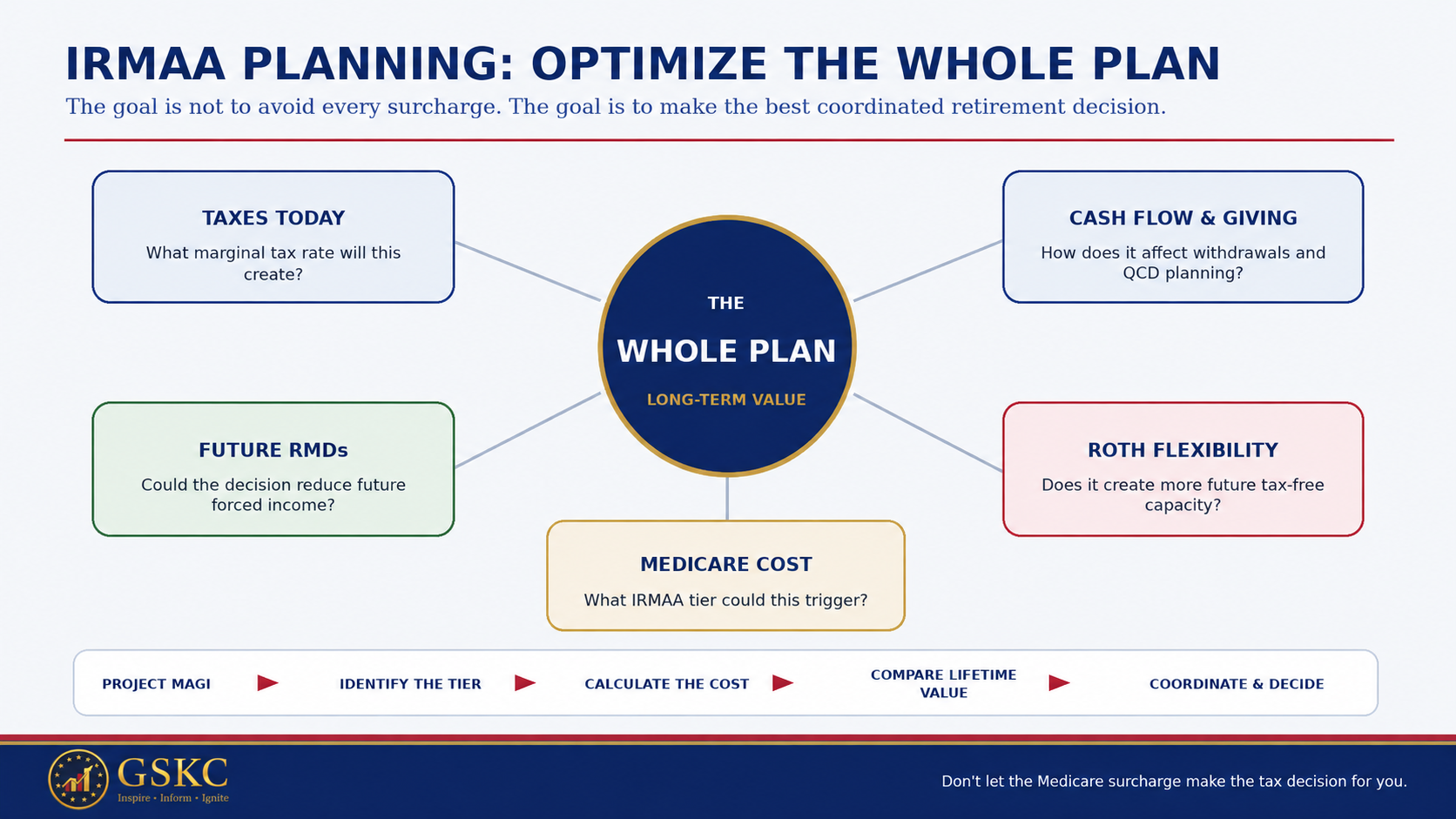
Project the income → identify the threshold → calculate the Medicare cost → compare the lifetime tax benefit → coordinate the decision.
The goal is not to make income artificially low every year. The goal is to use each year intelligently.
When Life Changes
The two-year lookback can also create an unfair-looking result when someone retires. Imagine that Social Security uses income from a high-earning work year to determine Medicare premiums after the person has stopped working and household income has fallen.
Social Security provides a process for certain situations like this. If a qualifying life-changing event reduces income, a beneficiary may ask Social Security to use more recent income information by filing Form SSA-44. Qualifying events include marriage, divorce or annulment, death of a spouse, work stoppage, work reduction, certain losses of income-producing property, loss or reduction of pension income, and certain employer settlement payments.
Retirement itself can therefore matter if it involves a work stoppage or reduction and produces lower income.
But not every one-time income event qualifies. A voluntary investment sale, a Roth conversion, or simply discovering that a prior decision created IRMAA does not automatically provide SSA-44 relief. Social Security’s qualifying-event list is specific.
That makes documentation and professional guidance especially valuable when income changes around retirement.
Optimize the Whole Retirement Plan
IRMAA is worth planning for. It is not worth allowing it to dominate every retirement decision.
A retiree who refuses to cross an IRMAA threshold could potentially preserve a few thousand dollars of Medicare premiums while giving up a Roth conversion that might save substantially more in future taxes.
Another retiree might unknowingly cross a threshold by only a small amount when better timing could have produced essentially the same financial outcome at a lower Medicare cost.
Both situations illustrate the same principle. Costs should be managed in context.
Retirement planning is not about minimizing each tax, premium, or expense independently. It is about coordinating decisions across years to create the greatest long-term value, flexibility, and security.
What to do:
- Know the IRMAA thresholds.
- Understand the two-year lookback.
- Project MAGI before major income decisions.
- Use SSA-44 when a qualifying life-changing event makes the old income information no longer representative.
- Seek advice from a qualified tax or financial professional when appropriate.
But above all, remember the larger objective:
Don’t let the Medicare surcharge make the tax decision for you. Optimize the whole retirement plan.
— Matt Cucinotta | Growth Solutions KC | Inspire · Inform · Ignite
This article provides general educational information and is not individualized tax, legal, or investment advice. Tax rules and their application can change; consult an appropriate professional about your circumstances.
Primary Sources
- CMS, 2026 Medicare Parts A & B Premiums and Deductibles — official 2026 Part B and Part D IRMAA amounts.
- Centers for Medicare & Medicaid Services
- Social Security Administration, 2026 Medicare Premiums / IRMAA Tables.
- Social Security Administration, Form SSA-44 — Medicare Income-Related Monthly Adjustment Amount — Life-Changing Event.
- Social Security Administration, Modified Adjusted Gross Income (MAGI) guidance.



Comments ()