

Giving with Purpose: A Simple Guide to the Qualified Charitable Distribution (QCD)
A Qualified Charitable Distribution can turn required retirement withdrawals into purposeful giving while potentially improving the tax efficiency of the broader retirement plan.

A tax-smart way to turn retirement savings into charitable impact
GSKC Retirement Planning Series
After years of saving for retirement, many people begin asking a different question: How can the wealth I have built do meaningful good? For charitably inclined IRA owners, a Qualified Charitable Distribution may offer a practical answer.
A QCD allows an eligible IRA owner to send money directly from an IRA to a qualifying charity. When the rules are followed, the distribution can count toward a required minimum distribution while remaining excluded from federal gross income. That combination can make a QCD more effective than taking a taxable IRA distribution and then writing a personal check.
The strategy is valuable, but the details matter. Age, account type, recipient eligibility, timing, documentation, and tax reporting can determine whether the transfer receives QCD treatment. Here is what to know before acting.
What is a Qualified Charitable Distribution?
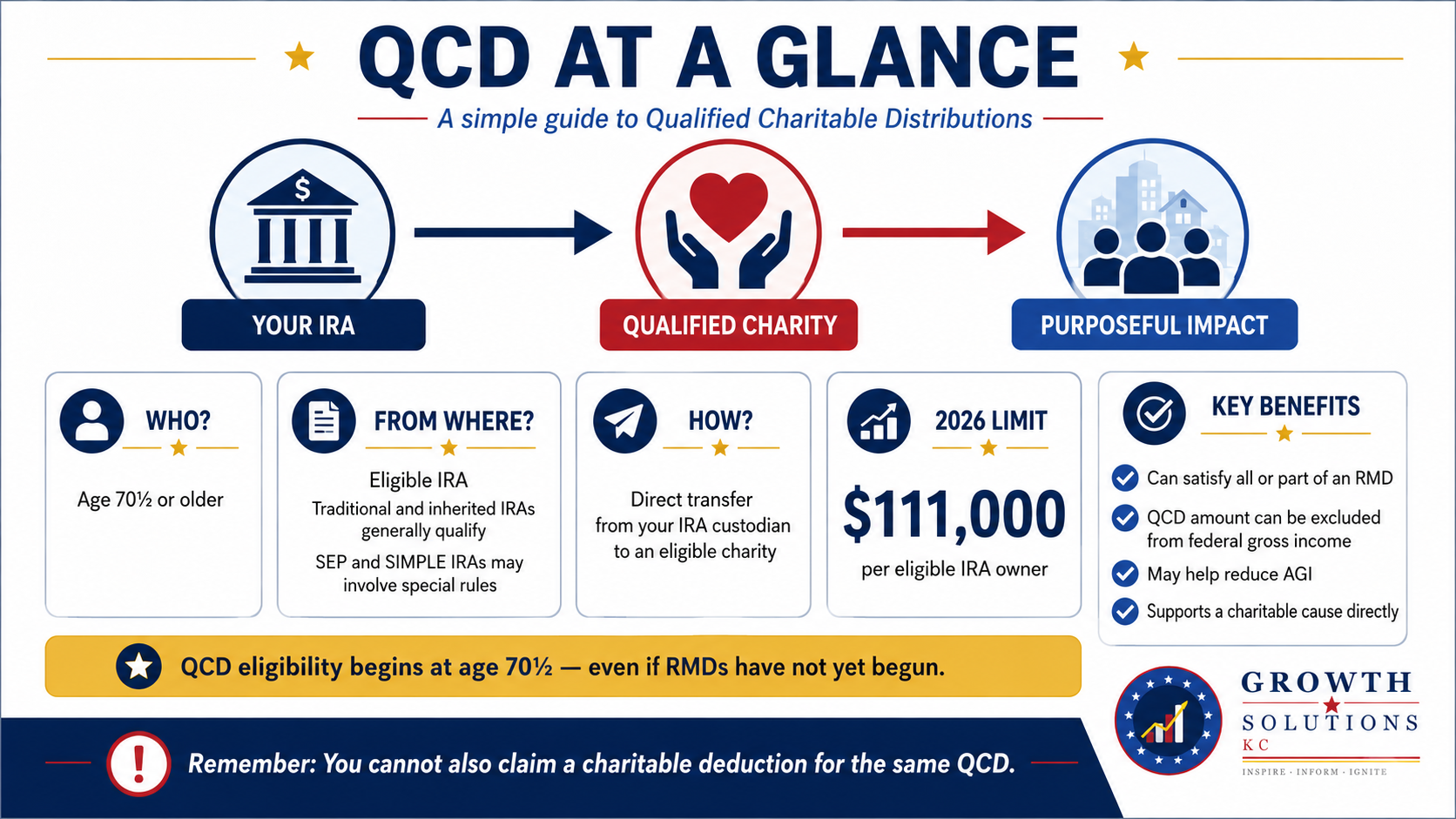
A Qualified Charitable Distribution is a payment made directly by an IRA trustee or custodian to an eligible charitable organization. The IRA owner must be at least age 70½ on the date of the distribution. A person who will turn 70½ later in the year must wait until reaching that age before making the gift.
QCDs are generally made from traditional IRAs, including inherited traditional IRAs. Certain SEP and SIMPLE IRAs may qualify when they are not receiving employer contributions for the year. Employer plans such as 401(k)s and 403(b)s cannot make QCDs directly. A rollover to an IRA may create future QCD flexibility, but rollover and RMD rules should be reviewed before moving funds.
The recipient must be an organization eligible to receive tax-deductible charitable contributions. Donor-advised funds, supporting organizations, and most private foundations are not eligible QCD recipients. The donor also cannot receive goods or services in exchange for the gift.
Why a QCD can be more valuable than a personal check
A personal charitable gift generally affects federal taxes only if the donor qualifies for a deduction. A QCD works differently: the eligible distribution is excluded from gross income rather than claimed as a charitable deduction. You cannot also deduct the same gift on Schedule A.
That distinction matters because reducing adjusted gross income can have effects beyond the income-tax calculation. Depending on the taxpayer’s circumstances, a lower AGI may help:
- Satisfy all or part of an RMD without adding the QCD amount to taxable income.
- Reduce the amount of Social Security benefits subject to federal income tax.
- Limit exposure to income-related Medicare Part B and Part D surcharges, commonly called IRMAA.
- Preserve deductions or other tax benefits that phase out as income rises.
For 2026, the comparison is especially relevant. Individuals who itemize generally may deduct only charitable contributions above 0.5% of AGI, while a new deduction of up to $1,000—or $2,000 for married couples filing jointly—is available for certain cash gifts by non-itemizers. Those rules can help some donors, but they do not reproduce the AGI benefit of a QCD.
The enhanced senior deduction also makes income planning more important. Eligible taxpayers age 65 or older may claim up to $6,000 per person for 2026, subject to a phaseout when modified AGI exceeds $75,000 for a single filer or $150,000 for a joint return. A QCD can reduce AGI, although the precise benefit depends on the taxpayer’s full return.
The 2026 limits
The annual QCD exclusion limit is indexed for inflation. For 2026:
- The maximum is $111,000 per eligible IRA owner.
- A married couple could transfer as much as $222,000 if each spouse is eligible, owns a separate IRA, and makes a qualifying distribution from that IRA.
- A separate one-time election permits up to $55,000 of QCDs to certain split-interest entities, including a qualifying charitable gift annuity or charitable remainder trust. This amount counts toward the donor’s annual QCD limit, and specialized rules apply.
These are federal limits, not recommendations. The right amount depends on charitable goals, cash-flow needs, RMDs, IRA basis, state tax treatment, and the rest of the retirement plan.
How to make a QCD
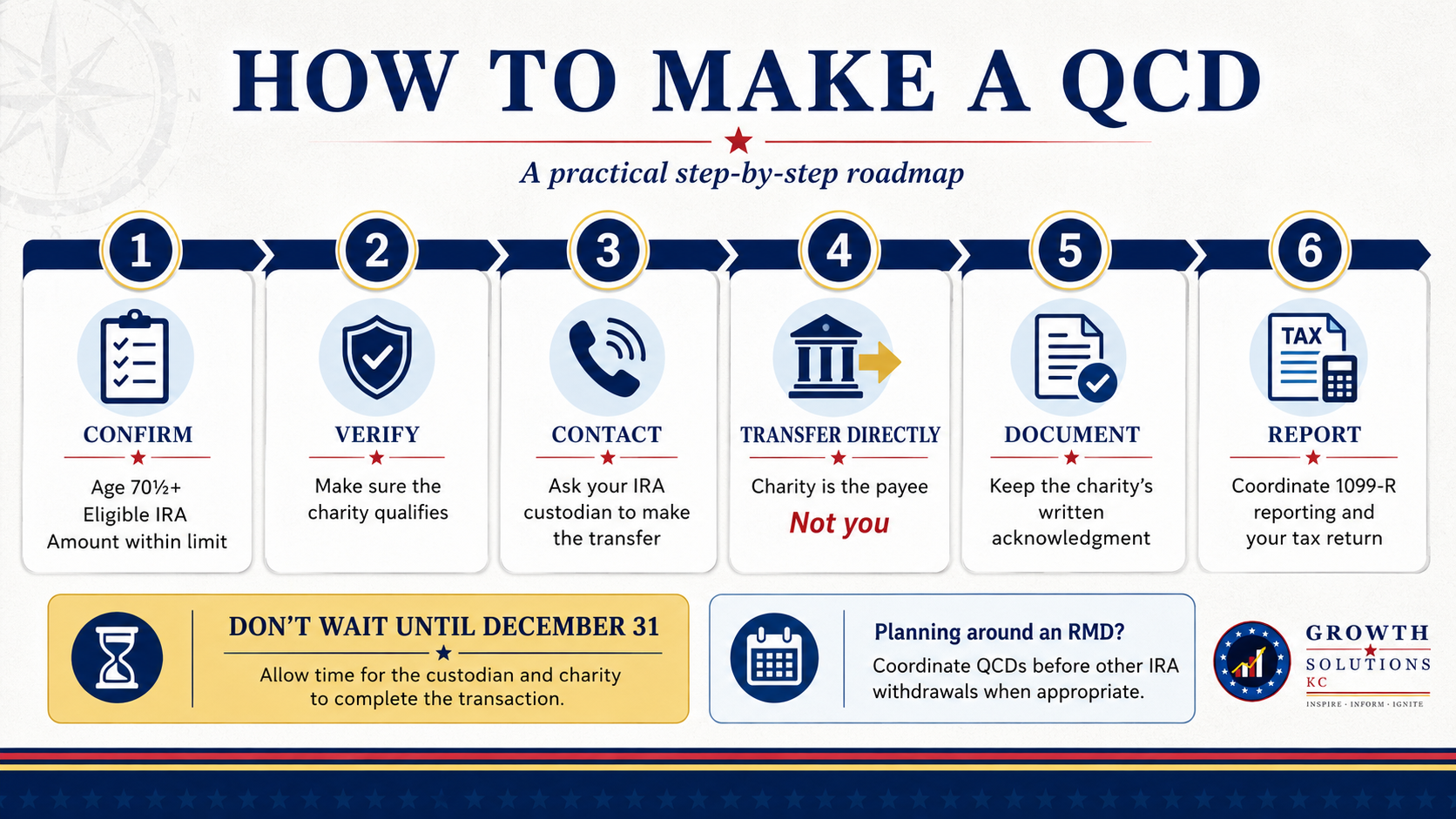
A successful QCD depends on execution. A useful sequence is:
- Confirm eligibility. Verify that the IRA owner has reached age 70½, the account is eligible, and the proposed amount is within the annual limit.
- Verify the charity. Confirm that the organization is eligible to receive a QCD. The IRS Tax Exempt Organization Search tool can help, but it does not replace review of the QCD-specific exclusions.
- Contact the IRA custodian. Request a direct payment to the charity. Follow the custodian’s procedures and make sure the check or electronic payment identifies the charity as the payee.
- Keep written acknowledgment. Obtain a contemporaneous receipt from the charity showing the amount received and stating whether any goods or services were provided.
- Coordinate the timing. Complete the transfer by December 31 for the intended tax year, allowing enough processing time for the custodian and charity.
- Report it correctly. IRA distributions are reported on Form 1099-R and on the individual income-tax return. Do not assume the tax form alone will automatically produce the correct QCD treatment; retain the acknowledgment and provide the details to the tax preparer.
Timing and the “first-dollars-out” rule
Once an IRA owner is subject to RMDs, distributions taken during the year are counted toward the RMD as they occur. A taxable distribution taken early in the year cannot later be relabeled as a QCD. If charitable giving is part of the plan, completing the QCD before taking other IRA withdrawals may help ensure that the charitable transfer satisfies the intended portion of the RMD.
This does not mean every QCD must occur first, but sequencing matters. Coordinating IRA withdrawals before the year begins is often easier than trying to repair the result afterward.
Common mistakes to avoid
- Taking the distribution personally and then donating the proceeds. A personal distribution followed by a gift is generally not a QCD.
- Making the transfer before reaching age 70½. Eligibility is determined on the actual distribution date.
- Sending money to an ineligible recipient, including a donor-advised fund or supporting organization.
- Receiving tickets, meals, membership benefits, or other goods or services in return for the payment.
- Waiting until the final days of December, when processing delays may push completion into the next tax year.
- Claiming both the income exclusion and a charitable deduction for the same dollars.
- Assuming the custodian or tax software has identified the QCD correctly without reviewing the tax return.
A purposeful giving decision

A QCD is not simply a charitable donation with a tax benefit attached. It is a planning tool that can connect generosity, retirement-income management, and legacy goals in one coordinated decision.
For the right donor, the result is straightforward: retirement savings support a valued cause, an RMD may be satisfied, and taxable income may be lower than it would be after a conventional IRA withdrawal. But the strategy works only when the rules are followed carefully.
Thoughtful planning helps ensure that the gift reaches its destination with its intended impact intact.
— Matt Cucinotta | Growth Solutions KC | Inspire · Inform · Ignite
This article provides general educational information and is not individualized tax, legal, or investment advice. Tax rules and their application can change; consult an appropriate professional about your circumstances.
Primary sources
- IRS Publication 590-B: Distributions from Individual Retirement Arrangements (IRAs)
- IRS Notice 2025-67, subsequently published in IRB 2025-49: 2025-32: 2026 inflation-adjusted tax items
- IRS Publication 505 (2026): charitable deduction changes
- IRS: One Big Beautiful Bill provisions for individuals and workers
- IRS Tax Exempt Organization Search



Comments ()