
THE CHIEFS’ NEXT CHAPTER: Beyond the Stadium
What Makes This a Good Deal for Kansas City?
Part III • The Stadium, the Deal, and the Community
A stadium’s opening day is easy to picture: a full crowd, a new field and a region watching together. Its value to the community will take longer to see.
The more revealing picture may be an ordinary Tuesday. Is a nearby business serving new customers? Can a local worker reach a dependable job? Are families using the surrounding spaces? Can residents see what the public commitment has delivered?
Part I established what the Chiefs plan to build. Part II followed the money. The final question is how that investment becomes lasting value for Kansas City—and how we will know.
Start with what is genuinely new
The Chiefs’ June economic-impact announcement projects $1.5 billion in annual regional activity and support for 8,500 full-time-equivalent jobs from operations and visitor spending. It also projects 36,500 construction job-years across the development period. These are forecasts, not results already achieved. [1]
A job-year means one full-time-equivalent job for one year. It does not mean a permanent position. Similarly, economic activity includes business transactions and spending supported by the project; it is not the same as public revenue or a net return to taxpayers.
Geography matters, too. A purchase moving from Missouri to Kansas may benefit Kansas’ tax collections without creating an equivalent gain for the metro as a whole. A visitor making an additional trip to the region presents a different opportunity.
The St. Louis Federal Reserve’s explanation of stadium economics highlights this problem: some spending at a new venue replaces spending that would have occurred elsewhere. [2]
The Chiefs project includes surrounding development, so its particular mix of uses deserves examination. The right question is how much additional activity it creates, where that activity occurs and how the benefits compare with the costs. A busy district can be successful while the broader public return remains uncertain.
Make opportunity reachable
Construction work can provide meaningful wages, apprenticeships and experience. Long-term operations can support careers in hospitality, maintenance, security, management and other fields. The public should be able to distinguish those opportunities by duration, pay, hours and prospects for advancement.
A headline employment total cannot tell a Wyandotte County resident whether a job is accessible or a Johnson County student whether training leads to a career.
A useful local hiring plan would name recruitment partners, explain qualifications, publish opportunities early and report hires and retention. “Local” should have a clear definition. Training should connect to real openings.
The same principle applies to small businesses. A restaurant, cleaning company or contractor needs a workable route into the project: understandable bidding requirements, timely payment, realistic contract sizes and clear contacts. Counting local contract dollars alongside the number of participating firms would show whether opportunity is spreading.
Those are standards for judging delivery, not promises that these programs are already in place. The strongest benefit is a resident or business becoming more capable of succeeding long after construction ends.
Build places that work between events
In August, the Chiefs and Hunt Midwest announced Two-Point Development to develop districts around the stadium and the Olathe headquarters. Their stated vision includes hospitality, retail, housing and public gathering spaces, with activity beyond game days. [3]
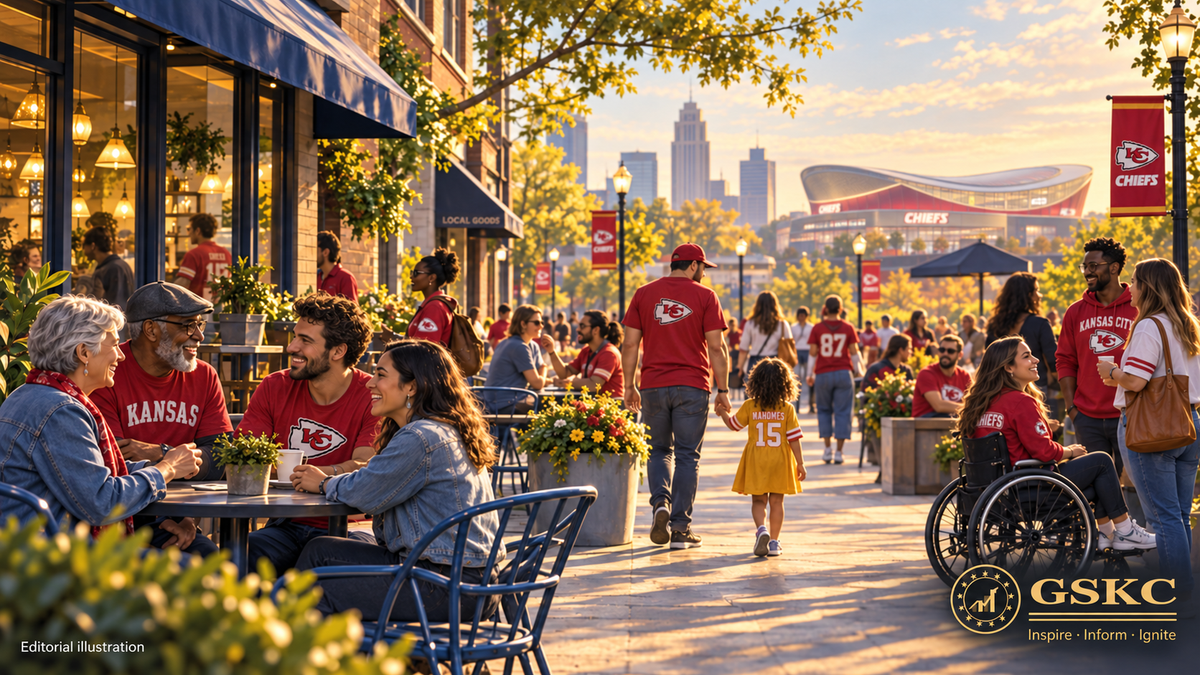
That creates a useful test: can these places serve people who are not attending a Chiefs game?
Year-round businesses need reasons for customers to return. Public spaces need comfortable routes, shade, seating and programming. Families need affordable ways to participate. Workers need transportation that fits their shifts, including late finishes.
Traffic, parking spillover, lighting and event noise should be addressed alongside the attractions. Residents should know whom to contact, how complaints will be tracked and what response they can expect. Those practical details help determine whether neighbors experience the project as an asset.
The regional view also includes the Missouri communities and businesses around Arrowhead. Moving activity across the state line can create adjustment costs there. Their future belongs in the conversation, even as Kansas prepares for new investment.
A development’s success should be judged partly by how well it connects with the community already around it.
Turn community commitments into visible results
The December framework calls for a Community Impact Agreement and at least $3 million annually from the team into a Community Impact Fund. Its team-controlled account would support eligible community projects, with at least half of that account’s spending directed within Kansas but outside the KC metro. [4]
That geographic requirement is important: the fund should not be described as money reserved entirely for Wyandotte County or Olathe.
The framework also contemplates community use of the stadium, subject to availability and team scheduling priority, with costs borne by the state. [4] Community access therefore needs practical terms: available dates, eligible users, costs and a straightforward application process.
Residents should be able to trace each commitment from agreement to delivery. What is required? Who controls the funds? Which communities qualify? When will the benefit arrive? Who checks the result, and what happens if an obligation is missed?
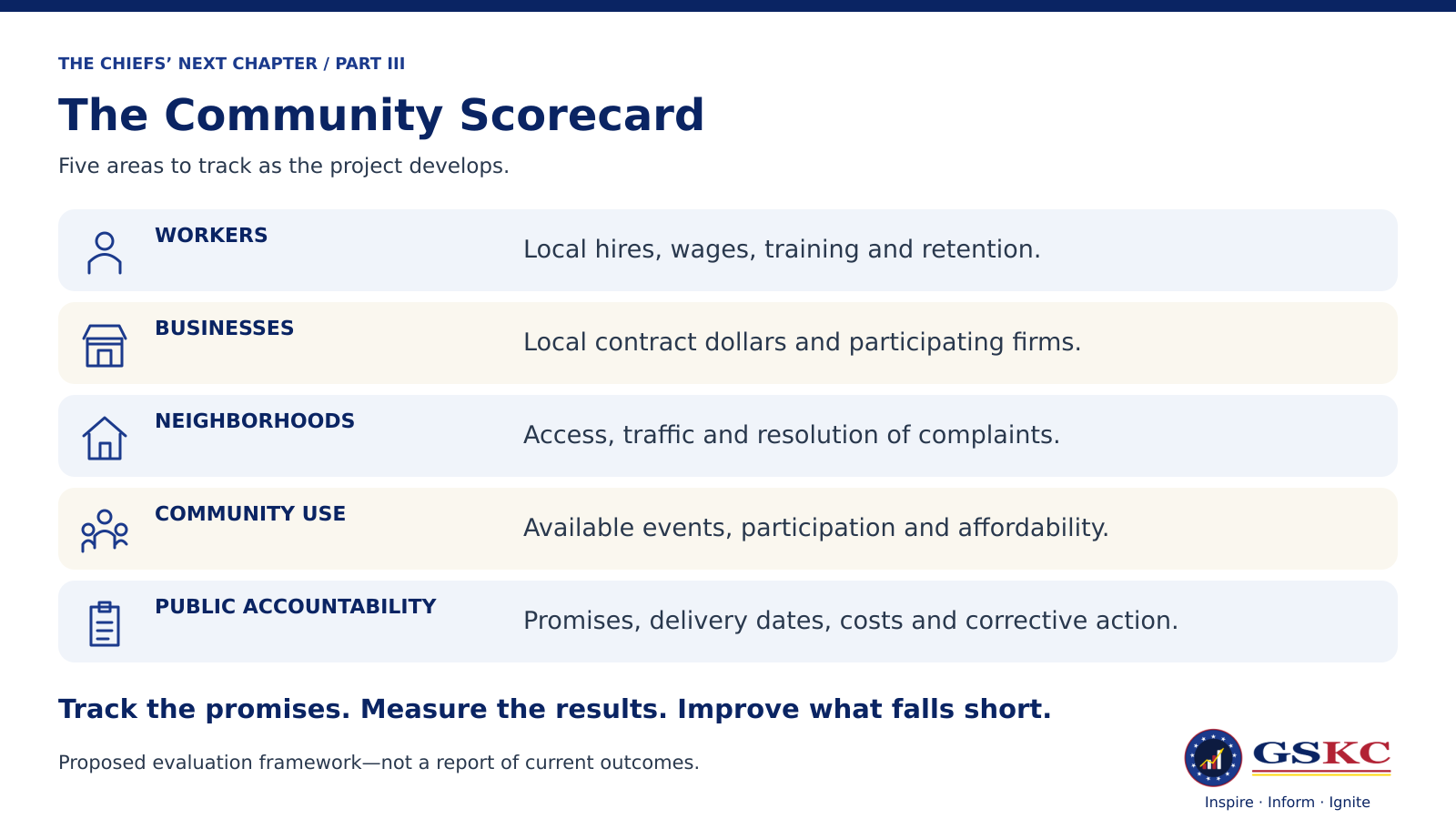
An annual public scorecard could bring those answers together with local hiring, business participation, neighborhood conditions and ongoing public costs. It should show gaps and corrective action as plainly as successes.
The goal is to make accountability part of normal project management, with information people can actually use.
Give civic pride a practical home

The Chiefs can connect people who disagree about almost everything else. Family traditions, neighborhood watch parties and memories passed between generations have value that reaches beyond ticket sales.
Those experiences deserve a place in public judgment. They also belong to the people who sustain them. A building can provide a setting; the community supplies the relationships, traditions and welcome.
That distinction matters here because Chiefs pride already exists. The new project should strengthen and broaden it. Youth activities, accessible community events and inviting shared spaces are ways to ask whether more people can participate.
Pride does not require everyone to approve every financing decision. People can support the team, question a public commitment and work toward a better outcome together. A healthy civic conversation leaves room for all three.
What residents can do now
Follow the public meetings and development notices that affect your neighborhood. Ask for specific commitments and their reporting dates. Business owners can request procurement contacts and bid schedules; workers and educators can ask how recruitment and training will connect.
Bring practical knowledge into the process. A resident may spot a difficult crossing, a shift worker an unreliable connection, or a small business an unnecessary barrier to bidding. Those observations can improve decisions while changes are still possible.
Over time, compare what was promised with what was delivered. Celebrate real gains. Ask for corrections where the evidence shows a gap.
The next chapter will be written through more than construction. It will take capable leadership, responsible stewardship, local enterprise and citizens willing to participate.
A good stadium gives people a place to gather. A good public investment leaves the community stronger when the crowd goes home.
— Matt Cucinotta | Growth Solutions KC | Inspire · Inform · Ignite
Sources
1. Chiefs: June 30, 2026 economic-impact announcement
2. Federal Reserve Bank of St. Louis: The Economics of Subsidizing Sports Stadiums (2017)
3. Chiefs and Hunt Midwest: Two-Point Development announcement, August 31, 2026
4. Kansas–Chiefs STAR Bond Agreement, December 22, 2025; Community Impact and RMMO Funding
Research distinctions
Source review: September 13, 2026. Economic projections are attributed to the Chiefs’ announcement of the Econsult analysis; they are not presented as independently validated net benefits. The Fed source supplies general economic context, not a forecast for this project. Community provisions are attributed to the December framework. Recommendations for hiring, access and reporting are proposed evaluation standards.


Comments ()