

Reading the Verdict: What the 2026 Midterms Changed, and What They Didn't
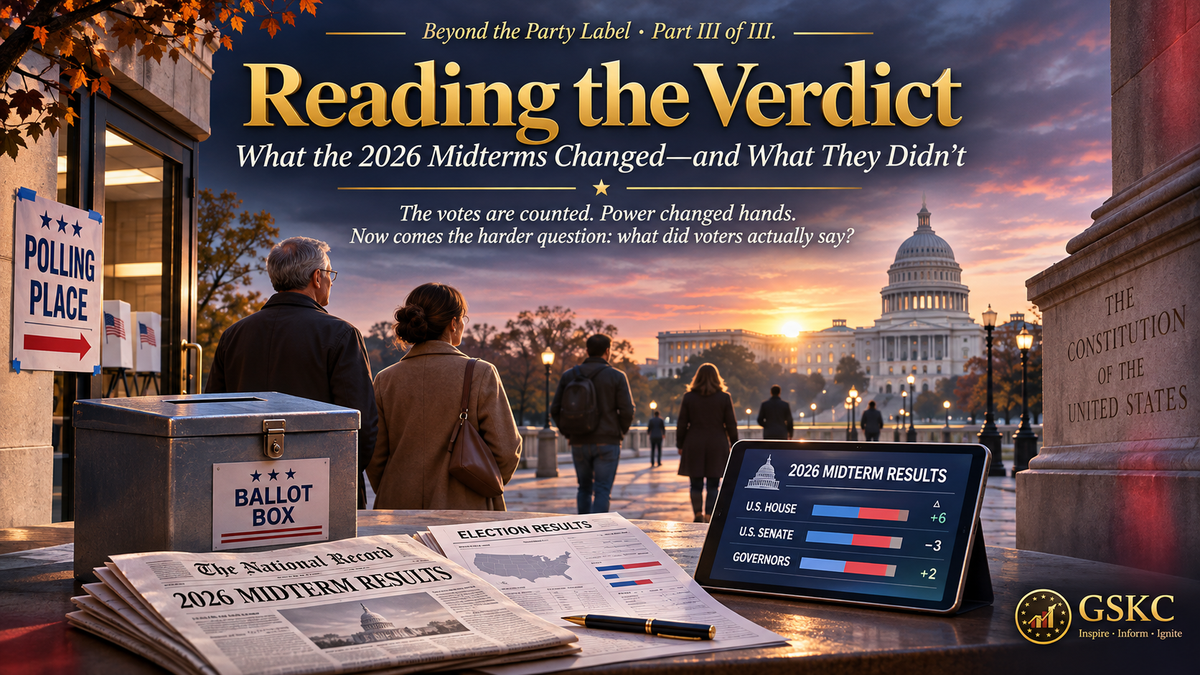
The ballot measures tell a more complicated story about what Americans actually want.

Beyond the Party Label: The 2026 Midterms and the Choice Before Us — Part 3 of 3
Editor's note: Results in this article reflect counts reported through Friday, November 6, 2026. Some races and ballot measures were still being counted at that time, and final certified results may differ.
Voters used the Founders' midterm check with unusual force, handing Democrats both chambers of Congress. Here is what changed, what did not, and what citizens should watch next.
In Part 1, we called the midterm election a check the Founders built into the system. In Part 2, we looked at the ballot measures where voters write the law themselves.
On November 3, Americans used both tools, and they used them forcefully.
Democrats won control of the House and the Senate. Voters in deep-blue California rejected a billionaire tax. Missourians rejected a plan to abolish state taxes, a new congressional map, and limits on their own initiative power. Communities from Ohio to Kansas voted, by wide margins, to slow the data center boom. And on Thursday, Wall Street had its worst day since April 2025.
Read together, the results do not tell a simple partisan story. They tell a story about a public that is frustrated, cautious.
The republic did exactly what it was designed to do: it gave citizens a peaceful way to rebalance power.
What Happened
The scale of the shift was historic.
The Senate. Democrats flipped at least seven Republican-held seats, including in Texas, Ohio, Iowa, North Carolina, Maine, South Carolina, and Kansas. That gives them a majority of at least 54 seats, with a few races still being finalized. In Kansas, Adam Hamilton defeated Sen. Roger Marshall, making him the first Democratic senator from Kansas in nearly a century.
The House. As of November 6, Democrats had won 248 seats to Republicans' 150, with 37 races still uncalled, a net gain of about 41 seats. Republicans had entered the election with a 218–214 majority.
The governors. Democrats flipped governorships in Texas, Ohio, Georgia, and Iowa. In Kansas, the race to succeed Gov. Laura Kelly remained too close to call days after the election, with Democrat Cindy Holscher narrowly ahead of Republican Ty Masterson.
For a publication grounded in conservative principles, this is a result to examine honestly, not to explain away. A governing party that loses this broadly, in states it had carried comfortably, has received a clear message from voters about cost of living, direction, and leadership. Constructive conservatism begins by listening to that message.
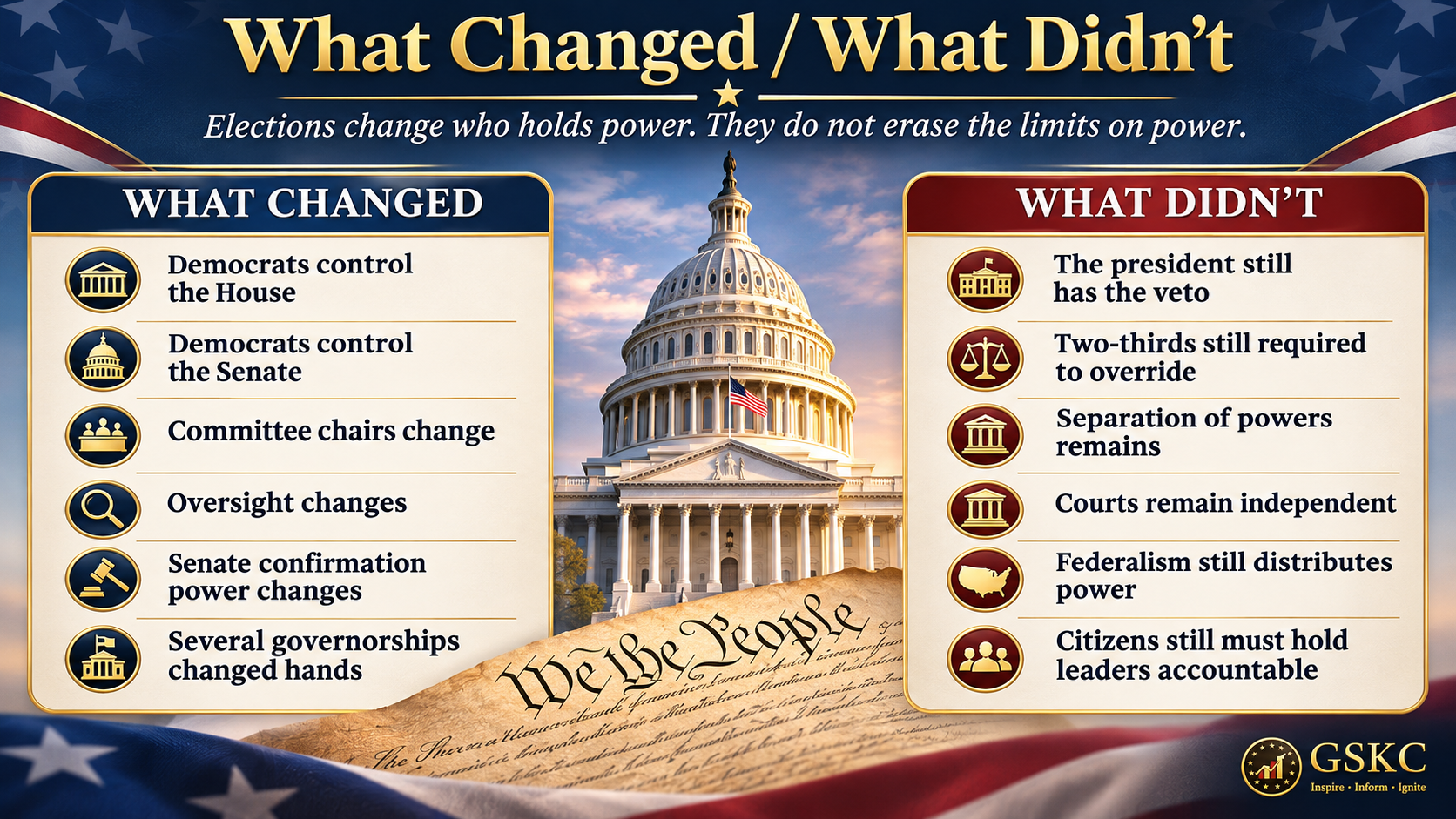
The Founders' Check, Working as Designed
Whatever one thinks of the outcome, the mechanism deserves recognition.
In 1787, the Founders gave the House two-year terms so that the people's branch would remain dependent on the people. On November 3, that design produced one of the largest midterm shifts in modern history, without violence, without a constitutional crisis, and with the losing side's officials preparing to hand over committee gavels in January.
Beginning in 2027, the channels described in Part 1 will change hands:
- The purse. Democratic majorities will write the spending bills and shape the budget for President Trump's final two years.
- Oversight. Democrats will chair the committees that can subpoena executive branch documents and question officials.
- Confirmations. A Democratic Senate will control the calendar for federal judges, cabinet officers, and regulatory commissioners.
The president keeps the veto, and overriding it requires two-thirds of both chambers. The most likely result is negotiation on a few issues, gridlock on most, and intense oversight.
There is a second-order effect worth watching. When Congress and the president are at odds, presidents of both parties tend to reach for executive orders and emergency powers. That makes the constitutional questions raised in Part 1 more urgent, not less. Article I gives Congress the power to legislate, tax, and spend. A new majority that believes in those limits should insist on them through legislation, not only through investigations, and should accept the same limits when its own party next holds the White House.
The test of constitutional conviction comes when your own side holds power. For the new majority, that test begins in January.
A Mandate, But Not for Everything
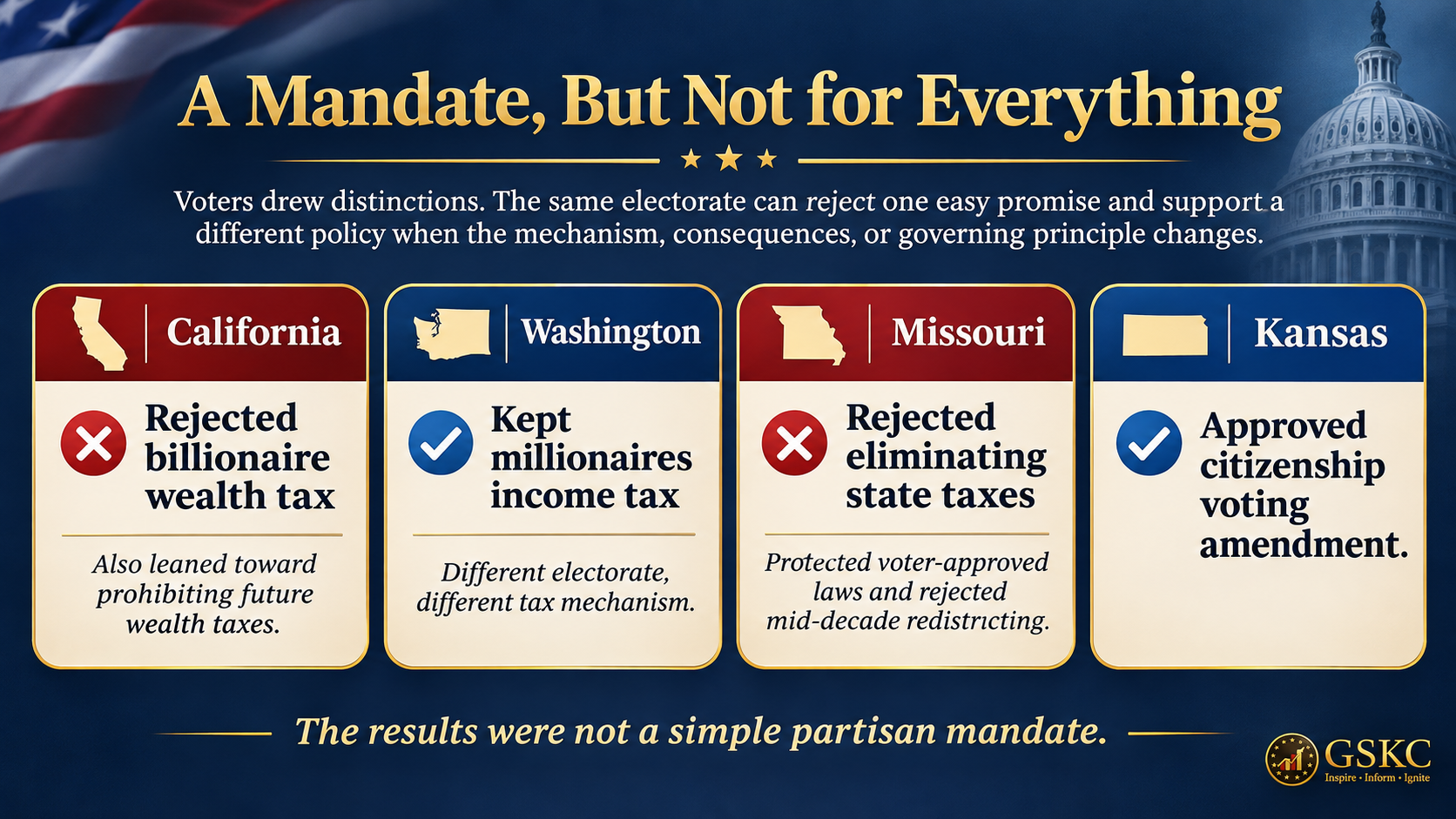
Election nights invite sweeping interpretations. The ballot measures suggest caution.
California said no to a wealth tax. Proposition 40, a one-time 5% tax on billionaires' net worth, was trailing roughly 55% to 45% as counting continued. Voters also appeared to be approving Proposition 42, a competing measure that bans future wealth taxes and retroactive taxes. Gov. Gavin Newsom and Governor-elect Xavier Becerra, both Democrats, opposed the billionaire tax. Opponents spent about $317 million against it, a figure that deserves to be noted alongside the result.
Washington kept its millionaires tax. The honest ledger requires reporting the result that cuts the other way. Washington voters rejected Initiative 645 by about 58% to 42%, preserving the state's new 9.9% tax on household income above $1 million. It is only the second time Washington voters have approved an income tax. The tax still faces a challenge before the state Supreme Court.
The contrast is instructive. Voters rejected a tax on accumulated wealth, which is hard to value and easy to move. They accepted a tax on high annual income, which is a familiar tool used by most states. Americans are not voting as ideologues. They are drawing practical lines between ideas they find workable and ideas they find risky.
Missouri voters drew lines, too. They rejected Amendment 7, the plan to build a state investment fund large enough to eliminate state taxes, about 61% to 39%. An easy promise from the right fared no better than easy promises from the left. They approved Amendment 6 with about 60% of the vote, requiring an 80% legislative supermajority to change voter-approved laws. They rejected Proposition A by about 62% to 38%, striking down the legislature's 2025 mid-decade congressional map. And they rejected Amendment 3, which would have reversed the abortion-rights amendment voters approved in 2024 and added restrictions on gender-transition care for minors, about 55% to 45%.
Kansans approved their citizenship amendment, making explicit in the state constitution that only U.S. citizens may vote in Kansas elections.
The pattern that emerged in Part 2 held. Voters on both sides of State Line were wary of politicians changing the rules, and protective of their own role in government.
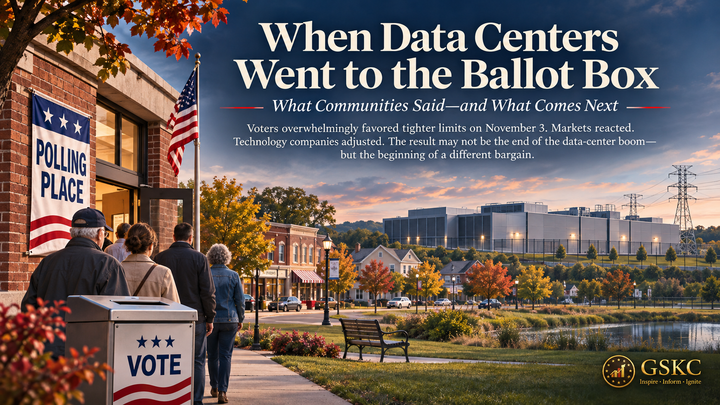
The Data Center Vote
One of the clearest messages of the night came not from Congress but from city halls and township ballots.
According to Ballotpedia, voters decided 41 local data center measures in 10 states. Restrictions won in 40 of them, often by wide margins. Granville, Ohio, approved a ban with about 82% of the vote. Closer to home, El Dorado, Kansas, approved a ten-year ban on large data centers and battery storage, and Emporia capped new projects at 10 megawatts and 100,000 gallons of water a day.
Statewide, the incoming Democratic governors of Texas, Ohio, and Georgia have all proposed pausing new data center construction. Texas Governor-elect Gina Hinojosa has called for an immediate moratorium until the legislature writes new rules.
For readers of GSKC's Data-Center Divide series, none of this is surprising. Communities have been asking the same questions for two years: who pays for the power, who bears the water and noise, and who decides. On November 3, those communities answered at the ballot box.
The honest ledger cuts both ways here, too. Local control is a conservative principle, and communities have every right to weigh what a project costs them. But blanket bans and statewide moratoriums also carry costs: lost tax base, lost jobs, and investment that moves to other states or other countries. The better path is the one GSKC has argued for throughout that series: clear rules, ratepayer protections, transparency, and developers who pay their own way. Uncertainty is the worst outcome for everyone.
Data centers lost because communities felt unheard. The lesson for builders is not to fight local self-government, but to earn it.
What to Watch in 2027 and 2028
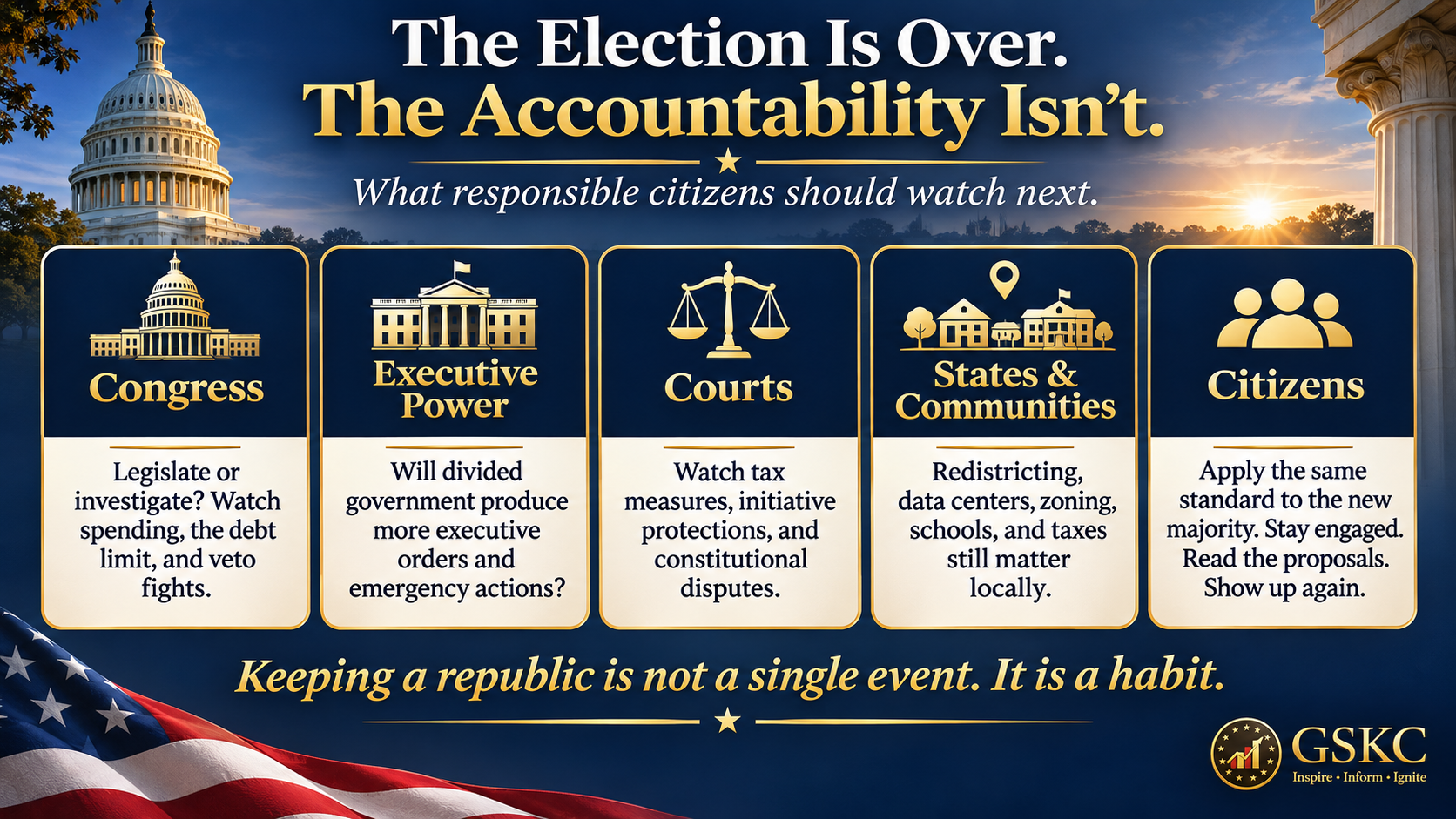
Congress. Watch whether the new majority legislates or mainly investigates. Watch spending bills, the debt limit, and how often the president uses his veto.
The courts. With the Senate changing hands, judicial confirmations will slow. Washington's millionaires tax, Missouri's Amendment 6, and California's Proposition 42 all face likely legal challenges.
Missouri. Amendment 6 applies retroactively to initiatives passed since 2010 and is likely to be tested in court. Republican lawmakers are reportedly considering another round of redistricting before 2028.
The data center buildout. Watch Texas, Ohio, and Georgia, where new governors have promised pauses. Watch whether developers respond with ratepayer protections and community agreements, or simply move elsewhere.
Your own state and city. The decisions that shape daily life increasingly happen at the state and local level, as this election's 40-of-41 data center results show.
What Citizens Can Do Now
- Apply the same standard to the new majority. The five questions from Part 1 do not expire when power changes hands. Ask where the authority comes from, who pays, and who decides.
- Resist both triumph and despair. A wave election is neither the end of the republic nor its salvation. It is the system working.
- Stay engaged locally. City councils, school boards, and county commissions will decide many of the questions that drove this election, from data centers to property taxes.
- Watch the 2027 off-year. Local elections next year will shape zoning, schools, and budgets in ways national coverage rarely captures.
- Read the measure next time, too. This year, voters who read past the slogans made distinctions that campaigns did not expect.
The Republic, Kept for Another Two Years
Franklin's warning in 1787 was that a republic must be kept. This month, Americans kept it the way the Founders intended: at the ballot box, peacefully, with power changing hands on schedule.
Not everyone will like the result. Many readers of this publication will not. This writer did not. But a constitutional republic is not measured by whether one's own side wins. It is measured by whether power remains accountable, limited, and subject to correction.
By that measure, the system held. The work now is to hold the new majority to the same standards we asked of the old one, and to keep showing up.
Keeping a republic is not a single event. It is a habit. It's our duty and responsibility to pass on.
— Matt Cucinotta | Growth Solutions KC | Inspire · Inform · Ignite
Explore more strategic analysis and policy commentary at growthsolutionskc.com.
Sources
- Al Jazeera, "Democratic Party wins US Senate in 2026 midterm elections" (Nov. 4, 2026); Outlook India, "US Midterm Elections 2026: Democrats Flip Seven Senate Seats And Four Governorships, Win Congress" (Nov. 4, 2026).
- Ballotpedia, "United States House of Representatives elections, 2026" (results as of Nov. 6, 2026, 4:00 p.m. ET).
- HPPR / NPR, "Hamilton wins: Kansans elect Democratic senator for the first time in nearly a century" (Nov. 3, 2026); KCUR, "Ty Masterson trails in Kansas governor race by 5,500 votes" (Nov. 4, 2026); HPPR, "There's no winner in the Kansas governor's race" (Nov. 4, 2026).
- KCTV5, "Kansas voters support citizenship voting requirement amendment" (Nov. 4, 2026).
- California Today, Prop 40, 41 and 42 results (Secretary of State semi-official count, Nov. 5, 2026); Dealroom/CalMatters on opposition spending (Nov. 4, 2026); GV Wire, "California billionaires faced down a tax, won new protections for their wealth" (Nov. 5, 2026).
- KUOW, "WA millionaires tax supporters claim victory as repeal effort concedes" (Nov. 5, 2026).
- News Tribune (Jefferson City), "Nov. 3 election results: Missouri amendments and propositions" (all precincts reporting); KY3, "Missouri voters reject Amendment 3" (Nov. 4, 2026); KCUR Up To Date, "Missouri voters gave 2 big wins to direct democracy" (Nov. 6, 2026).
- Baxtel, "Voters back data center limits in 40 of 41 ballot measures across 10 states," citing Ballotpedia; The Stack, "After Election Day, the data center boom is about to look very different."
- KUOW, "How the blue wave affects Microsoft and Amazon's data center ambitions" (Nov. 5, 2026).
- Tekedia, "Hyperscalers gain after Democrats win midterm elections but data center restrictions hit smaller AI providers" (Wednesday market moves, Needham and Baird commentary).
- Wealth Professional, "Wall Street sheds US$3 trillion in worst session since April 2025" (Reuters-based, Nov. 5, 2026); Open Magazine, "Trump Blames Democrats' Midterm Wins for Wall Street Rout as Dow Sinks 1,833 Points."
- La Nación (AP), "How major US stock indexes fared Friday 11/6/2026."
Transparency Note: This article was developed with AI assistance and reviewed, edited, and finalized by Growth Solutions KC prior to publication.


Comments ()