

Pine Island’s Data-Center Test: Before You Say Yes—or No—Show the Work

Project Skyway promises jobs, school funding, infrastructure, and a larger tax base. It also raises unresolved questions about electricity, water, costs, and trust. A good decision requires both sides of the ledger.

Pine Island, Minnesota, is a small community facing a very large decision.
The town of roughly 3,800 people sits about 20 miles northwest of Rochester. On its edge, nearly 500 acres of agricultural land have been assembled for a technology-development campus known as Project Skyway.
Google plans an initial data center on roughly 88 acres of that larger site.
The potential benefits are substantial: hundreds of construction jobs, permanent technical employment, new infrastructure, millions of dollars for local schools, and a dramatic expansion of the city’s commercial tax base.
So are the questions.
The project could require hundreds of megawatts of electricity. Residents and regulators want to know whether existing utility customers are adequately protected from the costs of serving that demand. Questions remain about municipal water needs, future development, noise, land use, and whether the economic projections will ultimately match reality.
A lawsuit over the project’s environmental review temporarily halted construction. In late October, the city, developer, Google affiliate Echo Zone, and the Minnesota Center for Environmental Advocacy reached a settlement requiring a more extensive state-supervised environmental review before construction can move forward.
For Pine Island, this is no longer an abstract debate about artificial intelligence or “the cloud.” It is a decision about land, power, water, taxes, schools, infrastructure, and the future of the community.
And neither a billion-dollar promise nor a yard sign is enough to answer it.
THE OFFER IS REAL
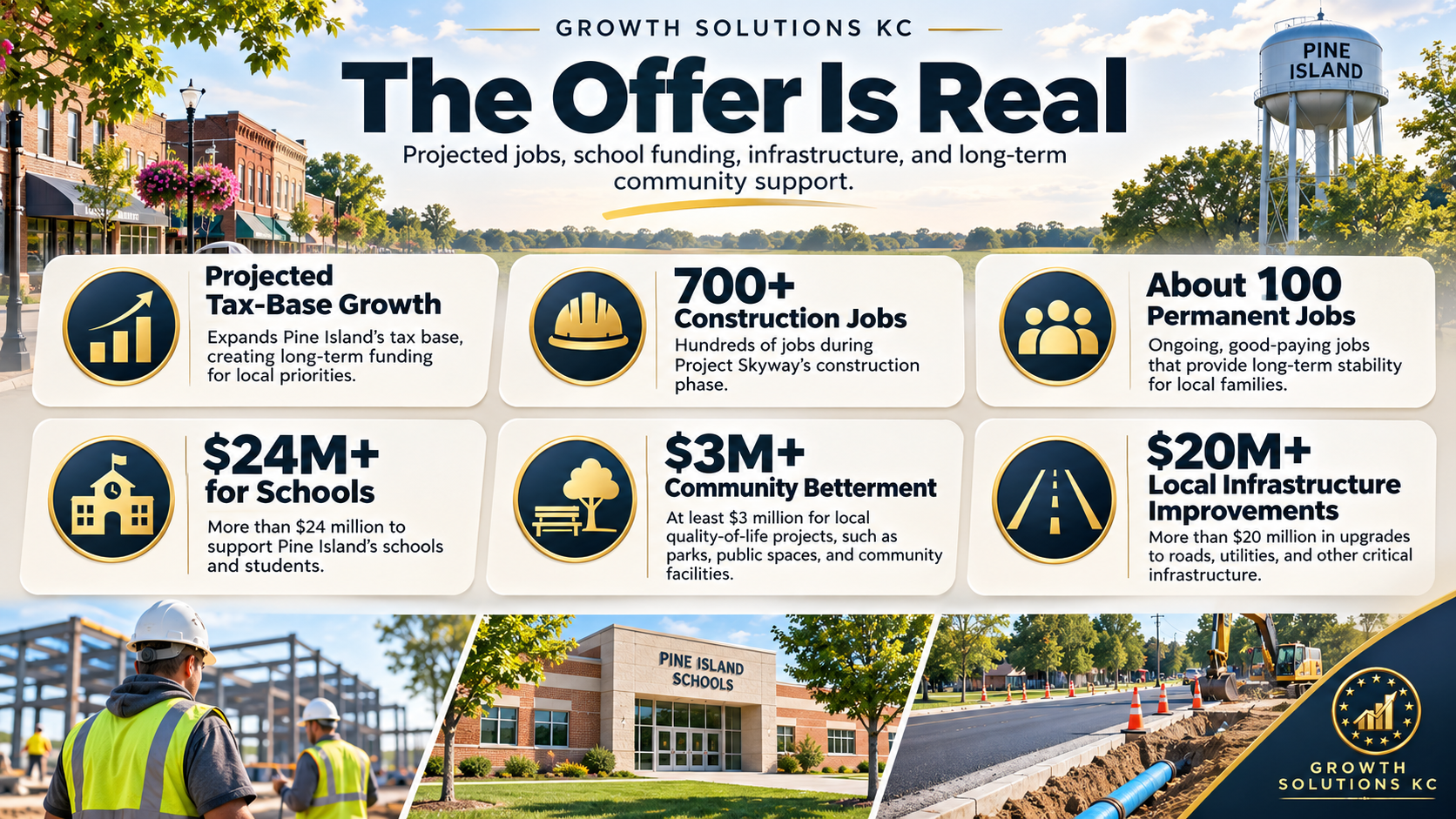
It would be a mistake to dismiss Project Skyway as a development offering little to Pine Island. The economic case is meaningful.
The initial project has been projected to support more than 700 skilled construction jobs and approximately 100 permanent positions. Under the city’s subsidy agreement, qualifying jobs must pay at least roughly $31 an hour, and employment requirements are tied to future tax-abatement benefits.
The project also includes significant community commitments.
Pine Island estimates that the Panther Program could provide approximately $24 million for local schools over the life of the agreement. A separate Community Betterment Fund is projected to provide more than $3 million in today’s dollars.
Developer-funded road and utility improvements exceed $20 million.
And then there is the tax base.
City projections have cited approximately $131 million in net new city property-tax revenue over a 28-year period after accounting for tax abatements.
That number deserves attention.
It also deserves context.
The $131 million projection assumes a much broader buildout of Project Skyway—including multiple industrial buildings and offices—not simply Google’s first data center.
That distinction matters.
The economic upside is substantial. But projections are not guarantees.
Responsible communities should neither dismiss the opportunity nor count every projected dollar before it arrives.
THE QUESTIONS ARE REAL TOO
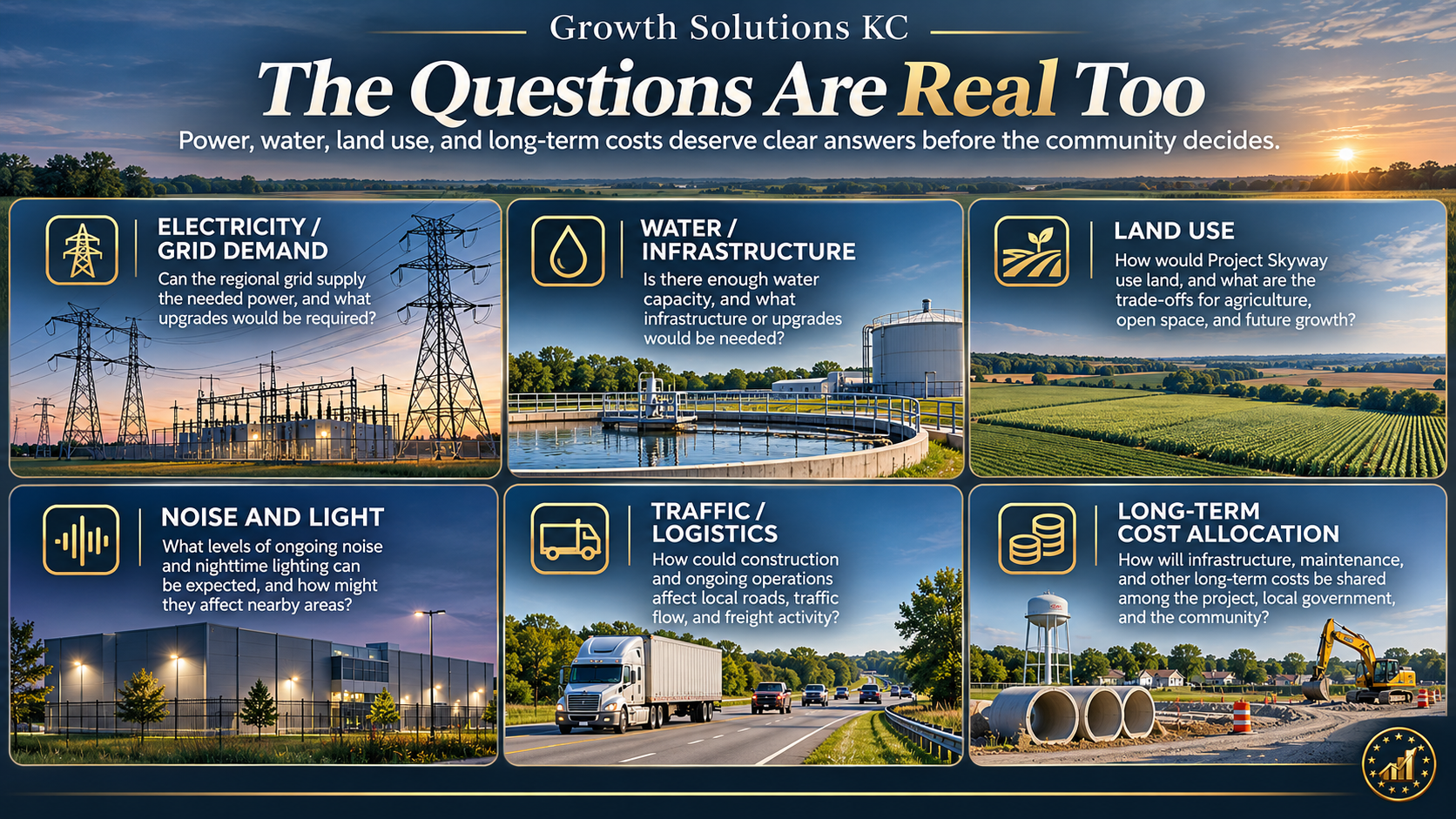
The strongest argument for deeper review is not that Project Skyway is necessarily a bad project. It is that the consequences are large enough to justify knowing exactly what Pine Island is agreeing to.
Start with electricity.
Google’s Pine Island project has more recently been described as requiring approximately 780 megawatts of electric capacity.
The proposed agreement with Xcel Energy includes significant protections intended to prevent other customers from subsidizing that demand. It includes minimum-payment requirements, capacity-reduction fees, credit protections, construction-cost responsibilities, and provisions addressing early termination. Xcel argues the agreement could produce roughly $1.1 billion in benefits for other customers over its initial 15-year term.
Minnesota Attorney General Keith Ellison’s office has raised a very different concern, arguing that the agreement has not yet demonstrated that existing customers are adequately protected from cost shifting and stranded investments. Its analysis has suggested the result could instead approach $1 billion in net costs under different assumptions.
That is an enormous gap.
The question is not whether protections exist.
They do.
The unresolved question is whether those protections are strong enough to work as promised.
Next, examine water.
Project Skyway is not currently proposing the type of high-volume evaporative cooling system that dominates many data-center headlines. The proposed design uses air cooling and a closed-loop chilled-water system intended to avoid consumptive water use for server cooling. That is important.
But it does not eliminate every water question.
The larger campus will still require municipal water for sanitation, fire protection, irrigation, landscaping, and other uses. Public documents have produced different estimates for full-development demand, and future growth may require additional water infrastructure.
Which number is correct? That is precisely the wrong way to frame the question.
Good analysis does not choose whichever number best supports its preferred conclusion. It asks why the numbers differ.
That is one purpose of environmental review.
Then, noise, backup generation, traffic, & other considerations.
The same applies to noise, backup generation, lighting, traffic, farmland conversion, and whatever future phases eventually occupy the larger development area.
Some concerns may prove significant. Others may prove manageable. Still others may be reduced through better engineering or stronger agreements. The purpose of review is to find out.
THE PROCESS BECAME PART OF THE PROBLEM
At some point, Project Skyway stopped being only a debate about a data center.
It became a debate about trust.
Residents questioned what information had been available before major decisions were made, why portions of utility agreements were redacted, and whether the original environmental review sufficiently captured the scale of the development.
Not every confidential business term belongs in the public record.
Companies have legitimate competitive information. Utilities operate under rules governing protected data. Economic-development negotiations sometimes require a degree of confidentiality. But communities also need enough information to evaluate the risks they are being asked to accept.
There is a difference between protecting legitimate trade secrets and preventing citizens from understanding the assumptions underneath a decision that could shape their community for decades.
When that distinction becomes unclear, trust deteriorates quickly. Information gaps become filled with suspicion. Supporters become frustrated with what they see as misinformation. Opponents assume that whatever remains hidden must be worse than what has been disclosed.
The debate becomes emotional precisely when it most needs to become analytical.
That is a governance problem.
THE SETTLEMENT IS A SECOND CHANCE
The October settlement provides Pine Island with something valuable: another opportunity to get the process right.
The settlement does not cancel Project Skyway.
It does not provide final approval either.
Previous city approvals remain in place, but Google must now complete a state-supervised Environmental Assessment Worksheet examining issues including water, energy use, grid capacity, noise, air quality, wastewater, lighting, greenhouse gases, and cumulative effects. The process includes public comment.
Google must also develop a mitigation plan addressing identified impacts. Pine Island will then decide whether to approve, reject, or modify that plan before construction can move forward.
Future portions of the larger development area face additional environmental-review requirements.
That is not anti-growth.
It is governance.
A better review may confirm some of the project’s claims. It may demonstrate that certain fears were overstated. It may uncover risks requiring stronger protections.
Most likely, it will do some of all three.
That is what a serious review process is supposed to accomplish.
WHAT PINE ISLAND SHOULD ASK NOW
The next stage does not require Pine Island to decide whether it likes or dislikes data centers. It requires the community to answer four practical questions.
- Does the project pay the costs it creates?
If serving hundreds of megawatts of new electric demand requires generation, transmission, substations, or other infrastructure, the agreements should clearly establish who carries those costs—and what happens if demand later falls short of projections.
- Are the local impacts manageable over the life of the project?
Water, noise, lighting, land use, emergency services, and infrastructure should be evaluated using realistic operating conditions, not merely best-case assumptions.
- Are the promised economic benefits enforceable?
Projected taxes, jobs, school contributions, and community investments should be distinguished from contractual commitments and tied wherever possible to measurable performance.
- What happens when circumstances change?
Technology evolves. Companies expand. Projects shrink. Equipment becomes obsolete. Ownership can change. A good agreement should still protect the community when the future does not unfold exactly as planned.
Those questions are not hostile to development. They are what responsible development requires.
SHOW THE WORK
Data centers increasingly support the systems Americans depend on every day.
- Banking.
- Healthcare.
- Communications.
- Transportation.
- Commerce.
- Government.
- Artificial intelligence.
As Growth Solutions KC explored in A Day Without the Cloud, these buildings are no longer obscure pieces of the technology economy. They are becoming part of the physical infrastructure supporting modern life.
That makes building them important.
It does not make every proposed location, utility agreement, tax incentive, or development plan automatically wise.
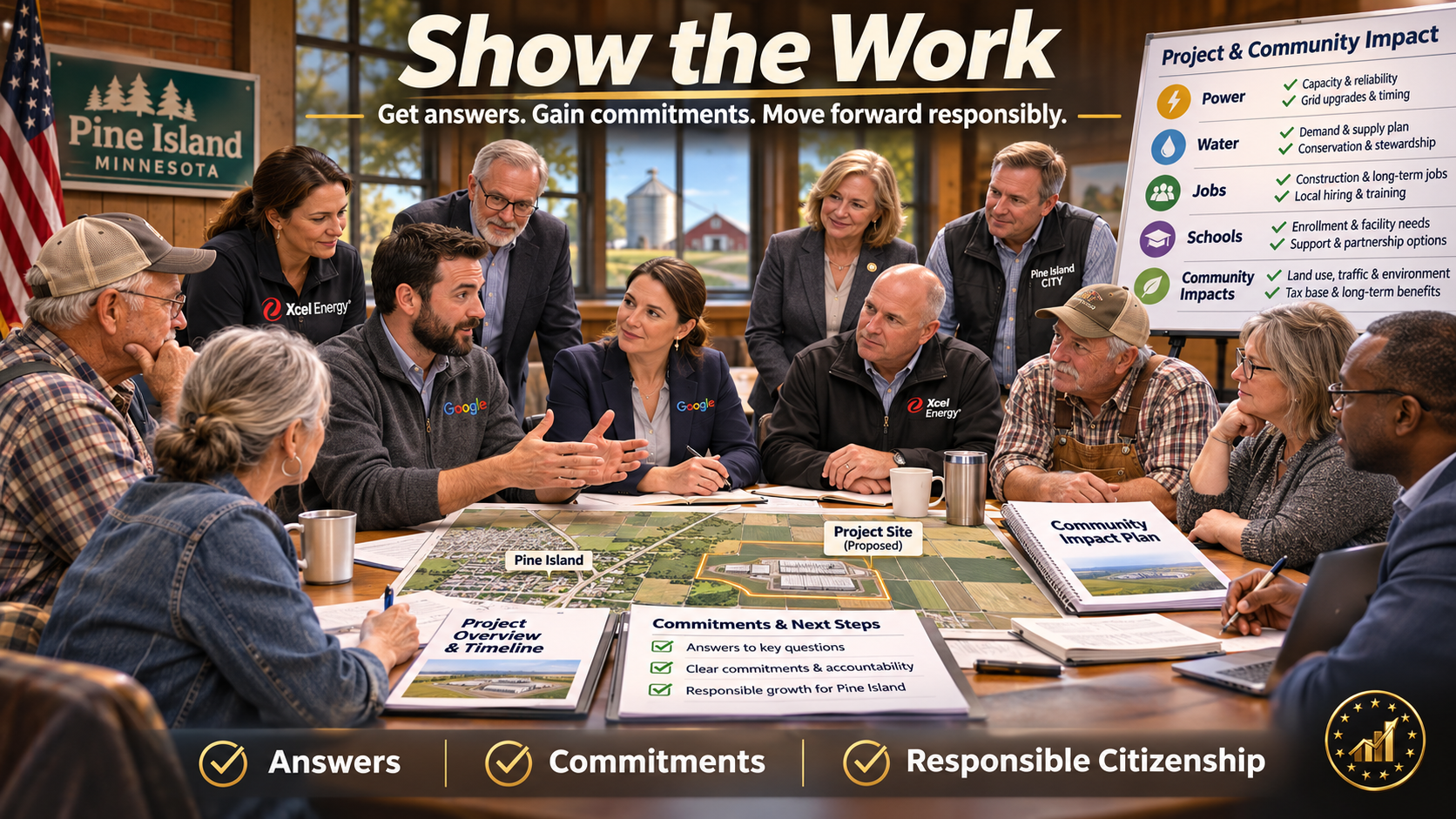
Pine Island does not need to prove that it is pro-technology or anti-technology. It needs to determine whether Project Skyway is a good deal for Pine Island. That requires something less dramatic than a slogan and more demanding than a promise.
Understand the project.
Verify the assumptions.
Protect the community.
Then decide.
— Matt Cucinotta | Growth Solutions KC | Inspire · Inform · Ignite
Explore more strategic analysis and policy commentary at growthsolutionskc.com.
For more about communities and data centers read "Festus Should Fix the Process — Not Forfeit a Generational Opportunity" & "If Not a Data Center, Then What?"
Transparency Note: This article was developed with AI assistance and reviewed, edited, and finalized by Growth Solutions KC prior to publication.



Comments ()