

Why the Data-Center Backlash Is Growing — and What It Gets Right and Wrong
Good decisions begin with facts, clarity, and project-specific analysis—not slogans, fear, or assumptions.
Americans have become remarkably skeptical of data centers. Some of the concerns are well founded. Others are exaggerated or applied too broadly. Before deciding what to think, it is worth asking what changed—and why.
Something changed
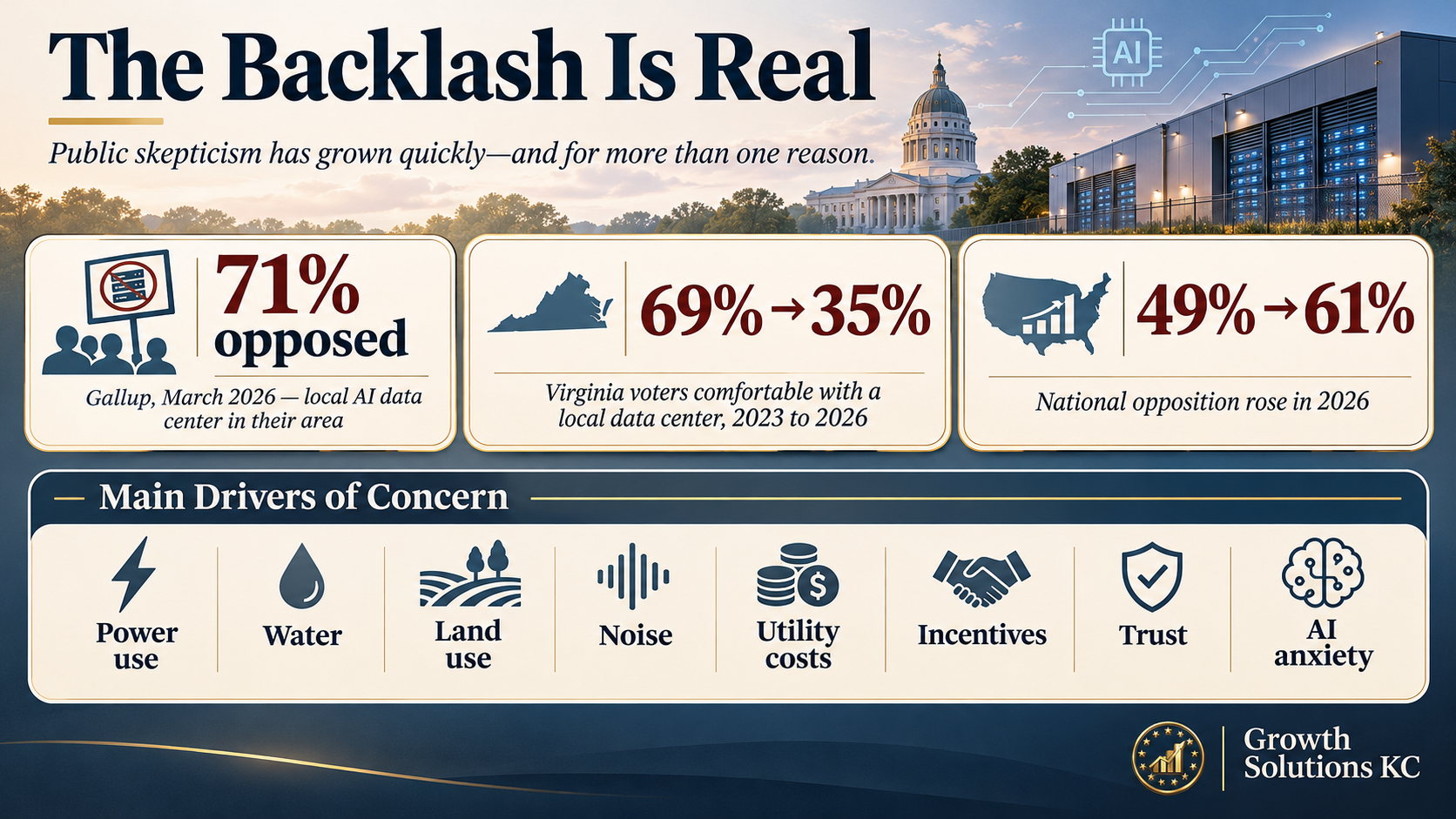
In 2023, 69% of Virginia voters surveyed by The Washington Post and George Mason University's Schar School said they would be comfortable with a data center being built in their community. By March 2026, just 35% said the same.
That is not a small shift in public opinion.
Nationally, the picture is similarly striking. A March 2026 Gallup survey found 71% of Americans opposed construction of an AI data center in their local area, including 48% who were strongly opposed. Opposition crossed party lines.
Another national survey found opposition rising from 49% early in 2026 to 61% just a few months later.
Why?
We cannot reduce that change to a single explanation.
But we can say this:
The projects became larger. The public conversation became louder. The consequences became more visible. And Americans became much more skeptical.
The harder question is why.
THE BACKLASH IS REAL
Data-center opposition is no longer a handful of neighborhood disputes.
Communities across the country are debating projects over electricity, water, land use, noise, tax incentives, utility costs, environmental impacts, and how much control residents should have over development decisions.
Temporary moratoria, zoning fights, lawsuits, packed public meetings, and organized local opposition have become increasingly common. The research also shows something important: the resistance does not fit neatly into the familiar political divide. Environmental groups, rural landowners, ratepayer advocates, homeowners, conservatives, progressives, and local officials can find themselves questioning the same project for very different reasons.
It would therefore be easy—but wrong—to dismiss the backlash as simply anti-technology hysteria.
The concerns are not imaginary. But that does not mean every claim is equally accurate, or that every project deserves the same verdict.
THE CONCERNS ARE REAL
Start with electricity.
The AI buildout is producing facilities far larger and more power-intensive than many earlier generations of data centers. Projects once measured in tens of megawatts are increasingly being proposed at hundreds of megawatts, with some campus plans reaching toward gigawatt scale.
That has consequences.
Utilities may need new generation, substations, transmission lines, transformers, and other infrastructure. The legitimate public question is straightforward:
Who pays?
If a data center creates a new cost, residents have a reasonable interest in making sure that cost is not quietly shifted onto household utility bills.
Water raises similar questions.
Some data centers use significant amounts of water for cooling. Others increasingly rely on closed-loop, air-cooled, direct-to-chip, reclaimed-water, or hybrid systems that can dramatically change the equation.
That distinction matters.
So do land use, noise, backup generators, lighting, farmland conversion, construction traffic, and the familiar question of whether large tax incentives are justified by relatively modest permanent employment.
Those are not irrational concerns. They are questions communities should ask. But asking good questions and assuming the answer are two different things.
WHAT CHANGED?
Part of the backlash may simply reflect the fact that today's data centers are different.
For much of the cloud era, data centers were relatively obscure infrastructure. They stored business records, powered websites, handled search queries, supported streaming, processed transactions, and kept enterprise software running. Most people benefited from them without thinking very much about the buildings themselves.
Then came the AI boom.
Computing density increased. Proposed campuses became much larger. Demand for electricity accelerated. Development spread beyond traditional technology hubs into exurban, rural, and agricultural communities.
At the same time, the data center stopped being associated merely with “the cloud.” It became associated with artificial intelligence.
That changed the emotional context.
For someone who worries that AI may eliminate jobs, weaken privacy, concentrate corporate power, spread misinformation, or alter society too quickly, the data center can become something more than a building.
It becomes the physical symbol of all those fears. That does not make the underlying infrastructure concerns false. But it can make separating the actual project from the larger cultural argument much harder.
DO PEOPLE REALLY UNDERSTAND WHAT THEY OPPOSE?
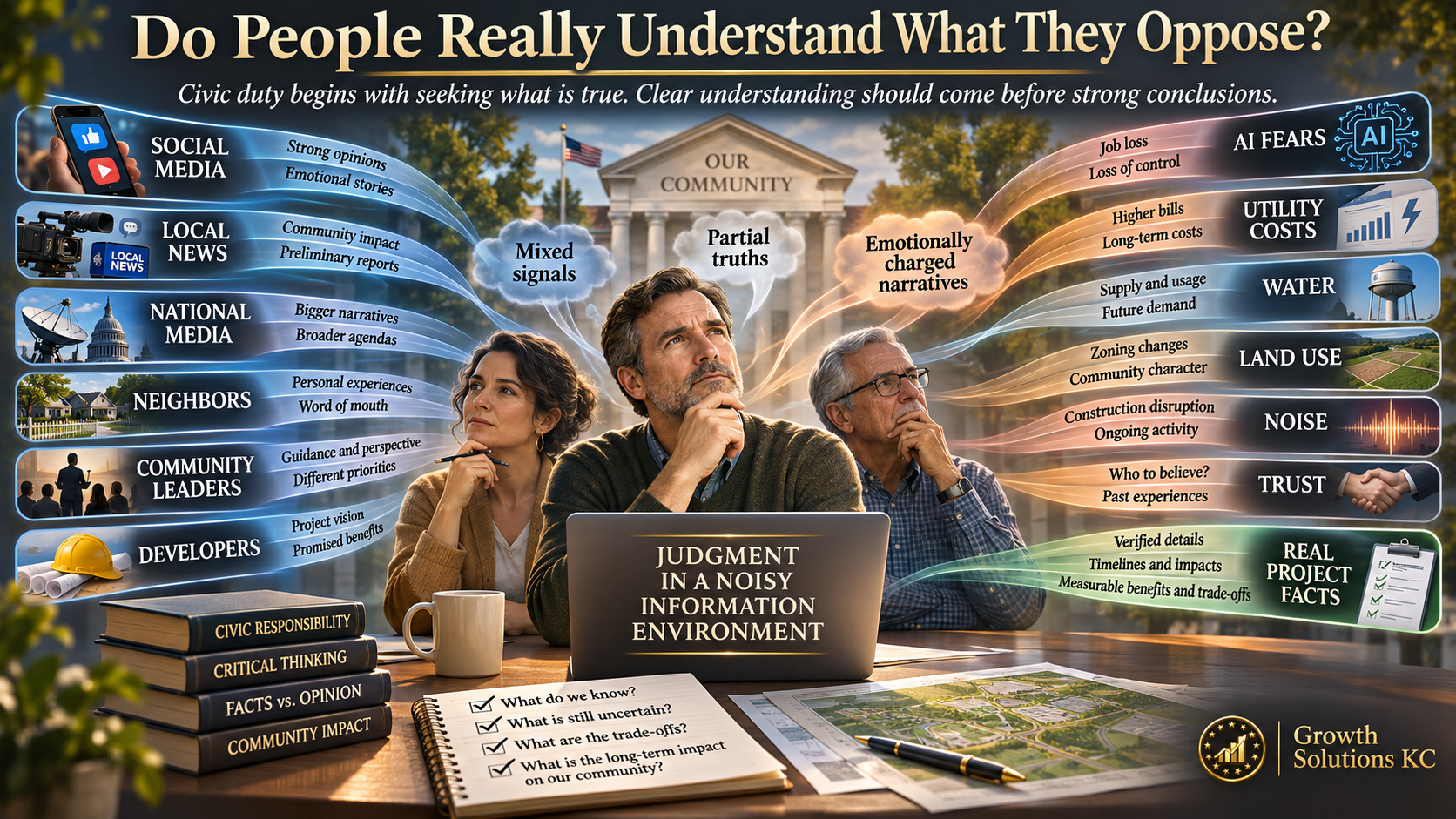
This may be the most interesting question.
Americans clearly have opinions about data centers. They are less certain about how well they understand them.
A June CBS News/YouGov survey found that only 16% of Americans said they knew “a lot” about data centers. Significant numbers were uncertain about how they affect resources, utility costs, local economies, taxes, and jobs. Even among those who said they knew a lot, however, opposition remained greater than support.
Lack of information does not explain everything. Neither does dislike of AI.
Annenberg found something particularly revealing. Between early and mid-2026, opposition to nearby data centers increased by 12 percentage points even while Americans' broader attitudes toward AI remained statistically unchanged. Heavy AI users were more optimistic about AI itself—but were about as opposed to nearby data centers as people who rarely or never used AI.
People may understand some risks very well and others poorly.
- They may be responding to actual local experience.
- They may have absorbed stories about problems somewhere else and assumed those conditions apply everywhere.
- They may distrust the developer, utility, government, or approval process.
- They may dislike AI.
- They may simply not want industrial infrastructure near their homes.
Usually, it is probably some combination.
Public understanding is uneven. Better information may correct exaggerated fears, but it may also make legitimate trade-offs clearer. Understanding should improve the decision—not dictate the answer.
The goal of better information is not to persuade everyone to support data centers. It is to help people reach better-grounded conclusions.
WHEN DISTRUST AMPLIFIES THE REACTION
There is another ingredient in the backlash: trust.
When a community first learns about a massive project after negotiations are already underway, when the developer operates through an unfamiliar entity, when documents are heavily redacted, or when residents cannot easily understand what a utility agreement actually requires, suspicion grows.
Sometimes that suspicion uncovers legitimate problems. Sometimes it fills information gaps with assumptions. Often it does both.
Social media can accelerate the process.
A story about a noisy facility in one state, a water-intensive project in another, or a utility-rate dispute somewhere else can travel nationally within hours. Soon those examples become evidence for what “data centers” supposedly do everywhere.
But infrastructure is intensely local.
- A facility using evaporative cooling in a water-stressed region is not automatically comparable to an air-cooled facility in another state.
- A project next to a residential neighborhood is not the same as one built on an industrial brownfield.
- A utility agreement that shifts costs onto ratepayers should not define one that contractually assigns new infrastructure costs to the large customer.
- A poorly negotiated tax-abatement package does not prove that every community receives a bad deal.
The details matter. So, understanding the details is essential.
JUDGE THE PROJECT, NOT THE CATEGORY
That may be where the current debate most often goes wrong.
Supporters can become so focused on investment, jobs, tax revenue, and technological competitiveness that they minimize legitimate local costs.
Opponents can become so focused on the worst examples that the words data center themselves become sufficient reason to object.
Neither approach requires much thought.
Responsible citizenship does:
- Ask how much electricity the project actually needs.
- Ask who pays for the infrastructure.
- Ask which cooling system it uses.
- Ask how much municipal water it will actually consume.
- Ask what happens if the project expands—or leaves.
- Ask what the tax incentives cost and what the community receives in return.
- Ask whether noise, traffic, setbacks, and land use are appropriate for that particular location.
- Ask what commitments are enforceable rather than promotional.
Then make the decision.
That is slower than reacting to a headline. It is also more likely to produce a good result.
BETTER THINKING, BETTER OUTCOMES
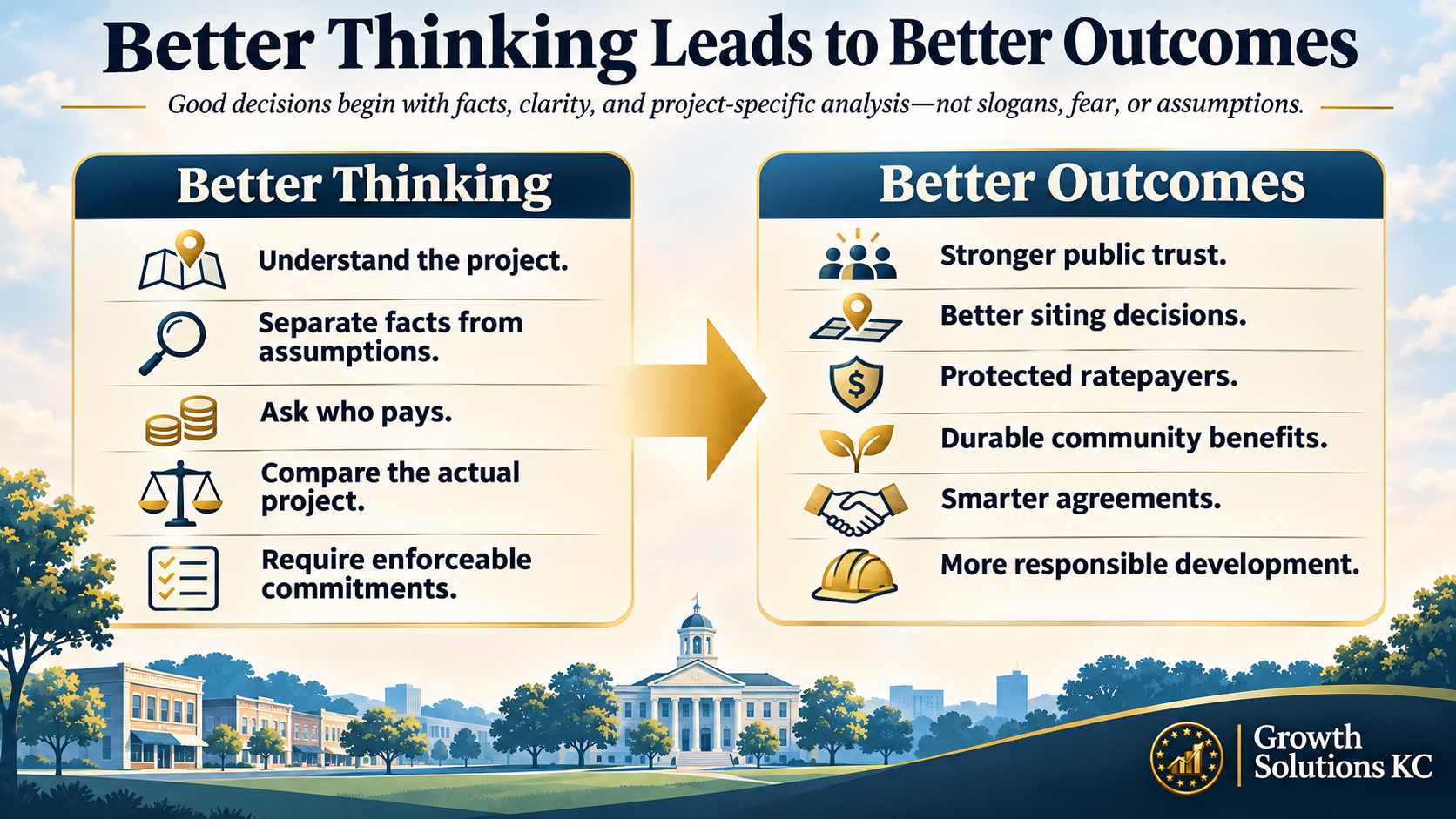
The data-center backlash is neither manufactured outrage nor perfectly informed judgment.
It is a response to real changes in scale, real local costs, broken trust, broader anxiety about AI, and an information environment that can turn legitimate concerns into categorical opposition.
That means the answer is not to dismiss the backlash.
Nor is it to surrender to it.
The answer is to understand what is actually driving it.
Data centers increasingly support systems Americans use every day—from banking and healthcare to logistics, communications, cloud computing, scientific research, and artificial intelligence.
That does not make every project good. It makes evaluating each one carefully more important.
Concern deserves investigation.
Support deserves evidence.
Opposition deserves reasons.
And consequential decisions deserve something better than fear, enthusiasm, or the opinion of the crowd.
Understand the project.
Understand the trade-offs.
Then decide.
Better thinking does not guarantee agreement.
But it gives us a better chance at better outcomes.
— Matt Cucinotta | Growth Solutions KC | Inspire · Inform · Ignite
Explore more strategic analysis and policy commentary at growthsolutionskc.com.
Transparency Note: This article was developed with AI assistance and reviewed, edited, and finalized by Growth Solutions KC prior to publication.

Comments ()