

The AI Reset
What This Week’s Tech Sell-Off Really Signals
Artificial intelligence can change the economy while disappointing investors who pay too much for its promise. This week’s technology sell-off brought that distinction into focus.
The evidence supports a reassessment of AI’s investment economics. It does not establish that the technology has failed—or that the market decline will be brief.
As we argued in The Investor’s Lens, a powerful technology trend still requires discipline about valuation, business economics, and risk. This week puts that framework to work.
The question has become more demanding: Can the companies building the AI future earn enough from it to justify what they are spending?
AI demand is still growing. Investors are asking harder questions about spending, profits, and who captures the value.
What happened this week
Selling intensified during the final two trading days of October as investors absorbed earnings reports and spending commitments. Friday, October 30, left the major indexes sharply lower:[1]
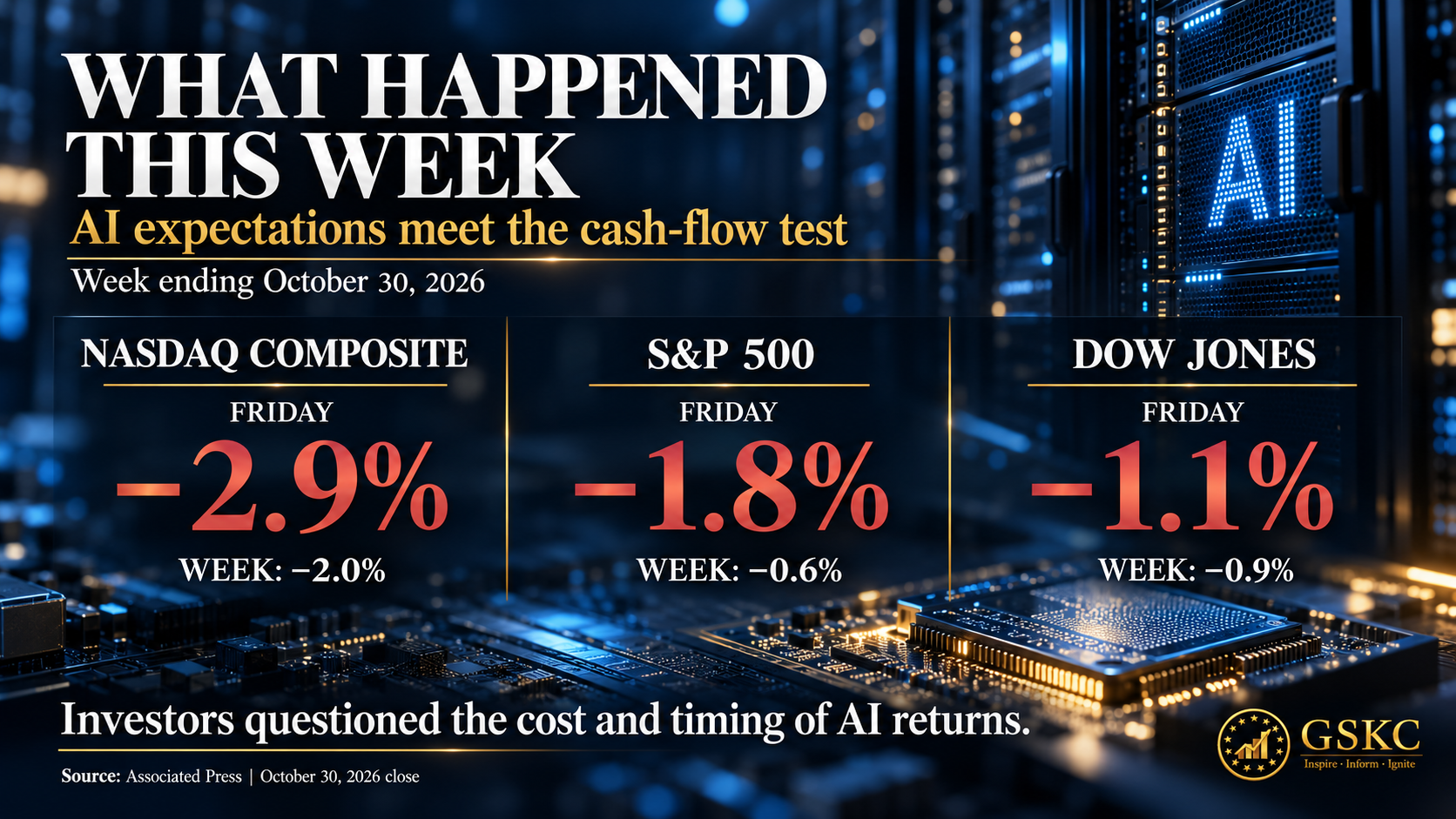
Friday’s drop exceeded the week’s net decline, underscoring how sharply sentiment shifted late in the week.
Semiconductors suffered especially heavy losses. Intel fell about 28.6%, AMD 10.9%, and Nvidia 4.2% on Friday; the Philadelphia Semiconductor Index dropped 7.2%. The Nasdaq Composite finished 7.8% below its October 6 closing high.[2]
Three company reports help explain the pressure:
Alphabet exposed the monetization challenge. Google Cloud revenue rose 103% to $30.7 billion, while Search revenue increased 12%. Management acknowledged that lower monetization in AI Mode contributed to Search’s growth slowdown, alongside currency and advertising-market factors. Quarterly free cash flow was negative $9.1 billion, although trailing twelve-month free cash flow remained positive at $19.7 billion.[3]
Amazon exposed the cash demands. AWS revenue grew roughly 39%, and Amazon reported its highest operating margin ever. Yet trailing twelve-month free cash flow was a $42.4 billion outflow, driven primarily by increased infrastructure investment. Strong operating performance and heavy cash consumption existed together.[4]
Intel exposed uneven conditions within technology. Revenue increased 21%, but its fourth-quarter outlook disappointed investors. Management expected the PC slowdown to persist through at least the first half of 2027, even while describing robust demand for data-center CPUs.[2][5]
These are different businesses with different problems. Treating every decline as proof that “AI demand collapsed” misses the evidence.
Why investors reacted
AI infrastructure requires money well before its full economic payoff arrives. Servers, specialized chips, buildings, cooling, and electricity create a substantial funding requirement. Investors must judge how quickly those assets will generate profitable business.
An important accounting distinction helps: Capital spending generally reduces cash flow upfront. Depreciation then spreads the expense through earnings over an asset’s useful life. A company can report strong operating profit while spending more cash on infrastructure than its operations produce.
The scale makes the timing consequential. UBS Global Research, as reported by The Economic Times, projects $7.7 trillion in spending by six major hyperscalers between 2026 and 2030. Its analysis estimates that earning a 15% return on invested capital by 2031 would require approximately $1 trillion in additional annual operating earnings.[6]
Those figures describe a projected spending path and a modeled return hurdle. Actual spending and returns may differ substantially. They illustrate how much commercial success the investment could require.
Physical constraints complicate that calculation. The International Energy Agency identifies grid connections and electrical-equipment supply as barriers to deployment. Goldman Sachs Global Institute also highlights memory-price volatility and potential pressure across packaging and other components.[7][8]
As our grid and transmission analysis explained, obtaining chips is only part of the task. Capacity has to be connected to reliable power before it can serve customers.
Scarcity can strengthen a supplier’s profits while raising its customers’ costs. Delays can postpone revenue while financing and other obligations continue. The same AI boom can therefore produce very different financial results across the supply chain.
Has the AI thesis changed?

Separate three questions.
Will AI become more useful? This week’s stock prices do not answer that question. Rapid cloud growth offers evidence of substantial commercial demand, although cloud revenue includes services beyond AI.[3][4]
Will AI investment earn attractive returns? That remains company-specific. More usage must translate into revenue, manageable delivery costs, and cash returns that justify the capital required.
Will today’s shareholders earn attractive returns? That also depends on the price paid. Our Broadcom and the Burden of Dominance article examined expectation risk: strong results can disappoint when the market has already priced in something better. This week adds a larger question about the cost of sustaining growth.
Our assessment: The long-term technology thesis remains credible. The assumption that growing AI adoption automatically justifies every AI valuation deserves much greater scrutiny.
AI could improve productivity while competition passes much of the benefit to customers. Economic value created and shareholder value captured are related, but they are not interchangeable.
A reset or deeper trouble
A reset is a reasonable interpretation of the current evidence. Calling it temporary is a forecast we cannot yet verify.
The constructive scenario is straightforward: paid demand expands, existing capacity becomes more productive, and cash generation catches up with investment. Expectations adjust while the technology continues advancing.
The more troubling scenario is equally clear: spending keeps rising, monetization disappoints, core businesses weaken, or financing becomes harder to obtain. Under those conditions, a valuation adjustment could develop into a longer investment downturn.
Continued infrastructure spending alone cannot settle the issue. It demonstrates commitment; it does not prove adequate returns. Conversely, slower spending could reflect either better discipline or weaker demand. Investors need the explanation and the operating evidence behind the number.
What to watch next
Nvidia’s next earnings call is scheduled for November 17. It will be a useful checkpoint for the infrastructure cycle, alongside subsequent customer and software-company reports.[9]
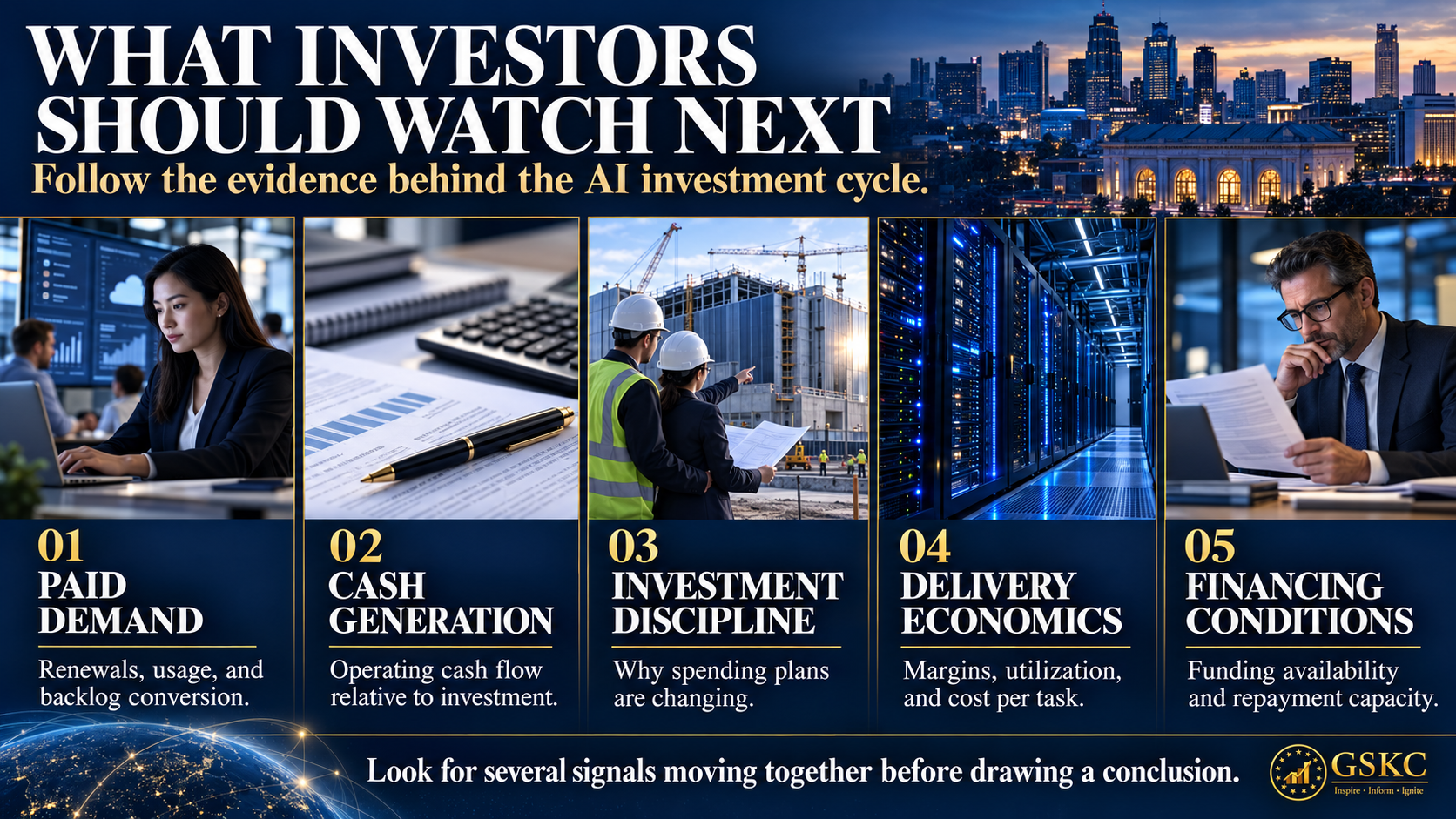
Backlog, including remaining performance obligations, provides visibility rather than certainty. Its value depends on contract terms, customer finances, delivery schedules, and eventual collections. Busy servers alone do not prove attractive returns. Likewise, issuing debt is not by itself evidence of distress; repayment capacity and funding terms matter.
Market breadth and volatility can indicate stabilizing sentiment. They cannot substitute for evidence that customers are paying and investments are earning adequate returns.
The future of the AI sector
We expect a more selective market, with opportunity across infrastructure, software, and businesses applying AI effectively. There is no guaranteed timetable for value to move from chipmakers to applications, and no reason to assume every participant will benefit equally.
Efficiency will matter alongside capability. Cheaper ways to deliver useful AI could expand adoption while reducing the revenue earned per task. The investment outcome depends on whether additional demand outweighs pricing pressure and continuing costs.
For investors, the practical response is to review concentration, valuation, cash-flow durability, and time horizon. A lower share price alone does not establish that a stock is inexpensive.
For business leaders, measure AI through work completed, errors reduced, customers served, and the full cost of delivery. A stock-market correction does not erase a useful business application.
The AI future remains promising. This week’s sell-off raises the standard for financing it: useful technology must become durable economic value, and durable economic value must eventually become cash returns.
Explore more in GSKC’s Markets & Investing collection.
— Matt Cucinotta | Growth Solutions KC | Inspire · Inform · Ignite.
Explore more strategic analysis and policy commentary at growthsolutionskc.com.
This article is for informational and educational purposes only and does not constitute personalized investment advice. Securities and sectors discussed in this series are illustrative and should be evaluated in light of each reader’s own financial situation, risk tolerance, time horizon, and professional guidance.
Sources and methodology
Market changes reflect the October 30, 2026 close. Daily and weekly returns are distinguished; company cash-flow periods are identified separately. Company disclosures provide operating figures. Interpretations and forward scenarios are Growth Solutions KC analysis. The UBS estimate is attributed to The Economic Times reporting on UBS Global Research. Forecasts are conditional, and aggregate cloud growth is not treated as a measure of AI-only revenue.
- Associated Press — How major US stock indexes fared Friday, October 30, 2026.
- Reuters — Wall Street closes sharply lower as AI cash burn fears spark tech selloff, October 30, 2026.
- Alphabet — Third-quarter 2026 earnings-call transcript, October 28, 2026.
- Amazon — Third-quarter 2026 results, October 29, 2026.
- Intel — Third-quarter 2026 results, October 29, 2026.
- The Economic Times — $7.7 trillion AI bet: Can hyperscalers earn enough to justify the spending?, October 26, 2026.
- International Energy Agency — Key Questions on Energy and AI, executive summary, 2026.
- Goldman Sachs Global Institute — Tracking Trillions: The Assumptions Shaping the Scale of the AI Build-Out.
- Nvidia — Third-quarter financial-results conference-call announcement, October 28, 2026.
Transparency Note: This article was developed with AI assistance and reviewed, edited, and finalized by Growth Solutions KC prior to publication.



Comments ()