

Grid, Transmission, and Permitting: The Unsexy Bottleneck
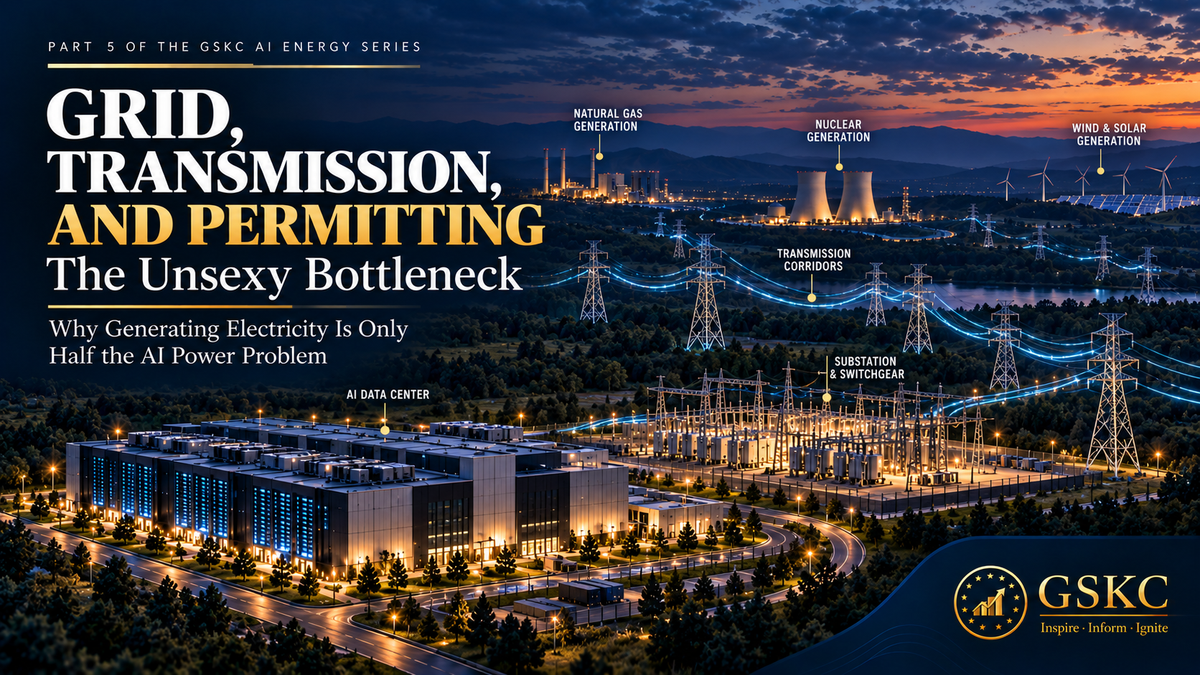
Why Generating Electricity Is Only Half the AI Power Problem
Part 5 of the Growth Solutions KC AI Energy Series
Natural gas can generate more electricity. Nuclear plants can restart. Small reactors may eventually add new sources of dependable power. Wind and solar can expand. Batteries can store energy for later use.
But none of those resources solves the entire AI power problem if the electricity cannot get to where it is needed. That is the less glamorous side of the AI infrastructure boom.
The grid.
Behind every data center are transmission lines, substations, transformers, switchgear, interconnection studies, permits, rights-of-way, utility planners, regulators, construction crews, and thousands of pieces of electrical equipment that most people rarely notice.
Until they become the bottleneck.
In September, Broadcom CEO Hock Tan described the challenge confronting AI developers as multidimensional. The availability of chips matters, but so do land, power, and the physical facilities needed to deploy them. One of the recent articles collected for this series highlighted the increasingly important role of power-ready sites, transformers, permitting, and construction schedules in determining when AI capacity can actually become operational.
That observation captures an important shift. For much of the AI boom, attention centered on whether companies could obtain enough advanced chips.
Increasingly, another question matters just as much:
Can the physical electricity system support them?
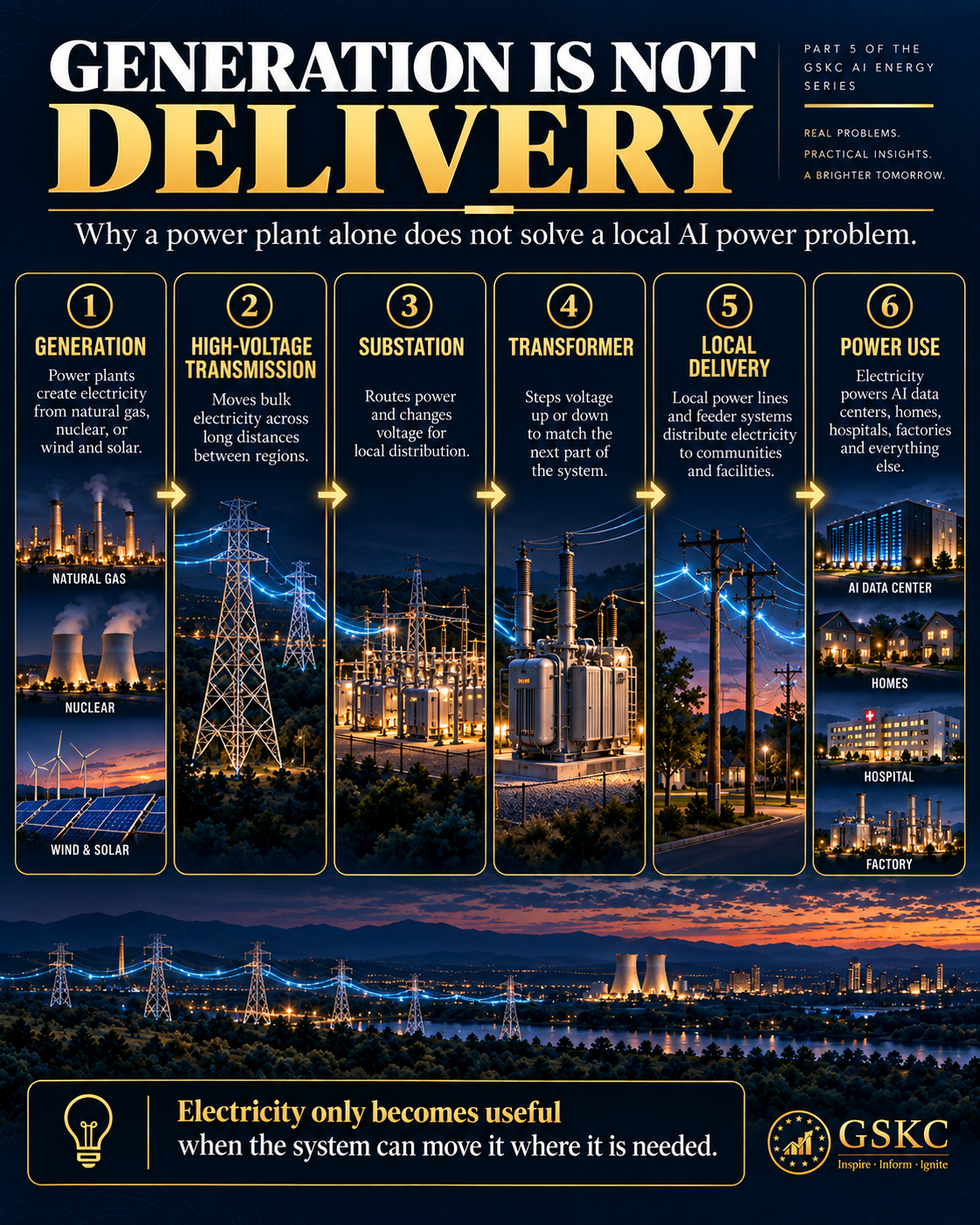
What Matters: Generation Is Not Delivery
Electricity has to travel.
Power may be produced at a nuclear plant, natural-gas facility, wind farm, solar installation, hydroelectric dam, or another source.
But generation is only the beginning. High-voltage transmission lines move large amounts of electricity across regions. Substations change voltage and direct power through the network. Transformers step voltage up or down. Distribution systems eventually deliver electricity to homes, factories, businesses, and data centers.
Think of generation as producing the water. The grid is the network of pipes. Building another reservoir does not help very much if the pipes cannot move enough water to the customer.
The same principle applies to electricity.
A region can technically have enough generating capacity and still face a local power constraint because the transmission system cannot deliver enough electricity to a particular location.
That distinction becomes especially important with AI data centers because their loads can be enormous and concentrated.
A new neighborhood adds electricity demand gradually. A hyperscale data center can arrive more like a new industrial complex — sometimes requesting hundreds of megawatts at a single site.
The grid was not necessarily designed for that demand to appear there, at that scale, on that timetable.
The Grid Was Built for a Different Growth Pattern
For years, U.S. electricity demand grew relatively slowly. Utilities and transmission planners built systems around forecasts that generally assumed incremental change. AI, advanced manufacturing, electrification, and other large loads are disrupting that pattern.
The Department of Energy's draft 2026 National Transmission Needs Study describes a fundamental shift from decades of comparatively stagnant electricity demand toward significant new load growth. DOE specifically identifies hyperscale data centers, expanding domestic manufacturing, and large industrial loads as drivers of new transmission needs. NERC warns that uncertainty about whether new generation and infrastructure can arrive quickly enough is increasing reliability concerns in several regions.
The challenge, then, is not simply:
Build more power plants.
It is:
Build generation, transmission, substations, transformers, and other infrastructure at roughly the same pace.
That synchronization is the challenge.
The Interconnection Problem
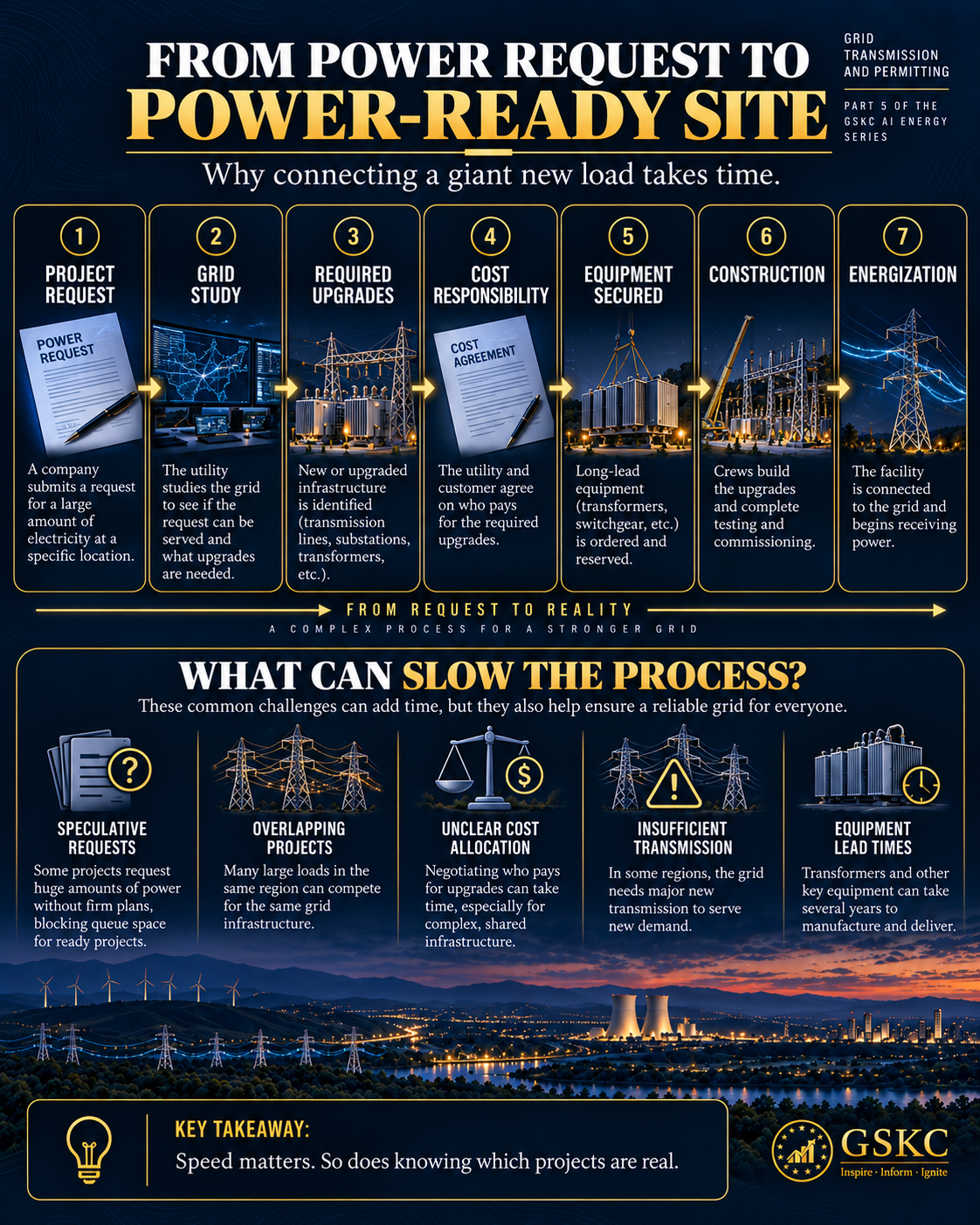
Suppose a developer identifies land for an AI data center.
The fiber access works. The building can be constructed. The market makes sense. Now the developer asks the utility for several hundred megawatts of electricity.
Before simply connecting the facility, the grid operator has to determine what will happen to the system.
- Can existing lines carry the load?
- Does a substation need to expand?
- Will new transformers be required?
- Could additional demand create reliability problems during extreme weather?
- Does new transmission need to be built?
- Who should pay for the upgrades?
- What happens if the data-center project is delayed — or never gets built at all?
Those questions require comprehensive engineering studies. And worth noting, a prospective data-center developer may examine multiple locations and request large amounts of capacity while deciding where to build.
If planners treat every request as certain, projected electricity demand can become exaggerated. Then utilities risk designing infrastructure around loads that never arrive.
Planning has to distinguish a real project from a possible project.
Then There Are the Transformers
Even when everyone agrees on what should be built, another bottleneck can appear:
Can the equipment be obtained?
Transformers are among the least glamorous pieces of the AI infrastructure story. They may also be among the most important.
DOE reported this year that demand for distribution transformers has risen sharply since 2019. Typical delivery times that once measured several months have stretched to one or two years in some cases. For the much larger transformers used at substations and generation facilities, lead times can extend to three or even four years.
Transformers are not optional accessories. They are fundamental to moving electricity safely between different voltage levels.
Everyone is competing for parts of the same supply chain.
Reuters reported this summer that shortages extend beyond transformers to equipment including circuit breakers and switchgear, leading utilities and developers to order years in advance, refurbish older equipment, and secure long-term manufacturing slots.
It is another recurring lesson of the AI buildout:
Infrastructure is a chain. Bottlenecks are real. The project moves at the speed of its slowest critical component.
Building a Transmission Line Is Not Like Installing a Server
Equipment is only one constraint. Transmission lines cross land communities, and neighborhoods.
That means engineering, environmental review, property rights, local governments, state regulators, utilities, landowners, communities, and sometimes federal agencies can all become part of the process.
Most transmission siting authority remains with states, while federal authority is more limited and depends on specific circumstances. FERC's own explanation of the process illustrates how multiple layers of state and federal review can become involved in eligible interstate transmission projects.
There are legitimate reasons for scrutiny. “Permitting reform” therefore should not simply mean ignoring people who live along the route.
But the opposite extreme creates problems too. If every jurisdiction can delay infrastructure indefinitely while electricity demand continues rising, the system can become incapable of building what everyone eventually expects it to provide.
The productive question is not: Regulation or no regulation?
It is: Can the process protect legitimate interests while reaching decisions in a predictable amount of time?
The Geography Problem
Electricity does not always exist where the demand is. Some regions have abundant generation potential but limited ability to move that power elsewhere. Others have rapidly growing demand but insufficient local generation.
Transmission connects the two.
DOE's transmission research has repeatedly identified congestion and limited transfer capability between parts of the country. This creates a geographic tension in the AI boom. Companies increasingly want data centers where electricity is available.
But other factors matter too: fiber connectivity, land, water, tax structure, workforce, latency, proximity to customers, local approval, and existing data-center ecosystems.
The perfect computing location may not be the perfect power location.
Bigger Is Not the Only Answer
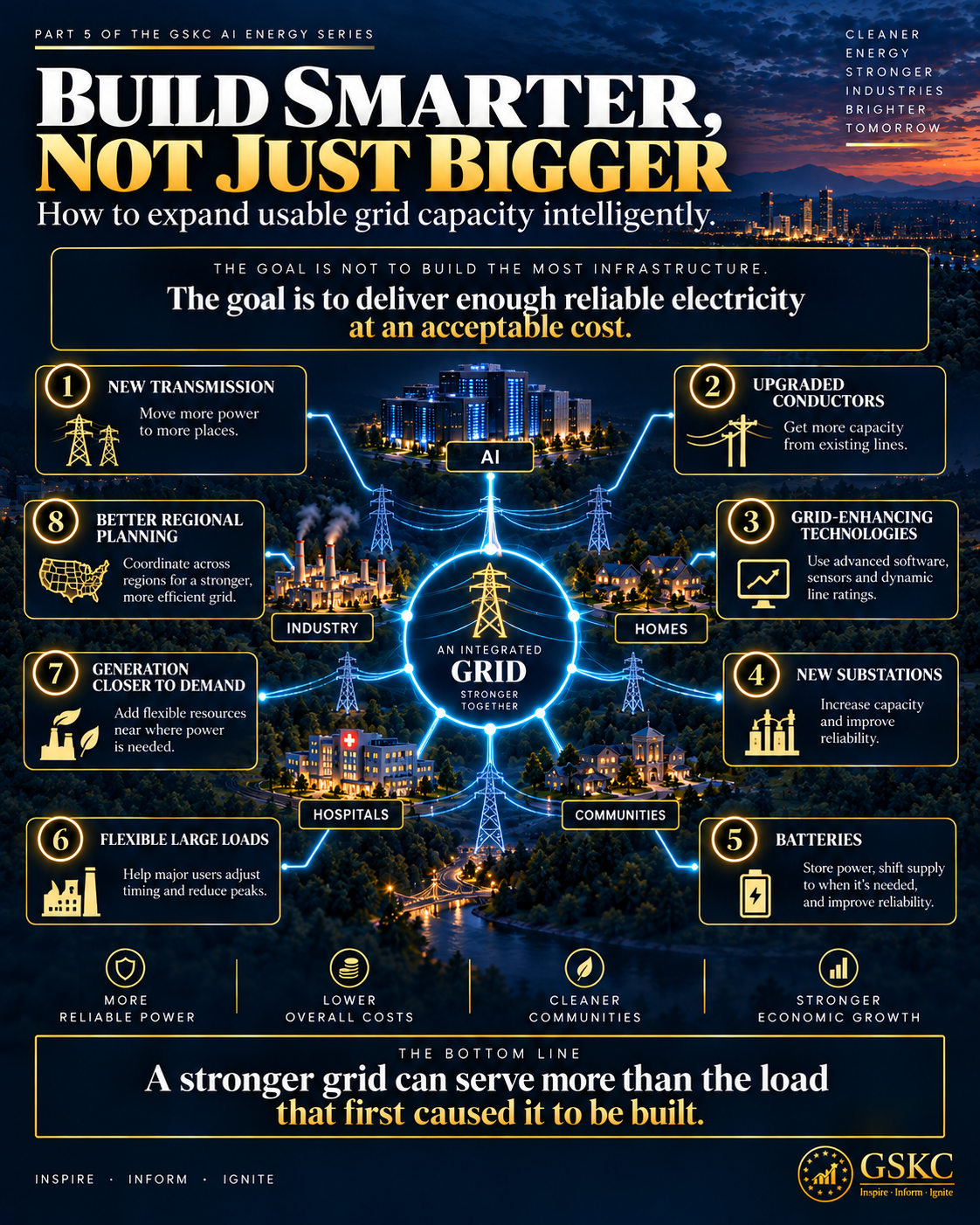
It would be easy to conclude that the solution is simply to build enormous amounts of transmission everywhere. The more interesting answer is broader.
FERC's 2026 large-load initiative specifically encourages consideration of alternative transmission technologies and new service structures for flexible loads alongside traditional expansion.
That matters because the fastest grid upgrade may occasionally be the one that gets more performance out of infrastructure already in the ground.
The goal is not to build the most equipment.
The goal is to deliver enough reliable electricity at an acceptable cost.
The Honest Ledger
Transmission and grid investment can create broad benefits.
A stronger network can support new businesses, improve reliability, connect additional generation, reduce congestion, and give regions more options during emergencies.
Infrastructure built partly because of AI demand may ultimately serve factories, homes, hospitals, and future economic development as well.
But that does not mean every proposed grid project automatically deserves approval. The same principle from Article 1 applies here:
Growth should pay its own way where costs are clearly caused by growth.
Transmission can also provide benefits beyond the customer that first triggered the project. That is why these decisions cannot always be reduced to a simple formula.
The grid is shared infrastructure.
What Happens Next
The AI electricity problem is often described as a search for generation.
- More nuclear.
- More natural gas.
- More renewables.
- More storage.
But generating additional electricity is only useful if the larger system can move it.
That means transformers have to arrive. Substations have to be built. Transmission capacity has to expand or operate more efficiently. Interconnection rules have to distinguish serious projects from speculative requests. Permitting processes have to protect legitimate public interests without becoming endless. And planners have to make decisions today about electricity demand that may not fully materialize for years.
This is why the grid may be the least glamorous and most consequential piece of the AI energy story.
The AI power bottleneck is not simply a shortage of electrons.
It is a shortage of the infrastructure required to put those electrons where they are needed.
The good news is that the same AI boom creating this challenge may also give companies, utilities, regulators, manufacturers, and communities a reason to modernize parts of an aging electricity system that requires attention anyway.
The question is whether America can build intelligently — not just quickly.
Because once the wires arrive, another question becomes unavoidable:
What does all of this infrastructure mean for the communities that host it?
The next AI energy debate will not happen only inside utility control rooms or corporate boardrooms. It will happen in communities.
— Matt Cucinotta | Growth Solutions KC | Inspire · Inform · Ignite
Source and methodology note: This article draws on the Growth Solutions KC AI Energy research portfolio, recent reporting supplied for the series, and primary-source information from the U.S. Department of Energy, Federal Energy Regulatory Commission, and North American Electric Reliability Corporation. Secondary reporting and company commentary are used as market signals and illustrative context rather than as the sole authority for load-bearing claims. Grid structures, cost allocation, permitting authority, interconnection processes, and electricity markets vary significantly by region.


Comments ()