

SAVE America Act, Part I: What It Actually Does — and What It Does Not
Restoring Public Trust in the Ballot Box: A Three-Part Guide to the SAVE America Act
ACCURACY NOTE:
This analyzes the version of the SAVE America Act that passed the House as an amendment to S. 1383 on February 11, 2026. Earlier SAVE Act proposals differ in many ways. Requirements could change again before enactment, and the bill is not federal law as of July 24, 2026
About this series
The SAVE America Act has become the subject of intense political argument, but much of the debate blurs what the legislation requires, why supporters believe it matters, and how its provisions would work in practice.
This three-part series separates those questions. Part I explains what the House-passed legislation actually does — and what it does not. Part II examines fraud, administrative error, voter-list accuracy, public support, and the relationship between verification and trust. Part III addresses implementation, document access, name changes, due process, congressional responsibility, and the practical path forward.
Why the SAVE America Act Matters
When an administrative failure can mistakenly register thousands of people who had already indicated that they were not citizens, is self-attestation alone still a sufficient standard for federal voter registration?
That question became more immediate in July 2026, when New Jersey disclosed that a software error at its motor-vehicle agency had improperly registered approximately 6,600 noncitizens during 2023 and 2024. A preliminary review found that fewer than 400 subsequently cast ballots. State officials attributed the registrations to a software failure rather than a coordinated scheme.4,5
The distinction matters, but its deeper implications belong in Part II. For now, the event establishes a narrower policy question: Should citizenship eligibility for federal elections remain dependent largely on self-attestation and varying state procedures, or should the nation adopt a clearer system of documentary verification, identification, and voter-list maintenance?
The Safeguard American Voter Eligibility (SAVE) Act: Accountability, Confidence, and Civic Trust
In an era where confidence in foundational democratic institutions has been severely tested, election integrity remains a cornerstone of civic stability.
At the center of current congressional debate is the Safeguard American Voter Eligibility (SAVE) Act (also known as the SAVE America Act).
Elections depend on more than counting ballots. They depend on trust, confidence, and accountability that every lawful voter can participate, that the rules are applied consistently, and that only eligible citizens determine the outcome of federal elections.
The New Jersey incident illustrates why the verification question deserves serious examination. The proposed answer is a clearer federal framework for documentary proof at registration, identification when voting, and voter-list maintenance supported by notice and review.
Citizenship establishes the legal boundary of the federal franchise. Verification gives that boundary practical meaning. Yet a law designed to strengthen trust must be implemented in a way that protects eligible citizens from avoidable error, delay, or confusion.
The case for passage is ultimately a case for institutional stewardship. A clear, consistently administered verification system can strengthen accountability and establish public trust and confidence in elections.
Pass a workable SAVE America Act because citizenship, integrity, and public trust matter — and implement it in a way that protects every eligible citizen, corrects errors promptly, and gives the public confidence that the same rules apply to everyone.
WHAT MATTERS
What the SAVE America Act Actually Is — and What it is Not
The SAVE America Act is federal legislation designed to amend the National Voter Registration Act (NVRA) of 1993 by establishing a uniform federal standard requiring documentary proof of U.S. citizenship when individuals register to vote in federal elections.
Federal law already makes it unlawful for a noncitizen to vote in an election held in whole or in part to choose a federal candidate. The unresolved policy question is not whether citizenship matters; it is how government verifies that qualification and maintains accurate records.2
What It Does
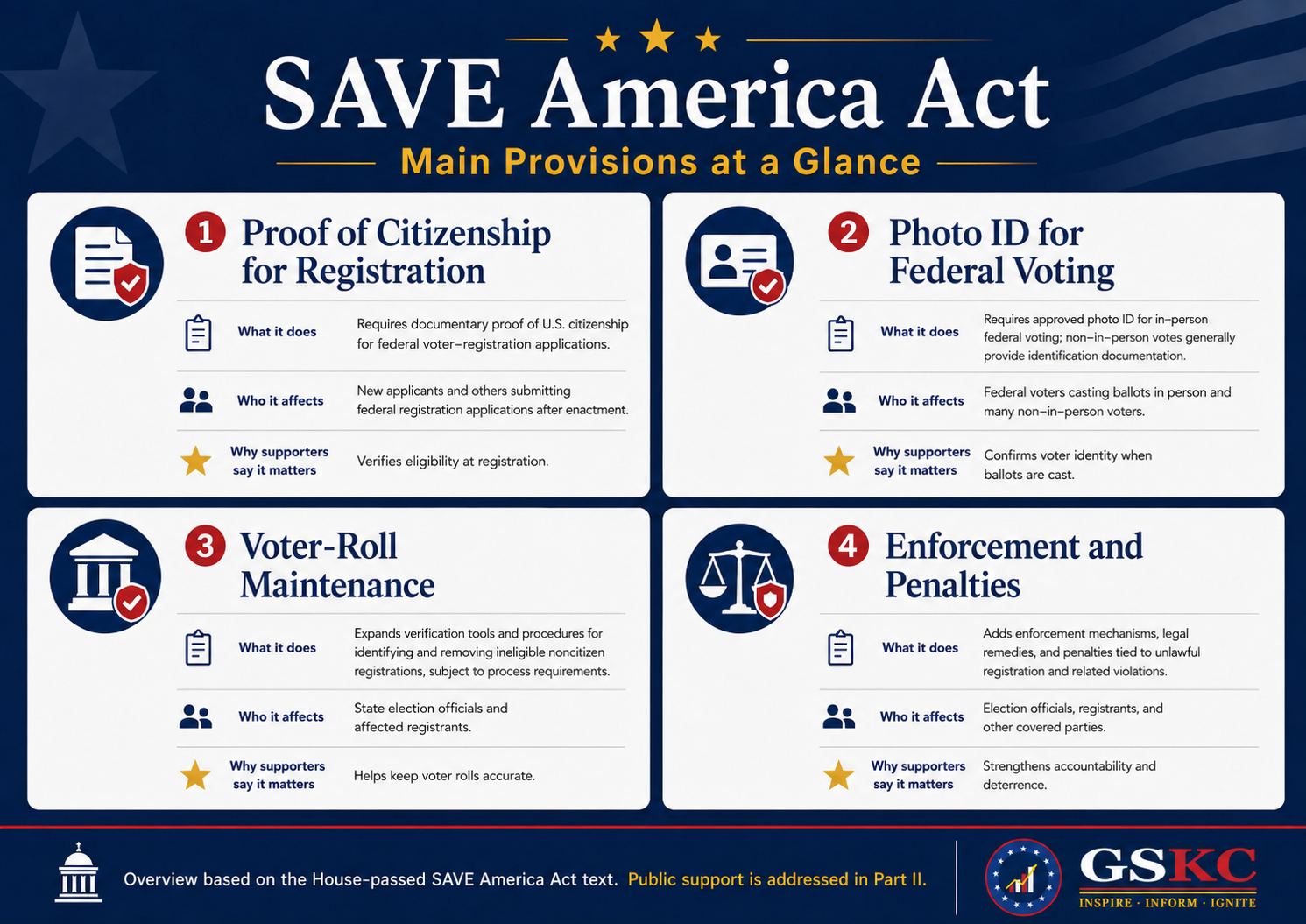
The House-passed SAVE America Act would amend the National Voter Registration Act and related federal election law in four major ways.1
- Registration verification requiring proof of U.S. citizenship: A state could not accept and process a new federal voter-registration application unless the applicant presents documentary proof of U.S. citizenship.
- Photo identification at voting: Beginning with federal elections held in 2027 or later, in-person voters would present an approved physical photo ID. Voters who cannot do so could use a provisional-ballot process.
- List maintenance and data sharing: Provides verification tools to states, granting state election officials access to federal databases. States would submit voter lists to the federal SAVE system for citizenship checks, investigate potential mismatches, notify affected registrants, and provide an opportunity to establish eligibility before removal.
- Enforcement and accountability: The bill establishes duties, remedies, and penalties intended to ensure compliance and deter knowing violations.
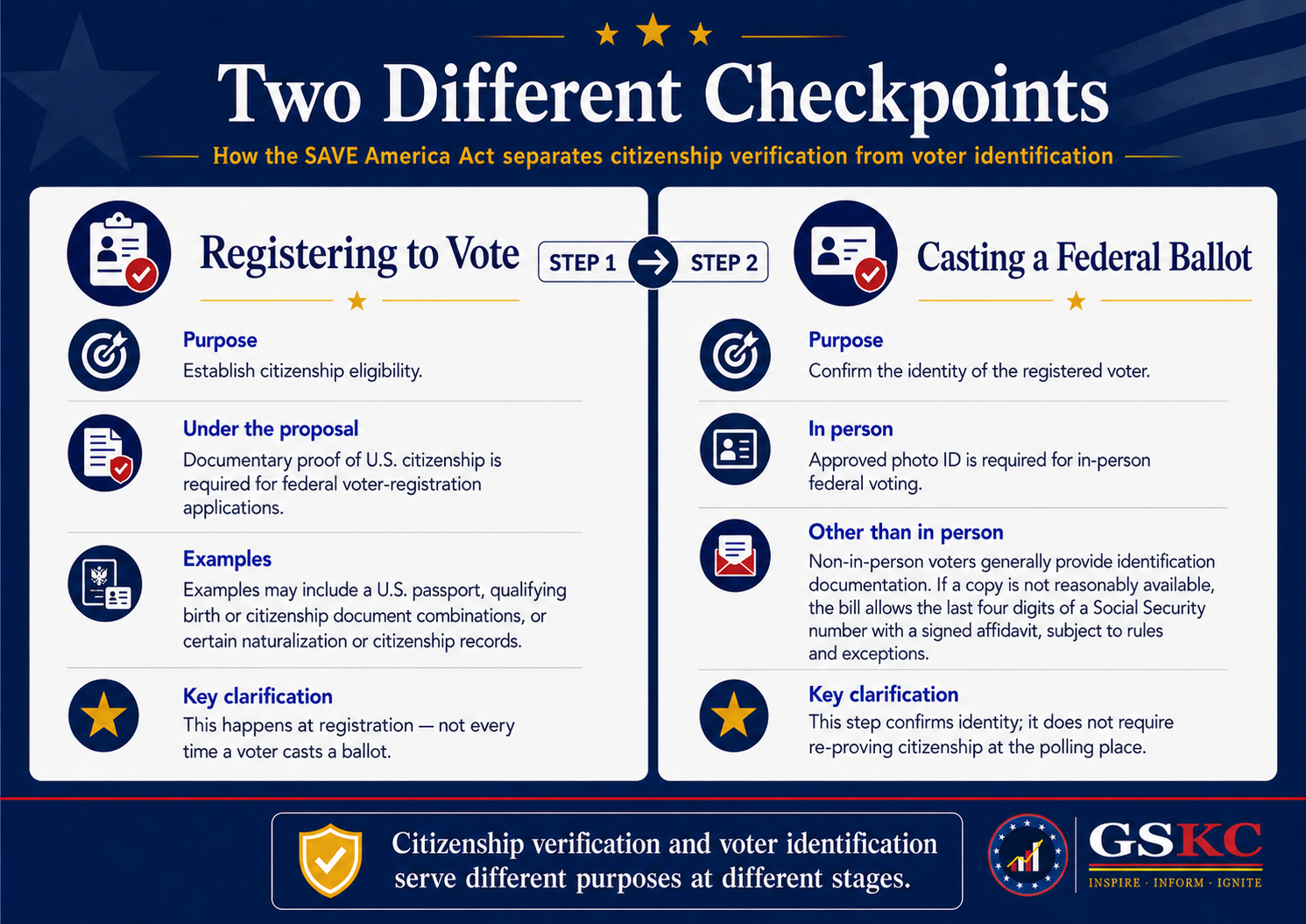
Registration proof and voting ID are different checkpoints
Public debate often blurs two different questions: what a person must show when registering, and what a properly registered voter must show when casting a ballot. The House-passed text treats them separately.
What counts as documentary proof of citizenship?
The exact document list matters because some simplified descriptions are inaccurate. Under the House-passed text, a REAL ID qualifies by itself only if it indicates that the holder is a U.S. citizen. An ordinary driver’s licenses — including a REAL ID that does not indicate citizenship — would not qualify by itself.1
The bill also recognizes several other routes. An applicant registering to vote may use a valid U.S. passport; certain military identification and service records; a government-issued photo ID showing a U.S. birthplace; or a government photo ID combined with a certified birth certificate, hospital record, adoption record, consular birth report, naturalization certificate, citizenship certificate, or another listed citizenship record. It also requires an alternative-evidence process for applicants who cannot produce the standard combinations.1
What currently registered citizens need to know
CURRENT STATUS AND PRACTICAL MEANING
1. The bill is not law today. It currently changes no voter’s federal registration or voting requirements.
2. The House-passed text does not order every existing registrant to re-register or appear with a birth certificate. It does require states to check existing lists through the SAVE system and to give notice and an opportunity to prove citizenship before removing a flagged registrant.
3. New federal voter-registration applications submitted after enactment would be subject to the documentary-proof rules. Whether a particular name change, address change, or registration update would be treated as a new application would depend on the final enacted language and state implementation guidance.
4. If enacted without further changes, the federal photo-ID requirement would apply to federal elections held in 2027 or later.
5. For voting other than in person, the House-passed text generally requires identification documentation with the ballot, while providing an affidavit and Social Security-number alternative in specified circumstances, along with certain exceptions.
6. Until a bill becomes law and states issue implementation guidance, citizens should follow the rules currently in force where they live.
What the bill is not
It is NOT a new declaration that only citizens may vote in federal elections.
It does NOT change which citizens are legally eligible to vote. The legislation does not restrict any eligible U.S. citizen from exercising their constitutional right to vote. It changes how citizenship eligibility and voter identity would be verified.
It is NOT a passport mandate.
It is NOT a requirement that every voter bring a birth certificate to vote after registering.
It is NOT an excuse to remove a registrant solely because of an unverified database match.
It does NOT categorically disenfranchise married women or naturalized citizens. The text includes procedures for name discrepancies and alternative evidence; the practical details are examined in Part III of this series.
It is NOT a partisan trap. The mechanics of verifying citizenship apply identically to every voter regardless of political affiliation.
The Central Takeaway
Before Americans debate how common intentional noncitizen voting may be, whether every provision is properly designed, or how much administrative effort implementation would require, they must first understand the actual proposal.
The House-passed SAVE America Act is not a passport mandate. It does not require every currently registered voter to re-register. It does not require voters to bring birth certificates to polling places.
It creates a federal verification framework built around four functions:
- Establishing citizenship when an individual registers.
- Confirming identity when that individual votes.
- Maintaining voter lists through documented review and due process.
- Establishing enforcement mechanisms, legal remedies, and penalties.
Those are meaningful changes. They should be judged by their actual text — not by slogans, exaggerations, media narratives, or political personalities.
Clarity about the law is the first obligation of honest civic debate.
Understanding the bill is only the first step. The deeper question is why documentary verification matters when intentional noncitizen voting appears uncommon.
Part II examines fraud, administrative error, deceased and outdated voter records, disputed federal estimates, public support, and the relationship between verification and public trust.
— Matt Cucinotta | Growth Solutions KC | Inspire · Inform · Ignite
Scope and methodology: This article analyzes the version of the SAVE America Act passed by the House as an amendment to S. 1383 on February 11, 2026. It draws upon legislative text, official federal sources, bipartisan policy analysis, and reporting available through the publication date. Because the legislative process remains active, provisions and implementation requirements may change.
References and Research Methodology
Major factual claims in this installment were checked against the House-passed legislative text, official federal sources, bipartisan policy analysis, and reporting that distinguishes verified findings from disputed claims. Accessed July 24, 2026.
1. Rules Committee Print 119-19: Text of House Amendment to S. 1383 — U.S. House of Representatives (Feb. 6, 2026). Open source Primary source for the House-passed policy text.
2. 18 U.S.C. § 611: Voting by Aliens — Office of the Law Revision Counsel (Current U.S. Code). Open source Existing federal prohibition.
3. Six Things to Know About the SAVE America Act — Bipartisan Policy Center (Updated July 17, 2026). Open source Implementation concerns and discussion of incentive-based alternatives.
4. New Jersey Software Error and Noncitizen Registrations — Associated Press (July 21, 2026). Open source Approximately 6,600 registrations; fewer than 400 ballots.
5. Hundreds of Noncitizens Voted in New Jersey Due to Software Error — Reuters (July 2026). Open source Additional reporting and context.
6. Modernizing Voter List Maintenance: An Evidence-Based Framework — Bipartisan Policy Center (Sept. 9, 2025). Open source Database limitations, access, integrity, and due process.


Comments ()