

SAVE America Act, Part III: Making the SAVE America Act Work
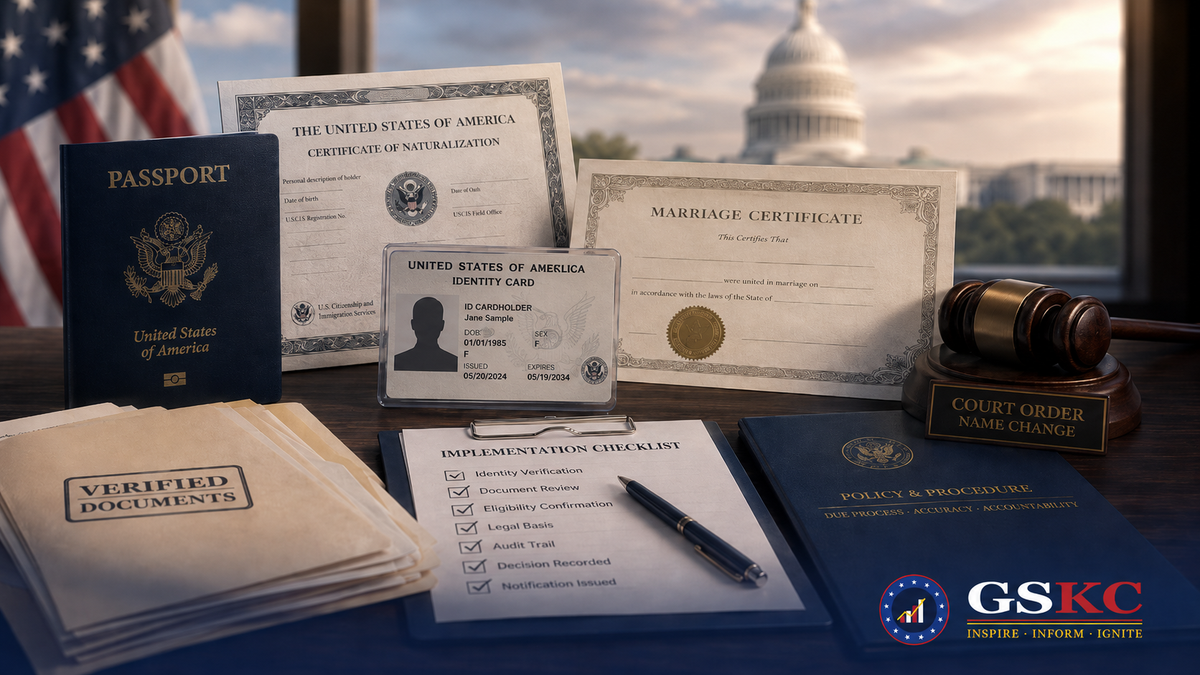
Restoring Public Trust in the Ballot Box: A Three-Part Guide to the SAVE America Act
ACCURACY NOTE:
This analyzes the version of the SAVE America Act that passed the House as an amendment to S. 1383 on February 11, 2026. Earlier SAVE Act proposals differ in many ways. Requirements could change again before enactment, and the bill is not federal law as of July 26, 2026
About this series
Part I explained what the House-passed SAVE America Act requires. Part II examined why election integrity cannot be reduced to a single fraud statistic and what recent findings and public polling actually show. Part III turns from principle to practice: how stronger verification can be implemented without sacrificing accuracy, due process, or lawful access.
What happens when a broadly supported civic principle meets the difficult realities of government administration, incomplete records, changed names, database errors, and limited local resources?
CLARITY OVER NOISE
Correcting the Record Without Dismissing Every Concern
A persuasive case should answer the strongest criticisms rather than label every objection a lie. Some claims are plainly overstated. Other concerns identify real implementation questions. The correct response is to separate the two.
Responsible effort is part of citizenship
No serious civic system is entirely effortless. Anything worth doing is rarely effortless. The correct standard is not zero effort; it is reasonable effort, equal rules, clear instructions, accessible documentation, and workable remedies.
Citizens already accept modest responsibilities to exercise important rights and fulfill important duties: maintaining accurate legal records, responding to official notices, appearing for jury service, filing taxes, and keeping licenses current.
Verifying citizenship for federal voter registration can be understood in the same way — as responsible citizenship and institutional stewardship in action.
Government, in turn, has a matching responsibility to make compliance practical and to correct its own errors quickly.
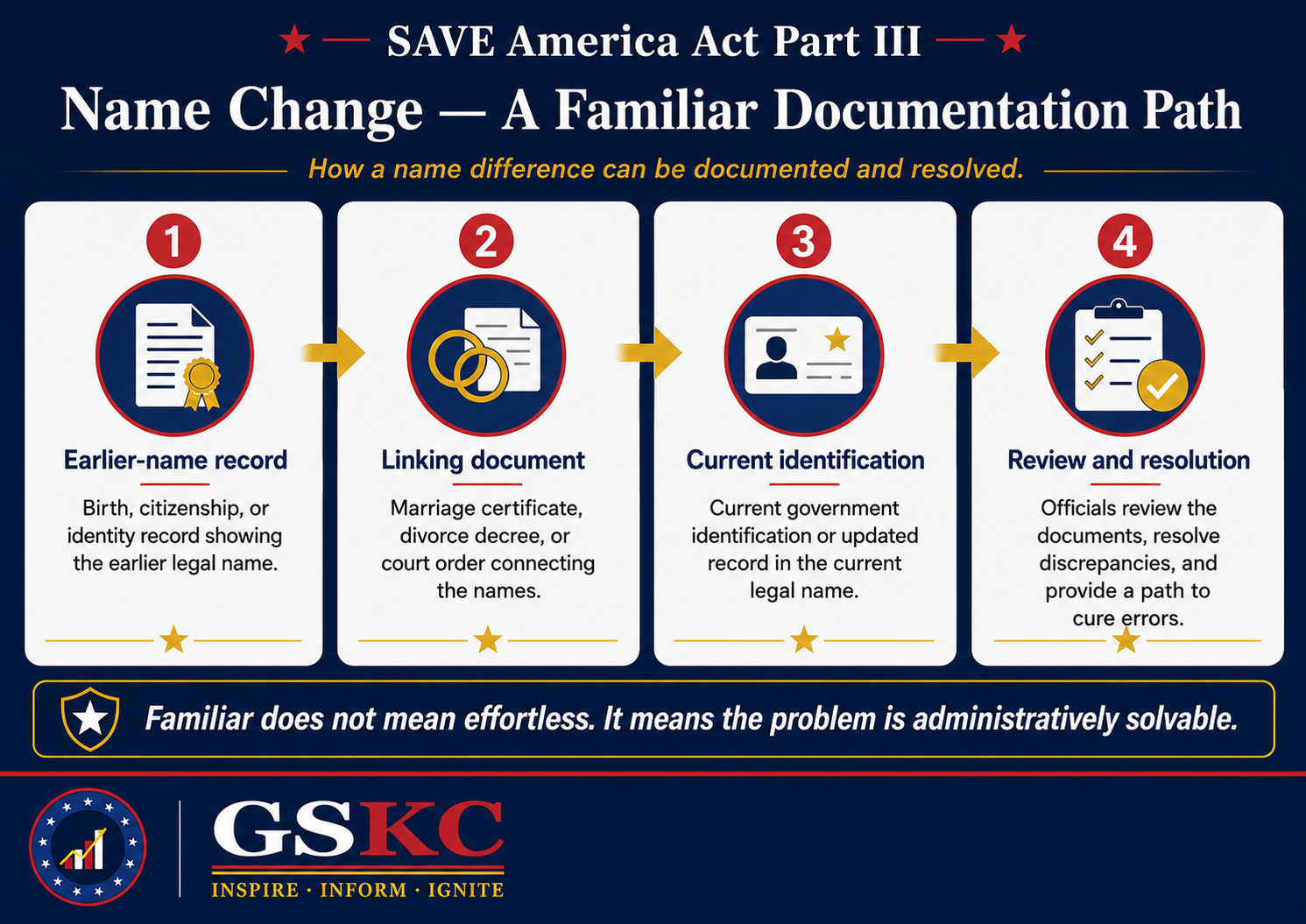
Married women already navigate name-linking processes
The name-change concern deserves a clear and practical answer. A woman whose birth certificate says Jane Smith and whose current identification says Jane Jones may need a marriage certificate or another record connecting the two names. That is not a new or uniquely electoral concept. Women have long used marriage records and similar documents to update Social Security records, passports, and driver’s licenses.161718
The Social Security Administration requires evidence of identity, the new legal name, and the name-change event; it accepts marriage documents, divorce decrees, naturalization certificates showing the new name, and court orders. The State Department likewise uses marriage certificates, divorce decrees, and court orders for passport name changes. State driver-license rules commonly use the same type of certified linkage record.161718
That familiar process is evidence that the issue is administratively solvable — not proof that every case is effortless. Some citizens lack the necessary documents or have records containing errors. The responsible answer is neither panic nor dismissal. It is a clear discrepancy process, affordable replacement documents, trained officials, and prompt review.
Name-linking is familiar, not novel. Women have long used marriage certificates and related records to update Social Security, passports, and driver’s licenses. That does not make every case effortless; it demonstrates that the challenge is administratively solvable. Election rules should make the same process clear, affordable, and accessible.
STEWARDSHIP IN PRACTICE
The Implementation Test
Supporting the SAVE America Act does not require pretending the current House text is administratively perfect. It requires defending the principle while improving the execution.
A law intended to restore trust must not produce preventable backlogs, wrongful removals, inconsistent decisions, or confusing public instructions.
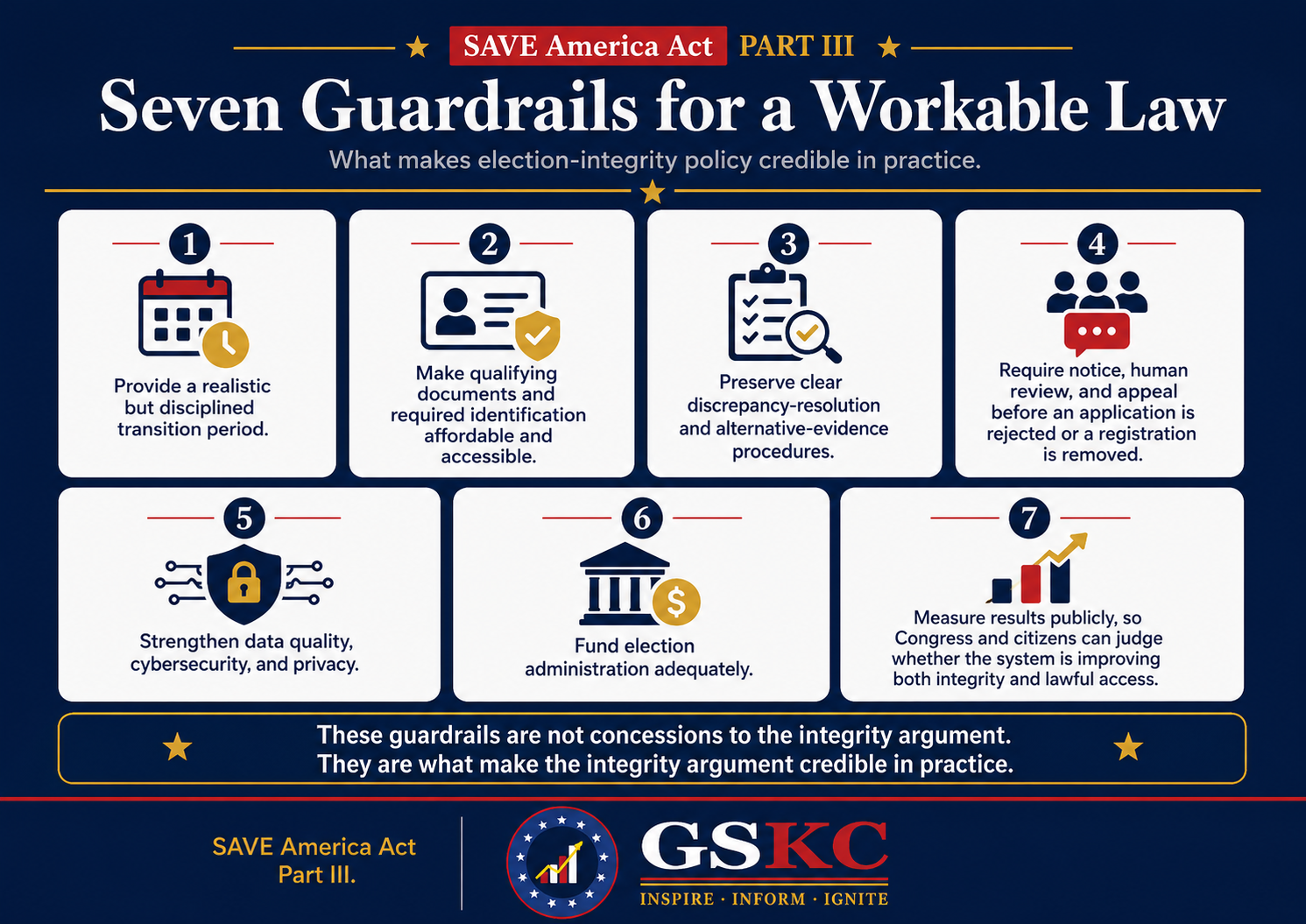
Seven guardrails for a workable law
- Provide a realistic but disciplined transition period.
- Make qualifying documents and required identification affordable and accessible.
- Preserve clear discrepancy-resolution and alternative-evidence procedures.
- Require notice, human review, and appeal before an application is rejected or a registration is removed.
- Strengthen data quality, cybersecurity, and privacy.
- Fund election administration adequately.
- Measure results publicly, so Congress and citizens can judge whether the system is improving both integrity and lawful access.
Put more verification responsibility on government where possible
Document presentation and verification can be part of the system without being the entire system.
Federal and state agencies already hold citizenship, identity, death, and address information. Where lawful and reliable, agencies should conduct secure back-end verification, request additional records only when necessary, and give citizens a simple way to correct a mismatch. The goal should be verified eligibility, not paperwork for its own sake.
Critics are right to warn that database systems can produce false positives.
Supporters are right that self-attestation alone is an incomplete control.
A well-designed system learns from both concerns: documentary standards, reliable data, human review, notice, and remedy.91920
WHAT HAPPENS NEXT
Three Possible Paths and Their Consequences
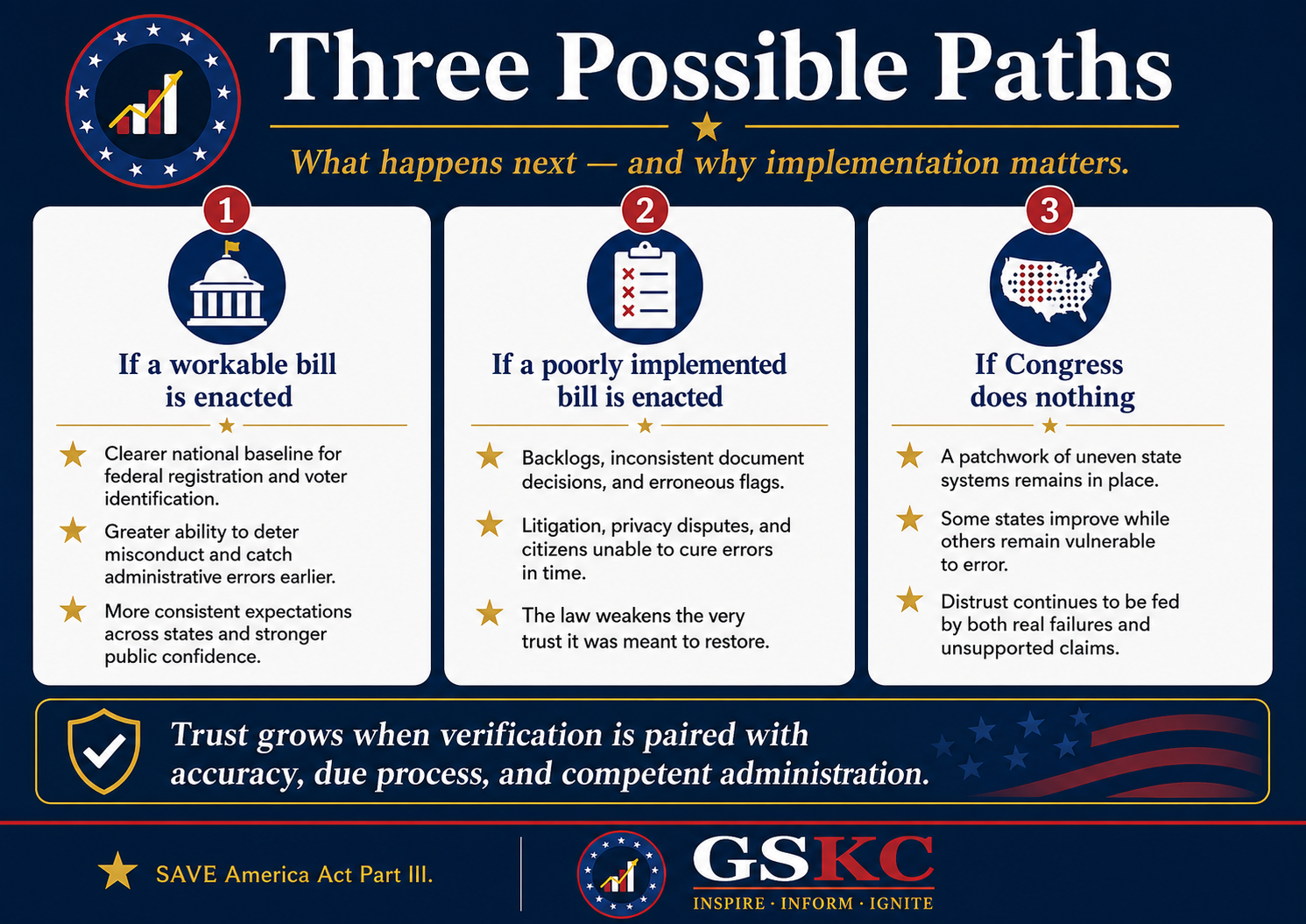
If a workable bill is enacted
A carefully implemented SAVE America Act would strengthen public confidence by establishing a clearer national baseline for federal registration and voter identification. It could deter deliberate misconduct, catch administrative errors earlier, improve coordination across agencies, and create more consistent expectations across states.
It could also change the political conversation. Instead of recurring arguments over whether citizenship is being verified, public debate could focus on measurable performance.
If a poorly implemented bill is enacted
A rushed or underfunded rollout could produce the opposite of the intended result: registration backlogs, inconsistent document decisions, erroneous citizenship flags, litigation, privacy disputes, and eligible citizens unable to cure a mismatch before a deadline. Those failures would not merely inconvenience voters. They would weaken the trust the law is intended to restore.
That is why implementation is not a secondary concession to opponents. It is part of the integrity argument itself. A system cannot claim moral seriousness if it is strict with citizens but careless with its own data and administration.
If Congress does nothing
Existing federal law would continue to prohibit noncitizen voting, and states would continue using a patchwork of self-attestation, identification rules, database checks, and list-maintenance practices.
Some states would improve their systems; others would remain vulnerable to the kinds of errors recently disclosed in New Jersey. Public distrust would continue to be fueled both by real failures and by unsupported claims that cannot be resolved because verification practices differ so widely.
Doing nothing is therefore not a neutral choice. It preserves the current mixture of lawful safeguards, uneven controls, stale records, and recurring suspicion.
Congress should pass a workable SAVE America Act or produce a credible alternative that achieves the same core objective: only eligible citizens register and vote in federal elections, every eligible citizen can comply, and errors found are corrected promptly and transparently.
CONGRESSIONAL ACCOUNTABILITY
The Legislative Status — and the Duty to Act
The House passed the SAVE America Act as an amendment to S. 1383 on February 11, 2026, by a vote of 218–213. In March, the Senate considered procedural steps related to the House message, but a cloture vote on the Husted amendment failed 53–47. The measure therefore remains unresolved and has not become law.23
Recent discussion has also included a scaled-back, incentive-based approach that would offer federal funding to states adopting specified citizenship-verification and voter-ID standards rather than imposing a blanket mandate. That alternative remains part of an unsettled legislative process, not enacted law.9
Congress should not evaluate election-integrity legislation according to affection or dislike for any political personality.
The relevant questions are institutional: Is citizenship a meaningful qualification? Should eligibility be verified? Are the safeguards proportional and workable? Will eligible citizens have due process? Will the system produce more accurate records and greater trust?
The public deserves more than partisan slogans and false narratives from either side. It deserves transparent legislative text, honest cost and implementation estimates, recorded votes, and an explanation from every member of Congress.
Governing requires resolving hard questions — not postponing them until the next cycle of distrust.
Do not oppose a sound civic safeguard merely because you dislike the person advocating it. Do not support a flawed mechanism merely because your party proposed it. Improve upon it, protect eligible citizens, require honest administration, and vote on the merits. Trust and confidence are paramount to a thriving republic.
WHAT PEOPLE SHOULD DO
Turn Concern Into Constructive Civic Action
Growth Solutions KC exists to Inspire, Inform, and Ignite. Understanding public policy matters only when it produces better judgment and responsible action. Citizens can support election integrity without amplifying unverified claims or treating neighbors as enemies.
For citizens
- Read the House-passed text or a reliable summary before sharing claims about what the bill requires.
- Cut through media sensationalism, false narratives, and misinformation by sharing verifiable facts with neighbors and community groups.
- Keep essential documents of citizenship, identity, marriage, adoption, naturalization, and court records organized and replace missing certified copies before an urgent deadline.
- Verify that your current registration information accurately reflects legal name and address under the rules now in force.
- Notify the appropriate election office when ballots or election mail continue arriving for someone who has died or permanently moved.
- Ask legislators two questions together: Will you support verifiable citizenship eligibility, and what protections will you require for eligible citizens with missing or mismatched records?
- Share polling with the exact question and scope — not a headline that overstates support for every detail.
- Reject both complacency and conspiracy. Documented failures deserve correction; large claims deserve evidence.
For Congress and election administrators
- Support common-sense verification measures backed by nearly 80% of the voting public.
- Advance a transparent vote on a workable citizenship-verification framework.
- Build implementation funding, document assistance, training, privacy protection, and realistic timing into the law.
- Preserve provisional ballots, notice, cure, human review, and appeal for citizens affected by errors.
- Publish verified performance data and audit results so success is measured rather than merely asserted.
- Hold agencies and vendors accountable when their systems create improper registrations or fail to update records.
- Use federal databases as tools for investigation — not unquestionable verdicts.
- Prioritize long-term institutional health over short-term political soundbites.
Elections are the mechanism through which free citizens consent to be governed. Protecting that mechanism is not a partisan favor. It is a constitutional responsibility, an institutional duty, and a promise owed to every lawful voter.

CONCLUSION
Integrity Above Political Reflex
The decline of public trust cannot be repaired by telling citizens that every concern is imaginary. Nor can it be repaired by turning every outdated record into proof of a stolen election. Trust is restored through truth, competence, transparency, and rules that apply equally.
The SAVE America Act begins with a sound principle: only eligible U.S. citizens are registered to vote and cast ballots in federal elections, and the system should be able to verify that qualification.
Recent failures in New Jersey and continuing list-maintenance work in North Carolina and Michigan show why administration matters.
Polling shows that strong majorities support citizenship verification and voter identification. The case for action is real. The effort is worthy because it represents responsible citizenship and institutional stewardship in action.
Pass a workable SAVE America Act because citizenship, integrity, and public trust matter — and implement it in a way that protects every eligible citizen, corrects errors promptly, and gives the public confidence that the same rules apply to everyone.
Truth over narrative.
Integrity above all.
— Matt Cucinotta | Growth Solutions KC | Inspire · Inform · Ignite
Scope and methodology: This article analyzes the version of the SAVE America Act passed by the House as an amendment to S. 1383 on February 11, 2026. It draws upon legislative text, official federal sources, bipartisan policy analysis, and reporting available through the publication date. Because the legislative process remains active, provisions and implementation requirements may change.
Full Series References and Research Methodology
Major factual claims in this series were checked against the House-passed legislative text, official federal sources, bipartisan policy analysis, and reporting that distinguishes verified findings from disputed claims. Accessed July 24, 2026.
Because this installment concludes the three-part series, the complete research bibliography is reproduced below. Not every source is cited directly in Part III; several principally support Parts I and II and the forthcoming long-form position paper.
1. Rules Committee Print 119-19: Text of House Amendment to S. 1383 — U.S. House of Representatives (Feb. 6, 2026). Open source Primary source for the House-passed policy text.
2. S. 1383 Actions and House Roll Call Vote 69 — Congress.gov / U.S. House Clerk (Feb. 11, 2026). Open source House passage: 218–213.
3. Thursday, March 26, 2026 Senate Floor Log — U.S. Senate Daily Press (Mar. 26, 2026). Open source Cloture on the Husted amendment failed 53–47.
4. 18 U.S.C. § 611: Voting by Aliens — Office of the Law Revision Counsel (Current U.S. Code). Open source Existing federal prohibition.
5. February 2026 Key Results and Press Release — Harvard CAPS / Harris Poll (Feb. 25–26, 2026). Open source 1,999 registered voters; full proposal and component support.
6. March 2026 Key Results — Harvard CAPS / Harris Poll (Mar. 25–26, 2026). Open source Follow-up support and timing question.
7. Americans Endorse Both Early Voting and Voter Verification — Gallup (Oct. 24, 2024). Open source 84% photo ID; 83% first-time proof of citizenship.
8. Majority of Americans Continue to Back Expanded Early Voting, Voting by Mail, Voter ID — Pew Research Center (Aug. 22, 2025). Open source Additional context on broad voter-ID support.
9. Six Things to Know About the SAVE America Act — Bipartisan Policy Center (Updated July 17, 2026). Open source Implementation concerns and discussion of incentive-based alternatives.
10. New Jersey Software Error and Noncitizen Registrations — Associated Press (July 21, 2026). Open source Approximately 6,600 registrations; fewer than 400 ballots.
11. Hundreds of Noncitizens Voted in New Jersey Due to Software Error — Reuters (July 2026). Open source Additional reporting and context.
12. State Board Identifies Deceased Individuals on Voter Rolls — North Carolina State Board of Elections (Apr. 27, 2026). Open source Approximately 34,000 deceased records identified.
13. Secretary Benson Announces More Than 2.1 Million Outdated Registrations Canceled or Identified — Michigan Department of State (Apr. 29, 2026). Open source Cumulative maintenance since 2019.
14. Voter Registration Cancellation Procedures — Michigan Department of State (Current). Open source Moves, deaths, duplicates, and voter-requested cancellations.
15. What to Know About the Administration’s 250,000 Claim — CBS News (July 2026). Open source Claim remains disputed and methodology insufficiently public.
16. How to Change or Correct a Name on a Social Security Card — Social Security Administration (Current). Open source Identity, new legal name, and name-change event.
17. Change or Correct a Passport — U.S. Department of State (Updated June 5, 2026). Open source Marriage certificates and other linkage documents.
18. Driver License Name Change Requirements — Missouri Department of Revenue (Current). Open source Illustrative state documentation process; requirements vary by state.
19. Modernizing Voter List Maintenance: An Evidence-Based Framework — Bipartisan Policy Center (Sept. 9, 2025). Open source Database limitations, access, integrity, and due process.
20. Reporting and Research on the Rarity of Noncitizen Voting and Risks of False Matches — Reuters / election administration research (2024–2026). Open source Context: rare overall, but administrative errors and false positives remain relevant.


Comments ()