

The Three Ideas Civilization Keeps Rediscovering
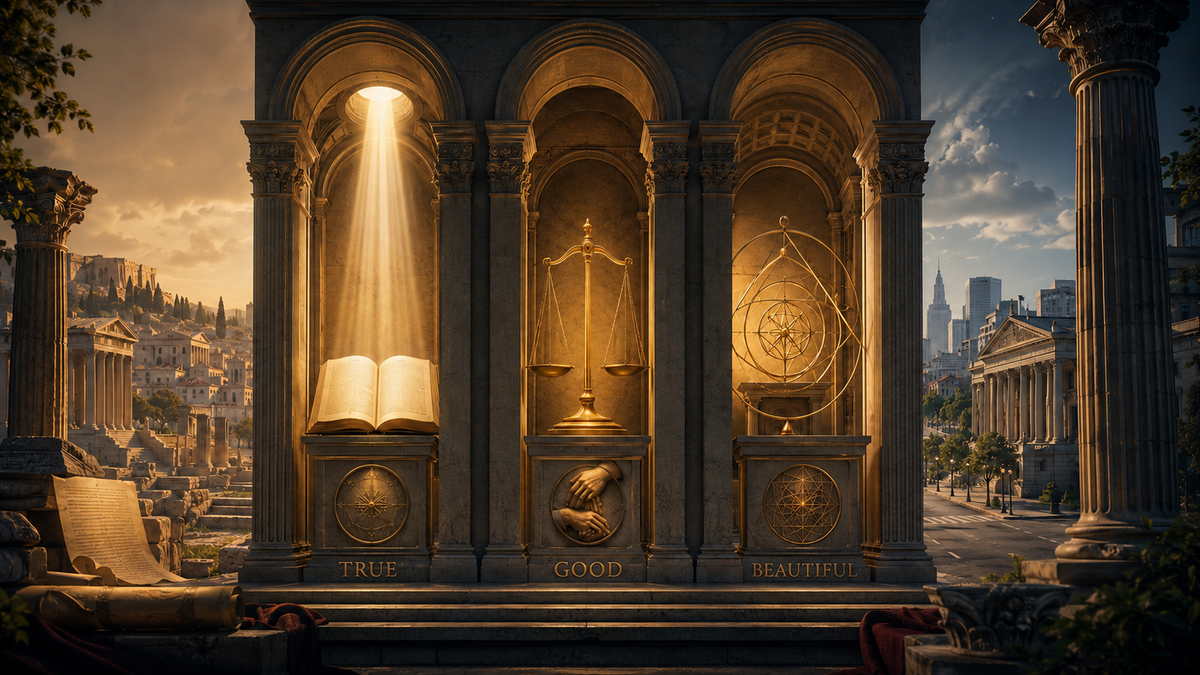
Why Truth, Goodness, and Beauty Have Guided Civilization for More Than 2,400 Years — and why recovering them is a civic task, not nostalgia.
Why Truth, Goodness, and Beauty Have Guided Civilization for More Than 2,400 Years — and why recovering them is a civic task, not nostalgia.
Consider an unlikely group of men. A pagan aristocrat in democratic Athens. His own student, who broke with him on nearly everything and trusted his eyes over his teacher’s visions. A third-century mystic writing in the twilight of Rome. And a thirteenth-century Dominican friar laboring inside a Church that regarded much of his source material with suspicion. Separated by as much as seventeen centuries, by language, religion, and temperament, they agreed on almost nothing about how the world worked.
And yet each arrived at the same conclusion: that reality, at its foundation, is marked by three qualities — the True, the Good, and the Beautiful — and that human flourishing depends on aligning ourselves with them.
The technologies change. The political conflicts change. The institutions change. The vocabulary changes. But beneath the surface, human beings keep returning to the same fundamental questions.
What is true?
What is good?
What is beautiful?
These questions are not academic decorations. They are civilization-shaping questions. They determine how people think, how leaders govern, how families form, how institutions operate, how communities endure, and how nations renew themselves.
In a time of confusion, distrust, polarization, and institutional weakness, it is tempting to believe the answer must be found in something entirely new — a new platform, a new policy, a new slogan, a new movement, a new strategy, a new personality, a new technology.
Modern life is not suffering from a shortage of information. It is suffering from a shortage of wisdom. We have more data than any civilization in history, yet less shared confidence about what is true, less agreement about what is good, and less of the harmony and order that classical thinkers called beautiful. The result is a culture that often mistakes noise for knowledge, preference for morality, and appearance for beauty. The transcendentals challenge that confusion.
Civilizations are not renewed by novelty — they are renewed when people recover what lasts. Across centuries, cultures, and institutions, some of history’s greatest thinkers repeatedly concluded that human flourishing depends upon alignment with Truth, Goodness, and Beauty.
That is the enduring power of the transcendentals.
They are not merely philosophical concepts. They are not relics of ancient Greece or medieval theology. They are not words reserved for scholars, clergy, or classrooms. Properly understood, they are a practical framework for life, leadership, citizenship, and civic renewal.
The True teaches us to align with reality.
The Good teaches us to fulfill purpose.
The Beautiful teaches us to build harmony, order, and wholeness.
Reality. Purpose. Order.
These are not luxuries. They are the architecture of flourishing.
For more than 2,400 years, some of the greatest minds in Western civilization have returned to them. That convergence is the puzzle worth our attention. When thinkers who disagree about everything else keep independently reaching the same destination, the honest question is not “who said it first?” It is: what did they all keep running into?
What the Transcendentals Actually Are
Before tracing why these ideas endured, it helps to define them precisely, because the modern ear tends to hear them as matters of taste.
In classical and medieval philosophy, the True, the Good, and the Beautiful are not three separate ideals you might rank by preference.
Damage one, and you cannot keep the others intact. A falsehood cannot serve a genuinely good end for long. A society that abandons its sense of purpose does not produce beautiful, well-ordered institutions; it produces fracture. This interdependence is precisely why the framework proved so difficult to discard — and why it is the natural successor to the question of why Truth, Goodness, and Beauty matter for civic life.
Plato and the Search for Ultimate Reality
The story begins in ancient Greece.
Plato did not use the medieval term “transcendentals.” He did not write the later scholastic doctrine of being, truth, goodness, and beauty. But he gave Western civilization one of its earliest and most influential accounts of why Truth, Goodness, and Beauty are more than temporary opinions or cultural preferences.
Plato lived in a world of political instability, public rhetoric, and competing claims about justice, virtue, knowledge, and power. He saw how easily people could be persuaded by appearances. He saw how public opinion could shift. He saw how societies could confuse popularity with wisdom. So, he asked a deeper question: Is there a higher standard beyond what people happen to believe at the moment? For Plato, the answer was yes.
Behind the changing world of appearances, Plato argued, there are higher realities — the Forms. These are not physical objects. They are the enduring standards by which particular things are understood.
A just law participates in Justice.
A beautiful object reflects Beauty.
A true statement corresponds to Truth.
A good life is ordered toward the Good.
In The Republic, Plato presents the Good as the highest reality, comparing it to the sun. Just as the sun makes physical sight possible, the Good illuminates reality and makes understanding possible. Without the Good, people may see shadows, but they do not see clearly. That insight matters far beyond philosophy.
If truth is only opinion, public life becomes manipulation.
If goodness is only preference, leadership becomes self-interest.
If beauty is only appearance, culture becomes performance.
Plato’s lasting contribution was the conviction that human beings need standards higher than appetite, fashion, faction, or force. A civilization must be ordered toward something real.
Aristotle and the Nature of Being
Aristotle, Plato’s student, approached the question differently.
Where Plato looked upward toward the Forms, Aristotle looked carefully at the world itself. He studied nature, logic, ethics, politics, causation, change, purpose, and being. His work was more empirical, more systematic, and more grounded in observation. Yet Aristotle also helped lay the foundation for what later thinkers would call the transcendentals.
He asked what it means for something to exist. This may sound abstract, but the question is deeply practical. If we do not understand what a thing is, we cannot understand what it is for. And if we do not understand what it is for, we cannot judge whether it is good.
A knife is good when it cuts well.
A school is good when it educates well.
A family is good when it forms people in love, responsibility, belonging, discipline, and sacrifice.
A government is good when it fulfills its proper role in preserving justice, order, security, liberty, and the common good.
This kind of reasoning depends on the idea that things have natures, purposes, and proper ends.
Aristotle’s world was not a random collection of isolated preferences. It was ordered. Things could be understood. Causes could be examined. Purposes could be evaluated. Human flourishing could be studied.
His ethics begins with the question of the good life. What does it mean for a human being to flourish? His answer is not merely pleasure, wealth, power, or status. It is a life of virtue, reason, responsibility, and excellence.
The same logic applies today.
Modern society often evaluates institutions by emotion, optics, tribal loyalty, or short-term results. Aristotle reminds us to ask a better question — "what is this thing for?"
That question cuts through confusion.
What is a family for?
What is a school for?
What is a business for?
What is government for?
What is citizenship for?
When institutions forget their purpose, they drift. When leaders forget purpose, they become reactive. When citizens forget purpose, public life becomes a contest for power rather than a shared responsibility for stewardship.
Aristotle helped give Western civilization a language for order, purpose, virtue, and flourishing.
That foundation would prove essential.
Plotinus and the Unity Behind Reality
Centuries later, Plotinus carried this tradition forward.
As a leading figure of Neoplatonism, Plotinus sought to explain the unity behind reality. He drew from Plato, but his thought also helped bridge classical philosophy and later Christian reflection.
For Plotinus, reality flows from a single ultimate source, often called “The One.” From this source come being, intellect, goodness, and beauty. The many things we encounter in the world are not disconnected fragments. They are related to a deeper unity.
This matters because it strengthens one of the most important insights of the transcendental tradition — Truth, Goodness, and Beauty are connected. They are not isolated values competing for attention.
Truth without goodness can become cold or manipulative.
Goodness without truth can become sentimental or naïve.
Beauty without truth and goodness can become empty image or seductive disorder.
But when truth, goodness, and beauty work together, they reveal something whole.
Plotinus helped preserve the idea that reality has unity, and that truth, goodness, and beauty are not merely useful human inventions. They are different ways of encountering a deeper order.
That idea would become central to medieval thought.
Aquinas and the Formal Doctrine of the Transcendentals
By the Middle Ages, Christian scholastic philosophers began giving this tradition a more formal structure.
Thinkers such as Philip the Chancellor, Albert the Great, and Thomas Aquinas developed the language of the transcendentals. Aquinas, in particular, gave the doctrine a lasting intellectual form.
In medieval philosophy, a transcendental is a property that applies to being as such. In simpler terms, it is not limited to one category of reality. It is not merely a feature of a certain kind of object, person, institution, or experience. It transcends categories.
The True is reality as it relates to the mind. It is knowable.
The Good is reality as it relates to the will. It is desirable.
The Beautiful is reality encountered with delight. It is truth and goodness experienced as harmony, proportion, and radiance.
That may sound philosophical, but its practical implications are enormous. If truth is connected to reality, then truth must be discovered, not invented. If goodness is connected to purpose, then goodness must be judged by whether something fulfills what it exists to do. If beauty is connected to harmony and order, then beauty cannot be reduced to image, style, or personal taste.
Aquinas and the scholastic tradition did not create these ideas out of nothing. They received, refined, and systematized a long inheritance.
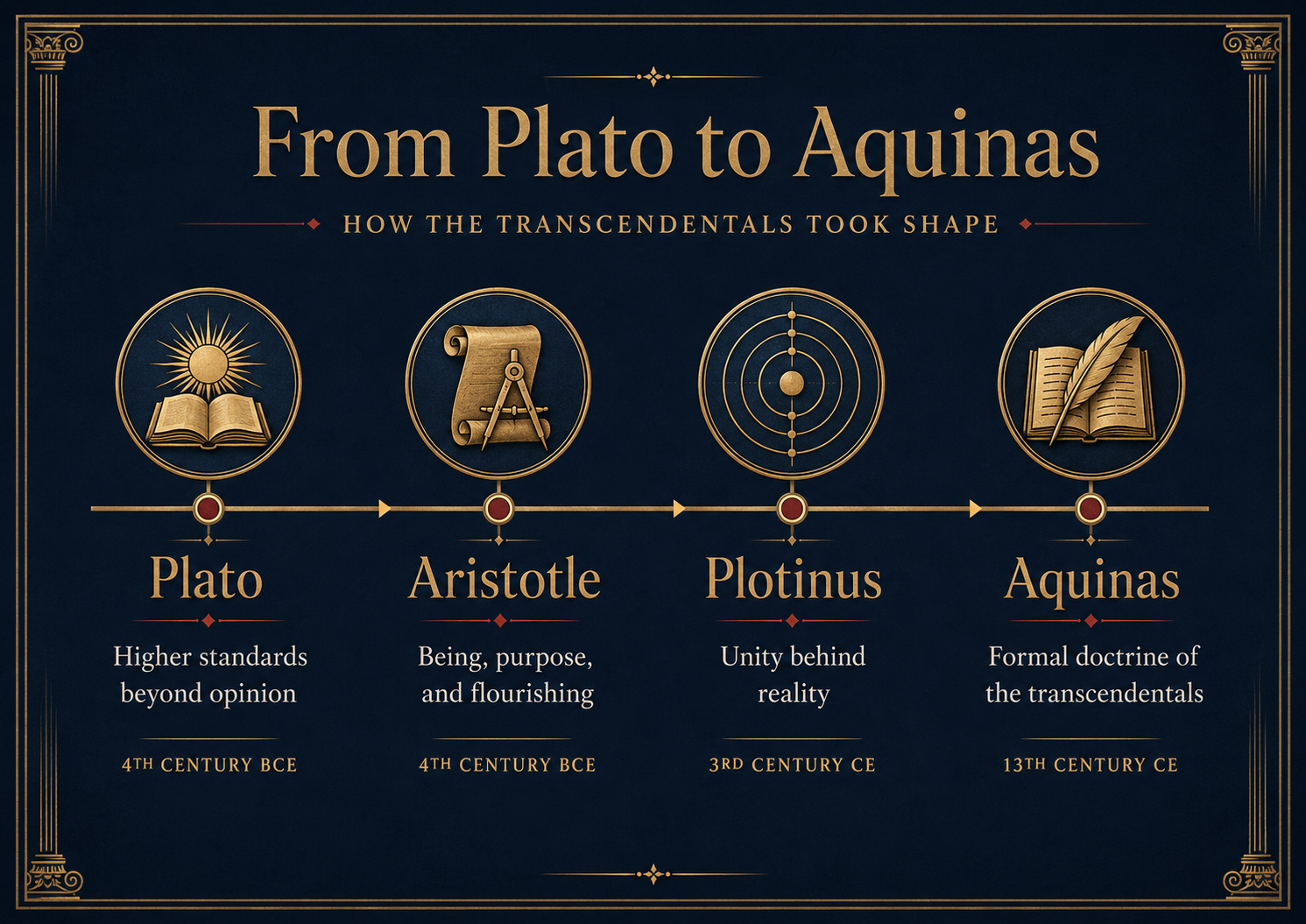
Plato gave the West a vision of higher realities.
Aristotle gave it a language of being, purpose, virtue, and flourishing.
Plotinus emphasized unity and the relationship among truth, goodness, and beauty.
Aquinas helped bring the tradition into a coherent framework that shaped theology, philosophy, education, law, ethics, art, architecture, political thought, and the broader moral imagination of Western civilization.
The more important question is why they survived.
Why These Ideas Survived for 2,400 Years
Thousands of ideas have come and gone.
Philosophical movements rise and fade. Political theories dominate for a season and then weaken. Cultural trends capture attention and then disappear. Slogans become popular and then lose their force.
But Truth, Goodness, and Beauty endure.
Why?
Ideas survive for one of two reasons: tradition protects them, or examination cannot break them. Tradition is fragile; it collapses the moment a serious challenger declines to be reverent. The transcendentals endured the second way. They were repeatedly handed to people positioned to discard them — an empiricist suspicious of his idealist teacher, a Christian wary of a pagan source — and those people, testing the framework against their own commitments, concluded it held.
Reality matters.
People seek truth because reality eventually asserts itself. A person can ignore facts, but not consequences. A business can manipulate reports, but not market reality forever. A government can distort language, but not indefinitely escape the results of bad policy. A family can avoid hard conversations, but unresolved truth does not disappear. It compounds.
Purpose matters.
People seek goodness because human beings cannot flourish on self-interest alone. A life built only on appetite becomes empty. A family built only on convenience becomes fragile. A business built only on extraction becomes exploitative. A nation built only on power becomes unstable.
Order matters.
People seek beauty because the human soul responds to order, harmony, excellence, and wholeness. We recognize the difference between a house and a home, between a crowd and a community, between a functioning institution and a trustworthy one, between a clever argument and a wise one.
That is why these ideas endure. Science seeks truth. Ethics seeks goodness. Art seeks beauty. Leadership requires all three. Citizenship requires all three. Civilization requires all three.
When a society honors truth, it can correct itself.
When a community honors goodness, it can direct itself toward human flourishing.
When a nation honors beauty, it can inspire loyalty, gratitude, trust, and belonging.
But when a society rejects truth, it becomes vulnerable to manipulation. When it abandons goodness, it becomes vulnerable to selfishness. When it loses beauty, it becomes vulnerable to disorder. This is not merely a philosophical warning. It is a civic diagnosis.
The transcendentals survived because they describe permanent human needs.
People need purpose.
People need order.
No technology can replace those needs. No political victory can erase them. No cultural trend can make them obsolete.
What the Transcendentals Mean for American Civic Life
A healthy public square can be understood as the three transcendentals operating together. Truth is the shared commitment to facts and reality over narrative and assumption — the precondition for any honest disagreement. Goodness is the orientation of institutions toward their actual purpose: courts that adjudicate, schools that educate, representatives who represent. Beauty is the harder-to-name quality of a republic in which citizens can argue fiercely over policy while remaining bound by mutual respect and a shared identity.
The framework also explains our present strain with uncomfortable precision. When public life weaponizes falsehood to provoke division, the predictable result is a fractured and disordered civic landscape — the Untrue producing the Bad, yielding the Ugly. The classical thinkers would not have found our condition mysterious. They would have recognized it as the consequence of severing three things that were never meant to be separated.
A Practical Test, Not Nostalgia
The point of recovering the transcendentals is not nostalgia.
The value of a 2,400-year-old framework is not that it lets us admire the past. It is that it hands us a usable standard for the present. The point is to recover durable principles that can help modern people think more clearly, lead more responsibly, and rebuild trust where it has been weakened.
Truth: Rebuilding Shared Reality
A healthy society requires a shared respect for reality.
That does not mean everyone will agree on every policy, priority, or interpretation. Disagreement is part of public life. A free society should always include debate.
But debate becomes impossible when people no longer care what is true. When facts become weapons, language becomes manipulation, and narratives become more important than evidence, trust begins to collapse.
Citizens stop asking, “Is this accurate?” They begin asking, “Does this help my side?”
That is how public life becomes dishonest.
Truth requires discipline. It requires intellectual humility. It requires the courage to examine evidence that complicates our assumptions. It requires leaders who tell people what is real rather than what is emotionally satisfying. It requires citizens who would rather be corrected than manipulated.
A culture that wants renewal must recover respect for reality. It is not ‘my truth.’ It is not ‘your truth.’ It is the truth — reality as it is.
Goodness: Recovering Purpose and Responsibility
A healthy society also requires goodness.
But goodness cannot mean whatever benefits the individual, the faction, the institution, or the moment. Goodness is rooted in purpose. A school is good when it educates. A family is good when it forms people in love, discipline, sacrifice, responsibility, and belonging. A government is good when it protects ordered liberty, administers justice, preserves public safety, and serves the common good.
This is where civic renewal becomes personal. It is easy to criticize institutions. It is harder to strengthen them. It is easy to condemn national decline. It is harder to build trust in the places we actually touch. It is easy to demand better leaders. It is harder to become the kind of person who makes leadership better.
The Good calls us away from cynicism and toward stewardship.
It asks: What is my responsibility? What would it look like to serve rather than merely complain? What can I improve?
A society recovers goodness when individuals, families, businesses, churches, schools, civic organizations, and public institutions recover purpose.
Beauty: Restoring Order, Trust, and Belonging
Beauty may be the most misunderstood of the three.
Modern people often reduce beauty to appearance. But classical beauty is far deeper than image. Beauty is harmony, order, and excellence made visible.
A loving household has beauty. A neighborhood where people know and help one another has beauty. A public meeting where disagreement remains respectful has beauty. A nation that remembers its inheritance with gratitude and improves it with responsibility has beauty.
This kind of beauty cannot be manufactured through branding. It cannot be faked through public relations. It cannot be created by image management. It must be built. And building it requires habits.
Tell the truth. Have integrity. Practice excellence. Be responsible. Honor commitments. Serve others. Be grateful.
This is how beauty returns to civic life. Not all at once. Not from the top down. But from the bottom up. One person. One household. One school. One business. One church. One neighborhood. One institution. One community at a time.
The Transcendentals as a Framework for Renewal
The power of the True, the Good, and the Beautiful is that they do not remain trapped in theory. They become questions we can actually use.
For any decision, leader, institution, policy, business, family, or community, we can ask:
Is it true?
Does it align with reality, evidence, facts, incentives, constraints, and consequences?
Is it good?
Does it fulfill the proper purpose of the person, family, organization, or institution involved?
Is it beautiful?
Does it create greater order, trust, harmony, integrity, excellence, and long-term confidence?
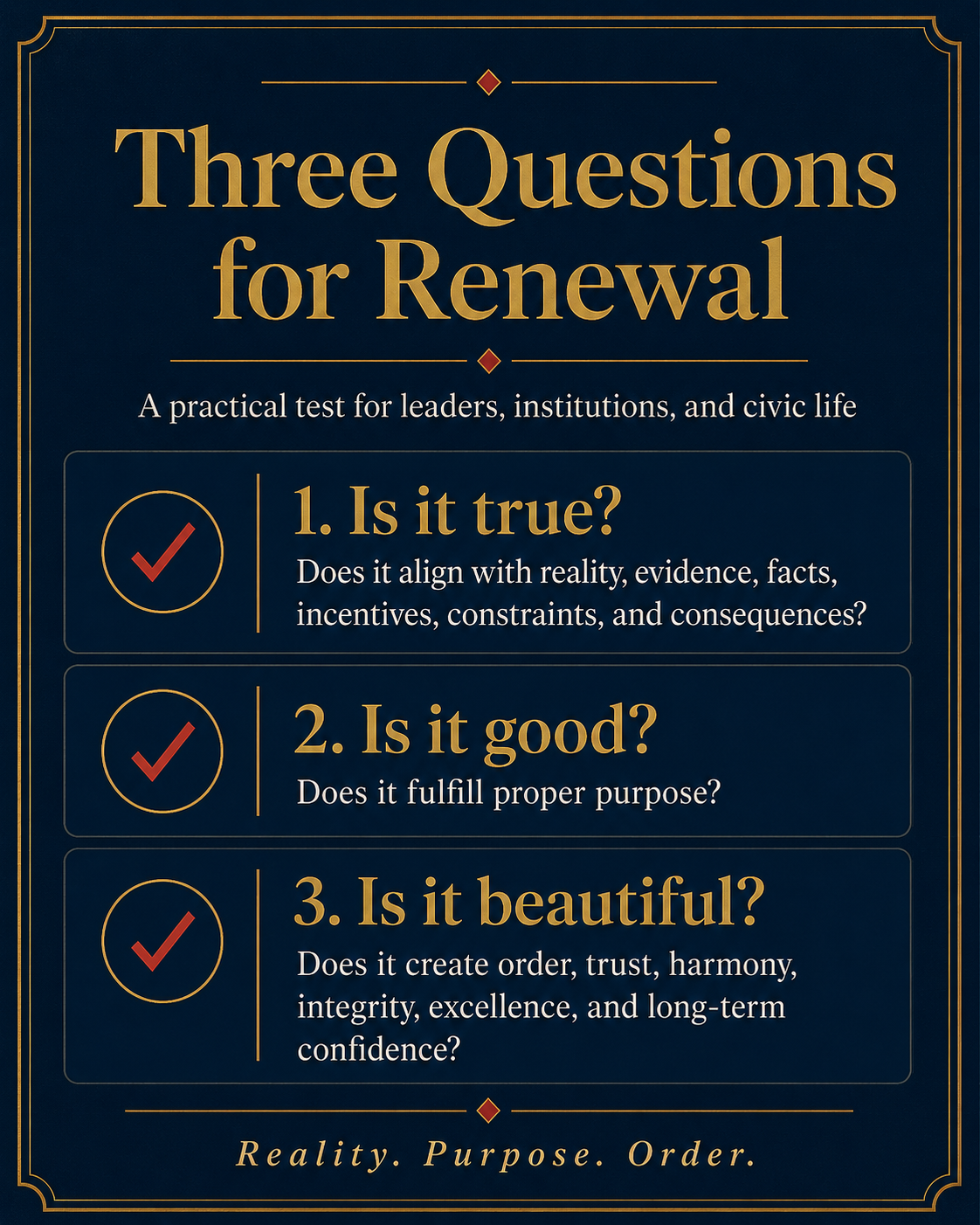
Those questions clarify, expose distortion, reveal mission drift, challenge shallow thinking, and force us to move beyond emotion, image, and short-term advantage.
They also remind us that renewal is not merely a public project. It is a personal one. A republic cannot be healthier than the people who sustain it. That means civic renewal begins close to home.
It begins with the individual who refuses to lie. It begins with the parent who forms children in responsibility. It begins with the teacher who still believes excellence in education matters. It begins with the business owner who serves customers and employees with integrity. It begins with the citizen who serves others and participates locally instead of only reacting nationally. It begins with the leader who chooses reality over narrative, purpose over popularity, and order over applause.
Recovering What Lasts
Every generation must decide what it will build on:
Some build on power. Some build on pleasure. Some build on image. Some build on ideology. Some build on resentment. Some build on whatever happens to be popular at the moment.
Foundations matter.
A life built on illusion eventually meets reality. An institution detached from purpose eventually loses trust. A community indifferent to order eventually becomes fragmented. When a nation loses sight of truth, goodness, and beauty, it eventually loses the ability to renew itself.
That is why these ideas have endured for more than 2,400 years. They are not old because they are obsolete. They are old because they are permanent.
Plato saw that human beings need standards beyond opinion.
Aristotle saw that reality has purpose and order.
Plotinus saw that truth, goodness, and beauty are connected.
Aquinas helped give this inheritance a formal structure that shaped centuries of Western thought.
But their greatest contribution is not merely historical. Their contribution is practical. They remind us that civilization depends on more than wealth, power, technology, or politics. It depends on people who can see clearly, serve rightly, and build faithfully.
The True reminds us to return to reality.
The Good reminds us to recover purpose.
The Beautiful reminds us to restore order.
Together, they give us more than a philosophy. They give us a path.
The challenge before us is not simply to admire Truth, Goodness, and Beauty from a distance. The challenge is to practice them. To tell the truth when distortion would be easier. To pursue the good when selfishness would be more convenient. To build beauty, order, and trust when cynicism would be more fashionable.
That is the work of renewal.
It does not begin somewhere far away. It begins with the people and places we can touch. It begins when individuals decide to stop drifting. It begins when families become stronger. It begins when institutions recover purpose. It begins when communities rebuild trust. It begins when citizens remember that responsibility belongs not only to someone else, but to each of us.
Civilizations change. Technologies evolve. Political movements rise and fall. But every generation must still answer the same questions.
What is true?
What is good?
What is beautiful?
The future depends on how we answer. And more importantly, how we live.
— Matt Cucinotta | Growth Solutions KC | Inspire · Inform · Ignite
For more on the transcendentals, check out GSKC's publication, "The Transcendentals of Civic Renewal."


Comments ()