

Energy Policy Has Consequences

How America Can Power the AI Era Without Sacrificing Reliability, Affordability, or Growth
Part 8 of the Growth Solutions KC AI Energy Series
Artificial intelligence moves at digital speed. Energy infrastructure moves at physical speed. That tension has followed us through this entire series.
A new AI model can be developed in months. Computing demand can rise almost overnight. A data-center campus can move from concept to construction remarkably quickly.
Power plants, transmission lines, substations, pipelines, transformers, regulatory approvals, utility planning, and community infrastructure operate on very different timelines. And electricity demand is no longer standing still while those systems catch up.
The U.S. Energy Information Administration expects American electricity generation to reach record levels in both 2026 and 2027, with data-center development and manufacturing contributing to stronger commercial and industrial demand. U.S. Energy Information Administration
That does not create one obvious energy solution. It creates a systems challenge.
- Natural gas can help meet some near-term demand.
- Nuclear can provide durable firm power.
- Small modular reactors may broaden the nuclear model if commercialization succeeds.
- Renewables can add substantial generation.
- Batteries can provide flexibility.
- Transmission has to move electricity where it is needed.
- Data centers may become more responsive to grid conditions.
- Artificial intelligence itself may help utilities operate the system more efficiently.
- Communities still have to live with the infrastructure that makes all of it possible.
The central lesson is therefore larger than any individual technology.
There is no single energy source that solves the AI electricity challenge.
That means the real question is no longer simply what kind of power America should build. It is whether generation, grids, utilities, technology companies, communities, regulators, capital, and emerging technologies can function as parts of the same system.
Policy matters because rules and incentives influence what gets built, how quickly it gets built, who carries the cost, how risks are allocated, and whether communities trust the result.
The consequences appear throughout the system.
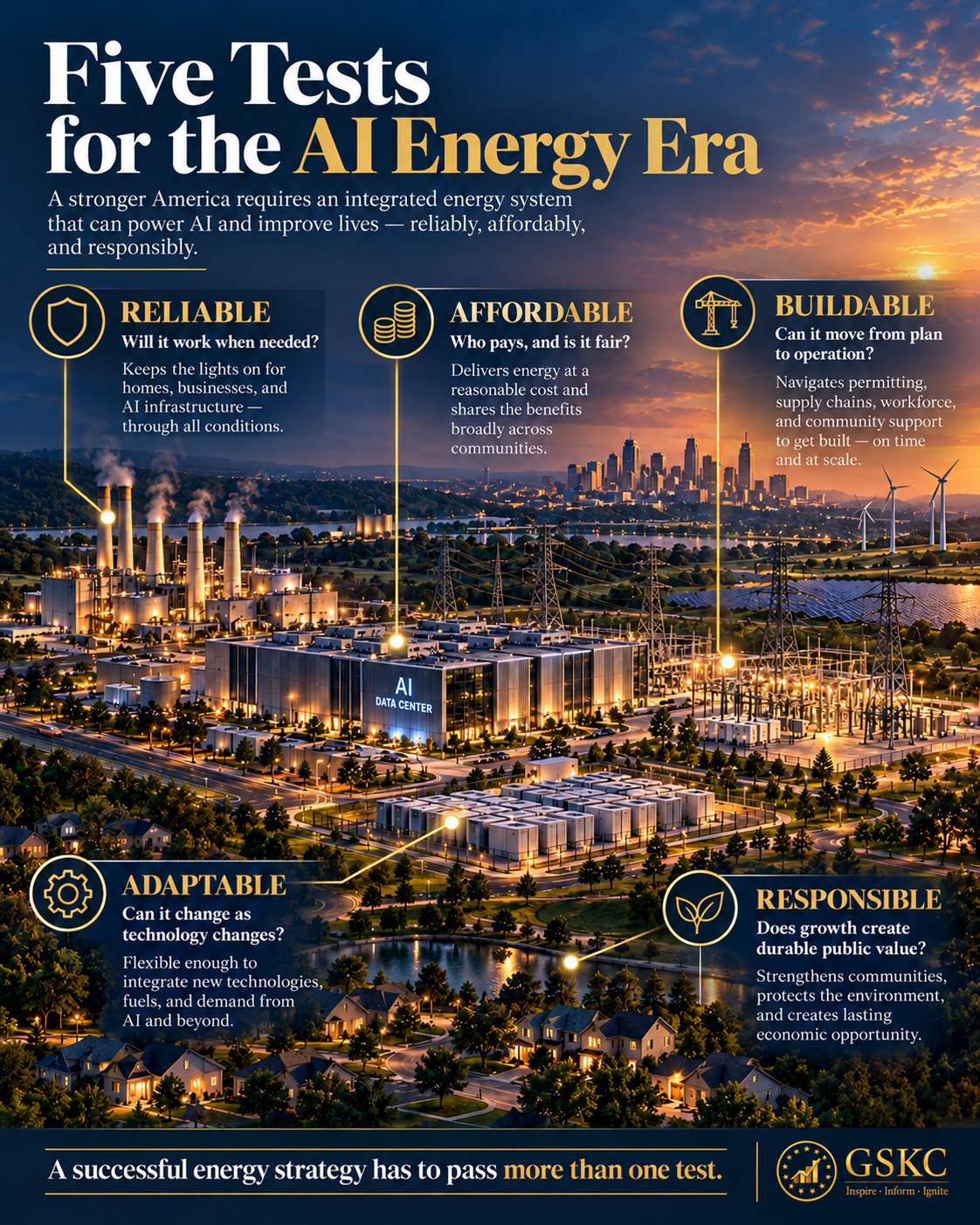
Five Tests for the AI Energy Era
After seven articles examining individual pieces of the energy puzzle, a useful way to evaluate the whole system is through five questions.
Is it reliable, affordable, buildable, adaptable. and responsible?
Those tests do not tell us that one technology wins. They tell us what the system ultimately has to accomplish.
Reliability: Will It Work When Needed?
Electricity is unusual infrastructure because supply and demand have to remain balanced continuously.
The International Energy Agency's 2026 electricity outlook emphasizes that changing generation patterns, storage, and highly concentrated new loads such as data centers require greater system flexibility alongside expanded grids. IEA
The goal is not simply to produce more electricity. It is to create a system capable of delivering electricity reliably under changing conditions.
Affordability: Who Pays?
Finding the right balance may be one of the toughest challenges in the AI energy transition.
If a big data center needs a new substation, transmission upgrade, or other dedicated facilities, someone has to pay for it. And if the project never materializes after the infrastructure is built, that cost still has to be covered.
FERC's 2026 large-load proceedings explicitly address this problem. Commissioner David Rosner described cost-recovery agreements designed to ensure that large new customers bear their share of infrastructure costs even if projects do not come online as originally planned, rather than leaving those costs with residential customers. Federal Energy Regulatory Commission
But the issue is not always simple. Some infrastructure serves one customer. Other upgrades can strengthen a shared grid and provide value to entire communities for decades. That is why affordability cannot be reduced to either make the data center pay for everything or spread everything across the system.
The challenge is building for credible demand and assigning costs fairly.
Affordability is not simply about building less. Reliability is not simply about building more.
Buildability: Can It Actually Happen?
The energy world contains plenty of announced megawatts. Announced megawatts do not power anything. A project that cannot survive reasonable review may not be ready to build. A project trapped indefinitely in an uncertain process cannot solve an infrastructure problem either.
A project still has to secure land, financing, equipment, permits, fuel where required, transmission access, interconnection approval, workers, and construction capacity. Then it has to operate.
The relevant test is whether a system can protect legitimate public interests and still reach decisions within a workable period of time.
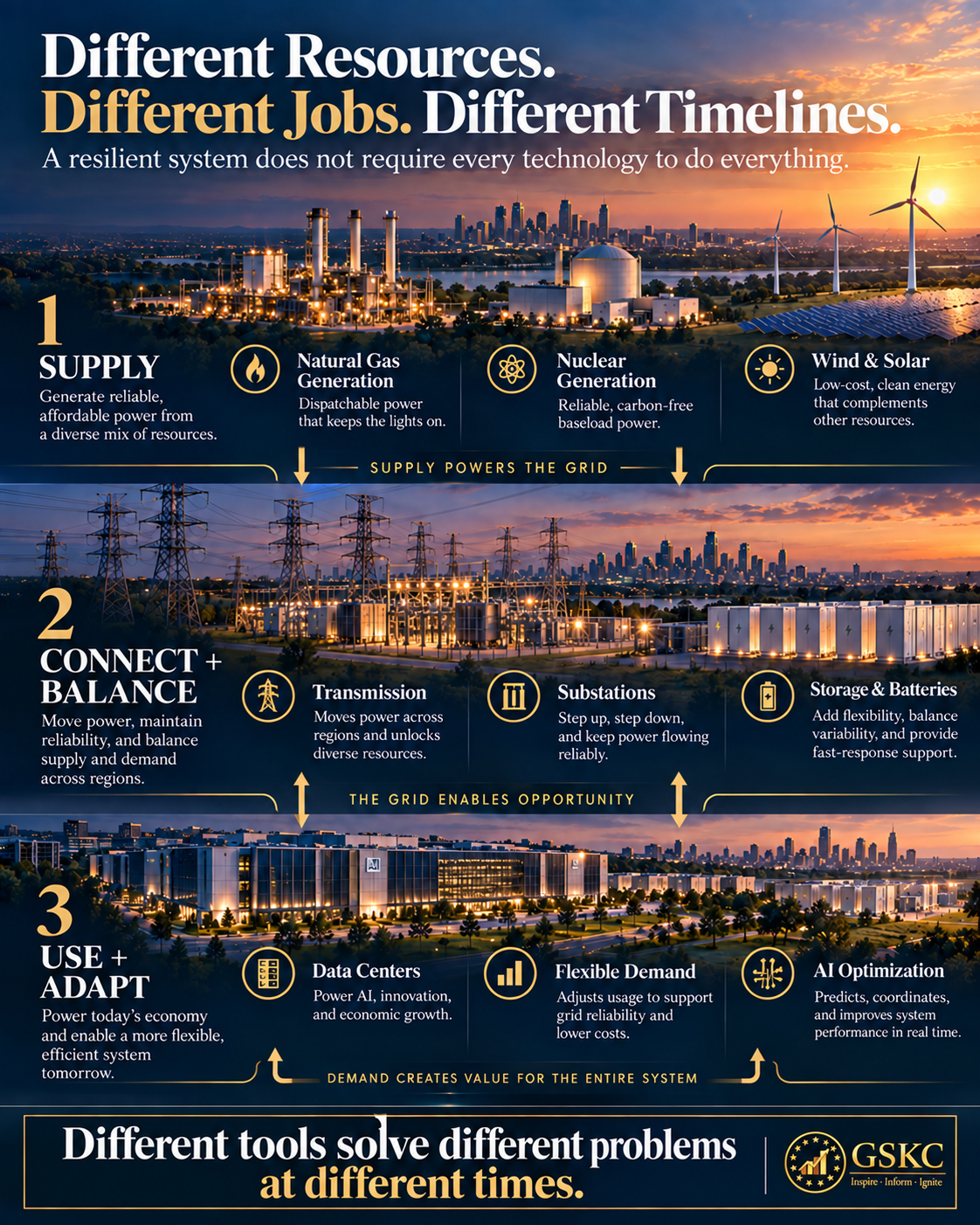
Different Resources. Different Jobs. Different Timelines.
Much of America's energy debate treats technologies as competitors in a contest where one must defeat the others. Different resources solve different problems.
Natural gas can offer relatively fast firm generation but requires fuel infrastructure and creates emissions and long-lived asset questions.
Nuclear provides dependable power over long periods but large projects take substantial time and capital.
SMRs may eventually broaden nuclear deployment, but commercialization still has to prove repeatability and economics.
Wind and solar can add generation without fuel costs, but their output changes with weather and time.
Batteries can respond quickly and help balance the system but store electricity rather than create primary energy.
Transmission connects generation to demand.
Flexible loads can sometimes reduce system stress.
Artificial intelligence can improve forecasting and optimization but cannot eliminate physical constraints.
A resilient system does not require every technology to do everything. It requires different technologies to perform the jobs they are suited to perform.
Adaptability: Can the System Change?
That leads to the fourth test.
Energy infrastructure lasts decades. Technology can change much faster. That means the system needs room to adapt.
FERC's current large-load proceedings acknowledge that some large customers can alter their consumption quickly and are examining frameworks that account for flexible loads alongside traditional grid expansion. Federal Energy Regulatory Commission
Internationally, the IEA similarly identifies demand-side participation and storage as important tools for increasing system flexibility as generation and demand patterns change. IEA
This does not eliminate the need to build. It changes how planners think about what must be built now and how it can be managed more intelligently.
A resilient system needs enough flexibility to adjust when reality differs from the forecast.
Responsibility: Growth Happens Somewhere
National infrastructure debates can sound abstract. Development is never abstract to the people living beside it.
A data center is built in an actual community. Transmission crosses actual property. Power plants occupy actual land. Utility costs appear on actual bills. Workers build the facilities. Emergency services respond to them. Local governments approve them. Communities experience both the economic gains and the physical consequences.
That is why national competitiveness and local stewardship cannot be separated.
Article 6 argued that the objective should not be choosing between AI growth and healthy communities. The objective should be designing infrastructure so that growth strengthens the places that host it.
A legally approved project can still become politically and socially difficult if communities believe its costs were hidden or its benefits exaggerated.
A well-designed project can create a different relationship when commitments are transparent, costs are allocated credibly, expectations are realistic, and local benefits can be measured over time.
Growth becomes more durable when the people hosting the infrastructure can see how they participate in its value.
The System Only Works if the Institutions Work Together
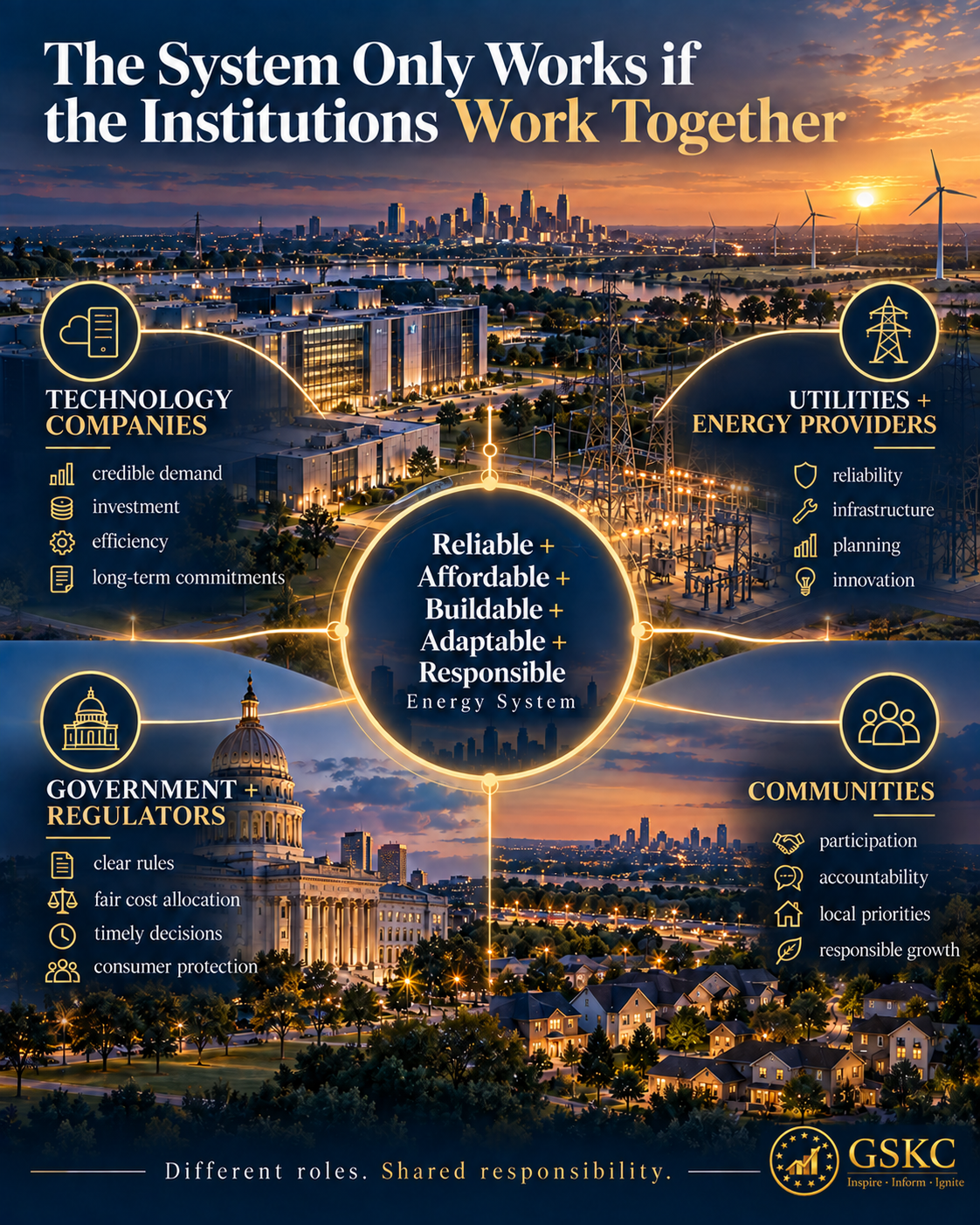
No participant can solve the AI energy challenge alone.
Technology companies have capital and rapidly growing electricity demand, but they do not operate the entire electric system. They can provide credible demand commitments, invest for the long term, use electricity efficiently
Utilities and Energy providers understand the grid and build generation, but they cannot control every development decision or technology timeline. They can plan against credible demand, maintain reliability, invest in infrastructure, and adapt operating models as large loads change.
Governments and regulators establish rules and protect public interests, but they do not manufacture transformers or construct every power plant. They should provide transparent rules, evaluate cost allocation, protect consumers, and make decisions predictably.
Communities host the physical infrastructure, but local decisions can have consequences far beyond local boundaries. Each community needs to participate early, demand accountability, evaluate real costs and benefits, and distinguish responsible growth from poorly structured development.
Each participant has a different role. The system works when those responsibilities reinforce one another. It struggles when each participant attempts to push its risks onto someone else.
There Is No Universal Global Model
The challenge is not uniquely American. Other countries are also confronting the collision between digital growth and physical infrastructure.
Their responses differ.
Singapore, for example, allocates new data-center capacity through a competitive process that evaluates strategic economic contribution and sustainability commitments, reflecting the country's unusually tight land and energy constraints. In August 2026, Singapore provisionally allocated 200 MW of new capacity through that framework. IMDA
Other markets emphasize different combinations of efficiency requirements, generation expansion, grid development, or flexible demand. There is no reason to assume that an energy strategy designed for a small, dense island nation should look identical to one designed for Texas, Virginia, Missouri, France, or Japan.
The appropriate response depends on the resources, grid, institutions, geography, costs, and communities involved.
What Happens Next
Seven articles brought us here.

We followed the cost of the AI power boom, examined nuclear and SMRs, natural gas, the grid, communities, and the possibility that artificial intelligence may help make the energy system itself more intelligent.
The final lesson is none of them works alone.
America does not need to choose between AI leadership, affordable electricity, reliable power, and responsible development. Achieving all four will require better planning, better incentives, faster infrastructure development, and clearer accountability.
The challenge is building a system capable of making many imperfect resources work together. It means:
- Build what we need.
- Pay for it fairly.
- Use it intelligently.
- Strengthen the communities that host it.
- Remain adaptable as technology changes.
These are questions of agency, responsibility, and stewardship.
Artificial intelligence may be digital. Its future will be built in the physical world.
The question is whether we build that future wisely.
— Matt Cucinotta | Growth Solutions KC | Inspire · Inform · Ignite
Source and methodology note: This article serves as the capstone to the Growth Solutions KC AI Energy Series and synthesizes issues examined throughout the preceding articles. Current factual context is drawn primarily from the U.S. Energy Information Administration, U.S. Department of Energy, Federal Energy Regulatory Commission, International Energy Agency, and other primary or institutional sources. Electricity markets, resource availability, regulatory structures, infrastructure needs, community impacts, and appropriate technology mixes vary significantly by region. The article does not assume that one generation technology or policy framework is appropriate in every market.
Transparency Note: This article was developed with AI assistance and reviewed, edited, and finalized by Growth Solutions KC prior to publication.



Comments ()