

The New Data-Center Bargain: How Communities Can Make the Deal Work for Them
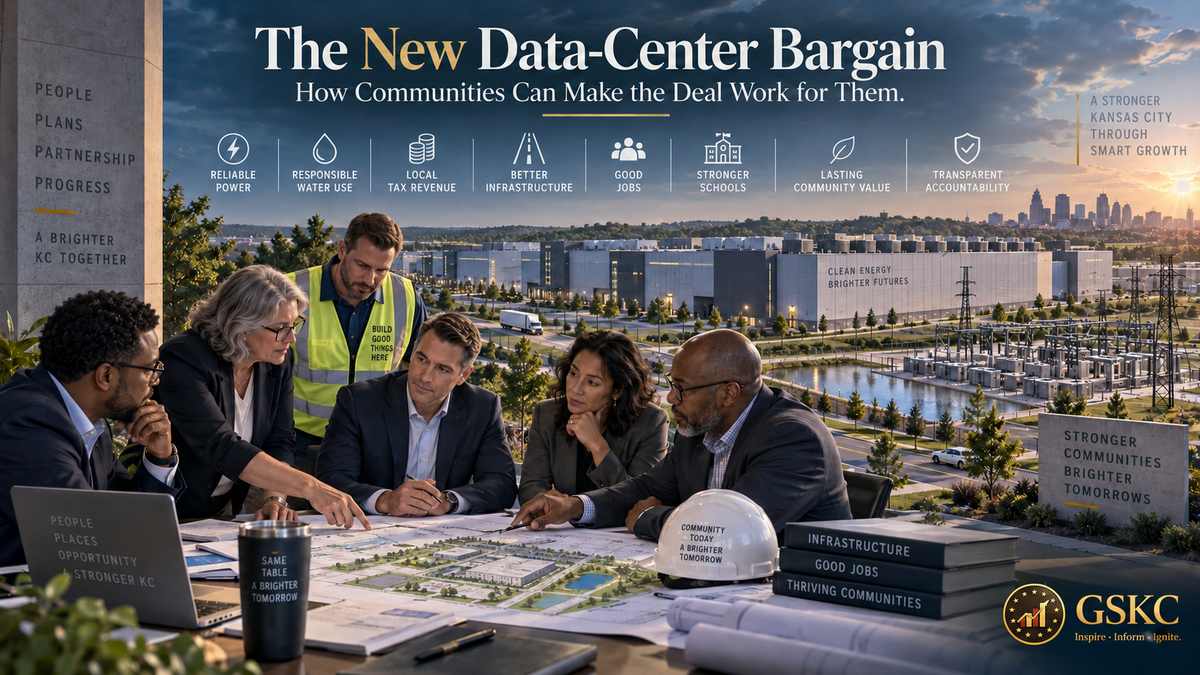
Communities do not have to choose between accepting whatever is offered and rejecting development altogether. They can negotiate a stronger deal—one that protects residents, captures public value, and establishes the rules before construction begins.
Data centers are becoming necessary infrastructure.
A community is approached with a proposal.
Hundreds of millions—or billions—of dollars in investment. New construction. New tax revenue. New infrastructure. Perhaps a recognizable technology company somewhere behind the project.
Then come the questions.
How much electricity will it need? How much water? Who pays for the substation? What happens to utility rates? How close will the buildings sit to homes? How much tax revenue actually remains after incentives? What happens if the project doubles in size five years later?
Those questions are sometimes treated as evidence that a community is hostile to growth. They should not be. They are the questions responsible communities are supposed to ask.
Parts I through III of The Data-Center Divide established three things. First, data centers are physical infrastructure supporting an increasingly digital economy. Second, their benefits and costs are both real. Third, Loudoun County’s decades of experience show that the rules governing them sometimes have to evolve as the industry itself changes.
That brings us to the practical question.
What should a community do before the next project is built?
The answer is negotiation.
Not negotiation as confrontation, but negotiation as governance.
A good data-center bargain answers four questions before construction begins: What exactly is being built? Who pays for what it requires? How does the community share in the value? And what happens if the promises are not kept?
I. KNOW WHAT YOU ARE NEGOTIATING
The first mistake a community can make is negotiating against an incomplete project description.
“Data center” is not enough.
How many buildings? How many phases? What is the maximum buildout? How much electricity will the first phase require—and how much could the final phase require? What cooling system is proposed? How much water will it need? Will the operator own the facility, lease it, or sell it? What backup generation is planned? What infrastructure has to be built before the first server turns on?
Those details change the bargain.
Texas recently confronted this problem at extraordinary scale. In August, Governor Greg Abbott ordered state grid officials to verify data-center projects seeking interconnection before allowing them to move forward. ERCOT was considering more than 474 gigawatts of requested connections—more than five times the state’s record peak electricity demand. The point of the review was partly to determine which proposed projects were real, financially credible, and capable of meeting their obligations.
A city does not need Texas-sized demand to learn from that principle.
Before committing scarce land, utility capacity, public infrastructure, or incentives, verify the project.
Temple, Texas, is moving in that direction at the local level. Its evolving rules would require conditional-use approval for major data centers, more technical information, noise planning, setbacks from homes, traffic analysis, and utility agreements. In the Rowan proposal, the developer has also committed significant funding toward water infrastructure while proposing closed-loop cooling.
The lesson is not that every community should copy Temple. It is that the negotiating table becomes much more useful once everyone knows what is actually on it.
A community cannot negotiate intelligently against a project description that keeps changing.

II. SET THE TERMS BEFORE THE COSTS ARRIVE
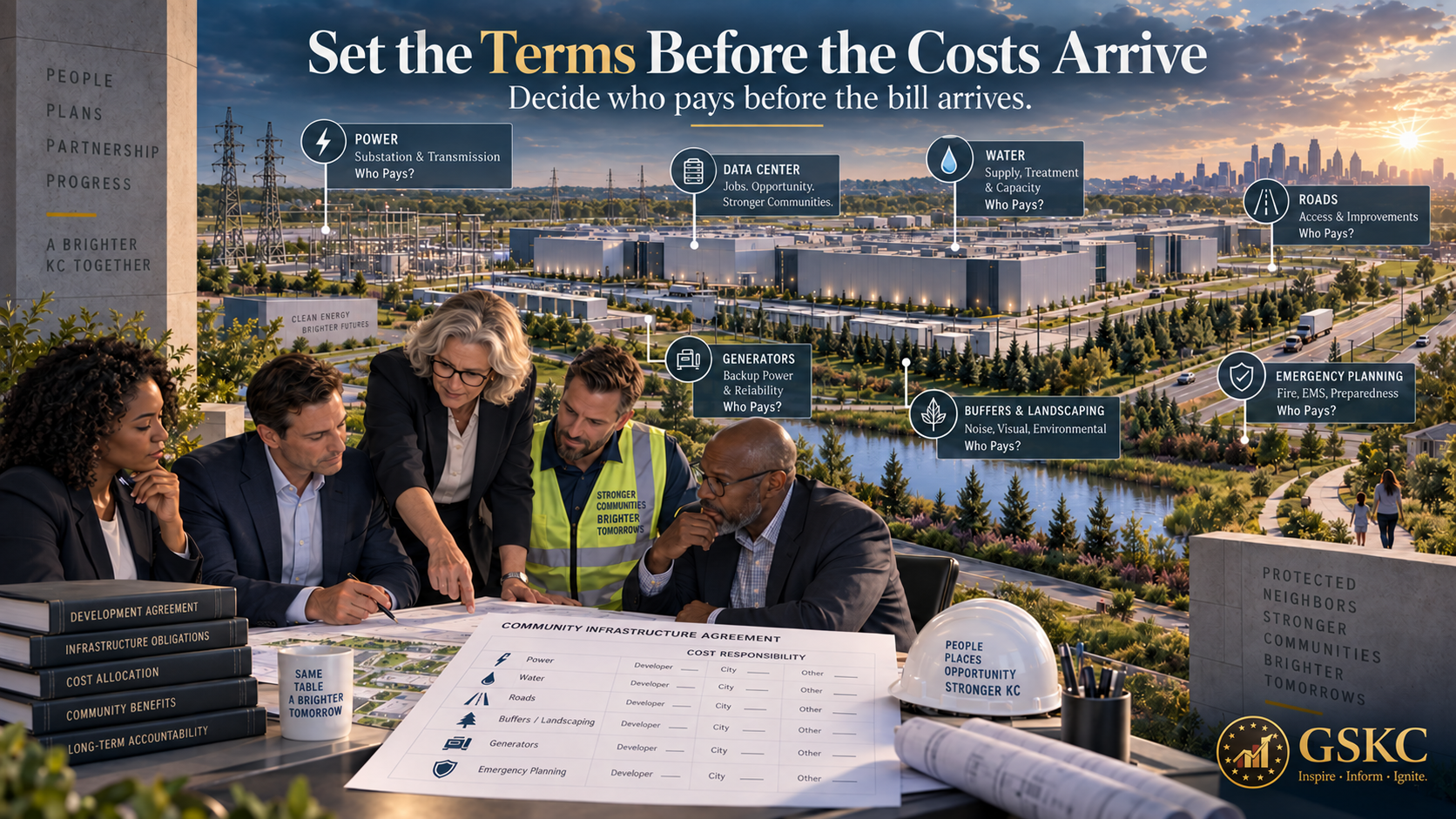
Once the project is defined, the next question is simple: Who pays?
Large data centers can require substations, transmission upgrades, water infrastructure, road improvements, emergency-response planning, and other investments.
Those facilities may ultimately benefit the broader community. But the existence of a broader benefit does not automatically mean existing residents should finance infrastructure primarily required by a new industrial load.
Missouri has become a useful example.
In 2025, state law required the Missouri Public Service Commission to establish large-load rates that reflect the costs those customers create and protect residential and ordinary commercial customers from unjust or unreasonable cost shifts.
The resulting Ameren and Evergy tariffs include long service commitments, financial-security requirements, exit fees, minimum monthly bills, and cost-recovery provisions intended to make large-load customers pay the full cost of serving them.
That is an important distinction.
The power problem is real. Cost shifting is not inevitable.
Microsoft has embraced a similar principle voluntarily. Its 2026 Community-First AI Infrastructure initiative says the company will support rates high enough to cover the electricity infrastructure its data centers require rather than asking the public to shoulder those additional costs. Microsoft also says that where water-system improvements are needed for its facilities, it will work with utilities on solutions that do not burden the host community.
That same principle should extend beyond electricity.
- If a project requires a road to be widened, decide who pays before construction traffic begins.
- If water infrastructure must be expanded, define the project’s share.
- If new sound walls, setbacks, buffers, or landscaping are necessary, put them in the approval.
- If backup generators require operating limits or testing schedules, establish those rules before neighboring residents start hearing them.
Growth creates infrastructure obligations. A good bargain decides who carries them before the bill arrives.
III. THE COMMUNITY SHARES IN THE VALUE
Paying for the costs a project creates is only one side of the bargain.
The other is value.
A community is providing something scarce: land, infrastructure capacity, public approvals, predictability, and permission to operate an industrial-scale facility for decades.
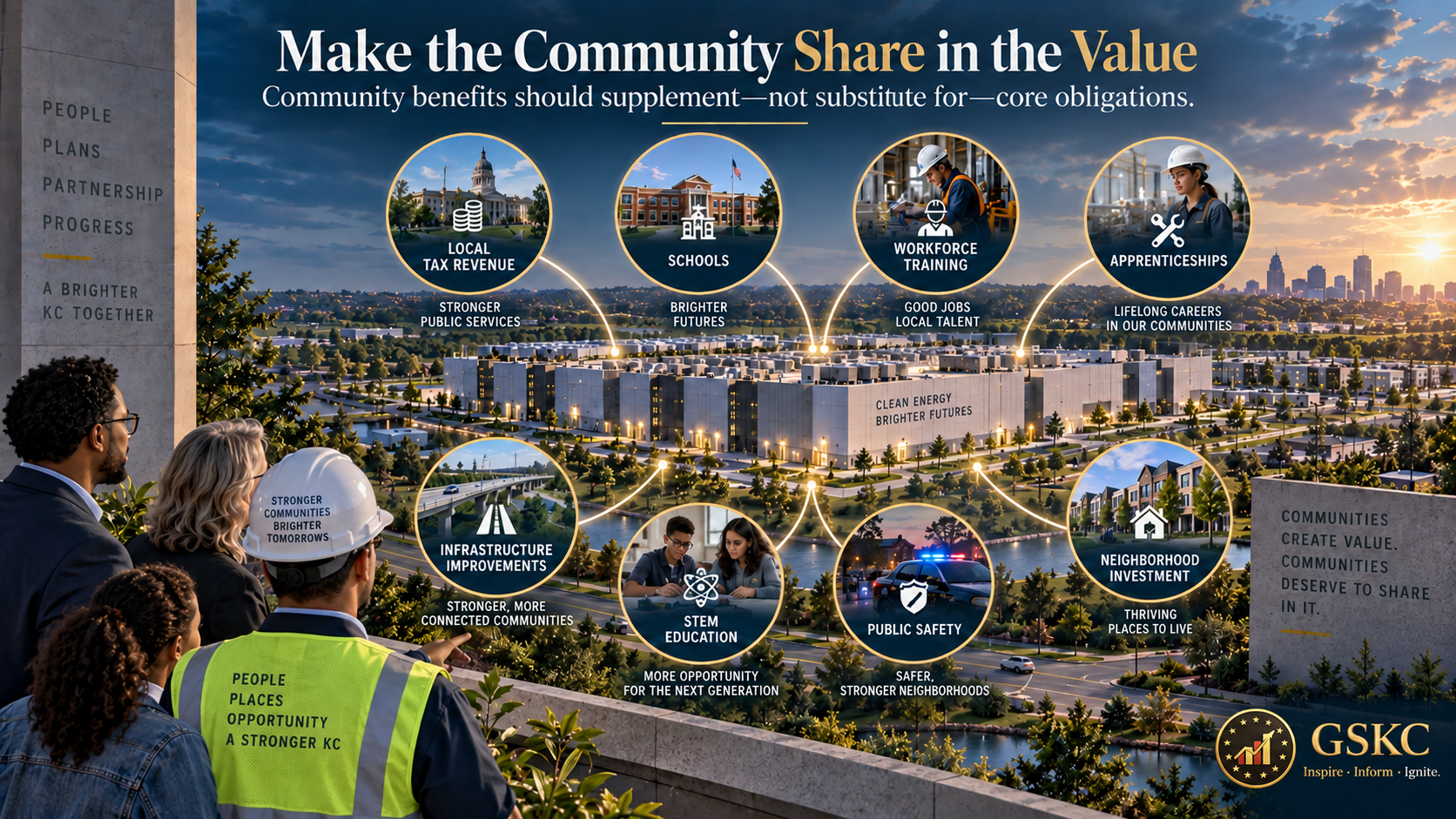
It is reasonable to ask what lasting value the community receives in return. Tax revenue is part of that answer. But it should not be the entire answer.
Google’s recent Missouri investments illustrate how companies are beginning to think more broadly about host communities. Alongside its new data-center development, Google announced a framework with Ameren supporting more than 500 megawatts of additional capacity while covering its operational and infrastructure costs. It also established a $20 million Energy Impact Fund aimed at weatherization and energy-efficiency programs for households, while supporting local workforce and apprenticeship programs.
Microsoft’s model similarly combines utility-cost responsibility with jobs, taxes, local training, and nonprofit investment.
These examples should not be treated as proof that every corporate promise always delivers exactly what is advertised.
They demonstrate something more useful:
The community relationship itself can be designed.
St. Louis offers perhaps the clearest current example.
In approving the Armory Innovation data-center project, the city attached conditions involving closed-loop and air-cooled cooling, water cost-of-service protections, noise, sustainability, monitoring, and other operating requirements. The city also negotiated a community-benefits framework that includes an estimated $15 million contribution, no request for local tax abatement, infrastructure and mobility improvements, and legal remedies if specified commitments are not met.
A similar approach is emerging in Frederick County, Maryland, where developers behind a proposed digital campus have reportedly offered a community package spanning schools, recreation, workforce training, agricultural preservation, and water reclamation, while also reducing the planned footprint and potable-water demand. The proposal is still under review, but the direction is significant: communities are increasingly asking developers to put measurable benefits and resource protections into the deal before approval—not simply promise economic growth afterward.
This is where communities have to distinguish between obligations and benefits.
A company should pay its fair share of infrastructure costs because that is part of doing business responsibly.
A scholarship fund, apprenticeship program, STEM initiative, park improvement, or community grant can create additional value. But philanthropy should never become a substitute for basic responsibility. The better bargain includes both.
Community benefits should supplement—not substitute for—the developer’s core obligations.
IV. WRITE A DEAL THAT SURVIVES THE RIBBON CUTTING
Most economic-development announcements focus on the beginning.
- Groundbreaking.
- Construction.
- Ribbon cutting.
But a major data center may operate for decades.
Ownership can change. Operators can change. Technology can change. A 100-megawatt project can seek another 200 megawatts. Cooling systems can be modified. Buildings can be added. Tax schedules can change. That means the agreement needs a life after approval.
Transparency is part of that.
Microsoft announced this year that it would stop using nondisclosure agreements with local governments for data-center development, while continuing to protect legitimate trade secrets and security-sensitive information. Its stated reason was straightforward: greater transparency can strengthen public trust and improve community dialogue.
That strikes the right balance.
A community does not need access to proprietary server architecture. It does need to know enough to understand the public bargain.
The same principle applies to enforcement.
If a developer promises a particular number of jobs, infrastructure improvements, operating limits, tax payments, or community investments, what happens if the promises are not fulfilled?
St. Louis’s Armory agreement includes legal remedies for noncompliance and allows the city to revoke occupancy if certain required conditions are not corrected.
Communities should think even further ahead.
Jefferson County, Missouri, now requires data-center operators to prepare decommissioning and remediation plans and provide financial assurance—through instruments such as a bond, letter of credit, or escrow—equal to 100% to 125% of the estimated cost. Its regulations also establish timelines for beginning and completing cleanup after closure.
That addresses a question almost nobody asks at the groundbreaking:
What happens at the end?
- Who removes obsolete equipment?
- Who handles hazardous materials?
- Who restores the site?
- What happens if the company that made the original promises sold the property fifteen years earlier?
The bargain should survive changes in management, ownership, technology, expansion—and eventually closure.
A COMMUNITY DATA-CENTER COMPACT
The details will differ from one community to another.
A water-rich community will negotiate differently from a drought-prone one. A project beside an industrial corridor will require different safeguards from one near homes. A 50-megawatt facility is not a 500-megawatt campus.
But the principles travel.
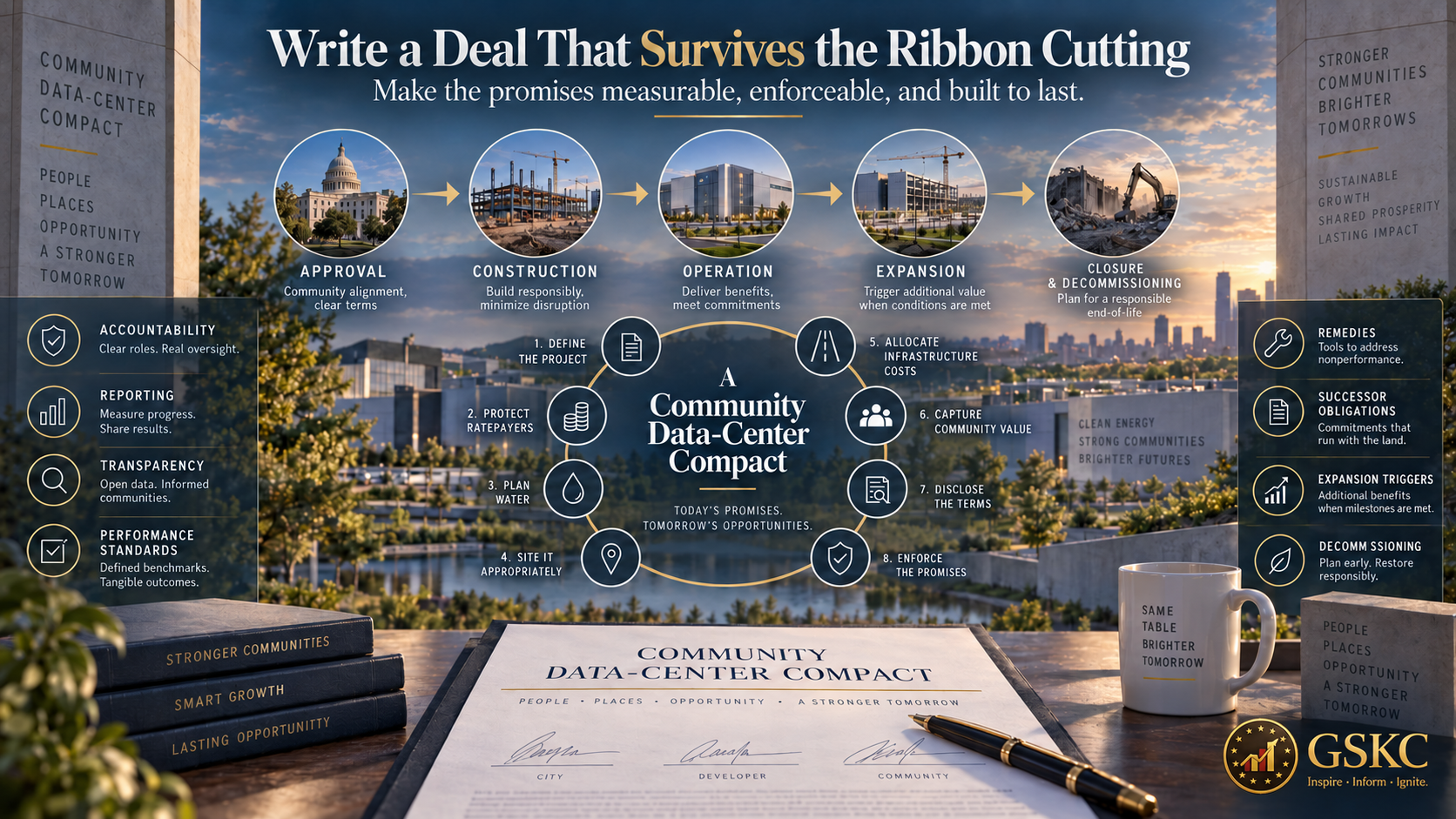
A practical Community Data-Center Compact could be built around eight commitments:
- Define the project — ownership, phases, maximum buildout, power, water, cooling, jobs, and timeline.
- Protect existing ratepayers — allocate the costs created by the new load fairly.
- Plan water responsibly — identify source, cooling design, peak demand, reuse opportunities, and drought contingencies.
- Site it appropriately — use setbacks, buffers, sound standards, lighting controls, and compatible land-use rules.
- Allocate infrastructure costs — identify roads, substations, water systems, and other upgrades before approval.
- Capture durable community value — taxes, workforce development, infrastructure, education, and locally appropriate investments.
- Disclose the terms — make the public bargain understandable without exposing legitimate proprietary information.
- Measure and enforce the promises — reporting, performance standards, remedies, successor obligations, expansion triggers, and decommissioning.
That is not anti-development.
It is development with expectations.
THE NEW BARGAIN
For decades, economic-development conversations often began with a familiar question: What does the community have to offer the company?
The data-center era calls for a more balanced question: What do the company and the community need from one another for the project to work?
The developer needs land, infrastructure, permits, utility capacity, predictability, and enough public confidence to operate successfully.
The community needs investment, fiscal value, infrastructure protection, responsible resource use, transparency, enforceable commitments, and confidence that today's promises will still mean something tomorrow.
Neither side needs to lose for the other to win. But neither side should be expected to sign a blank check.
Negotiation how communities and companies work together to turn growth into durable value.
The goal is not to eliminate every cost or guarantee that every prediction will be correct. It is to make the trade visible. Make the obligations fair. Make the benefits measurable. And make the promises enforceable.
New Data-Center Bargain is not merely a GSKC concept—it appears to be emerging in the market itself.
Part I asked us to understand.
Part II asked us to evaluate.
Part III asked us to learn from experience.
Part IV asks us to use those lessons before the concrete is poured.
Understand. Evaluate. Learn. Negotiate.
Then build wisely.
— Matt Cucinotta | Growth Solutions KC | Inspire · Inform · Ignite



Comments ()