

The Honest Ledger: What Data Centers Cost — and What Communities Gain

Data centers create real benefits and real tradeoffs. The more useful question is not whether they are “good” or “bad,” but whether communities understand the trade—and structure it wisely.
Data centers are becoming essential infrastructure. They are also becoming some of the most controversial infrastructure in America.
Both facts can be true.
In Part I of The Data-Center Divide, we started with a simple principle: First understand the thing. Then judge it. We looked at what data centers actually do, why modern life increasingly depends on them, and how artificial intelligence is changing the scale of the buildings, power systems, cooling, and networks behind the digital world.
Now comes the harder question:
Is a data center good or bad for the community that hosts it?
The answer is rarely as simple as the slogans suggest. A data center can bring billions of dollars in private investment, years of construction activity, substantial tax revenue, skilled jobs, and infrastructure improvements.
It can also consume enormous amounts of electricity, use water, change a landscape, generate noise, require new utility infrastructure, and create resentment if residents believe the project was approved before they understood the terms.
The honest answer is not “data centers are a windfall.” Nor is it “data centers are an extraction scheme.”
A data center is a major civic trade. And the outcome depends heavily on the terms.
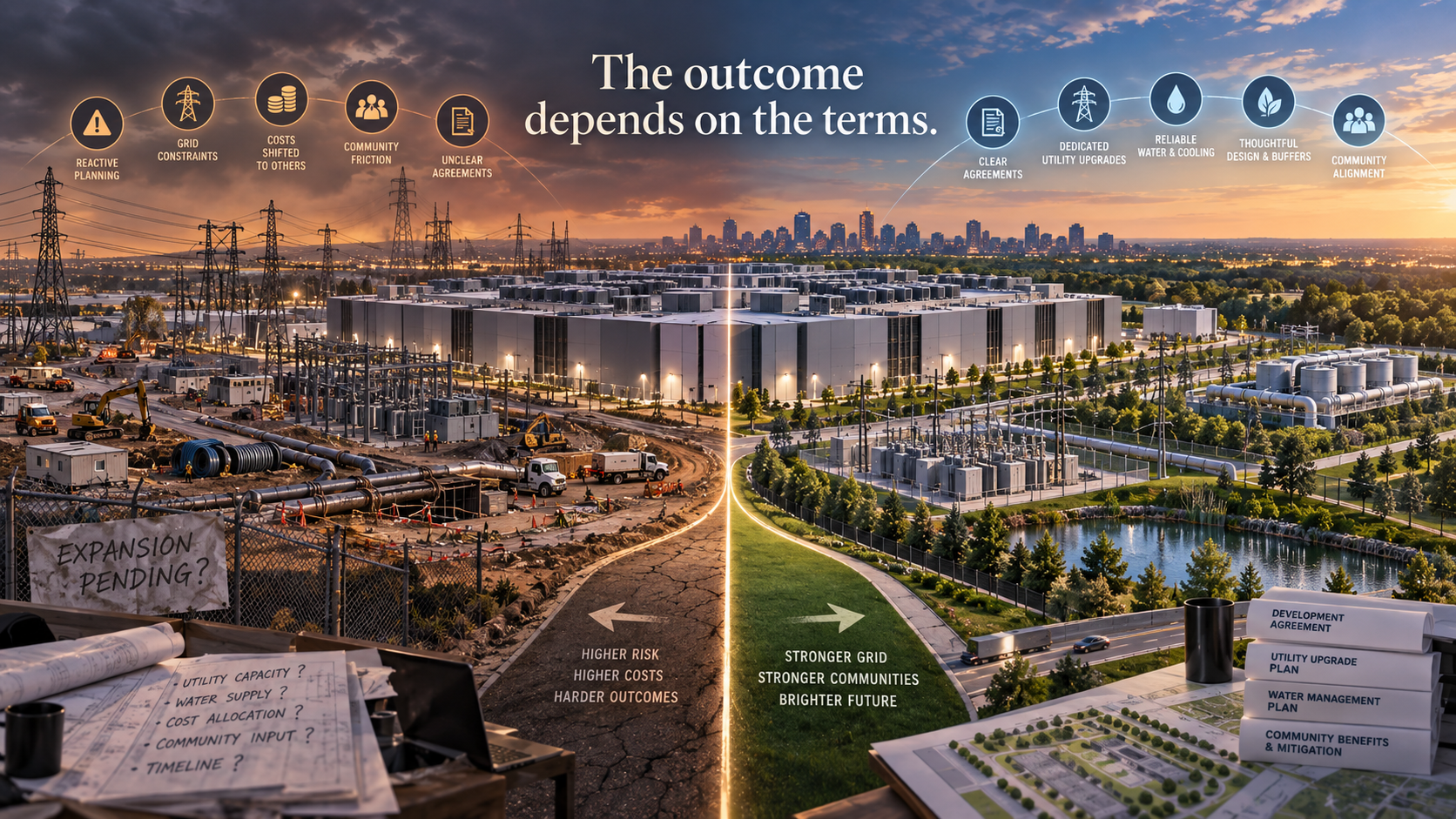
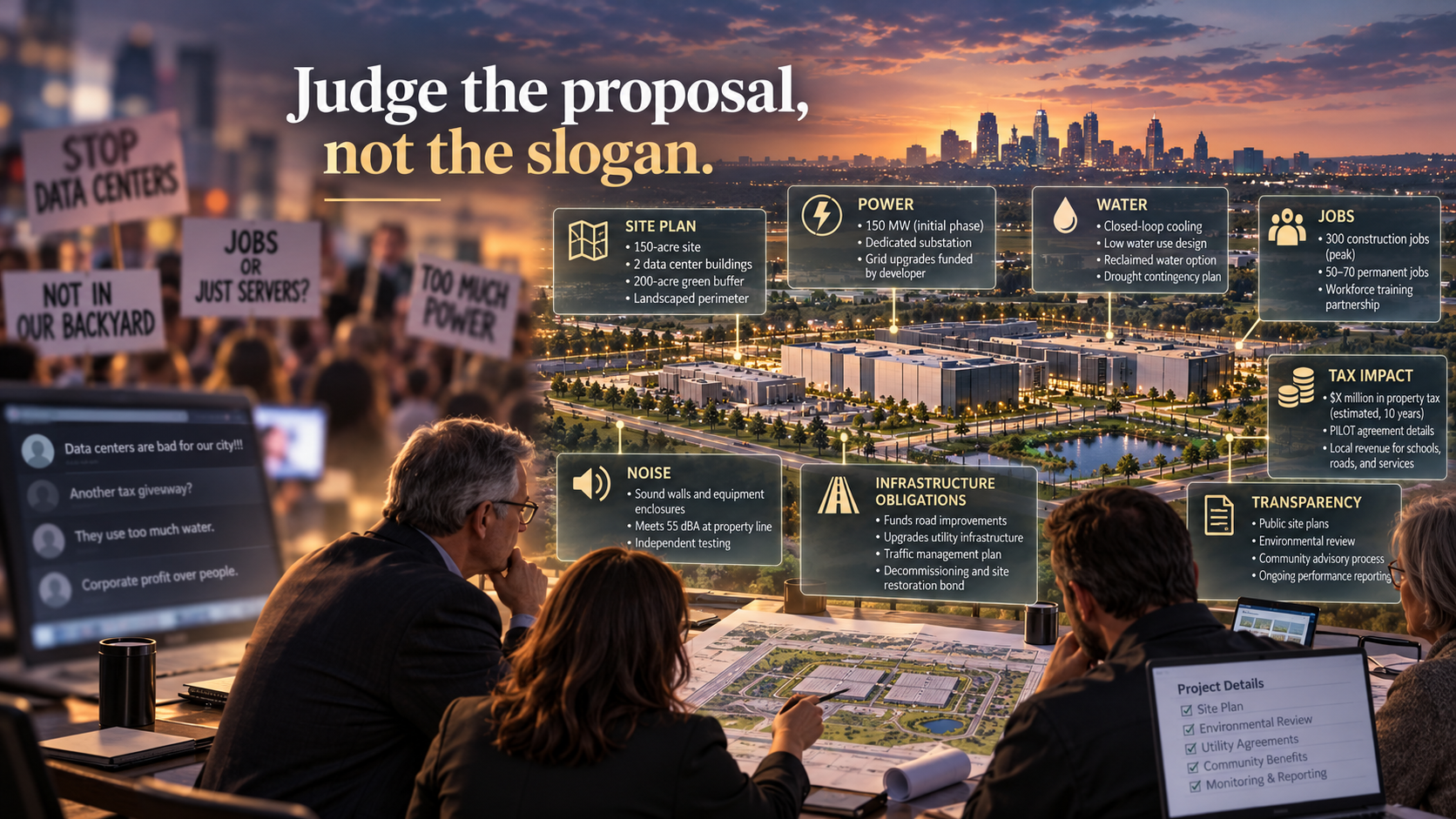
FIRST RULE: JUDGE THE PROJECT, NOT THE CATEGORY
“Data center” does not tell us enough. Facilities differ dramatically in size, power demand, cooling technology, water use, location, backup generation, tax treatment, staffing, and infrastructure requirements.
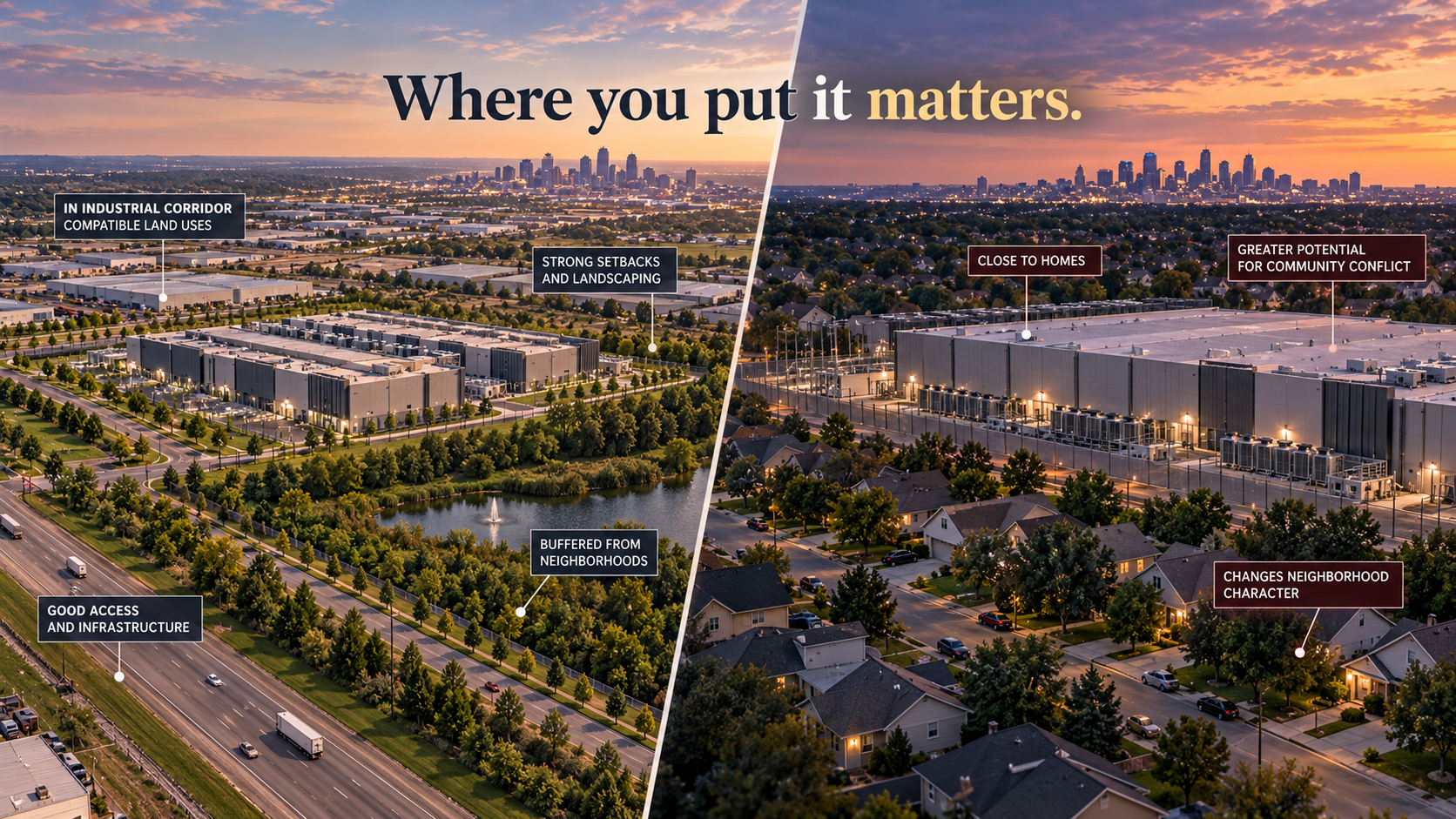
A closed-loop cooling facility is not the same as one heavily dependent on evaporative cooling. A campus that pays the full cost of the electrical infrastructure it requires is not the same as one that leaves existing ratepayers exposed to those costs. A project built in an appropriate industrial corridor is not the same as one placed beside homes.
That is why the better question is always:
What exactly is being proposed here?
POWER & RATEPAYERS: THE LOAD IS REAL. WHO PAYS IS A POLICY CHOICE.
The claim: Data centers will overwhelm the grid and send household electric bills soaring.
What’s true: Electricity is the central operating input for modern data centers, and AI is dramatically increasing demand. Lawrence Berkeley National Laboratory now estimates that data centers could account for about 11.8% of U.S. electricity use by 2030, with scenarios ranging from 9.5% to 15.3%.
That is not a trivial load.
What’s missing: A national electricity forecast does not tell us what a particular project will do to a particular family's utility bill.
The real questions are whether new generation, substations, transmission lines, or other infrastructure must be built—and how regulators allocate those costs.
Missouri provides a useful example. State law now requires special large-load tariffs intended to prevent residential and ordinary commercial customers from being charged unjust or unreasonable costs created by major users such as data centers. Approved Ameren and Evergy structures include long-term service commitments, financial security, exit fees, minimum bills, and requirements intended to recover the full cost of serving the large customer.
In other words:
The power demand is real. The cost shift is not inevitable.
What can be done: Before approval, communities should know the project's expected power demand by phase, what grid upgrades are necessary, who pays for them, what happens if the project is delayed or downsized, and what protections prevent those costs from being stranded on everyone else.
WATER & ENVIRONMENT: THERE IS NO SINGLE “DATA-CENTER WATER FOOTPRINT.”
The claim: Data centers will drain local water supplies. The industry response is sometimes the opposite: modern facilities barely use water at all.
What’s true: Either statement can describe a particular project.
Water use depends heavily on facility size, climate, computing density, and cooling design. Virginia's JLARC review found that most data centers there used about the same amount of water or less than a large office building, while a smaller number used substantially more—and some used less than a typical household.
Water consumption is partly an engineering choice. Evaporative cooling, closed-loop systems, reclaimed water, and other designs produce very different outcomes.
What’s missing: National averages can hide local scarcity. Water that is manageable in one region may be unacceptable in another. Likewise, reducing onsite water use may increase electricity demand elsewhere.
What can be done: Require the cooling design, water source, annual and peak demand, reclaimed-water use, backup-generation plans, and environmental controls to be disclosed—and where appropriate, made enforceable conditions of approval.
The question should never be merely, “How much water do data centers use?”
It should be:
How much will this one use, from where, under what conditions, and with what protections?
NOISE, LAND & SITING: MANY PROBLEMS BEGIN WITH WHERE WE PUT THEM
The claim: Data centers are quiet industrial neighbors.
What's true: Most are.
Virginia's statewide review found that a large majority generated no noise complaints. But it also found that persistent low-frequency sound has affected some nearby residents—and that traditional noise ordinances were often poorly suited to address continuous industrial sound.
The more revealing finding may be about land use: JLARC found roughly one-third of Virginia data centers were located near residential areas, sometimes because local zoning rules did not originally treat data centers as the industrial-scale facilities they had become.
What’s missing: That turns some of the “data-center problem” into a site selection problem.
Large buildings, cooling equipment, substations, generators, transmission infrastructure, security, lighting, and truck traffic belong in places capable of accommodating them.
A well-designed facility in an appropriate industrial location can have a very different community impact from the same facility placed beside an established neighborhood.
What can be done: Setbacks, buffers, landscaping, acoustic studies, enforceable property-line sound standards, generator-testing limits, lighting rules, truck routes, and appropriate zoning should be settled before construction begins.
Sometimes the right answer will be better design.
Sometimes it will be a different site.
And sometimes the proposed location simply will not make sense.
JOBS, TAXES & INCENTIVES: DON'T CONFUSE THREE DIFFERENT LEDGERS
The economic argument gets distorted from both directions.
The claim from supporters: Data centers create thousands of jobs and transform local economies.
The claim from critics: Billion-dollar buildings employ almost nobody.
Again, each contains part of the truth.
Data-center construction can support substantial employment. Virginia's JLARC found that a typical 250,000-square-foot facility might have around 1,500 workers onsite at peak construction, but only about 50 full-time workers once operating, roughly half of them contractors.
New Brookings research reaches a similarly nuanced conclusion. After controlling for the fact that data centers often choose communities already experiencing faster growth, researchers estimate roughly 100–200 additional local jobs associated with a first large facility, depending on the type of data center.
So permanent employment is real—but it is not the primary economic case.
The larger argument often rests on capital investment, construction, taxable property, equipment, and local public revenue.
What’s missing: Taxes and incentives are separate ledgers.
A project can produce tremendous property-tax revenue for a host community while simultaneously receiving a state incentive that deserves scrutiny. Those statements are not contradictory.
A billion-dollar investment figure also tells residents very little by itself. What matters is the net public value after abatements, exemptions, infrastructure obligations, and other concessions.
What can be done: Require construction employment, permanent jobs, and indirect economic effects to be reported separately. Show projected taxes year by year and by taxing jurisdiction. Disclose every major incentive. Include performance requirements and clawbacks where public benefits depend on promised jobs or investment.
The right question is not simply: How big is the investment?
It is: What is the community actually receiving in exchange?
TRANSPARENCY & PUBLIC TRUST: PROCESS CAN DESTROY A GOOD PROJECT
Sometimes the controversy surrounding a data center begins before residents ever debate electricity or water. It begins with trust and transparency—or the lack of.
The claim: Confidentiality is necessary because major technology projects involve competitive site selection, land acquisition, and commercially sensitive information. There is truth in that.
But public officials are also making decisions about zoning, infrastructure, taxation, and community impacts on behalf of citizens.
What’s missing: Commercial confidentiality and public accountability are not the same thing.
Festus was hardly unique. Across the country, communities have discovered that the economic-development process surrounding data centers can be almost as controversial as the facilities themselves.
When residents do not know who ultimately controls a project, what resources it will require, what incentives have been offered, or what obligations the developer has accepted, suspicion fills the information vacuum.
And poor behavior by one developer, contractor, supplier, or public body should be addressed for what it is.
Poor execution is an argument for better standards, better governance, and better agreements—not for abandoning infrastructure the modern economy increasingly requires.
What can be done: Before a binding vote, communities should receive a plain-English project summary covering ownership, maximum buildout, power and water requirements, infrastructure costs, tax treatment, jobs, environmental protections, reporting requirements, and remedies if commitments are not met.
Community investment can go further. Workforce programs, schools, STEM initiatives, water improvements, energy-efficiency projects, and other partnerships can create additional local value.
Those benefits should supplement, not substitute for, the project's core obligations. A good neighbor starts by paying its share and keeping its commitments.
THE LEDGER TELLS US SOMETHING IMPORTANT

Step back from the individual arguments and a pattern emerges. Many of the things people fear about data centers are real possibilities. But they are not fixed characteristics of data centers themselves.
They are often consequences of choices about:
- Cooling.
- Site selection.
- Electricity rates.
- Tax policy.
- Infrastructure.
- Disclosure.
- Regulation.
That does not mean every project should be approved. It means communities have more agency over the outcome than the public debate often suggests. The false choice is between approving everything in the name of progress and rejecting everything in the name of protection.
A community can pursue investment while demanding safeguards. It can recognize that America needs digital infrastructure without allowing that national need to override local responsibility. It can welcome growth without writing a blank check.
A good project is not the one with the largest press release. It is one whose benefits are measurable, whose costs are understood, whose obligations are fair, whose protections are enforceable, and whose process earns public trust.
Part I asked us to understand before judging.
The Honest Ledger asks us to judge the actual trade—not the rhetoric surrounding it.
Because data centers are neither civic saviors nor community destroyers.
They are infrastructure.
And infrastructure works best when we build it wisely.
— Matt Cucinotta | Growth Solutions KC | Inspire · Inform · Ignite


Comments ()