

The American Miracle, Part 2: Prosperity, Correction, and the Inheritance

Why the American miracle mattered most when it reached the household, kept reinventing itself, and corrected its failures — and why the next chapter is ours to write.
Part VII (2 of 2) — America at 250: Socialism, Capitalism, and the Choice Before Us
Part 1 of this capstone traced how free people built an extraordinary nation: from the first patent, signed by George Washington in 1790, through the canals, railroads, and factories of the industrial age, to a backyard shed in Milwaukee, a bicycle shop in Dayton, and an Arsenal of Democracy that helped defend the free world.
But productive power is not the whole story. A nation's achievements must also be measured by whether they reach ordinary families, whether they endure, and whether they are shared.
Part 2 asks what the American miracle was for.
Postwar America: Prosperity reaches the household
When the war ended, the story moved from the factory floor to the kitchen table.
On June 22, 1944, President Roosevelt had signed the Servicemen's Readjustment Act, known as the GI Bill. Within seven years, roughly eight million veterans used its education benefits. By 1955, it had backed 4.3 million home loans. [1]
A generation that had grown up in the Depression went to college, learned trades, bought homes, and started businesses. Between 1940 and 1960, the share of nonfarm households that owned their homes rose from about 41 percent to 61 percent. [2] Medical advances lengthened lives. New industries created new occupations and new paths for advancement.
Behind those numbers were ordinary lives. A veteran became the first in his family to earn a degree. A machinist opened his own shop. A young couple signed a mortgage on a small house with a yard. Parents began to believe their children would do better than they had.
That is when economic growth takes on its greatest meaning: not when a statistic rises, but when ordinary lives improve.
Postwar America did not achieve universal prosperity. Poverty, regional disparities, and discrimination remained. But the broad direction was unmistakable. Prosperity was reaching the household.
National prosperity becomes meaningful when it reaches the household — when work provides dignity, opportunity becomes accessible, and families can build across generations.

An economy that keeps reinventing the future
America's story did not end with the factories and suburbs of the postwar era.
In 1947, researchers at Bell Labs invented the transistor. It became the foundation of the semiconductor industry, which made possible computers, software, the internet, smartphones, and now artificial intelligence. Biotechnology, advanced medicine, aerospace, and energy followed similar paths, from laboratory to startup to global industry.
These innovations depended on more than individual genius. Universities educated scientists and engineers. Public research funding produced foundational discoveries. Private capital financed experiments. Entrepreneurs built companies, and competition pushed them to improve. In the American experience, scientific research and commercial enterprise have not been opposing forces. They have reinforced one another.

Global talent has been central. When German Jewish scientists fled Nazi persecution in the 1930s, U.S. patenting rose by about 31 percent in the fields where they worked. [3] Liberty attracted the talent that tyranny drove away.
By 2022, total U.S. research and development spending reached $892 billion. [4] And in June 2024, the U.S. Patent and Trademark Office issued utility patent number 12,000,000, for genetic-sequencing technology. [5] From potash in 1790 to genetic sequencing in 2024, the line of American invention has never stopped.
But innovation is never automatic. A nation must educate its people, maintain reliable infrastructure, protect legitimate intellectual property, preserve free inquiry, and remain open to new ideas. As Article 6 showed, other nations compete vigorously, and in some industries they now outproduce the United States.
The lesson of 250 years is not that America will always lead. It is that a society willing to learn, invest, invent, compete, and correct its mistakes can renew itself again and again.
The American miracle was never a single invention or a single golden age. It was a continuing capacity to reinvent the future.
Not perfection — correction
A serious celebration of America must recognize that the nation's ideals and practices have not always aligned.

The country that declared all men created equal permitted slavery. Native nations suffered dispossession and broken promises. Women were denied the vote for most of the nation's history. Black Americans faced segregation, disenfranchisement, violence, and barriers to education, property, and work. Monopolies abused their power, financial crises destroyed savings, and powerful institutions sometimes protected themselves rather than serving the public.
These failures were real and consequential. They should neither be erased nor allowed to become the entire American story.
Markets alone did not fix these wrongs. Correction required abolitionists and preachers, organizers and marchers, lawyers and judges, legislators and voters — and enormous personal sacrifice.
But they had something to appeal to.
In 1852, Frederick Douglass, who had escaped slavery, delivered one of the most searing indictments of American hypocrisy ever spoken. Yet in the same speech, he declared that the Constitution, rightly interpreted, "is a GLORIOUS LIBERTY DOCUMENT." [6] He did not reject the founding principles. He demanded that the nation live up to them.
That is how the republic corrected itself. The 14th Amendment, ratified in 1868, promised equal protection of the laws. The 19th Amendment, ratified in 1920, secured women's right to vote. The Civil Rights Act of 1964 outlawed discrimination in public accommodations and employment. After the Voting Rights Act of 1965, a quarter of a million new Black voters were registered by the end of that year alone. [7]
None of it happened automatically. It required civic courage, protest, litigation, legislation, and ordinary people willing to demand that America's promises apply to everyone.
And correction mattered economically as well as morally. Economists estimate that between 20 and 40 percent of growth in output per person after 1960 came from better use of talent, as barriers fell for women and Black Americans in occupations once closed to them. [8] Exclusion carried a measurable cost. One study found that violence against Black Americans between 1870 and 1940 suppressed more than 1,100 patents, compared with 726 actually granted. [9]
Every inventor shut out of the system was a loss to everyone. Expanding opportunity does more than address injustice. It allows more people to build.
American exceptionalism should not mean claiming America was always right. It should mean understanding what made the nation capable of becoming better — and accepting the responsibility to continue that work.
Correction is not a rejection of the American experiment. It is the fulfillment of the experiment's highest promises.
Built by people, not systems alone
Constitutional government, markets, capital, infrastructure, and technology all matter. But systems do not build nations without people.
Farmers cultivated land. Workers built factories. Immigrants brought determination and skill. Teachers educated children. Engineers solved problems. Entrepreneurs took risks. Scientists pursued discoveries. Service members defended the republic. Parents sacrificed for their children.
Churches, charities, schools, and civic associations strengthened communities and supported people when institutions or markets fell short. Across generations, Americans combined economic initiative with a remarkable tradition of voluntary association and local responsibility.
These human contributions are easy to lose when the story of capitalism becomes a discussion of corporations, stock markets, billionaires, or GDP. Yet Main Street is as much a part of the American economic story as Wall Street.
A family business. A skilled trade. A neighborhood restaurant. A local manufacturer. A community hospital. A scholarship funded by a generous donor. A volunteer organization helping families in need. These, too, are expressions of American enterprise and civic life.
The American miracle was built from the bottom up, strengthened by institutions, and carried forward by people who believed their efforts could create a better future.
The True, the Good, and the Beautiful: What prosperity should serve
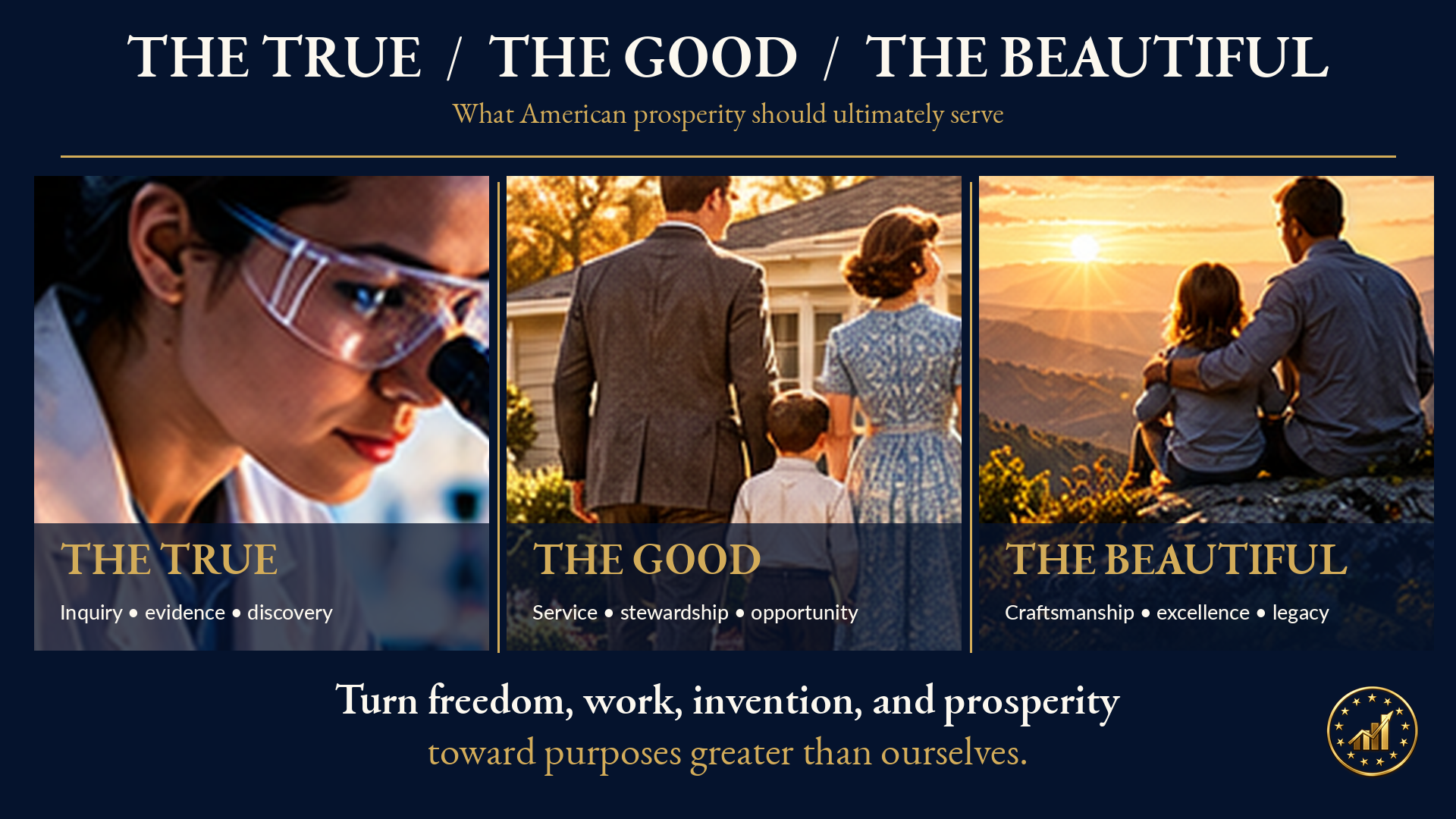
Economic achievement is important. But prosperity alone cannot tell us whether a society is flourishing. A nation can grow wealthy while trust deteriorates, families weaken, and citizens lose their sense of responsibility toward one another.
Material progress is not the same as moral progress. The classical transcendentals offer a deeper standard.
The True calls us toward reality, reason, and the honest pursuit of knowledge. America's achievements in science and enterprise depended on people willing to question assumptions, test ideas, and discover what worked. A healthy republic requires the same commitment from its citizens and institutions.
The Good asks what our freedom and achievements are ultimately for. Productive work supports families. Enterprise serves customers and creates opportunity. Wealth can fund education, philanthropy, and community institutions. Freedom carries responsibility for how we treat others and what we contribute.
The Beautiful reminds us that human achievement reaches beyond utility. It is found in craftsmanship, architecture, design, invention, and institutions built with care. A shed in Milwaukee and a wooden flyer on a North Carolina beach are their own kind of beauty.
These standards do not mean every American achievement was good or every economic success was virtuous. They give us a way to judge both success and failure.
Freedom requires purpose. Prosperity requires stewardship. Invention requires wisdom. Great institutions require integrity. And national achievement requires citizens who understand that they have inherited responsibilities along with opportunities.
The American miracle was not merely the creation of wealth. It was the opportunity to turn freedom, work, invention, and prosperity toward purposes greater than ourselves.
Conclusion: The next chapter is ours
Two hundred and fifty years of American history reveal something remarkable.
A republic founded on the promise of liberty became a center of invention, industry, entrepreneurship, scientific discovery, productive power, and opportunity.
It produced entrepreneurs who began in wooden sheds and modest workshops. Inventors who changed transportation and communication. Workers and businesses whose productive capacity helped defend civilization. Families who built opportunity across generations. Citizens who challenged injustice and pressed their country to better fulfill its founding principles.
The American miracle was not inevitable. It required freedom, work, risk, investment, sacrifice, responsibility, public institutions, and the willingness to correct what had gone wrong.
And it remains unfinished.
This series began with a question: when Americans are frustrated with the economy, should they turn to socialism? Across seven articles, the answer has been consistent. The challenges facing America today are real: institutional distrust, fiscal irresponsibility, concentrated economic power, weakened communities, educational failures, rising living costs, and political division. But the cure is not to hand more economic power to the state. It is to renew the conditions that made America extraordinary in the first place.
America's history reminds us that we possess the capacity to build.
We can strengthen families and communities. Restore confidence in institutions through competence and accountability. Encourage entrepreneurship. Invest in science and education. Defend constitutional liberties. Reject cronyism. Expand genuine opportunity. Practice civic responsibility. And recover the habits of truth, service, gratitude, and stewardship.
Our responsibility is not to recreate the America of 1776, 1900, 1950, or 2026. It is to preserve what was best in those generations, learn from their failures, and build an America worthy of the next 250 years.
Harley and the Davidsons, the Wright brothers, Henry Ford, and William Boeing did not know what their sheds and shops would become. Neither did the women at the rivet guns, the veterans in the classrooms, or the marchers who demanded the nation keep its word. They simply built — and passed it forward.
That is mature patriotism. Not the belief that America was perfect, but the conviction that America's ideals, freedoms, achievements, and capacity for renewal are worth preserving, improving, and passing forward.
The American miracle was never guaranteed. It was built by generations who inherited liberty, used it, defended it, corrected it, and passed it forward. At 250, the question is whether we will do the same.

America's greatest achievement was not simply becoming prosperous. It was creating — and continually working to improve — a republic in which free people could build, invent, govern themselves, correct injustice, and shape the future.
The inheritance is ours.
So is the responsibility.
America at 250: Socialism, Capitalism, and the Choice Before Us — What future will we hand down? The story of America isn't finished. We are writing the next chapter.
— Matt Cucinotta | Growth Solutions KC | Inspire · Inform · Ignite
Source List
- National Archives, "Servicemen's Readjustment Act (1944)". Primary source. Supports the June 22, 1944 signing, roughly eight million veterans receiving education benefits, and 4.3 million home loans by 1955.
- Federal Reserve Board, FEDS Notes, "Homeownership and Housing Equity in the Mid-Twentieth Century," September 2025. Supports nonfarm homeownership rising from about 41 percent (1940) to 61 percent (1960), and discriminatory barriers to mortgage access.
- Petra Moser, Alessandra Voena, and Fabian Waldinger, "German Jewish Émigrés and US Invention," *American Economic Review* (2014). Peer-reviewed. Supports the 31 percent increase in U.S. patenting in émigré research fields.
- National Center for Science and Engineering Statistics, "U.S. R&D Totaled $892 Billion in 2022" (2025). Official statistics.
- U.S. Patent and Trademark Office, "Milestones in U.S. Patenting". Official source. Supports the first U.S. patent (Samuel Hopkins, July 31, 1790) and utility patent No. 12,000,000 (June 4, 2024).
- National Constitution Center, Frederick Douglass, "What to the Slave Is the Fourth of July?" (1852). Primary source.
- National Archives, "Voting Rights Act (1965)". Primary source. Supports the quarter-million new Black voters registered by the end of 1965.
- Chang-Tai Hsieh, Erik Hurst, Charles I. Jones, and Peter J. Klenow, "The Allocation of Talent and U.S. Economic Growth," *Econometrica* (2019). Peer-reviewed. Supports the estimate that 20 to 40 percent of growth in output per person (1960–2010) reflects improved allocation of talent.
- Lisa D. Cook, "Violence and Economic Activity: Evidence from African American Patents, 1870–1940" (published in the Journal of Economic Growth, 2014). Peer-reviewed. Supports the estimate of more than 1,100 missing patents compared with 726 granted.
Source and Methodology Note: This article draws on primary historical documents, institutional archives, and economic-history research. Its interpretation of American development recognizes the interaction of constitutional institutions, free enterprise, resources, public investment, labor, immigration, science, and civic reform rather than attributing national prosperity to any one cause.
Transparency Note: This article was developed with AI assistance and reviewed, edited, and finalized by Growth Solutions KC prior to publication.

Comments ()