

Small Nuclear, Big Ambitions
Can SMRs Move From Promise to Powering the AI Economy?
Part 3 of the Growth Solutions KC AI Energy Series
Small nuclear reactors can sound almost purpose-built for the AI era.
- Build them smaller.
- Manufacture more of the components in factories.
- Add capacity in modules instead of committing to one enormous power plant.
- Place generation closer to the data centers that need it.
- Produce dependable electricity around the clock without the direct carbon emissions of fossil-fuel generation.
On paper, the fit is compelling.
That helps explain why technology companies, reactor developers, utilities, the Department of Energy, and now the U.S. military are putting serious money and attention behind advanced nuclear technology.
But there is an important distinction between an attractive engineering concept and a commercially proven energy system.
Small nuclear has made real progress. It still has much to prove.
That is the honest ledger.
The question is not whether small modular reactors could play a role in powering the AI economy. The question is whether they can be manufactured, licensed, fueled, financed, and operated reliably enough — and cheaply enough — to move from promising demonstrations to repeatable infrastructure.
What Matters: Smaller Changes the Nuclear Model
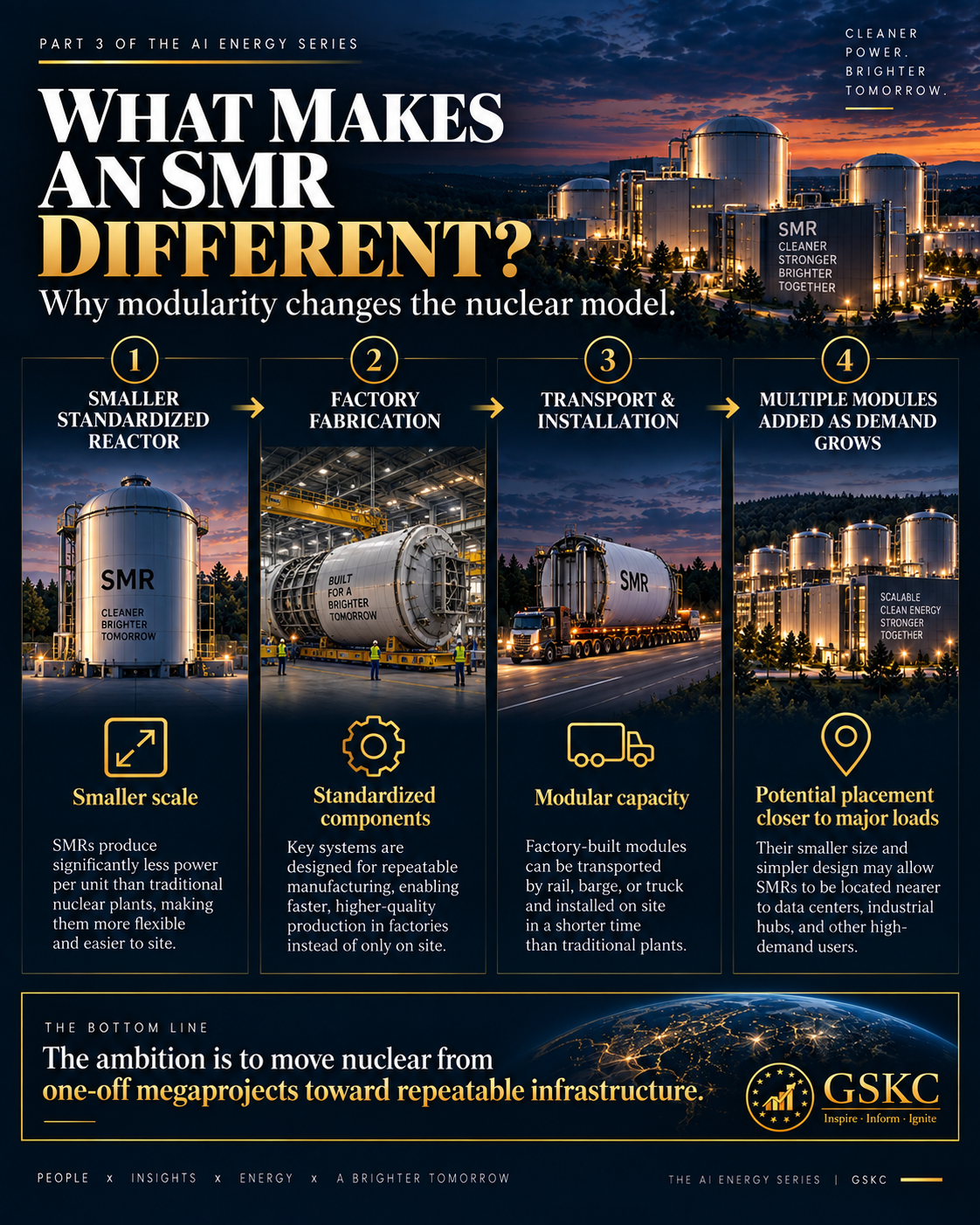
Traditional nuclear plants are enormous projects. A large commercial reactor can produce around a gigawatt of electricity, but the plant is generally custom-built at its site, requires immense upfront capital, and can take many years to plan, license, and construct.
Small modular reactors — or SMRs — attempt to change that model.
The Nuclear Regulatory Commission describes SMRs as smaller, scalable reactors that incorporate advanced engineering features, often including passive safety systems. More broadly, advanced reactors may also use different coolants, fuels, or reactor technologies than today's conventional light-water plants.
The central idea is standardization.
Instead of building every reactor as a one-off megaproject, manufacturers hope to produce standardized components — or eventually entire modules — repeatedly.
That matters because repetition can create learning. Learning can shorten schedules. Shorter schedules can reduce financing costs. And standardized production can potentially turn nuclear construction from a succession of bespoke projects into something closer to manufacturing.
That is the ambition.
It has not yet been proven at commercial scale in the United States.
SMRs and Microreactors Are Not Quite the Same Thing
The terminology can get confusing.
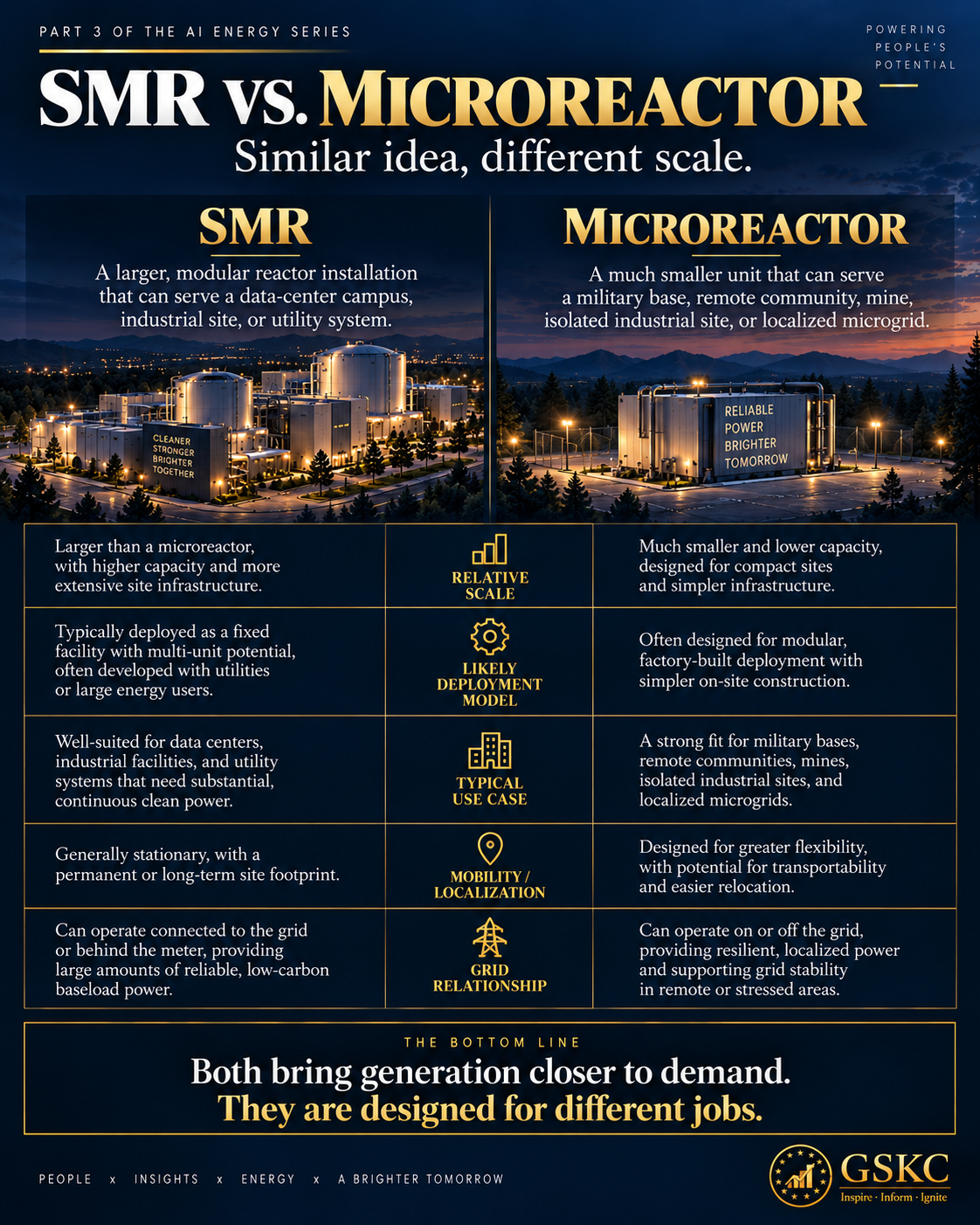
A small modular reactor may still generate tens or hundreds of megawatts and could serve a utility system, industrial facility, or large data-center cluster.
A microreactor is generally smaller still — designed for highly localized power needs, remote sites, military installations, industrial operations, or smaller campuses.
Both concepts share an important AI-era appeal: bring dependable generation closer to the load.
That could reduce reliance on long-distance transmission and potentially allow some projects to avoid waiting for every traditional grid upgrade before obtaining power.
But “closer to the load” does not mean “independent of the energy system.” A data center with on-site nuclear generation may still need backup power, transmission access, grid services, maintenance support, fuel logistics, and coordination with utilities and regulators.
Small nuclear changes the infrastructure equation.
It does not eliminate it.
Why AI Finds the Idea Attractive
AI data centers have a particular energy problem. Their demand is large, concentrated, and continuous. And technology companies want to add computing capacity faster than electric infrastructure can often be built.
That makes modularity attractive.
Imagine a data-center campus that ultimately requires several hundred megawatts. Instead of waiting for one enormous generation project, a modular model could theoretically add power in stages as computing demand grows.
The data center expands. Additional reactor modules follow. The electricity system grows alongside the compute system.
There is another advantage: footprint.
Nuclear generation can produce a large amount of electricity from a comparatively compact footprint, which matters around massive AI campuses where land, transmission access, water, and infrastructure all compete for space.
Then there is the potential for pairing small nuclear with batteries, microgrids, and other generation so different technologies can handle different time scales of power demand.
It is an appealing architecture.
Something Important Happened in 2026
This year provided a meaningful signal that advanced nuclear development is moving beyond PowerPoint presentations.
Under the Department of Energy's Reactor Pilot Program, four advanced reactor developers — Antares Nuclear, Valar Atomics, Deployable Energy, and Aalo Atomics — completed zero-power fueled criticality demonstrations at Idaho National Laboratory by early July. DOE confirmed Aalo-X as the fourth demonstration after the other three reached the same milestone in June.
That is real progress. But the language matters.
Criticality does not mean a commercial power plant is operating.
It means the reactor demonstrated a controlled, self-sustaining nuclear chain reaction. That validates an important part of the underlying physics and engineering. However, it does not prove that the reactor can economically generate electricity for a data center year after year.
The path from criticality to commercial power still includes engineering, safety systems, licensing, manufacturing, construction, operations, fuel, financing, and customer commitments.
The milestone matters precisely because we do not need to exaggerate it — it is real.
The Army Is Becoming an Anchor Customer
Another development may prove just as important.
In August, the U.S. Army selected five vendors and five military installations for its Janus Program, committing up to a combined $2.2 billion toward contractor-owned and operated microreactors.
The Army expects government and private funding together could eventually support more than 20 microreactors across military installations and is targeting September 2028 for operation of the first Army-regulated reactor.
The most interesting part is why.
The Army says it does not merely want reactors that operate briefly for demonstrations. It wants systems capable of delivering reliable power for years — and ultimately technologies that vendors can sell to customers beyond the military.
That makes the government something similar to the hyperscalers discussed in Article 2 — an anchor customer.
Early technologies often struggle because somebody has to absorb the cost and risk of being first. A large customer can provide demand, capital, operating experience, and a pathway toward manufacturing scale.
For advanced nuclear, that may be one way the bridge from demonstration to commercialization gets built.
First Is Expensive
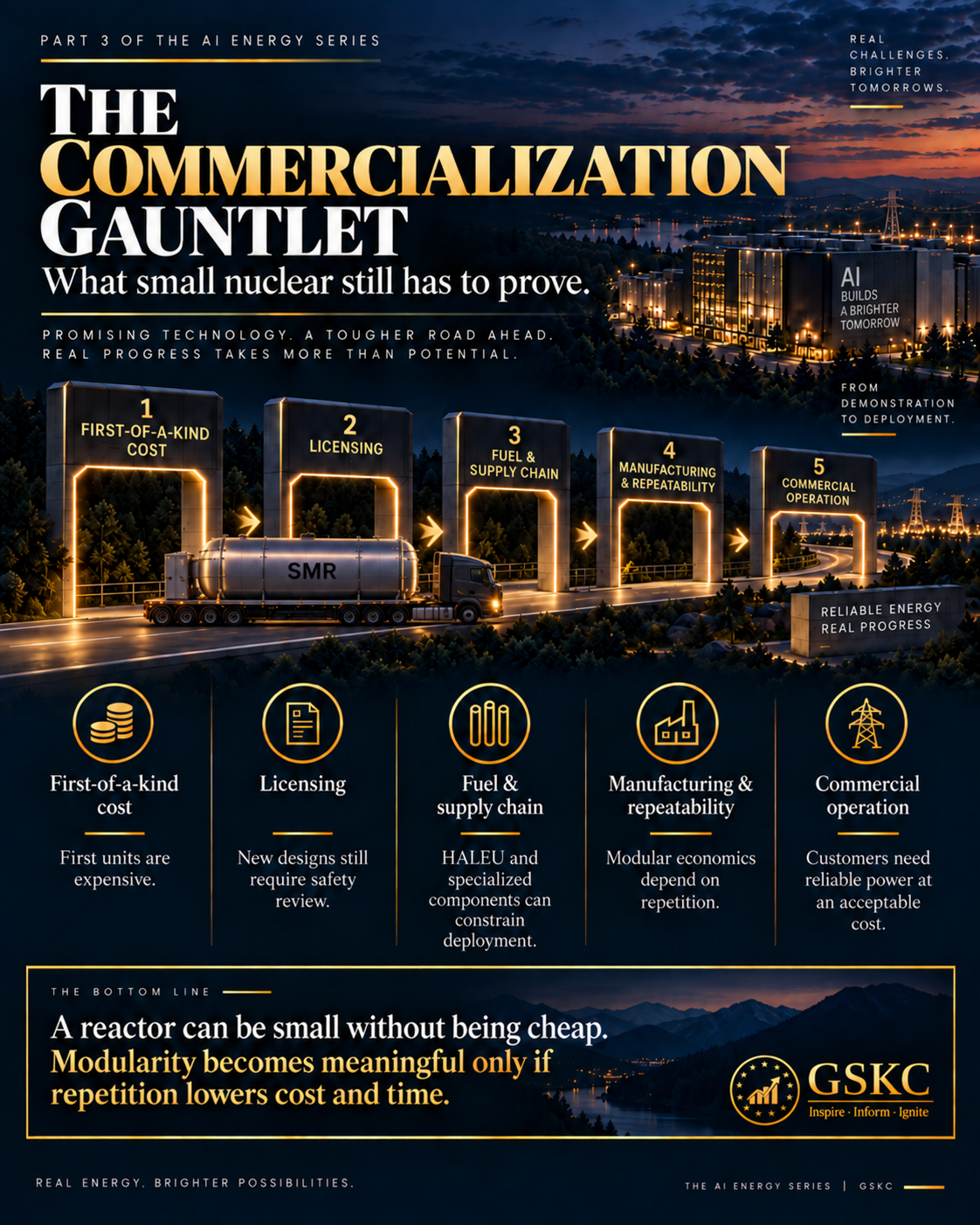
The modular thesis depends heavily on repetition.
But someone has to build the first unit. And the first unit does not benefit from years of repetition.
That creates what is often called first-of-a-kind risk.
- Engineering changes appear.
- Supply chains need to develop.
- Workers need experience.
- Manufacturing processes need refinement.
- Regulators encounter new designs.
- Schedules slip.
- Costs rise.
A reactor can be small without being cheap. The economic promise of SMRs therefore depends less on building one successful unit than on building many similar units repeatedly.
The real test will come when the industry moves from:
Can we build one?
to:
Can we build the tenth faster and cheaper than the first?
That is when modularity becomes an economic model rather than an engineering description.
Licensing Is Changing — But It Is Not Disappearing
Regulation is also evolving. The NRC's new Part 53 licensing framework became available in April 2026 as a technology-inclusive, risk-informed pathway for advanced commercial reactors. The agency is also developing a separate proposed Part 57 framework intended specifically to support rapid and potentially high-volume licensing of microreactors and similar low-risk designs.
That could matter enormously if standardized designs eventually move into fleet deployment.
A regulatory system built around repeatable designs should not have to reinvent the entire process every time another identical unit is proposed. But faster licensing cannot fix weak economics, bad engineering, construction failures, or an immature supply chain.
Regulatory reform can remove friction. It cannot manufacture commercial viability.
Then There Is Fuel
Many advanced reactor designs rely on high-assay low-enriched uranium, or HALEU.
HALEU can help enable smaller reactor designs, longer operating cycles, and higher efficiencies, but DOE says domestic supply remains a potential deployment constraint. The federal government is actively expanding enrichment capacity and allocating material to reactor developers while a private U.S. supply chain develops.
That reveals another important lesson. The nuclear supply chain is larger than the reactor. Commercial scale requires:
- fuel enrichment,
- fuel fabrication,
- specialized materials,
- qualified components,
- transportation,
- trained workers,
- regulatory capacity,
- and eventually a reliable maintenance ecosystem.
Just as the AI chip story turned out to include HBM and advanced packaging, the small-nuclear story will include much more than reactor design.
What Would Prove the Thesis?
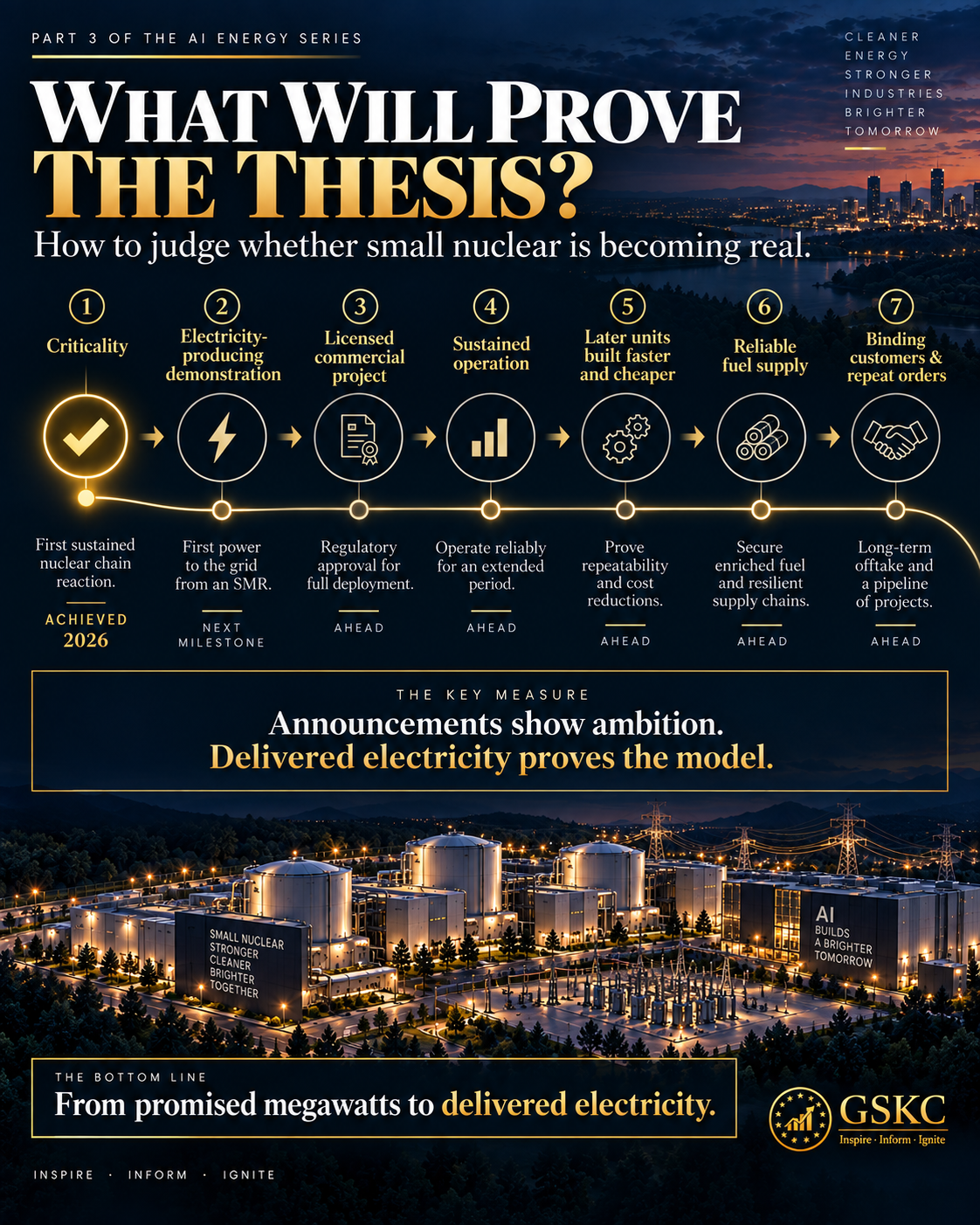
The next few years should give us better evidence. The most meaningful signal will not be another announcement.
It will be operation.
- Do the DOE demonstration programs move into electricity-producing systems?
- Does the Army put a reactor into sustained service near its 2028 goal?
- Do first commercial projects complete licensing and construction?
- Do later units cost less and arrive faster?
- Does domestic fuel supply expand?
- Do customers sign contracts with real financial commitments rather than nonbinding expressions of interest?
- Can the plants deliver dependable electricity at a cost customers are willing to pay?
Those milestones will tell us far more than projections about the eventual size of the SMR market.
What Happens Next
Small nuclear deserves serious attention because the underlying problem is serious.
- AI infrastructure needs enormous amounts of dependable power.
- America's grid cannot expand everywhere at technology speed.
- Large traditional power projects take time.
And companies building billions of dollars of computing infrastructure increasingly value control over when and where electricity becomes available.
SMRs and microreactors offer an intriguing answer: make nuclear smaller, more standardized, more scalable, and closer to the customer.
There is now real technical progress behind that vision. There is government capital behind it. There are technology companies interested in buying it. And regulators are changing how advanced reactors can be licensed. But the hardest transition is still ahead.
From demonstration to deployment.
From first-of-a-kind to repeatable manufacturing.
From promised megawatts to delivered electricity.
Small nuclear may eventually become one of the building blocks of the AI energy system. It has not earned that role yet. That is what makes the next several years so important.
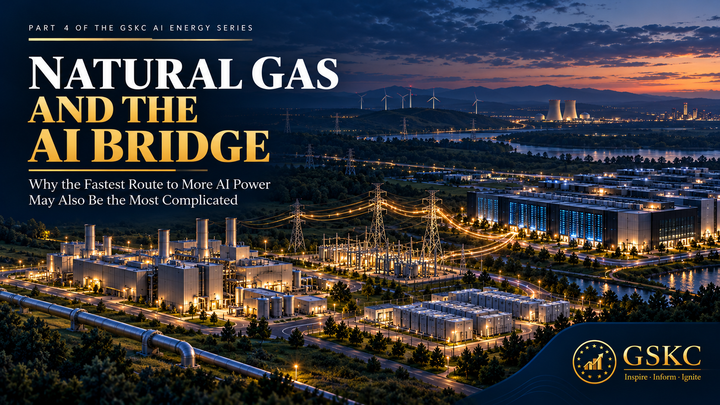
And while nuclear developers work on the longer-term answer, the AI buildout still needs power today. That leads us to the next piece of the energy puzzle:
Why is natural gas increasingly becoming the bridge between the power system we have and the AI infrastructure companies want to build now?
— Matt Cucinotta | Growth Solutions KC | Inspire · Inform · Ignite
Source and methodology note: This article uses the Growth Solutions KC AI Energy Research Dossier as a research framework and incorporates recent reporting supplied for the series. Major current claims were verified against primary sources from the U.S. Department of Energy, U.S. Army, and Nuclear Regulatory Commission. Advanced-reactor projects remain subject to technical, regulatory, fuel-supply, financing, construction, and commercial-execution risk. Criticality demonstrations should not be interpreted as commercially operating power plants.

Comments ()