

Retirement and the Tax Code: What Every Senior Needs to Know

Retirement does not simplify your relationship with the tax code — it transforms it.
Part II in the GSKC Year-Round Tax Planning Series.
Most relevant for retirees or near-retirees with traditional IRAs, 401(k)s, Social Security benefits, Medicare coverage, charitable giving goals, taxable investments, and/or inherited retirement accounts.
Retirement changes the tax triggers.
The assumption that quietly costs retirees thousands of dollars a year — that once the paychecks stop, the tax complexity stops with them. The reality is precisely the opposite.
Where you once had a single income stream and a straightforward withholding arrangement, you now navigate a web of interconnected tax triggers:
- Required Minimum Distributions that must begin at a precise age,
- Social Security benefits that become partially taxable based on a formula no one explained to you when you filed for them,
- Medicare premium surcharges driven by income you reported two years ago, and
- Inherited retirement accounts governed by rules that did not exist a decade ago.
These variables do not operate in isolation. They interact with each other — sometimes amplifying each other's consequences — in ways that can silently erode decades of accumulated wealth if left unmanaged.
The difference between a reactive retiree and a strategic one is not luck. It is knowledge, timing, and a tax plan that runs twelve months a year.

First in the series — "Tax Planning Is a Year-Round Strategic Imperative" — we established that tax strategy is a continuous discipline, not a seasonal event.
The Standard Deduction Has Changed — and Seniors Should Take Notice
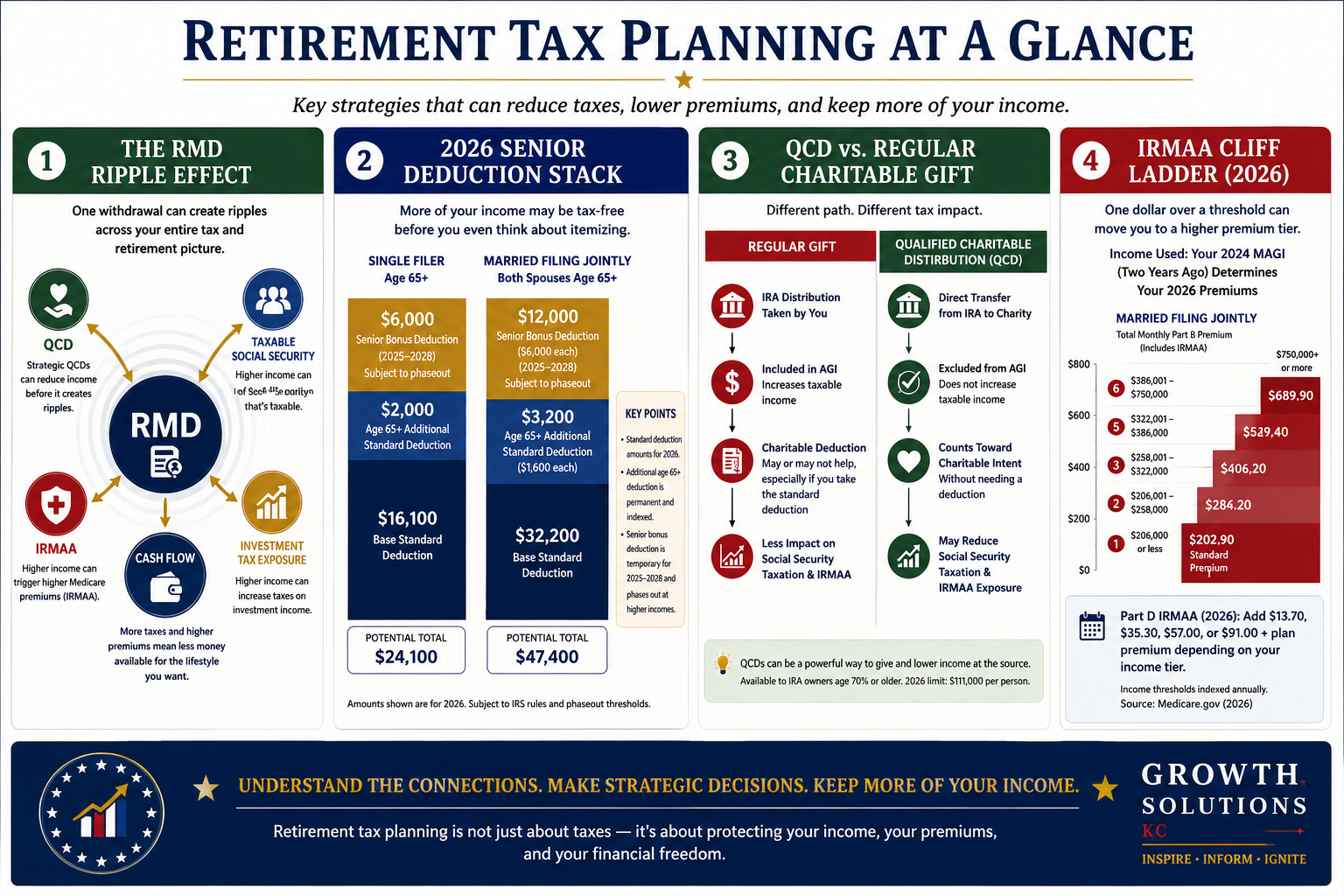
The 2026 standard deduction is larger than most retirees realize, and understanding it is not a minor administrative detail — it is the foundation of every other tax decision you will make this year. For tax year 2026, the base standard deduction stands at $16,100 for single filers and $32,200 for married couples filing jointly. Those figures alone represent a meaningful shield against taxable income.
But the tax code does not stop there for seniors.
Taxpayers age 65 or older are entitled to an additional deduction on top of the base: $2,050 per qualifying individual for single filers, and $1,650 per qualifying spouse for those filing jointly. A married couple where both spouses are 65 or older adds $3,300 to their deduction floor before a single other calculation is made.
And now, under the One Big Beautiful Bill Act — enacted in 2025 — there is a further temporary provision: a Senior Bonus Deduction of up to $6,000 per individual age 65 or older, available for tax years 2025 through 2028. This bonus phases out above $75,000 in income for single filers and $150,000 for married couples filing jointly, meaning it is specifically designed to benefit mid-range retirement incomes — exactly the households most likely to overlook it.
Run the math on a concrete example: a married couple, both age 70, with a combined income of $80,000. Their base standard deduction is $32,200. Add $3,300 for two qualifying spouses over 65. Add $12,000 for the Senior Bonus Deduction ($6,000 per individual). That is a potential total deduction of over $47,000 before a single dollar of their income is taxed. This is not a loophole — it is the tax code operating exactly as designed for seniors.
Yet the majority of retirees are making one of two costly errors: either overestimating their tax liability and/or making suboptimal withdrawal decisions.
Required Minimum Distributions
Under the SECURE Act 2.0, Required Minimum Distributions begin at age 73 for individuals born between 1951 and 1959, and at age 75 for those born in 1960 or later. This is not optional. An RMD is a mandatory annual withdrawal from tax-deferred retirement accounts — traditional IRAs, 401(k)s, 403(b)s, and similar vehicles — calculated using the prior year's December 31 account balance divided by an IRS life expectancy factor from the Uniform Lifetime Table.
Miss your RMD, and the IRS may assess a 25% excise penalty on the amount that should have been withdrawn. If corrected within the applicable correction window, that penalty may be reduced to 10%. Either way, the lesson is the same: RMD compliance is not something retirees should leave to year-end guesswork.
What makes RMDs genuinely dangerous for unprepared retirees is not the withdrawal itself — it is what that withdrawal does to everything else on the tax return.
RMDs are ordinary income. Every dollar of RMD income increases your Adjusted Gross Income, which can simultaneously tip a larger percentage of your Social Security benefits into the taxable column, push your Medicare premiums into a surcharge tier, and elevate the rate at which your investment income is taxed.
This cascade — we call it the RMD ripple effect — catches thousands of retirees every year who planned their retirement income in isolation rather than as an integrated system.
The Qualified Charitable Distribution: The Most Underused Strategy in Retirement
If there is one retirement tax strategy that consistently goes underutilized — not because it is complicated, but because it is not widely understood — it is the Qualified Charitable Distribution (QCD).
A Qualified Charitable Distribution is available to IRA owners age 70½ or older and must be transferred directly from the IRA custodian to a qualified charity. Properly executed, the QCD is excluded from gross income rather than claimed as a separate charitable deduction, which can make it especially valuable for retirees who take the standard deduction.
Here is why. When you make a regular charitable donation and then take the standard deduction — which, as we established above, most seniors will — your donation produces zero additional tax benefit.
A QCD operates entirely differently: it removes the donated amount from your IRA before it is ever counted as income.
The distribution goes directly to the charity without passing through your hands, and it never appears in your Adjusted Gross Income. This is not a deduction. It is an income exclusion — which is a structurally more powerful tool.
The cascade benefits follow directly from that distinction: a lower AGI means less of your Social Security may be taxable, reduces your exposure to Medicare IRMAA surcharges, and can keep your overall tax bracket lower — all from a single, well-timed move.
The timing reality is one that catches even informed retirees off guard: QCDs must reach the qualifying charity by December 31 to count for that tax year. The year-end rush in the financial services industry means that distributions initiated in December sometimes fail to clear in time.
The optimal window to evaluate, structure, and execute a QCD strategy is June through August — mid-year, when there is time to calculate the right amount, coordinate with your IRA custodian, and confirm the charities without urgency.
A QCD should be used thoughtfully as a strategic tool. This is not merely a charitable suggestion — it is a key retirement tax strategy, and for charitably inclined seniors over age 70½, it is often one of the most valuable moves they can make in a tax year.
Medicare Premiums and the IRMAA Cliff
Most retirees know that Medicare Part B carries a monthly premium. Fewer know that premium can more than triple based on their income — and that the income used to calculate it is from two years prior.
This is the Income-Related Monthly Adjustment Amount, known as IRMAA, and it is one of the most consequential — and least understood — tax mechanisms in retirement.
In 2026, the standard Medicare Part B premium is $202.90 per month for retirees at or below the base income threshold. For those earning above it, IRMAA surcharges stack on top — and they rise steeply. For 2026, higher-income total Part B premiums rise as high as $689.90 per month; and Part D IRMAA can add up to $91.00 to the plan premium each month.
The critical detail — the one that surprises even sophisticated retirees — is the two-year lookback. Your 2026 Medicare premiums are determined by your 2024 tax return.
The cliff effect makes this even more consequential: crossing a threshold by a single dollar triggers the full surcharge. This is not a sliding scale — it is a step function. One dollar of additional income can cost a couple thousands of dollars in annual premiums.
Precise income management is not optional in this environment; it is a structural necessity.
The strategic levers for controlling IRMAA exposure going forward are the same ones that appear throughout this article: QCDs that reduce AGI at the source, bracket management that prevents unnecessary income spikes, and Roth conversion timing that shifts future income out of the IRMAA-triggering categories entirely.
Social Security: The Taxable Income Most Retirees Don't Expect
Up to 85% of Social Security benefits are subject to federal income tax — and the income thresholds that determine what percentage is taxable have not been adjusted for inflation since 1984.
What Congress originally designed to affect only the highest-income retirees now reaches the vast majority of Social Security recipients, simply because income levels have grown over four decades while the thresholds have not.
The direct connection to RMDs is one of the clearest examples of how retirement income streams interact. Every dollar of RMD income increases your Adjusted Gross Income, which increases your combined income figure, which tips a larger portion of your Social Security into the taxable column — often moving a retiree from the 50% threshold to the 85% threshold with a single withdrawal decision.
This is not a hypothetical edge case. It is a predictable outcome that proactive planning can meaningfully reduce.
Roth IRA withdrawals, by contrast, do not count toward combined income at all. A retiree who strategically draws on Roth assets in years when Social Security income is high — rather than triggering additional traditional IRA withdrawals — can materially reduce the percentage of their benefits that are taxed.
This is one of the clearest illustrations of a foundational truth in retirement tax strategy: account type, not just account balance, determines your tax burden.
Retirement is not the end of financial strategy.
For those who approach it with the same discipline that built their wealth, it is simply the next chapter — one where the rules are different, the stakes are higher, and the rewards of getting it right are exactly what you worked your entire life to earn.
What You Should Do Next
Retirement taxes are not a single event. They are a continuous system — one in which timing, income sequencing, and proactive structure determine outcomes that span years and decades.
The provisions covered in this article do not operate as independent line items on a tax return. They interact. An RMD ripples into Social Security taxation. A well-timed QCD compresses AGI and simultaneously reduces other exposures.
Your Retirement Tax Planning Roadmap
Retirement tax planning works best when approached as a year-round process rather than a year-end scramble. The most successful retirees proactively manage income, charitable giving, Medicare thresholds, and required distributions throughout the year.
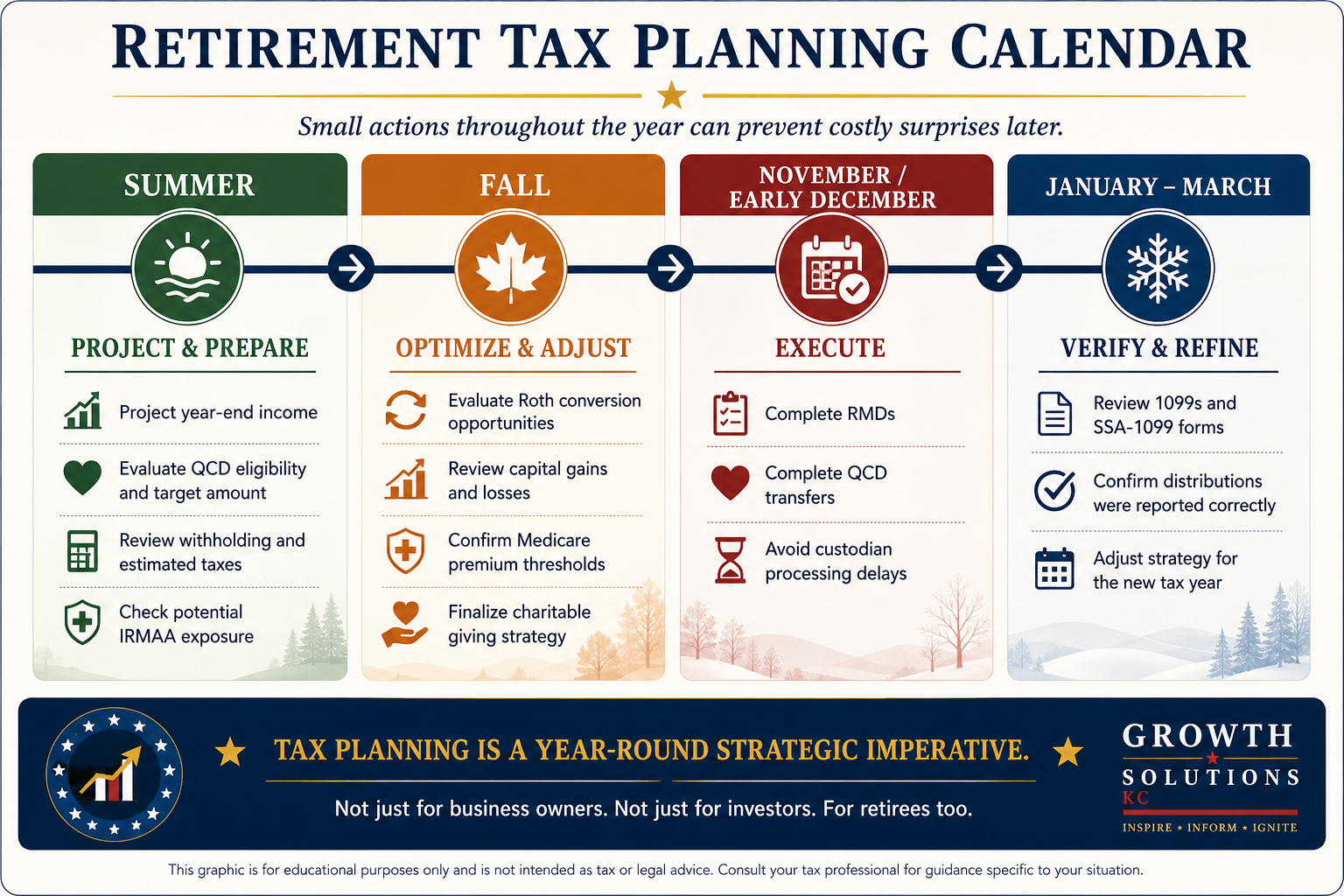
Retirement does not simplify your relationship with the tax code—it transforms it. The retirees who achieve the best outcomes are rarely those who react at filing time. They are the ones who plan ahead, understand the interaction between income, Medicare, Social Security, and charitable giving, and make strategic decisions throughout the year.
— Matt Cucinotta | Growth Solutions KC | Inspire · Inform · Ignite
This article is published as part of the GSKC's Tax & Wealth Planning page and is intended for informational and educational purposes only. It does not constitute tax, legal, or financial advice. Tax laws and thresholds referenced reflect the 2026 tax year and the provisions of the One Big Beautiful Bill Act as enacted. Readers should consult a qualified tax professional regarding their individual circumstances.



Comments ()