

Paying for College Is a Coordination Problem — That Can be Overcome

How College-Age Families Can Align Tax Credits, 529 Plans, Scholarships, and Financial Aid
Part IV in the GSKC Year-Round Tax Planning Series.
For many families, the arrival of a college acceptance letter brings both pride and financial reality.
College has become a major household capital expenditure — but families are often asked to coordinate it through rules divided among the tax code, financial-aid formulas, scholarship agreements, and account-ownership structures.
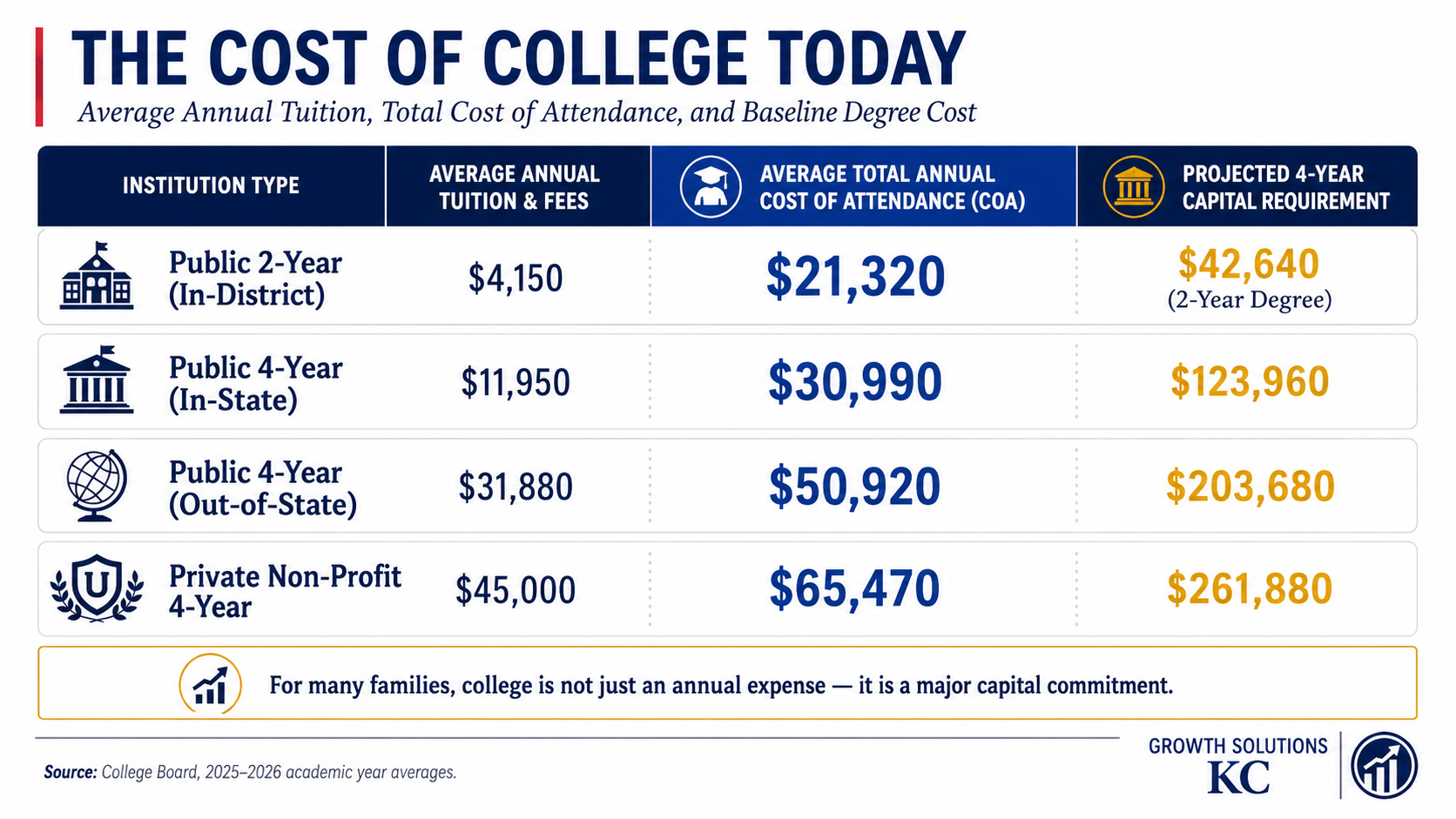
For the 2025–2026 academic year, the College Board estimates that average annual budgets range from approximately $21,320 for an in-district public two-year student to $65,470 for a student attending a private nonprofit four-year institution. The average annual budget for an in-state public four-year student is approximately $30,990 before grants, scholarships, tax benefits, or other assistance.
Those figures help establish the scale of the challenge, but cost alone is not the whole story.
Most families understand that preparing for college requires saving. Fewer realize that the order in which college expenses are paid — and the accounts used to pay them — can materially affect the tax benefits the family receives.
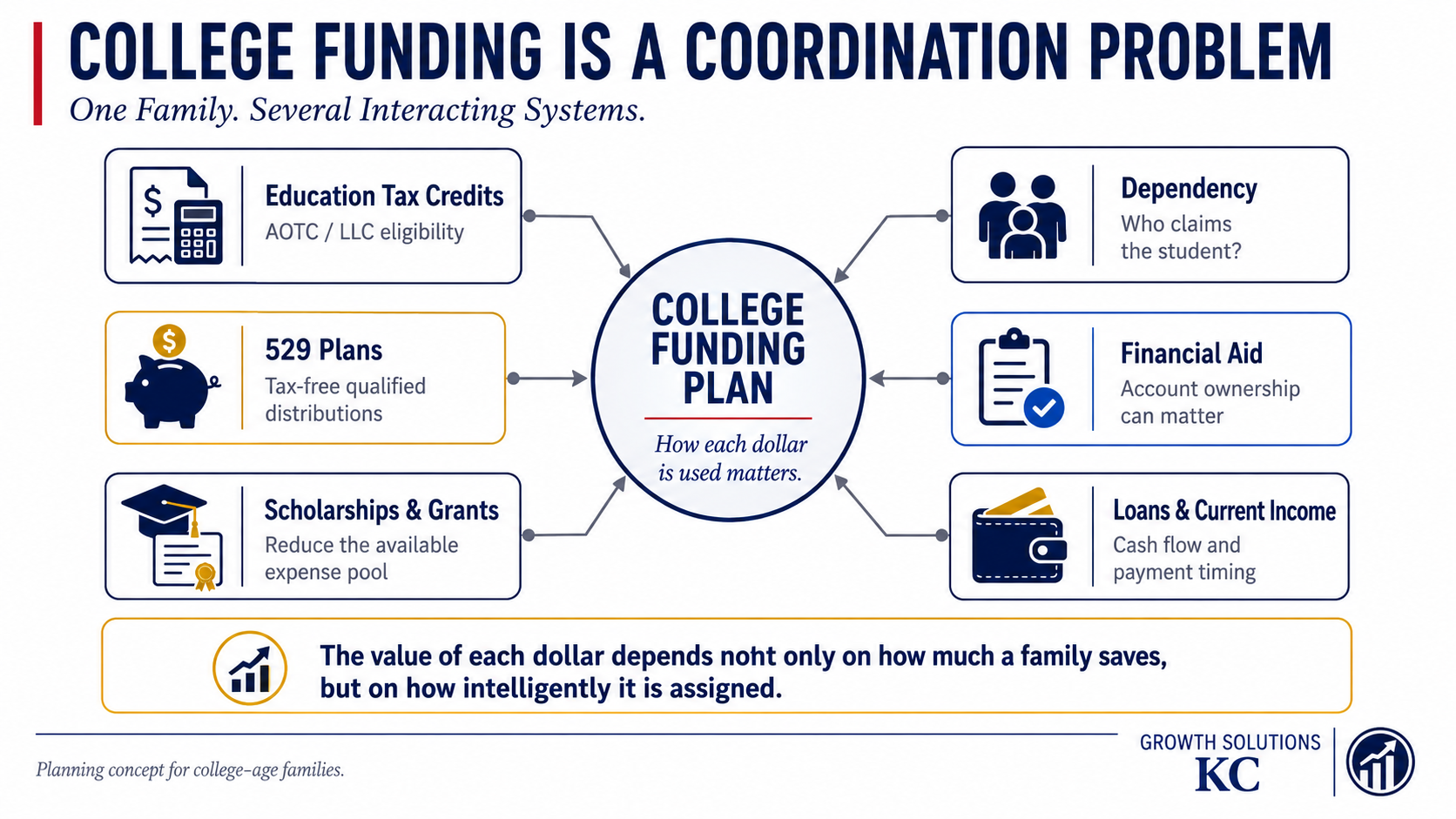
A family may have money in a 529 plan, qualify for an education tax credit, receive a scholarship, use current income, and borrow part of the remaining cost. Each resource may appear helpful on its own. The challenge is making sure they work together.
Saving Is Only Half the Strategy
A 529 plan can be an important part of a family’s college strategy. Investment earnings may grow free from federal income tax, and distributions are generally tax-free when properly matched with qualified education expenses.
Federal education tax credits can also reduce the cost of college. Scholarships and grants may lower the amount the family must provide. Financial aid can help bridge the remaining gap.
The complication is that these systems do not operate independently.
The tax code may define a qualified expense differently for an education credit than it does for a 529 plan. A scholarship may reduce the tuition available for a credit. The person claiming the student as a dependent may determine who can claim the credit. The ownership of an education account may affect how it is reported for financial-aid purposes.
That creates a series of decisions:
- Who will claim the student as a dependent?
- Is the family eligible for an education credit?
- Which expenses should be reserved for that credit?
- Which expenses should be assigned to the 529 plan?
- How do scholarships change the available expense pool?
- Did the payments and distributions occur in the correct calendar year?
- How will the account’s ownership be treated for financial aid?
None of these questions is necessarily overwhelming by itself. The difficulty comes from answering them together — and answering them before the money moves.
Who Claims the Student — and the Credit?
Before coordinating expenses, the family must determine who is entitled to claim the student and any related education benefit.
When parents claim a college student as a dependent, qualified expenses paid by the student or by another person on the student’s behalf may generally be treated as paid by the parents for purposes of the education credit. The dependent student cannot claim the same credit on a separate return.
When parents are entitled to claim the student but choose not to do so, the student may be able to claim an education credit instead. That does not automatically produce the best result. The decision can affect other tax benefits, and special rules can limit the refundable portion of the American Opportunity Tax Credit for certain students. The best outcome should therefore be evaluated across the family rather than one tax return at a time.
For eligible undergraduate students, the American Opportunity Tax Credit, or AOTC, is often the first credit to consider. It may provide up to $2,500 per eligible student for each of the first four years of postsecondary education. The credit equals 100% of the first $2,000 of qualifying expenses and 25% of the next $2,000. Up to $1,000 may be refundable, subject to eligibility requirements.
Because of that calculation, a family generally needs $4,000 of adjusted qualified expenses to receive the maximum AOTC.
Those expenses do not necessarily have to be paid from a traditional cash account. Subject to the other requirements, qualifying expenses may be paid with current income, savings, gifts, credit cards, or borrowed funds such as student or parent loans.
The Lifetime Learning Credit, or LLC, may apply when the AOTC is unavailable. It can provide up to $2,000 per tax return and may be available for undergraduate, graduate, professional, or job-skill courses. Unlike the AOTC, it is not limited to the first four years. A family cannot claim both credits for the same student during the same year.
Income limits, enrollment requirements, the student’s academic status, prior credit usage, and other restrictions can affect eligibility.
The first planning question is always: Who is eligible to claim what?
Coordinating Education Credits, Scholarships, and 529 Plans
After determining eligibility, the next step is deciding which expenses belong to which benefit.
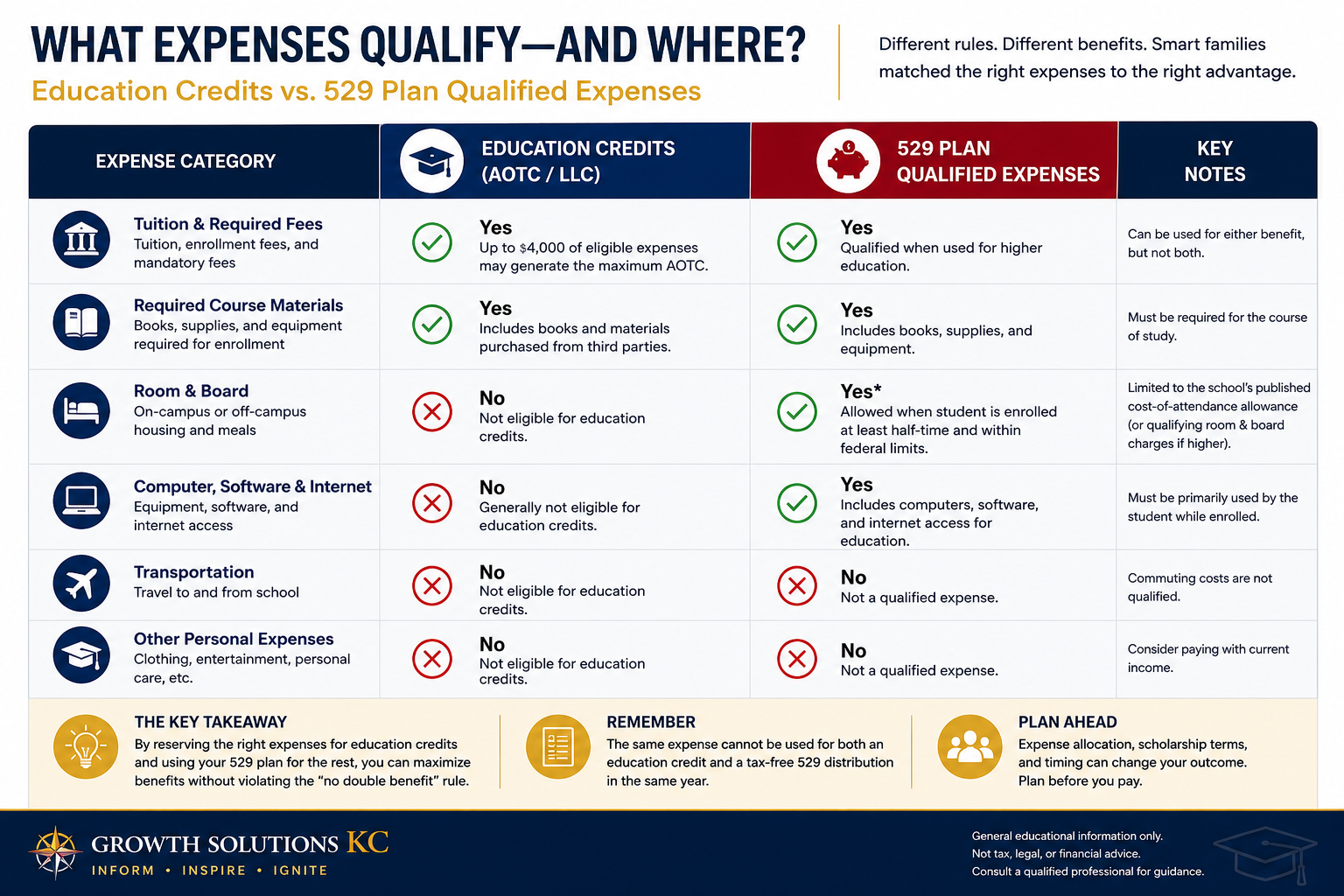
The IRS does not permit the same expense to be used twice. A family cannot use one tuition dollar to support both an education credit and the tax-free treatment of a 529 distribution.
A credit and a tax-free 529 distribution may be used during the same year — but they must be supported by different expenses.
This restriction creates the central planning opportunity.
Different programs recognize different expenses
The AOTC generally focuses on tuition, required enrollment fees, and qualifying course materials.
A 529 plan has a broader higher-education expense definition. In addition to tuition, fees, books, supplies, and required equipment, a 529 plan may cover qualifying computer equipment, software, internet access, and certain room-and-board expenses.
Room and board can qualify only when the student meets the applicable enrollment requirement, generally at least half-time, and the allowable amount is subject to federal limits tied to the school’s cost-of-attendance allowance or qualifying institutional charges.
This difference allows a family to reserve certain tuition expenses for the education credit while using the 529 plan for other eligible costs.
That is more efficient than automatically paying the entire tuition bill from the 529 account.
Scholarships change the calculation
Scholarships and grants must also be considered before expenses are assigned.
Tax-free educational assistance generally reduces the expenses available for an education credit or tax-free 529 treatment. A family receiving a $10,000 tuition scholarship does not necessarily have the same expense pool as a family paying the entire tuition bill itself.
The terms of the scholarship matter. Some awards are restricted to tuition. Others may be used for room, board, or additional educational costs.
In certain circumstances, a student may elect to treat part of an otherwise tax-free scholarship as taxable income and assign it to nonqualified expenses. That can preserve more tuition for an education credit. The strategy is not universally beneficial: it can increase the student’s taxable income, create a filing requirement, affect state taxes, or interact with other tax provisions. It should be modeled carefully rather than treated as a standard recommendation.
The broader lesson is simple:
A scholarship should not merely be subtracted from the bill. Its restrictions, tax treatment, and effect on other benefits should be reviewed as part of the family’s complete college-funding plan.
Timing matters too
Education planning follows the calendar year — not necessarily the school year.
The fall and spring semesters may belong to the same academic year but fall into different tax years. A December tuition payment, January 529 distribution, later scholarship adjustment, or school-issued refund can change the tax analysis.
Families should try to match 529 distributions with qualifying expenses in the same calendar year and preserve records showing what was paid, when it was paid, and how each expense was assigned. Forms 1098-T and 1099-Q are important, but they do not always tell the entire story. Account statements, school ledgers, receipts, scholarship documents, and payment confirmations may all be needed.
Planning after the return documents arrive may be too late to correct a distribution or recover an expense that was assigned inefficiently.
How Account Ownership Can Affect Financial Aid
The type of account is only part of the decision. Ownership can matter as well.
Under the current federal FAFSA framework, a 529 account owned by a parent for a dependent student — and a qualifying 529 owned by that dependent student — is generally reported with parental assets.
UGMA and UTMA custodial accounts are different. Because the minor is the legal owner, these accounts are reported as student assets. The federal aid formula treats student assets differently from parent assets.
A 529 owned by a grandparent or another person outside the student-and-parent household generally is not reported as an asset belonging to the student or parents on the federal FAFSA. Current FAFSA reporting also differs from the older framework that required certain third-party 529 distributions to be reported as student untaxed income. Families should still be cautious: an institution using the CSS Profile or its own financial-aid process may request information that the federal FAFSA does not.
Financial aid should therefore be viewed as another part of the coordination process — not as a separate application completed after the tax and investment decisions have already been made.
The “best” account cannot be determined from investment performance or tax treatment alone. Ownership, control, intended use, financial-aid treatment, state benefits, and the family’s overall objectives all matter.
A Hypothetical $12,000 Coordination Example
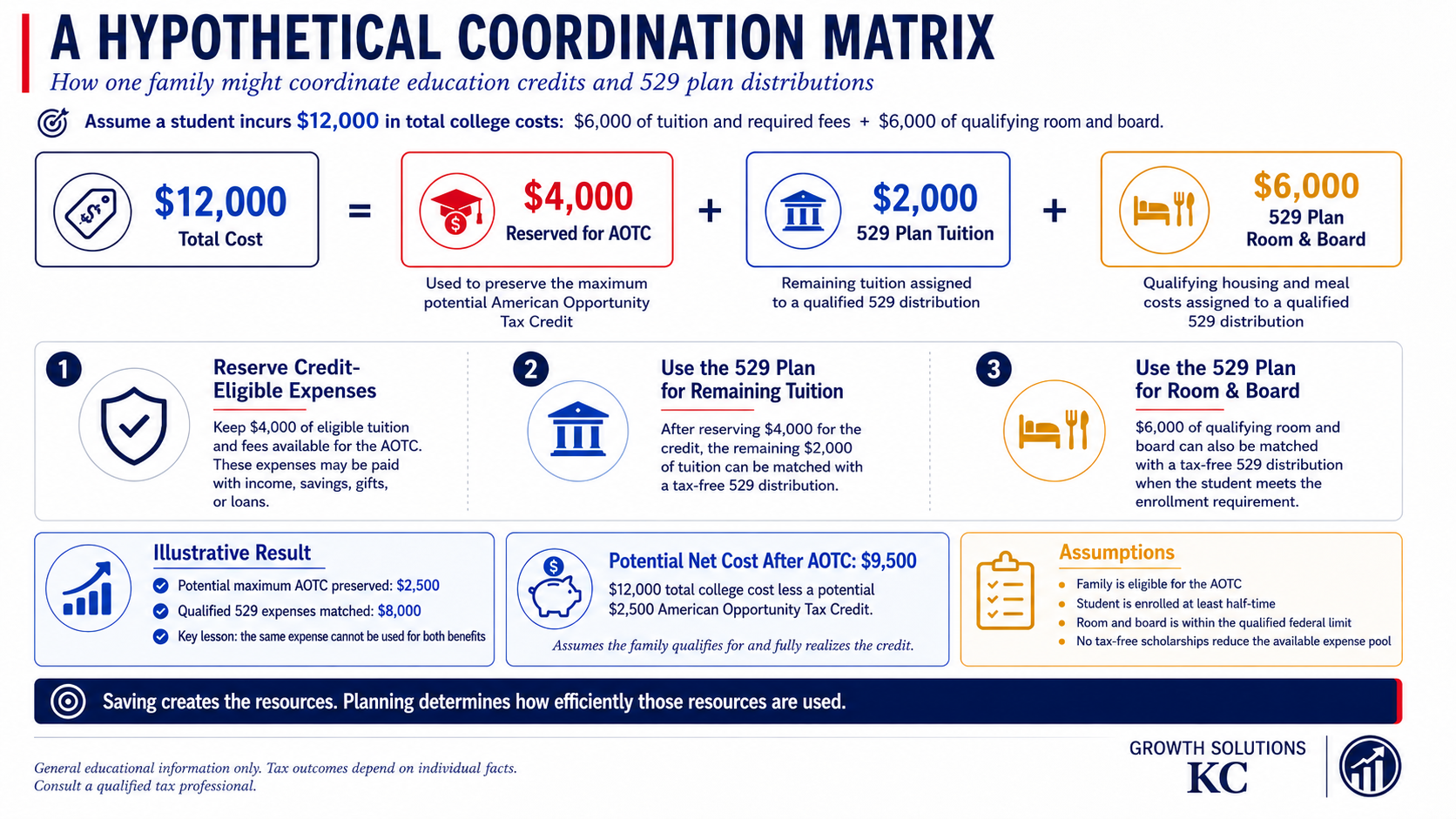
Consider a student with $12,000 of eligible college costs during the year:
- $6,000 of tuition and required fees
- $6,000 of qualifying room and board
Assume the family is eligible for the AOTC, the student is enrolled at least half-time, the room-and-board amount falls within the permitted limit, and no tax-free scholarships reduce the available expense pool.
The family could coordinate the expenses as follows:
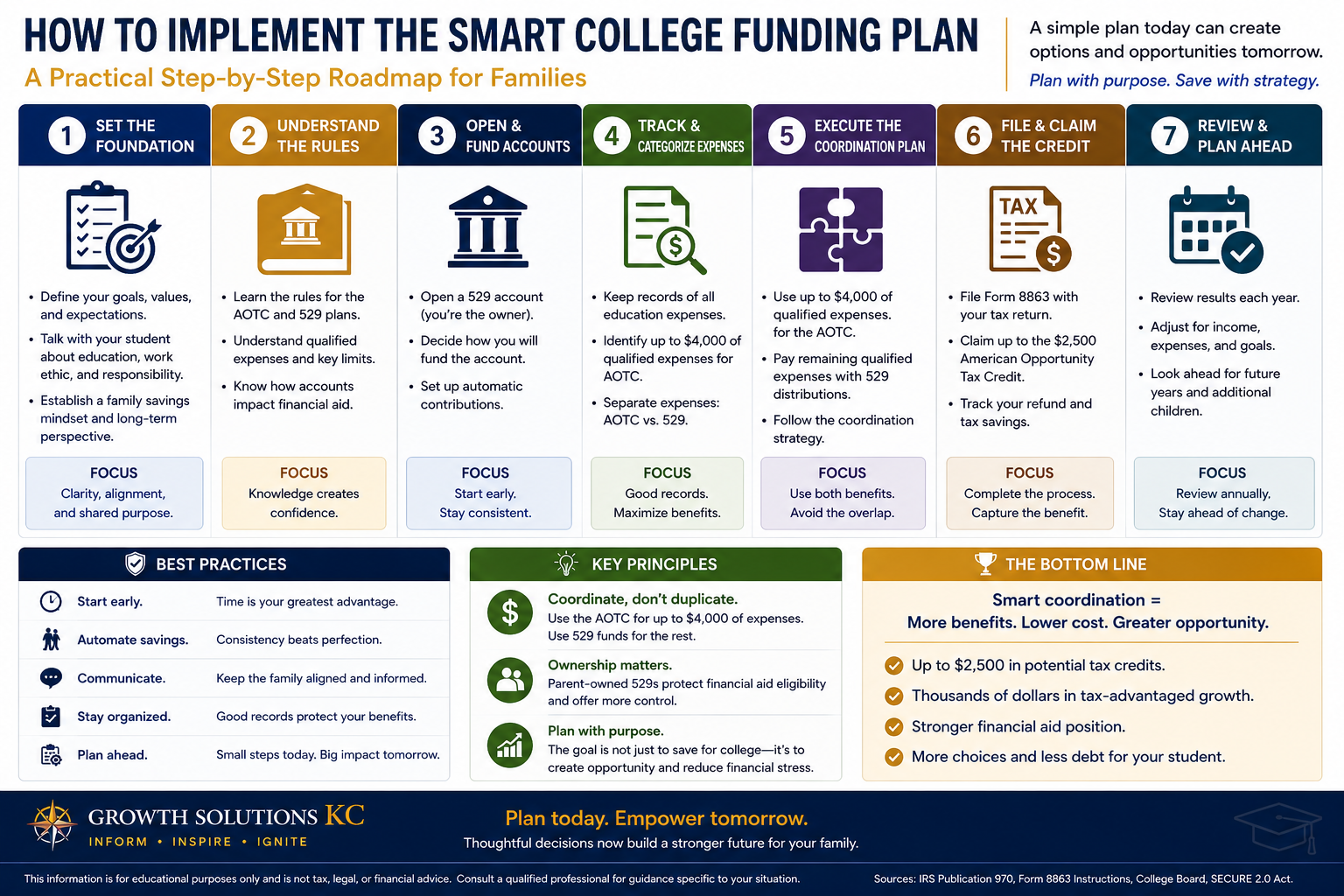
Step 1: Reserve $4,000 for the AOTC
The family assigns $4,000 of eligible tuition and required expenses to the AOTC calculation.
Those expenses might be paid with current income, savings, gifts, or borrowed funds. They do not have to be paid exclusively with cash reserves.
With sufficient eligibility and tax circumstances, the $4,000 expense allocation may support the maximum $2,500 AOTC.
Step 2: Assign the remaining tuition to the 529 plan
After reserving $4,000 for the credit, $2,000 of tuition remains.
The family assigns that $2,000 to the 529 plan.
Step 3: Use the 529 plan for qualifying room and board
The family also assigns the $6,000 of eligible room-and-board expenses to the 529 plan.
The total expense allocation is therefore:
$12,000 total cost = $4,000 reserved for the AOTC + $2,000 of 529-funded tuition + $6,000 of 529-funded room and board
In this hypothetical example, the family preserves a potential $2,500 federal credit while matching $8,000 of 529 distributions with separate qualified expenses.
The example does not create an additional deduction for the $12,000 of costs, nor does it guarantee that every family will receive the same result. It demonstrates how thoughtful allocation can prevent one resource from unintentionally displacing another.
Had the family automatically used the 529 account to pay all $6,000 of tuition, it might have left insufficient tuition and related expenses available for the maximum $2,500 AOTC.
The family saved the same amount of money. The difference was how the expenses were deployed.
A Local Planning Note for Kansas and Missouri Families
State income-tax treatment can add another layer of value.
Under current Kansas guidance, taxpayers may generally subtract up to $3,000 per beneficiary for contributions to a qualified 529 plan, or up to $6,000 per beneficiary for married taxpayers filing jointly. Kansas also recognizes qualifying contributions to plans established by other states.
Under current Missouri guidance, the subtraction is generally limited to $8,000 for an individual or $16,000 for a married couple filing a combined return. Contributions to Missouri MOST or another qualified 529 plan may qualify.
These are state income subtractions — not dollar-for-dollar tax credits. Their actual value depends on the taxpayer’s circumstances and applicable state tax rate.
State rules can change, and nonqualified withdrawals may create recapture or other state consequences. Families should confirm the rules for the year in which the contribution or withdrawal occurs.

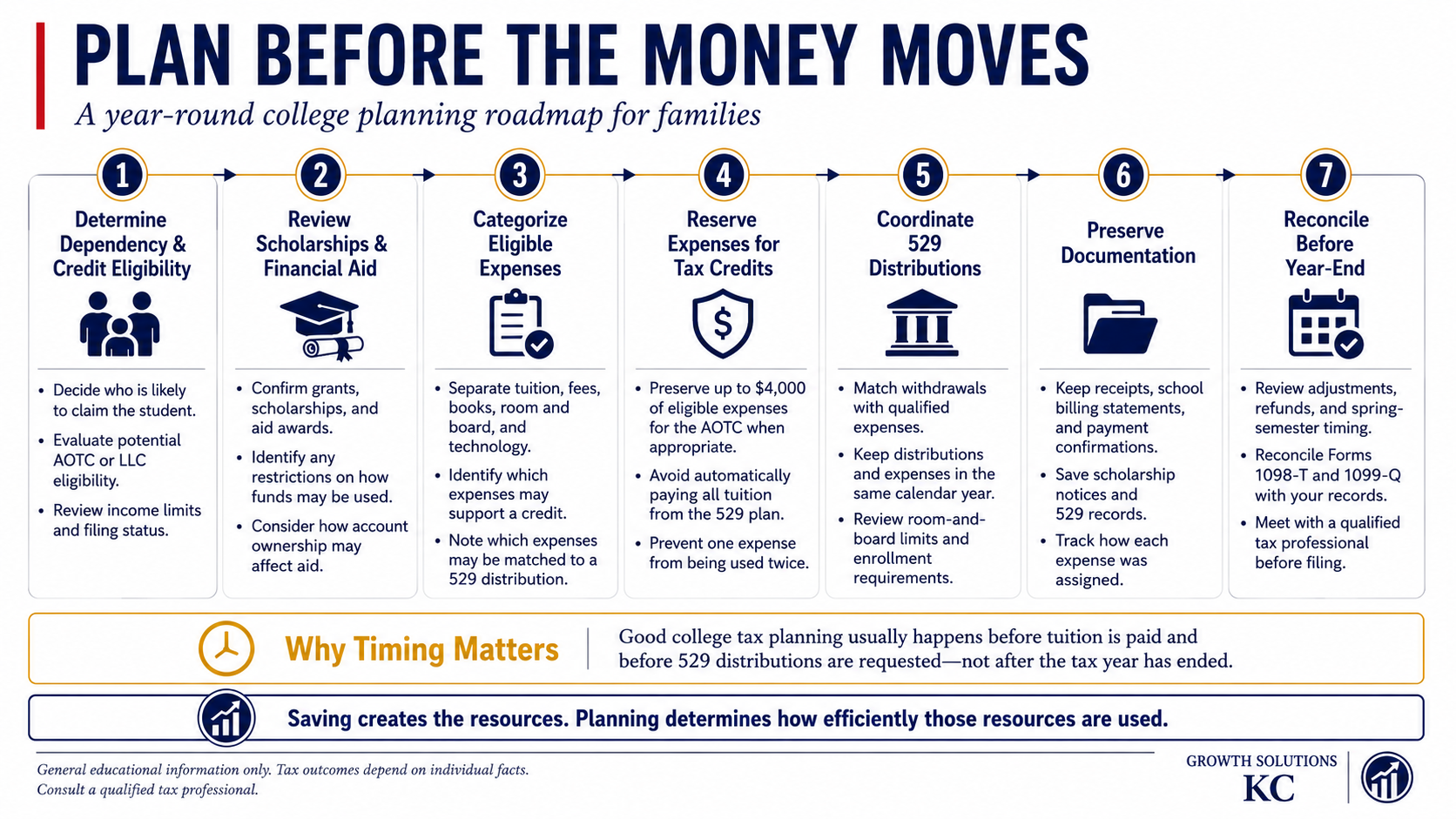
Plan Before the Money Moves
Good college tax planning should not begin when the tax return is prepared.
It should begin before tuition is paid and before a 529 distribution is requested.
Before the semester begins
Review the student’s enrollment status, expected tuition, housing costs, scholarships, grants, loans, and financial-aid package. Determine which family member is likely to claim the student and whether an education credit may be available.
Before paying tuition
Identify the expenses that may be needed to support the AOTC or LLC. Avoid automatically paying the entire tuition bill from the 529 account before the potential credit has been evaluated.
Before requesting a 529 distribution
Confirm that enough separate qualified expenses remain after accounting for tax-free scholarships, grants, employer assistance, and any expenses reserved for a credit.
Before the end of the calendar year
Compare total 529 distributions with total qualified expenses. Review school refunds, scholarship adjustments, spring-semester payments, room-and-board limits, and any expenses that may have crossed into another tax year.
When tax documents arrive
Reconcile Forms 1098-T and 1099-Q with the family’s own records. Do not assume that a tax form automatically reflects the final expense allocation or the most advantageous treatment.
A tax professional may also need to coordinate with the family’s financial advisor and the school’s financial-aid office. Each professional sees a different part of the system. Better results often come from connecting those parts before decisions become irreversible.
The Year-Round College Planning Checklist
The cost of college naturally encourages families to focus on accumulation: how much to save, how much to contribute to a 529 plan, and whether the account’s investments are on track.
Those questions matter. But as the student approaches college, the planning objective changes.
The family is no longer merely building the resources. It is deploying them.
That deployment may involve tax credits, 529 distributions, scholarships, financial aid, dependency decisions, loans, and state deductions. Each tool can help, but each comes with its own rules. A decision that appears reasonable in isolation can reduce another benefit when the complete system is not considered.
Families do not need to master every education provision in the tax code. They do need to recognize when coordination matters, where mistakes commonly occur, and when professional guidance can add value.
The best time to have that planning conversation with a tax professional is not after the tax year has ended. It is before tuition is paid, before distributions are taken, and before one education dollar is asked to do two different jobs.
— Matt Cucinotta | Growth Solutions KC | Inspire · Inform · Ignite
This article is intended for general educational purposes and does not constitute individualized tax, legal, investment, or financial-aid advice. Tax benefits and financial-aid outcomes depend on each family’s circumstances. Federal and state rules should be verified for the applicable year with a qualified tax professional and other appropriate advisors.
Learn more about tax planning at every stage by checking out the GSKC Year-Round Tax Planning Series.



Comments ()