

Raising a Family and the Tax Code: What Parents with Young Children Need to Know
Young families often manage tax credits, childcare benefits, payroll withholding, and education savings as separate decisions. Coordinating them can improve cash flow today while building greater financial security for tomorrow.

Coordinating child tax credits, childcare benefits, paycheck withholding, healthcare, and 529 savings in 2026.
Part III in the GSKC Year-Round Tax Planning Series.
Most relevant for parents and guardians with children under age 17, working parents paying for childcare, two-income households, single parents, and families beginning to save for education.
A child changes more than the family budget.
The arrival of a child is a beautiful blessing — and it changes nearly every part of a household’s financial life.
There are new medical expenses, childcare arrangements, insurance decisions, household purchases, and long-term savings goals. A parent may reduce work hours, change jobs, take parental leave, or begin paying thousands of dollars a year for daycare.
The tax consequences can be just as significant.
A new child may affect:
- The Child Tax Credit,
- The Child and Dependent Care Credit,
- Employer Dependent Care benefits,
- Federal income tax withholding,
- Filing status and dependency rules,
- Health Savings Account strategy, and
- Long-term education savings.
But these provisions are rarely coordinated automatically.
The daycare decision happens when care is needed. The dependent care FSA election happens during employee benefits enrollment. The Form W-4 may not be reviewed until a tax bill or unexpectedly large refund appears. The 529 plan may be opened only after a grandparent asks where to send a birthday contribution.
That fragmentation is where planning opportunities are lost.
In the first article in this series, we established that tax planning is a year-round discipline rather than a filing-season event. The second article applied that principle to seniors and retirees. For families with young children, the same principle applies — but the key variables are children, childcare, payroll, and education savings.
The Child Tax Credit: Valuable, but Not Automatic
For 2026, the Child Tax Credit is worth up to $2,200 for each qualifying child under age 17. Families with little or no federal income tax liability may also qualify for up to $1,700 per child through the refundable Additional Child Tax Credit, subject to earned-income and other eligibility requirements. The full credit generally begins phasing out when income exceeds $200,000 for most filing statuses or $400,000 for married couples filing jointly.
Those numbers are meaningful, especially for a family with several children.
But eligibility depends on more than simply being a parent.
The child generally must:
- Be under age 17 at the end of the year,
- Be claimed as the taxpayer’s dependent,
- Meet relationship, residency, support, and other qualifying-child tests, and
- Have the required Social Security number.
The taxpayer — or at least one spouse on a joint return — must also satisfy the applicable Social Security number requirements.
A newborn can affect the entire tax year
A child born alive at any time during the year may be claimed as a dependent when the applicable tests are met. That means even a child born near the end of December may qualify the family for the Child Tax Credit and potentially affect filing status and other family-related tax benefits.
The practical lesson is simple:
Do not wait until tax season to address the paperwork.
Apply for the child’s Social Security number, update health and employer benefit elections, review withholding, and confirm how the new dependent will affect the family’s projected tax return.
Separated parents need more than an informal agreement
Dependency rules can become especially important for unmarried, divorced, or separated parents.
A noncustodial parent may sometimes claim the Child Tax Credit when the required conditions and documentation are satisfied. However, the custodial parent may remain the person eligible for the Child and Dependent Care Credit, the dependent care benefit exclusion, the Earned Income Tax Credit, and head-of-household status. The different benefits do not always travel together.
This is why a sentence in a parenting agreement stating that the parents will “alternate claiming the child” may not resolve every federal tax question.
The tax code applies its own definitions. That is another reason separated parents should consult a qualified tax professional and address dependency decisions through year-round planning rather than at filing time.
Childcare Has Two Tax Systems — and Families Must Compare Them
Childcare is one of the largest expenses many young families face.
The tax code provides two primary ways to receive federal tax relief:
- The Child and Dependent Care Credit, claimed on the income tax return, and
- An employer-sponsored Dependent Care Flexible Spending Account, funded through payroll.
These benefits are related, but they are not interchangeable — and families generally cannot use the same childcare dollars for both.
Option One: The Child and Dependent Care Credit
The Child and Dependent Care Credit may be available when a taxpayer pays for the care of a qualifying individual so the taxpayer — and the taxpayer’s spouse when filing jointly — can work or actively look for work.
A qualifying individual is generally a dependent child under age 13 when the care is provided, although separate rules apply to spouses and dependents who are incapable of self-care. The taxpayer generally must have earned income and must identify the care provider on Form 2441.
For 2026, the amount of expenses used to calculate the credit remains limited to:
- $3,000 for one qualifying individual, or
- $6,000 for two or more qualifying individuals.
The maximum percentage applied to those expenses increased from 35% to 50% for qualifying lower-income households, with the percentage decreasing as income rises.
The credit can therefore be especially important for lower- and moderate-income working families.
What childcare expenses may qualify?
Depending on the circumstances, eligible care may include:
- Daycare,
- Preschool or nursery school,
- A nanny or babysitter,
- Before-school or after-school care, and
- Day camp, including certain activity-focused camps.
Private kindergarten tuition is considered an education expense rather than a childcare expense and generally does not qualify. However, separately stated before- or after-school care may qualify. Day camp may qualify when the care enables a parent to work, but overnight camp does not.
The distinction matters because the name of a program does not determine its tax treatment. Its purpose, structure, and connection to the parent’s work are what matter.
Documentation is part of the strategy
To claim the credit, parents generally need the provider’s:
- Name,
- Address, and
- Social Security number or employer identification number.
Families should request this information before paying a new provider—or at least well before tax season. The IRS provides Form W-10 for collecting provider information.
A childcare expense that might otherwise qualify becomes difficult to claim when the provider cannot be identified.
Option Two: The Dependent Care FSA
Some employers offer a Dependent Care Flexible Spending Account as part of their employee benefits package.
Beginning in 2026, the annual exclusion limit increased to $7,500, or $3,750 for a married employee filing separately. Eligible amounts are generally excluded from the employee’s taxable wages under the dependent care assistance rules.
This can provide tax savings through payroll rather than waiting until the annual income tax return.
For many middle- and higher-income working families, the dependent care FSA may produce a larger benefit than the Child and Dependent Care Credit because:
- The FSA limit is larger than the credit’s expense ceiling,
- The benefit may reduce federal income tax,
- It may reduce applicable payroll taxes, and
- It may also produce state income tax savings, depending on the state.
But that does not make the FSA the automatic answer for every family.
Lower-income households may receive a larger percentage benefit from the enhanced Child and Dependent Care Credit. Families must also consider plan deadlines, reimbursement procedures, eligible expenses, and the possibility of forfeiting unused funds under their employer’s plan.
The two benefits must be coordinated
Dependent care benefits excluded from income reduce the expenses remaining for the Child and Dependent Care Credit.
A family cannot place $7,500 of childcare expenses through a dependent care FSA and then use those same $7,500 again to calculate the credit. Under the Form 2441 calculation, excluded dependent care benefits reduce the applicable $3,000 or $6,000 expense ceiling.
That creates a planning decision that should occur before open enrollment, not when the tax return is prepared.
A family should compare:
Estimated tax savings from the dependent care FSA
versus
Estimated Child and Dependent Care Credit after considering income and eligible expenses.
The right answer may change when income, childcare costs, marital status, work schedules, or the number of qualifying children changes.
Withholding: A Refund Is Not a Tax Strategy
A new child often reduces a family’s projected federal income tax liability.
That does not mean payroll withholding will adjust automatically.
Employees use Form W-4 to tell their employer how much federal income tax to withhold. Step 3 of the 2026 form allows taxpayers to account for qualifying children, other dependents, and certain additional credits.
Updating Form W-4 may increase take-home pay during the year rather than requiring the family to wait for a large refund.
But there is an important distinction:
Changing withholding does not create a tax benefit. It changes when the family receives the benefit.
A family expecting a $5,000 refund may prefer to receive part of that money throughout the year to help pay for daycare, diapers, medical bills, debt reduction, or savings.
Another family may intentionally retain additional withholding because one spouse has self-employment income, investment income, bonuses, or another source of income without sufficient withholding.
The objective is not always the largest paycheck or the largest refund.
The objective is to have withholding reasonably match the family’s projected tax liability.
Two-income households require special care
When both spouses work — or when either spouse has more than one job—the correct withholding depends on income from all jobs.
The 2026 Form W-4 instructs taxpayers in multiple-job households to address the combined income in Step 2. It also generally directs the family to complete Steps 3 through 4(b) on only one Form W-4, preferably the form associated with the highest-paying job.
This helps prevent a common mistake: both spouses independently claiming the full value of the same children on their respective Forms W-4.
The tax return may allow only one combined family benefit, even though two payroll systems reduced withholding as though each spouse were entitled to the full amount.
Review withholding after major family changes
The IRS recommends checking withholding after events such as:
- A birth or adoption,
- Marriage, divorce, or separation,
- A new job,
- A spouse starting or stopping work,
- A significant income change,
- A change in childcare expenses, or
- A change in expected credits.
The IRS Tax Withholding Estimator can help families project their liability and prepare a revised Form W-4.
The earlier a withholding issue is identified, the easier it usually is to correct over the remaining pay periods.
Health Care Planning: An HSA Can Serve Today and Tomorrow
Medical expenses are another major part of raising a family.
Pregnancy, childbirth, pediatric care, prescriptions, dental treatment, vision expenses, therapy, and unexpected illnesses can place significant pressure on a household budget. Families enrolled in an HSA-qualified high-deductible health plan may be able to address those costs through a Health Savings Account.
For 2026, an eligible individual may contribute up to:
- $4,400 with self-only coverage, or
- $8,750 with family coverage.
Employer contributions count toward the same annual limit.
An HSA offers several potential tax advantages:
- Eligible personal contributions may be deductible even when the taxpayer does not itemize.
- Employer and qualifying payroll contributions may be excluded from taxable income.
- Earnings within the account may grow tax-free.
- Withdrawals may be tax-free when used for qualified medical expenses.
Unlike many flexible spending accounts, unused HSA funds generally remain in the account from year to year, and the account stays with the owner after changing employers.
The account can cover the family — not merely the employee
HSA funds may generally be used tax-free for unreimbursed qualified medical expenses incurred by:
- The account owner,
- The account owner’s spouse, and
- Dependents claimed — or potentially claimable — on the tax return.
The expense must generally be incurred after the HSA was established, and the family must retain sufficient records showing that the expense was qualified and was not previously reimbursed or deducted.
This makes the HSA more than an employee benefit. It can become a household healthcare-planning account.
Current spending versus long-term saving
Families can use an HSA in two broad ways.
The first is to contribute money and use it during the year for deductibles, copayments, prescriptions, dental work, vision care, and other qualifying expenses.
The second is to pay some current medical expenses from ordinary cash flow while allowing part of the HSA balance to remain invested for future healthcare needs.
Neither approach is automatically superior.
A young family with limited cash reserves may benefit most from using the HSA for current medical bills. A family with stronger cash flow may decide to preserve more of the balance for long-term growth. The decision should reflect the family’s emergency fund, medical needs, insurance coverage, and overall financial priorities.
Do not select a health plan solely for the tax deduction
An HSA is valuable only when paired with an HSA-eligible health plan. Families should compare:
- Monthly premiums,
- Deductibles,
- Maximum out-of-pocket exposure,
- Employer HSA contributions,
- Prescription coverage,
- Provider networks, and
- Expected family medical usage.
A high-deductible plan may work well for one household and poorly for another. A family expecting significant maternity, pediatric, specialist, therapy, or prescription expenses should evaluate the complete cost of coverage — not merely the tax benefit.
Families should also coordinate an HSA with other workplace benefits. Coverage through a general-purpose health FSA or HRA can sometimes make an individual ineligible to contribute to an HSA, although limited-purpose and post-deductible arrangements may be compatible.
529 Plans: Start Early, but Use Them Deliberately
A 529 plan allows families to save for education using a tax-advantaged account.
Contributions are not deductible on the federal income tax return, although individual states may offer their own deductions or credits. Earnings generally grow without current federal income tax, and distributions are generally tax-free when used for qualified education expenses.
For parents of young children, the greatest advantage is usually not an immediate deduction.
It is time.
A contribution made when a child is two years old may have more than fifteen years to grow before the child begins college. Even modest automatic monthly contributions can become meaningful when supported by long-term compounding.
The qualified-use rules expanded in 2026
Beginning in 2026, qualified elementary and secondary education expenses include more than tuition. Eligible K–12 expenses may include certain curriculum materials, books, outside tutoring, standardized and college-admission testing fees, dual-enrollment fees, and qualifying educational therapies for students with disabilities.
The annual limit for qualifying K–12 distributions increased to $20,000 per beneficiary across all of the beneficiary’s 529 plans.
That creates additional flexibility.
But flexibility should not be confused with an instruction to withdraw the money early.
A family may be permitted to use a 529 plan for private-school tuition or tutoring and still determine that leaving the money invested for college is the stronger long-term choice.
Every dollar withdrawn during elementary school is a dollar that no longer has ten or fifteen additional years to compound.
What if the child does not need all the money?
Parents sometimes avoid 529 plans because they fear overfunding the account.
Several options may be available when funds remain, including:
- Changing the beneficiary to another qualifying family member,
- Using the funds for graduate school or eligible vocational education,
- Using limited amounts for qualified student-loan repayment, or
- Completing an eligible trustee-to-trustee rollover to the beneficiary’s Roth IRA.
A qualifying 529-to-Roth rollover is subject to several restrictions, including the annual Roth IRA contribution limit, a $35,000 lifetime limit, a requirement that the 529 account generally have been open for at least 15 years, and limitations involving contributions made during the preceding five years.
These rules do not eliminate every risk of overfunding, but they make a 529 plan more flexible than many parents assume.
What Happens Next: Build a Family Tax System
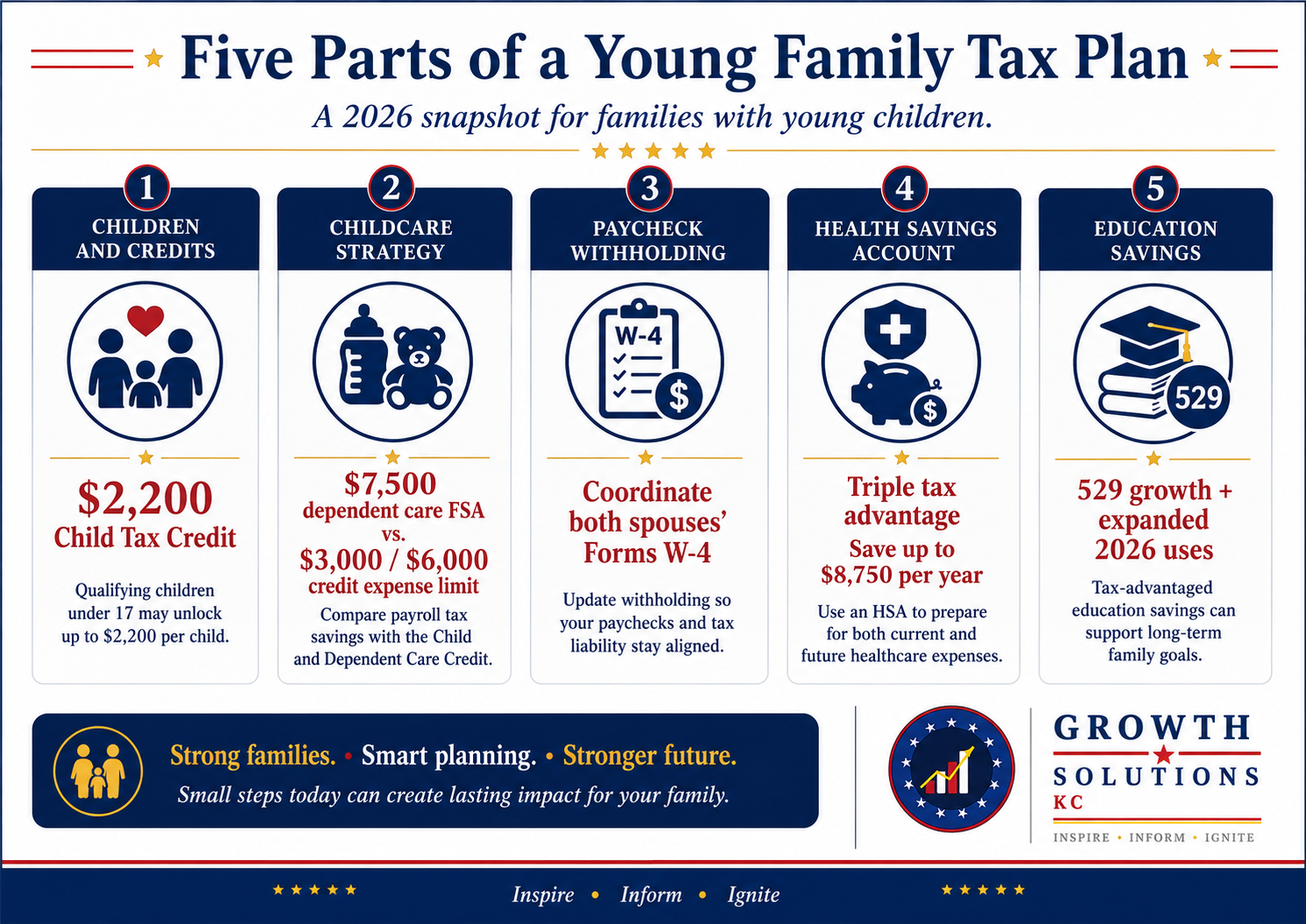
Tax credits, childcare benefits, withholding, healthcare planning, and 529 savings should not be managed as unrelated line items.
They interact.
The Child Tax Credit affects the amount that may appropriately be entered on Form W-4.
The dependent care FSA election affects taxable wages and the expenses remaining for the Child and Dependent Care Credit.
A spouse’s decision to return to work changes income, childcare costs, withholding, and possibly the value of available credits.
HSAs can offer a triple tax advantage while helping families prepare for both current and future healthcare expenses.
A 529 contribution competes with other family priorities, including the emergency fund, retirement contributions, insurance, debt reduction, and current childcare expenses.
These are not filing-season questions. They are household financial-planning questions.
A family that reviews each item separately may remain compliant with the tax code.
A family that coordinates them can improve cash flow, reduce surprises, and build greater long-term stability.
Your Family Tax Planning Roadmap
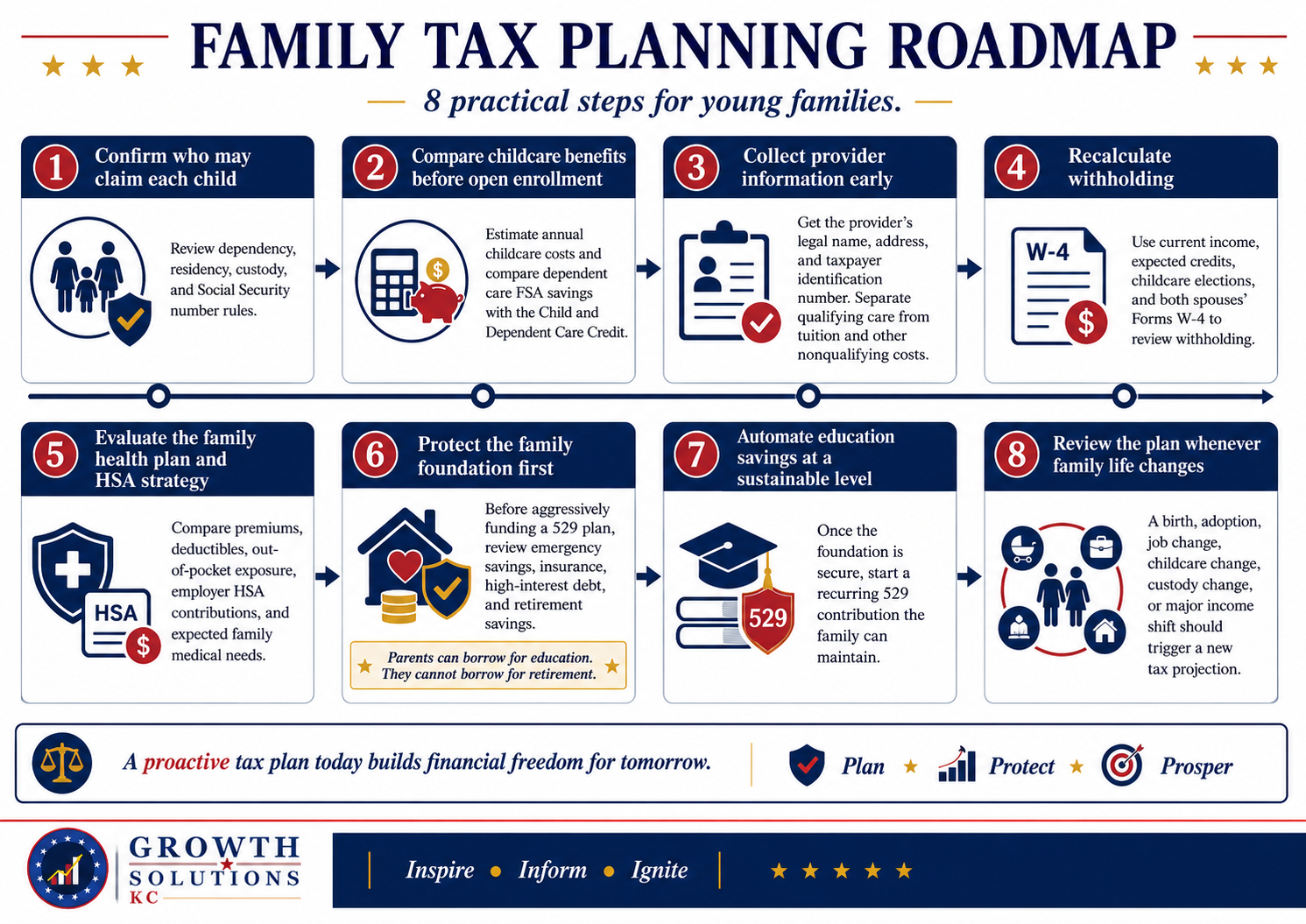
1. Confirm who may claim each child
Review dependency, residency, custody, and Social Security number requirements. Separated parents should confirm which benefits follow the dependency claim and which remain with the custodial parent.
2. Compare childcare benefits before open enrollment
Estimate annual childcare expenses and compare the potential dependent care FSA savings with the Child and Dependent Care Credit. Do not assume the benefit selected last year remains the best choice.
3. Collect provider information early
Obtain the provider’s legal name, address, and taxpayer identification number. Separate qualifying childcare charges from tuition, overnight camp, tutoring, and other nonqualifying costs.
4. Recalculate withholding
Use current pay stubs, projected income, expected credits, childcare elections, and other household income to review both spouses’ Forms W-4.
5. Evaluate the family’s health plan and HSA strategy
During open enrollment, compare premiums, deductibles, maximum out-of-pocket amounts, employer HSA contributions, provider networks, prescription coverage, and expected family medical needs. Confirm HSA eligibility and decide how much of the account should support current expenses versus long-term healthcare savings.
6. Protect the family foundation first
Before aggressively funding a 529 plan, evaluate the emergency fund, insurance coverage, high-interest debt, and retirement savings. Parents can borrow for education. They cannot borrow for retirement.
7. Automate education savings at a sustainable level
Once the foundation is secure, establish a recurring 529 contribution the family can maintain. Consistency is generally more valuable than waiting for the perfect contribution amount.
8. Review the plan whenever family life changes
A birth, adoption, job change, childcare transition, custody change, or major income shift should trigger a new tax projection.
The Bottom Line
Raising children is expensive. The tax code will not make childcare inexpensive, eliminate the strain on a young family’s budget, or guarantee that education will be fully funded.
But thoughtful planning can help.
The Child Tax Credit can reduce annual tax liability. Childcare provisions can offset part of the cost of working. Accurate withholding can place money in the family’s hands when it is needed rather than months later. An HSA can help families manage current medical costs while building resources for future healthcare needs. A properly funded 529 plan can turn small contributions today into greater educational flexibility tomorrow.
The strongest outcome does not come from maximizing every benefit independently. It comes from coordinating them around the family’s larger goals.
Ready to Build Your Family Tax Strategy?
Raising children brings joy, responsibility, and complexity — and the tax code reflects all three. Coordinating credits, childcare benefits, withholding, healthcare planning, and education savings is not simple, but it becomes manageable with a clear framework and a year‑round mindset.
If you want help applying these principles to your own situation, a qualified tax professional can walk you through the details and help you build a plan that supports your family’s goals throughout the year — not just at filing time.
Growth Solutions KC aims to help you think strategically, ask better questions, and build a coordinated system that strengthens your household today while preparing for tomorrow.
Year‑Round Planning → Better Decisions → Better Outcomes
— Matt Cucinotta | Growth Solutions KC | Inspire · Inform · Ignite
About This Series
The GSKC Year‑Round Tax Planning Series helps individuals, families, and retirees make smarter financial decisions by understanding how tax rules interact with real‑life choices. Each article focuses on a different stage of life — from retirement to raising children to planning for college — with one goal:
Better planning, fewer surprises, stronger financial outcomes.
Explore the full series on our Tax & Wealth Planning page.
This article is published as part of GSKC’s Tax & Wealth Planning page and is intended for informational and educational purposes only. It does not constitute tax, legal, investment, or financial advice. Tax laws, thresholds, and benefit limits referenced reflect the 2026 tax year and current federal law as of publication. Employer plans and state tax treatment may differ. Readers should consult a qualified tax professional or financial adviser regarding their individual circumstances.



Comments ()