

Natural Gas and the AI Bridge
Why the Fastest Route to More AI Power May Also Be the Most Complicated
Part 4 of the Growth Solutions KC AI Energy Series
Small nuclear may help build the AI power system of the 2030s. But the AI infrastructure boom is not waiting until the 2030s. Data centers are being planned now. Chips are being installed now. Computing demand is growing now.
That creates an uncomfortable but important question:
What can produce large amounts of dependable electricity fast enough to bridge the gap?
Increasingly, one answer is natural gas. That does not mean natural gas has “won” the energy debate. It does not mean nuclear, renewables, batteries, transmission, or efficiency have become less important.
It means time has become part of the energy equation.
Artificial intelligence is expanding faster than much of America's electric infrastructure can be planned, permitted, financed, and built. Natural gas already operates at enormous scale, can provide electricity when it is needed, and in some configurations can be deployed close to the data centers consuming the power.
That makes it attractive as a bridge. But bridges have to lead somewhere. And moving the bottleneck from grid access to natural-gas generation does not make the infrastructure problem disappear.
It can simply move the constraints to turbines, pipelines, fuel supply, emissions, permitting, economics, and long-term planning.
The question is not whether natural gas is good or bad. The question is what role it can realistically play, for how long, at what cost, and alongside what other energy resources.
What Matters: Why Gas Fits the Near-Term Gap
Natural gas already sits near the center of the American electricity system.
The U.S. Energy Information Administration's September 2026 outlook expects natural gas to provide about 40% of U.S. electricity generation in both 2026 and 2027. EIA also expects total U.S. electricity generation to reach records in both years as data centers and manufacturing increase commercial and industrial demand. (U.S. Energy Information Administration)
Gas has several characteristics that help explain its role.
It is firm: generators can generally produce electricity when customers need it rather than depending on weather conditions.
It operates within an existing national ecosystem of wells, pipelines, power plants, equipment suppliers, utilities, engineers, and operators.
And it can be flexible. Different gas technologies can serve large utility plants, smaller on-site facilities, backup systems, or hybrid configurations paired with batteries and renewable generation.
That makes it one of the technologies capable of addressing a particular problem confronting AI developers: the need for dependable power sooner than many other large infrastructure projects can arrive.
Speed-to-Power Changes the Equation
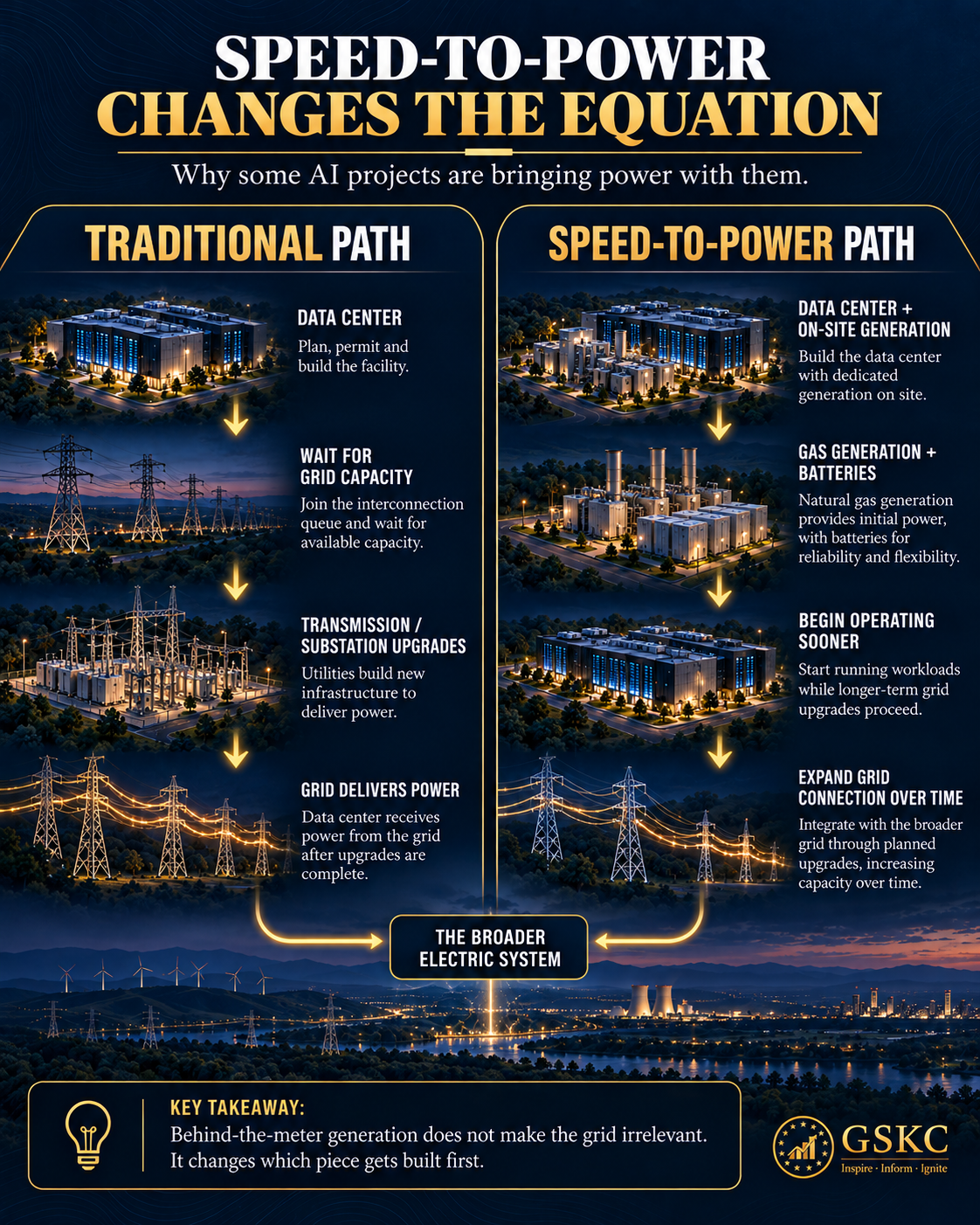
Traditionally, a large new electricity customer connected to the utility system and purchased power from the grid. AI is complicating that model.
A hyperscale campus can require hundreds of megawatts, and increasingly developers are confronting locations where the computing infrastructure can be built faster than the grid connection needed to power it.
One response is behind-the-meter generation.
Instead of waiting for every transmission line, substation, and interconnection upgrade to be completed, some developers can place generation at or near the data-center campus.
The site may operate primarily on its own power, supplement available grid service, or use on-site generation as a bridge until a larger grid connection becomes available.
GE Vernova, one of the major suppliers of gas-generation equipment, now describes multiple configurations specifically for data centers: fully on-site generation, grid-connected facilities with gas backup, gas paired with batteries, and hybrid systems incorporating renewable energy. (GE Vernova)
That signals an important shift. The question is no longer simply: When can the grid reach the data center? Increasingly it can also be: What power can the data center bring with it?
Behind-the-meter generation does not make the grid irrelevant.
It changes which piece gets built first.
Solve One Bottleneck, Find Another
There is a catch. If many developers turn to gas because it can help them obtain power faster, the equipment required to generate that electricity can itself become scarce.
In July, GE Vernova reported that its gas-power equipment backlog and slot reservations had grown to 116 gigawatts, and the company expects at least 125 GW under contract by the end of 2026.
It is increasing annual gas-turbine output toward roughly 30 GW by 2030 to meet demand. The same report noted that GE Vernova's data-center orders for electrification equipment had already exceeded $5 billion through the first half of 2026. (GE Vernova)
The point is not GE Vernova's financial performance. It is what the backlog tells us about infrastructure demand.
The AI hardware buildout has repeatedly shown the same pattern. Demand for GPUs surged. Then memory bandwidth became constrained. Then advanced packaging. Then data-center construction. Then electricity.
Speed-to-power is becoming valuable enough that companies are competing not only for electricity, but for generation equipment.
A Gas Turbine Still Needs Gas
There is another reason gas should not be mistaken for an infrastructure shortcut.
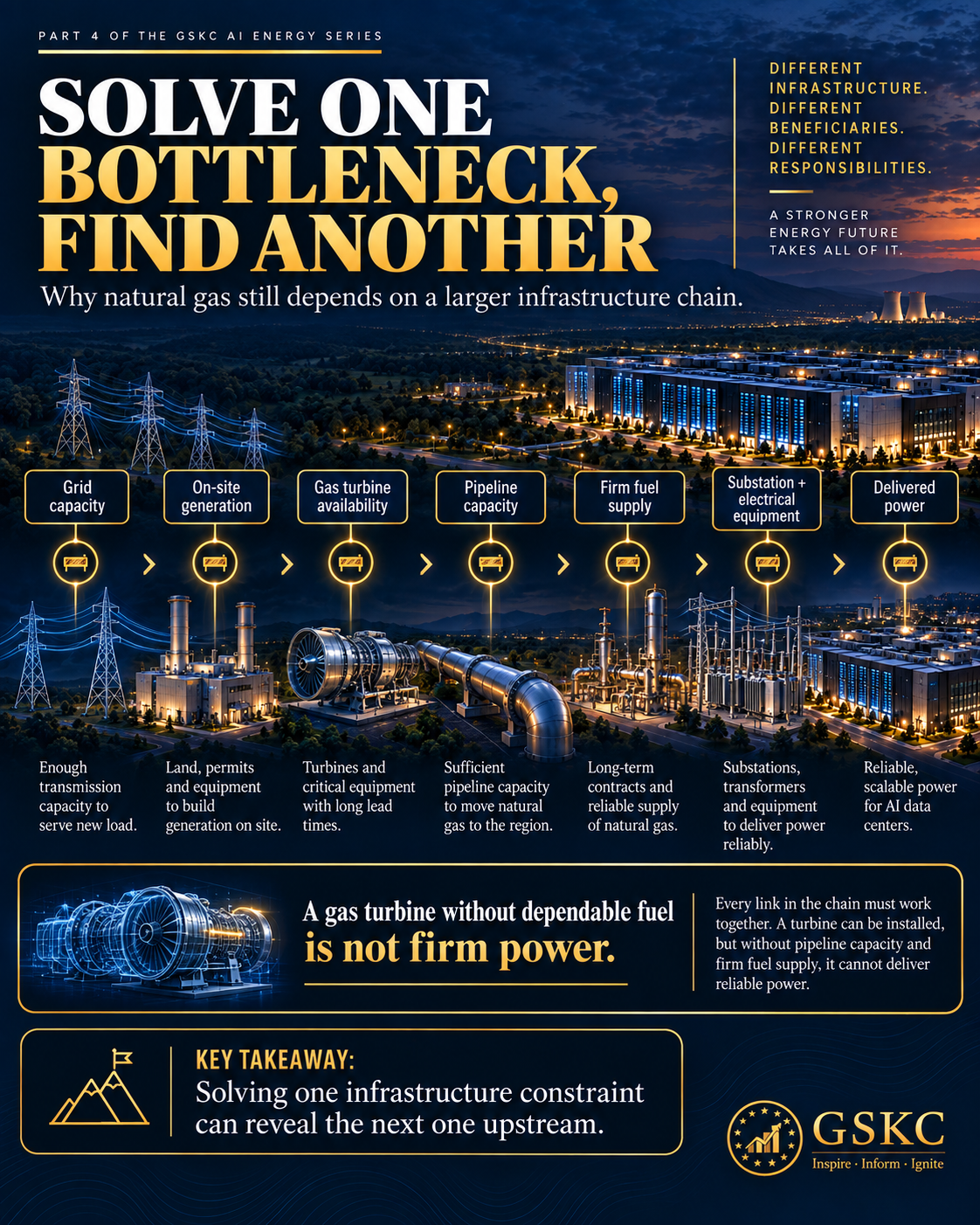
A turbine alone is not a power system. It needs fuel.
That can mean adequate pipeline capacity, compressors, firm transportation arrangements, storage or backup fuel strategies, permits, substations, electrical equipment, maintenance capability, and coordination between the gas and electricity systems.
EIA says developers plan almost 44.9 billion cubic feet per day of new U.S. natural-gas pipeline capacity during 2026 and 2027, with roughly two-thirds of the planned additions originating in Texas. Those pipelines will serve several kinds of demand, including electric generation, industrial customers, residences, and LNG facilities. (U.S. Energy Information Administration)
At the same time, the North American Electric Reliability Corporation continues to identify natural-gas availability and pipeline interdependencies as factors that can affect electric-system reliability, particularly during stressed conditions. (NERC)
That leads to a deceptively simple point:
A gas turbine without dependable fuel is not firm power.
The Honest Ledger
This is why the natural-gas story requires more nuance than either “gas will save the AI boom” or “gas should not be built.”
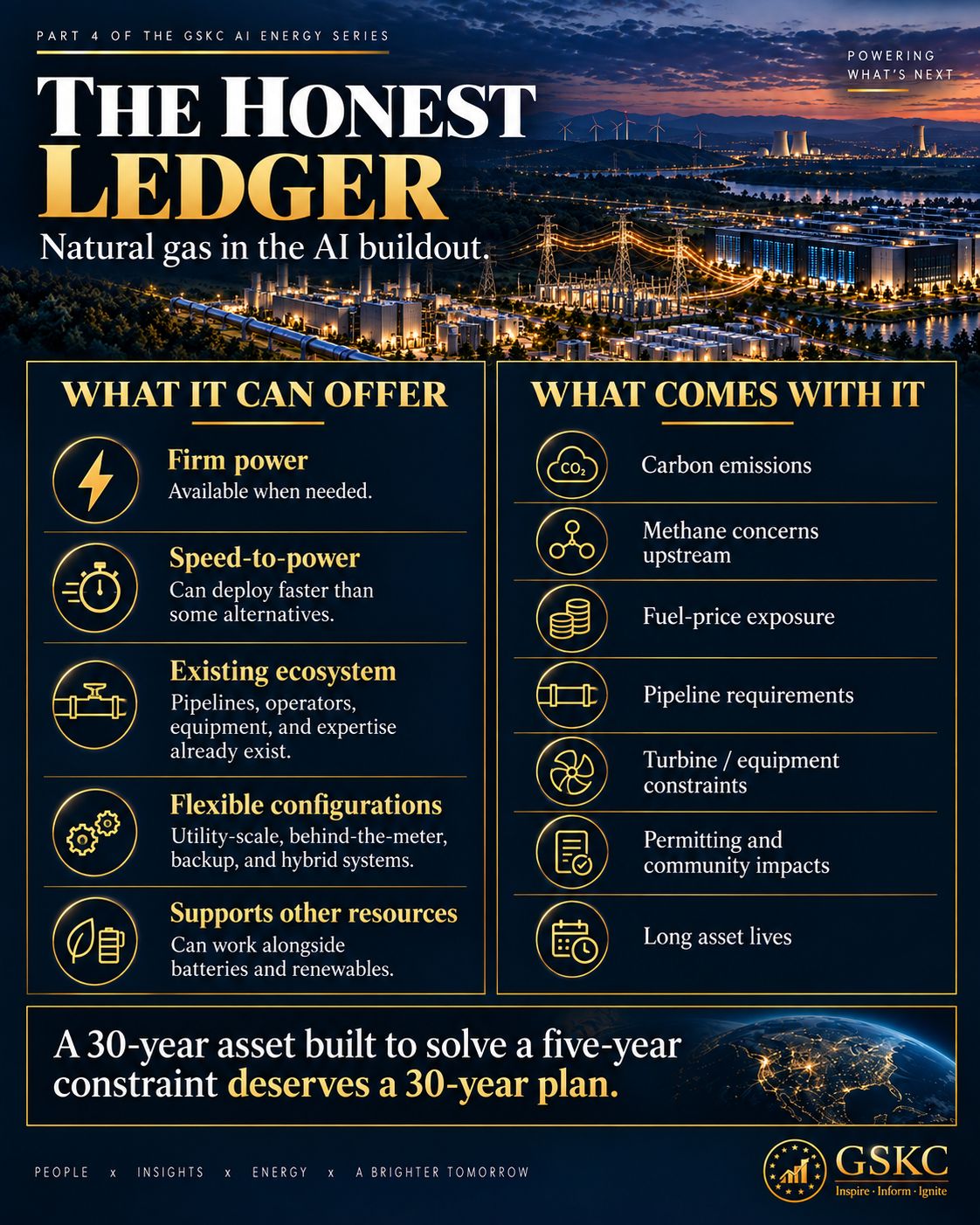
Natural gas can offer real advantages. It can provide dependable electricity. It can support large loads. Existing infrastructure and technical experience can reduce some development barriers. Smaller installations can potentially be located close to demand. Gas turbines can complement batteries, which are particularly effective at responding to short-duration changes in load, while thermal generation supplies sustained energy. (GE Vernova)
But those advantages come with tradeoffs.
Burning natural gas produces carbon dioxide, even though gas combustion is less carbon-intensive than coal for power generation. The production and delivery system can also release methane through parts of the natural-gas supply chain. (US EPA)
Gas projects can also face fuel-price exposure, pipeline limitations, equipment shortages, local permitting challenges, and community concerns.
There is a longer-term economic question that deserves more attention. A power plant designed to solve a five-year electricity shortage may operate for decades. If a gas facility is built as a “bridge,” what happens when additional transmission, nuclear generation, storage, or other resources eventually arrive?
- Does the plant continue providing useful flexibility?
- Does it become backup generation?
- Can it participate in the broader grid?
- Or does a supposedly temporary solution become permanent simply because the capital has already been spent?
A 30-year asset built to solve a five-year constraint deserves a 30-year plan. That does not argue against building it. It argues for knowing where the bridge is supposed to lead.
The Bridge Should Lead Somewhere
One of the mistakes in energy debates is treating every technology as if it must defeat all the others.
The AI electricity challenge suggests almost the opposite. Different resources solve different problems over different time horizons.
- Existing generation and efficiency can help now.
- Natural gas, batteries, on-site power, and accelerated grid upgrades can provide additional near-term capacity and flexibility.
- Renewables can continue adding significant generation.
- Transmission can connect regions with available electricity to regions where demand is growing.
- Existing nuclear plants can operate longer or restart where appropriate.
- Advanced nuclear and SMRs may eventually provide another source of durable firm power.
Those technologies do not necessarily form competing ideological camps. They form an energy system.
Natural gas may therefore be most valuable in the AI era not because it represents the final destination, but because it can buy something the infrastructure buildout desperately needs, time.
Time to build transmission. Time to expand generation. Time to develop storage. Time to commercialize new nuclear technologies. Time to strengthen the grid.
A bridge has value because of what becomes possible on the other side.

What Happens Next
Natural gas helps reveal one of the central lessons of the AI infrastructure boom.
There is rarely one bottleneck.
A company can obtain the chips and still lack a data center. It can build the data center and still lack electricity. It can install gas turbines and still lack pipeline capacity. And it can generate more electricity without having the transmission infrastructure required to move that power where it is needed.
AI companies can build generation.
Utilities can add power plants.
Nuclear facilities can restart.
Solar and wind farms can expand.
Batteries can store electricity.
But generation alone does not solve the entire problem if the wires, substations, transformers, and interconnection system cannot deliver that electricity to the customer.
Generating power is only half the problem.
Delivering it is the other half.
And that takes us to perhaps the least glamorous — and one of the most consequential — bottlenecks in the AI infrastructure boom: the grid.
— Matt Cucinotta | Growth Solutions KC | Inspire · Inform · Ignite
Source and methodology note: This article draws on the Growth Solutions KC AI Energy research portfolio and current primary-source information from the U.S. Energy Information Administration, North American Electric Reliability Corporation, U.S. Environmental Protection Agency, and energy-equipment suppliers. Company materials are used to illustrate developing infrastructure strategies rather than as independent proof of future costs or performance. Energy economics, permitting, fuel availability, emissions, utility structures, and project timelines vary significantly by location.


Comments ()