

Gig Work and the Tax Code: A Side Job Is Still a Business

How independent workers can manage Schedule C income, quarterly taxes, vehicle expenses, information returns, and audit-ready records
Part VII in the GSKC Year-Round Tax Planning Series
Most relevant for rideshare drivers, delivery workers, freelancers, consultants, creators, online sellers, task-based workers, seasonal contractors, and W-2 employees with side-business income.
The app makes earning easier. It does not make taxes automatic.
Gig work often begins casually.
Someone drives a few evenings a week, takes freelance projects, sells goods online, creates digital content, delivers food, or accepts task-based jobs through a platform. The app handles the customer, processes the payment, tracks some activity, and deposits cash into the worker's account.
The platform may simplify the transaction, but it does not replace the worker's tax records. It may show gross payments, net deposits, fees, refunds, incentives, bonuses, and tips in different places. It may issue a Form 1099. It may not. Either way, the worker remains responsible for taxable income, deductions, self-employment tax, and estimated payments.
The platform may call it a side hustle. The tax code treats it as income and, when the worker is an independent contractor, as a business with records, expenses, estimated taxes, and long-term consequences.
First Question: Employee, Contractor, Business, or Hobby?
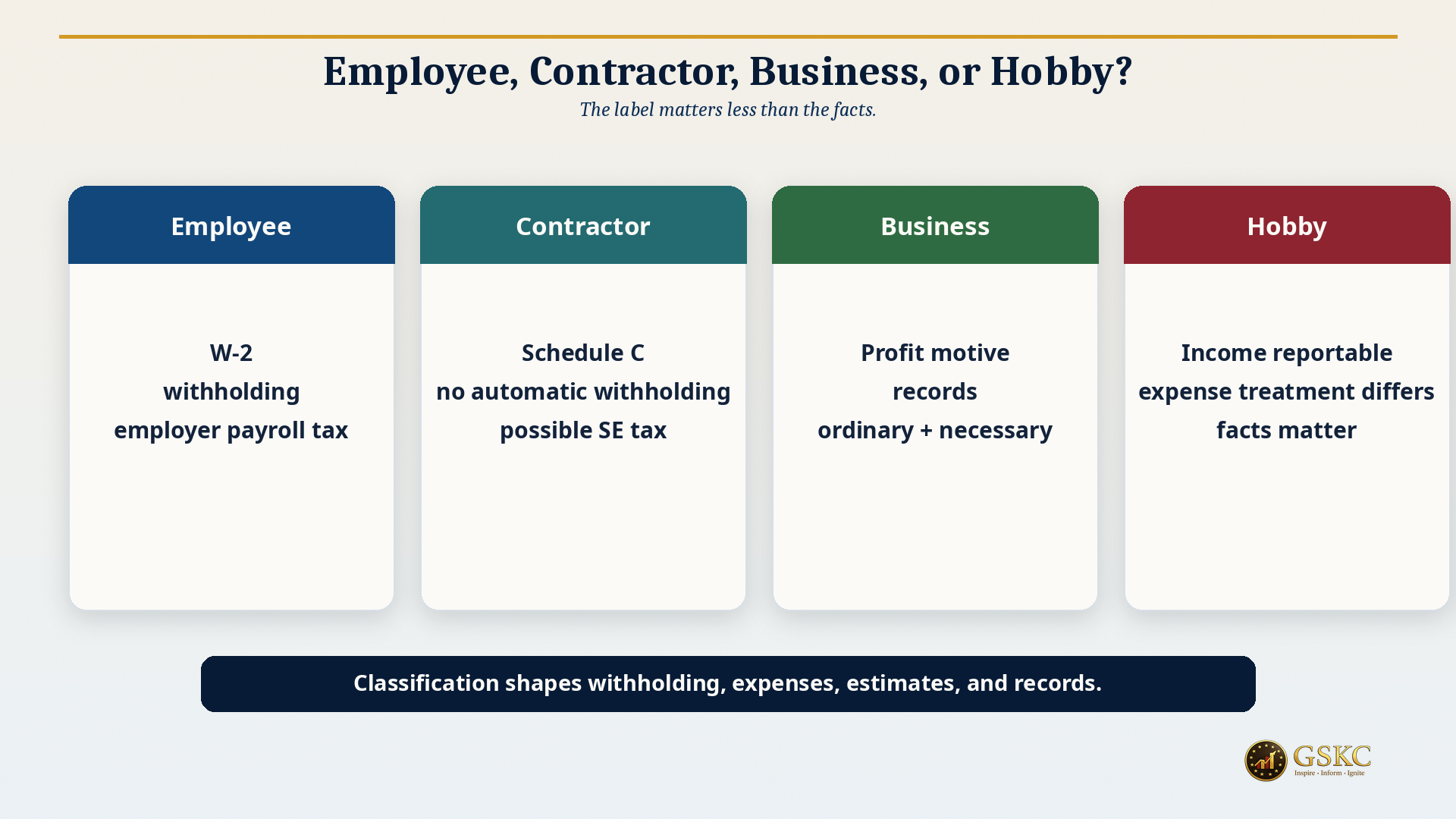
The first planning question is classification. Some workers are employees. Employees generally receive Form W-2, have taxes withheld from wages, and may have access to employer benefits. Independent contractors generally receive income without automatic withholding and may report business income and expenses on Schedule C.
A worker is not an independent contractor merely because a platform, contract, or customer uses that label. Federal tax classification depends on the facts, including behavioral control, financial control, and the relationship between the parties. State rules may use different tests.
The next question is whether the activity is a business or a hobby. A profit-motivated activity carried on in a businesslike way may belong on Schedule C. A casual hobby can still produce taxable income, but the expense treatment is different. No single factor controls the answer. Records, time devoted, expertise, profit history, dependence on the income, and the effort to improve profitability all matter.
This article focuses on independent workers operating for profit. Rentals, casual personal-item sales, and investment activity can follow different rules.
Forms Do Not Determine Income
A tax form reports income. It does not create the income, and the absence of a form does not erase it.
Gig income is generally reportable even if the work is part-time, temporary, supplemental, paid in cash, paid through an app, paid in property, or below a reporting threshold. The worker's own records remain the foundation.
For payments made in 2026, the general federal Form 1099-NEC reporting threshold for specified nonemployee compensation increased to $2,000. Some workers who previously expected a form may not receive one for smaller payment streams.
Form 1099-K creates a different issue. A third-party settlement organization generally reports when gross payments for goods or services are more than $20,000 and more than 200 transactions. Payment-card transactions, state rules, and platform practices can produce different results.
Neither threshold changes whether taxable income exists.
Form 1099-K can also report gross payments rather than the amount deposited into the worker's bank account. Platform fees, refunds, chargebacks, shipping, credits, discounts, incentives, and tips may need to be reconciled separately. Reporting only net deposits can understate income. Reporting gross forms without deducting legitimate fees can overstate profit.
The best practice is to reconcile platform summaries, Forms 1099, bank deposits, cash receipts, refunds, tips, and fees before filing.
The Second Tax System: Self-Employment and Quarterly Payments
Employees usually see income tax, Social Security tax, and Medicare tax withheld before money reaches the bank.
Independent gig workers often receive deposits first and face the tax system later.
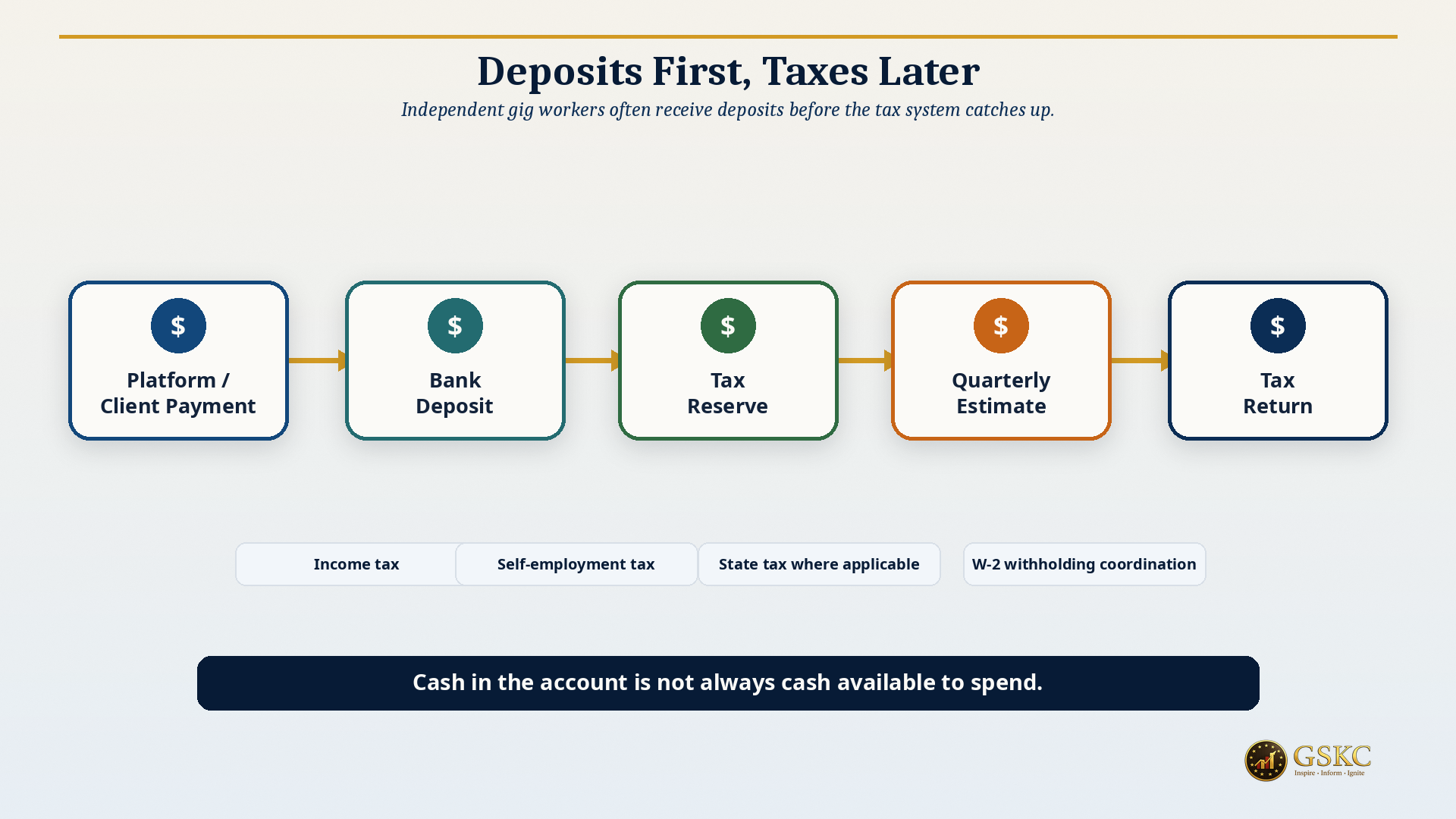
A self-employed worker generally reports business receipts and expenses on Schedule C and calculates self-employment tax on Schedule SE. Net earnings from self-employment of $400 or more generally trigger Schedule SE.
The self-employment-tax rate is 15.3%: 12.4% for Social Security and 2.9% for Medicare. For 2026, the Social Security portion applies up to the $184,500 combined wage and self-employment earnings base. Medicare tax does not have the same earnings cap, and Additional Medicare Tax can apply at higher income levels.
That is separate from federal income tax.
This is why a profitable side business can create a surprise even when the worker has a W-2 job. Paycheck withholding may cover wage income but not the extra business profit. Workers generally evaluate estimated payments when they expect to owe at least $1,000 after withholding and refundable credits.
Quarterly estimates are generally due April 15, June 15, September 15, and January 15 of the following year, subject to weekend and holiday rules. A worker with a W-2 job may be able to increase paycheck withholding instead.
The practical answer is a tax reserve. Set aside tax cash as income is earned, then update the reserve as profit, household income, state tax, self-employment tax, and withholding become clearer.
Deductions Require Business Purpose and Records
Business deductions are not a prize for being creative. They are a return position that must be supported.
A deductible business expense generally must be ordinary and necessary for the business. Personal expenses are not deductible. Mixed expenses require a reasonable business allocation.
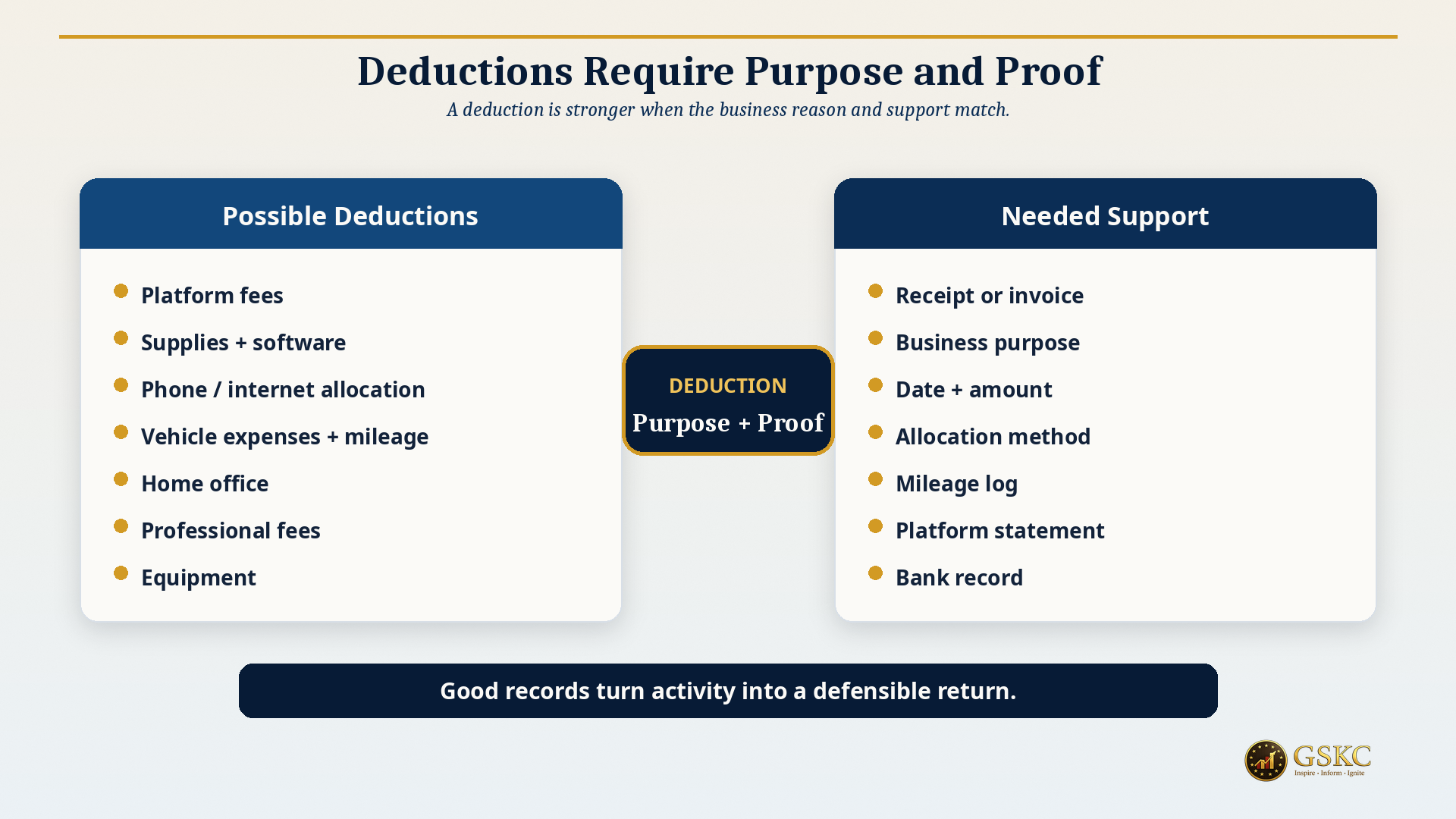
Common gig-worker expenses may include platform fees, payment-processing fees, supplies, software, advertising, insurance, professional fees, equipment, contract labor, and the business-use portion of phone or internet service.
The danger is turning this into a "deduct everything" mindset.
A phone used partly for business and partly for family life needs an allocation. A laptop used for client work and personal use needs records. A meal with no business purpose is not transformed into a business expense by a nearby email.
Good records are not merely an audit defense. They are the operating system of a small business. They help the worker understand profit, price services correctly, set aside taxes, and file a return that can be explained later.
Mileage Is Often the Largest Deduction, and the Weakest Record
For drivers, delivery workers, mobile service providers, and many task-based workers, vehicle expenses can be central.
For 2026, the standard mileage rate for business use is 72.5 cents per mile. The standard mileage method multiplies qualifying business miles by the annual rate. Business parking and tolls may generally be added separately.
But the mileage rate is not a free estimate.
Workers need records showing the date, destination, business purpose, business miles, and total annual miles. App records can help, but they may not capture every deductible or personal mile needed to support the business-use percentage.
The standard mileage method and actual-expense method cannot be mixed casually for the same vehicle in the same year. The standard mileage rate already includes operating costs and a depreciation component. A worker using it generally cannot also deduct gas, repairs, insurance, registration, lease payments, or depreciation for that vehicle.
The actual-expense method allocates real vehicle costs based on business use. It may be better in some cases, but it requires stronger records and can involve depreciation and recapture issues.
Ordinary commuting remains personal. The tax value comes from business miles, not from every mile driven while owning a side business.
Home Office, Tips, QBI, and Long-Term Benefits
Some gig workers may qualify for a home-office deduction. The space generally must be used regularly and exclusively for business, subject to limited exceptions. The simplified method uses $5 per square foot up to 300 square feet, for a maximum potential deduction of $1,500.
Workers in tipped occupations should also understand the temporary qualified-tips deduction for 2025 through 2028. Eligible employees and self-employed workers may be able to deduct qualified tips, subject to occupation, reporting, income, filing-status, Social Security number, and net-income limitations. Tips still must be reported as income.
Schedule C profit may also qualify for the qualified business income deduction. Beginning in 2026, eligible taxpayers with at least $1,000 of QBI may qualify for a $400 minimum deduction, subject to the rules. QBI does not reduce self-employment tax.
A profitable side business can also support longer-term planning. Depending on the facts, a worker may evaluate self-employed health-insurance deductions or retirement-plan options such as a SEP IRA, SIMPLE IRA, or one-participant 401(k).
Audit Hygiene: Build the Record Before the Question Arrives
Audit hygiene is not fear. It is discipline.
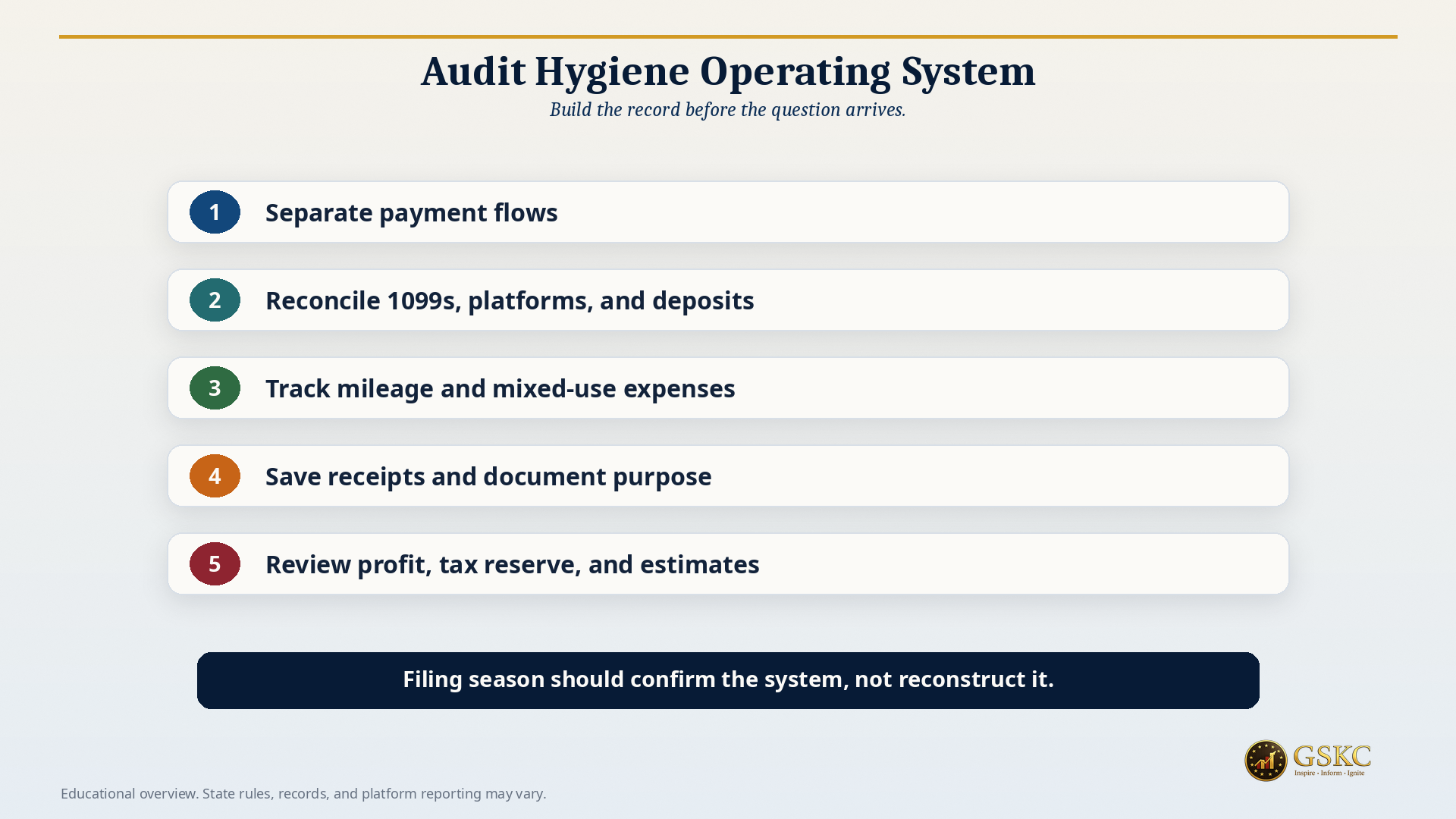
A gig worker should be able to show where income came from, how gross receipts reconcile to forms and deposits, why expenses were business-related, how mixed-use costs were allocated, and how mileage was measured.
At a minimum, build a monthly routine:
- Separate business and personal payment flows when practical.
- Reconcile platform summaries, Forms 1099, bank deposits, cash receipts, refunds, and fees.
- Save receipts and document the business purpose of unusual or mixed expenses.
- Maintain contemporaneous mileage records.
- Keep asset purchase records through disposition and the applicable limitation period.
- Correct erroneous Forms 1099 when possible and document attempted corrections.
The return should not be the first time the worker discovers profit. Filing season should confirm the system, not reconstruct it from scattered screenshots and app downloads.
When the Side Job Becomes a Business
Gig work may begin as supplemental income. That does not mean it should stay informal forever.
The structure should be reviewed when the activity produces dependable profit, hires workers or subcontractors, assumes liability, buys meaningful equipment, needs financing, supports retirement contributions, adds an owner, or becomes a primary household income source.
That does not mean every successful side business should immediately become an S corporation or a multi-entity structure. As Articles 5 and 6 explained, the answer depends on profit, payroll costs, state taxes, QBI, retirement goals, bookkeeping capacity, risk, and long-term plans.
A gig may begin as supplemental income, but once it produces dependable profit, hires workers, assumes liability, or supports a household, the questions change. The worker must begin thinking like a business owner.
The app tracks the payment. The worker must track the business.
— Matt Cucinotta | Growth Solutions KC | Inspire · Inform · Ignite
This article is published as part of GSKC's Tax & Wealth Planning page and is intended for general educational purposes only. It does not constitute individualized tax, legal, investment, or financial advice. Tax laws and thresholds referenced reflect the 2026 federal tax year and current federal law as of publication. State tax treatment, worker-classification rules, platform reporting, business deductions, retirement-plan rules, and individual circumstances may differ. Readers should consult qualified tax, legal, and financial professionals regarding their specific circumstances.



Comments ()