

Elections Matter: The Midterm the Founders Built
The Constitution does not require Americans to agree on every policy. It establishes the framework within which disagreement can be resolved, power can be challenged, and citizens can hold government accountable.
Beyond the Party Label: The 2026 Midterms and the Choice Before Us — Part 1 of 3
When the Constitutional Convention ended in September 1787, Maryland delegate James McHenry recorded an exchange in which a Philadelphia woman asked Benjamin Franklin what kind of government the delegates had created — a republic or a monarchy.
Franklin's answer, according to McHenry's account, has echoed across generations:
"A republic, if you can keep it."
Whether every detail of that exchange occurred precisely as recorded, the warning remains powerful.
The Constitution did not guarantee its own survival. It established a framework of representative government, divided authority, constitutional limits, and citizen responsibility. Preserving that framework would depend on generations of Americans understanding why it was designed that way — and accepting their responsibility to maintain it.
Every two years, Americans have another opportunity to exercise that responsibility.
On November 3, 2026, the next chapter will be written.
What Is Actually on the Ballot
On November 3, Americans will elect all 435 members of the House of Representatives, decide 35 U.S. Senate contests — 33 regularly scheduled elections and two special elections — and choose governors in 36 states. Voters will also decide numerous state and local offices and ballot questions. As of October 28, the National Conference of State Legislatures counted 146 statewide ballot measures scheduled for consideration.
These elections will do more than determine which party controls Congress. They will shape the authority, oversight, spending priorities, and policy direction of governments at multiple levels.
Most media coverage will treat the election as a scoreboard: which party wins, which party loses, what it says about the president. That framing is incomplete.
Beneath the party labels, Americans are being asked a more durable question, one that has run through this publication's entire Socialism, Capitalism, and the Choice Before Us series:
How much power should government hold, who should hold it, and how should citizens be able to take it back?
That is not a Republican question or a Democrat question. It is a constitutional one. The Founders designed frequent House elections to ensure that citizens would have recurring opportunities to hold their representatives accountable.
The Design Was Deliberate
The American system did not emerge by accident. It was argued over, line by line, by men who had just fought a war against concentrated power and who had watched the weak Articles of Confederation nearly fail. They wanted a government strong enough to function and restrained enough to remain free.
Their solution rested on a few core ideas, explained to the public in The Federalist Papers.
Limited, enumerated powers.
James Madison promised in Federalist No. 45 that "the powers delegated by the proposed Constitution to the federal government are few and defined. Those which are to remain in the State governments are numerous and indefinite." The national government would do specific things well; everything else stayed closer to home.
Separated powers.
In Federalist No. 47, Madison warned that "the accumulation of all powers, legislative, executive, and judiciary, in the same hands, whether of one, a few, or many, and whether hereditary, self-appointed, or elective, may justly be pronounced the very definition of tyranny." Note the phrase or elective. The Founders did not believe that winning an election made concentrated power safe.
Checks rooted in human nature.
Federalist No. 51 gave the system its realism: "If men were angels, no government would be necessary." Because they are not, "ambition must be made to counteract ambition." Each branch was given the tools and the motive to resist the others.
Frequent elections for the people's branch.
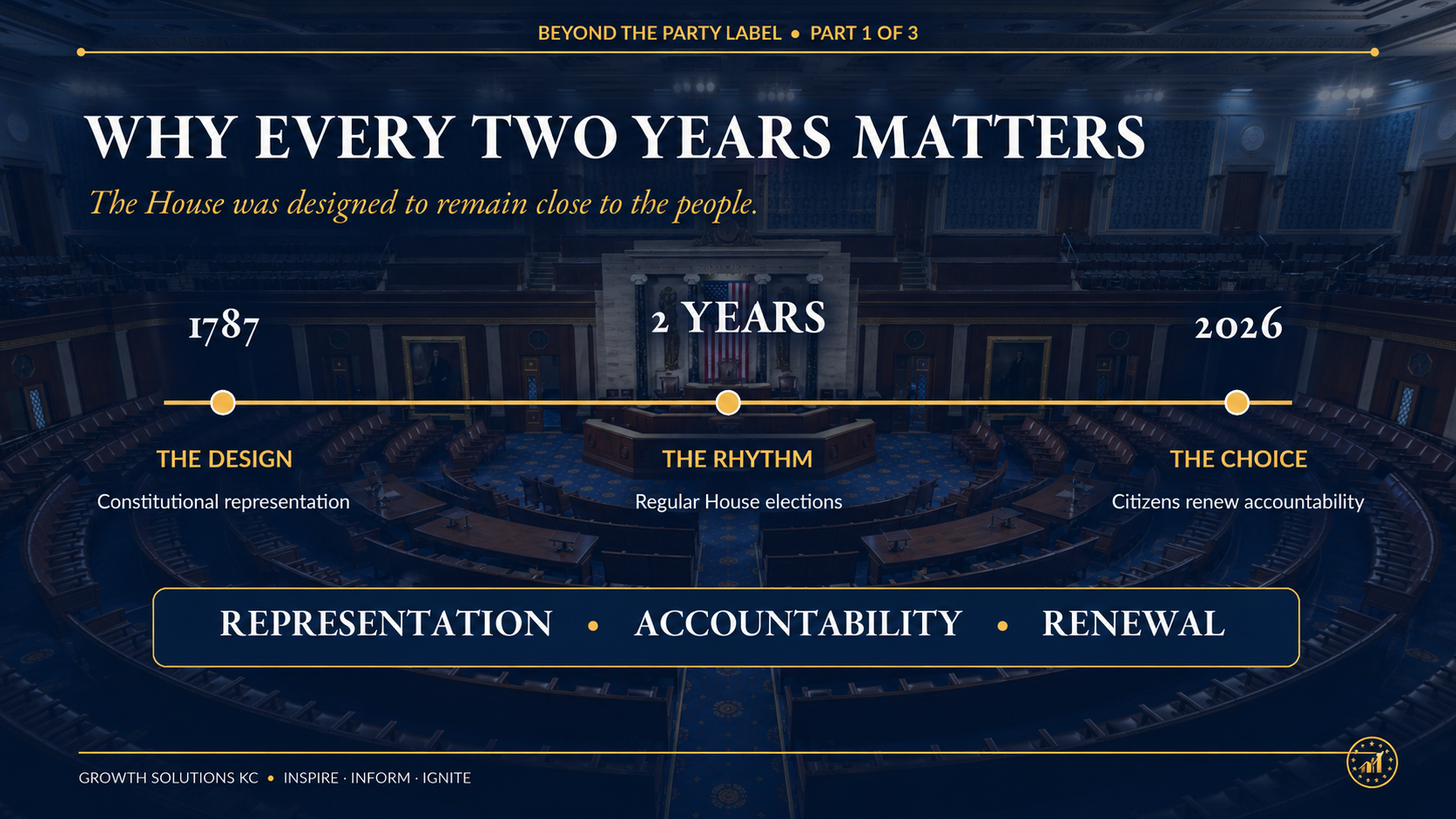
This is where the midterm comes in. The House was given two-year terms on purpose. Federalist No. 52 explained that the people's chamber must have "an immediate dependence on, and an intimate sympathy with, the people," and that "frequent elections are unquestionably the only policy by which this dependence and sympathy can be effectually secured."
The power of the purse.
In Federalist No. 58, Madison emphasized the power of the House of Representatives to influence government through control of public funds. The Constitution requires bills raising revenue to originate in the House, although the Senate may amend them. Both chambers participate in writing and approving appropriations and other spending legislation.
This arrangement was deliberate. Decisions about taxing and spending were placed within representative institutions, where elected officials must publicly debate competing priorities, approve legislation, and answer to the people.
The power of the purse is therefore more than control over money. It is a constitutional mechanism for accountability.
Put these pieces together, and the purpose of frequent congressional elections comes into focus.
The Founders deliberately established two-year terms for the House so its members would remain closely connected and regularly accountable to the people.
Halfway through a presidential term, voters have another opportunity to change representation, reshape congressional priorities, and alter the balance of legislative and oversight authority. Through Senate elections, they can also influence the chamber responsible for confirming federal judges and senior executive officials.
The significance is not that one party gains or loses. It is that constitutional power remains subject to recurring public accountability.
Why "Easy and Fair" Is Never Free
This is where the midterm meets the larger argument of The State of America: Why Socialism Will Not Save Us.
Socialist and heavily redistributive policies are attractive because they promise to make hard things easier: free health care, free college, guaranteed housing, and taxes paid by someone else. Each promise sounds fair. The real question is how government fulfills it — and at what cost. In the Socialism, Capitalism, and the Choice Before Us series we traced where that road can lead: fewer choices, weaker incentives, rationed services, and citizens who gradually become clients of the state rather than its owners.
As we examined in Socialism: What It Really Is and What It Is Not, public services, social insurance, safety nets, redistribution, and socialism are not the same thing. A constitutional republic can provide public goods and assistance while preserving private property, competitive markets, and free enterprise.

But every proposal involves tradeoffs. Who pays? Who decides? What lawful authority does government possess? How will a policy affect incentives, independence, opportunity, and personal responsibility? What safeguards prevent waste, fraud, favoritism, or excessive concentration of power?
Programs can provide meaningful benefits. Poorly designed programs can also create unintended costs, weaken incentives, reduce choice, and make people or institutions more dependent on government decisions.
The constitutional concern is not simply whether a promise sounds fair or compassionate. It is whether government has lawful authority to act, whether the policy can achieve its stated purpose, and whether citizens can hold those exercising power accountable.
The more power Washington holds, the higher the stakes of every election and the more bitter politics becomes. Constitutional restraint is therefore not only a principle of liberty, but a principle of civic peace.
Decentralization does not eliminate disagreement. But federalism, divided authority, and constitutional limits allow decisions to be made at different levels — and power to be challenged, corrected, and restrained.
The American answer is not government without responsibility or authority without limits. It is ordered liberty — government with legitimate duties, defined powers, constitutional restraints, and citizens who retain the freedom and responsibility to govern themselves.
What Is Decided on November 3
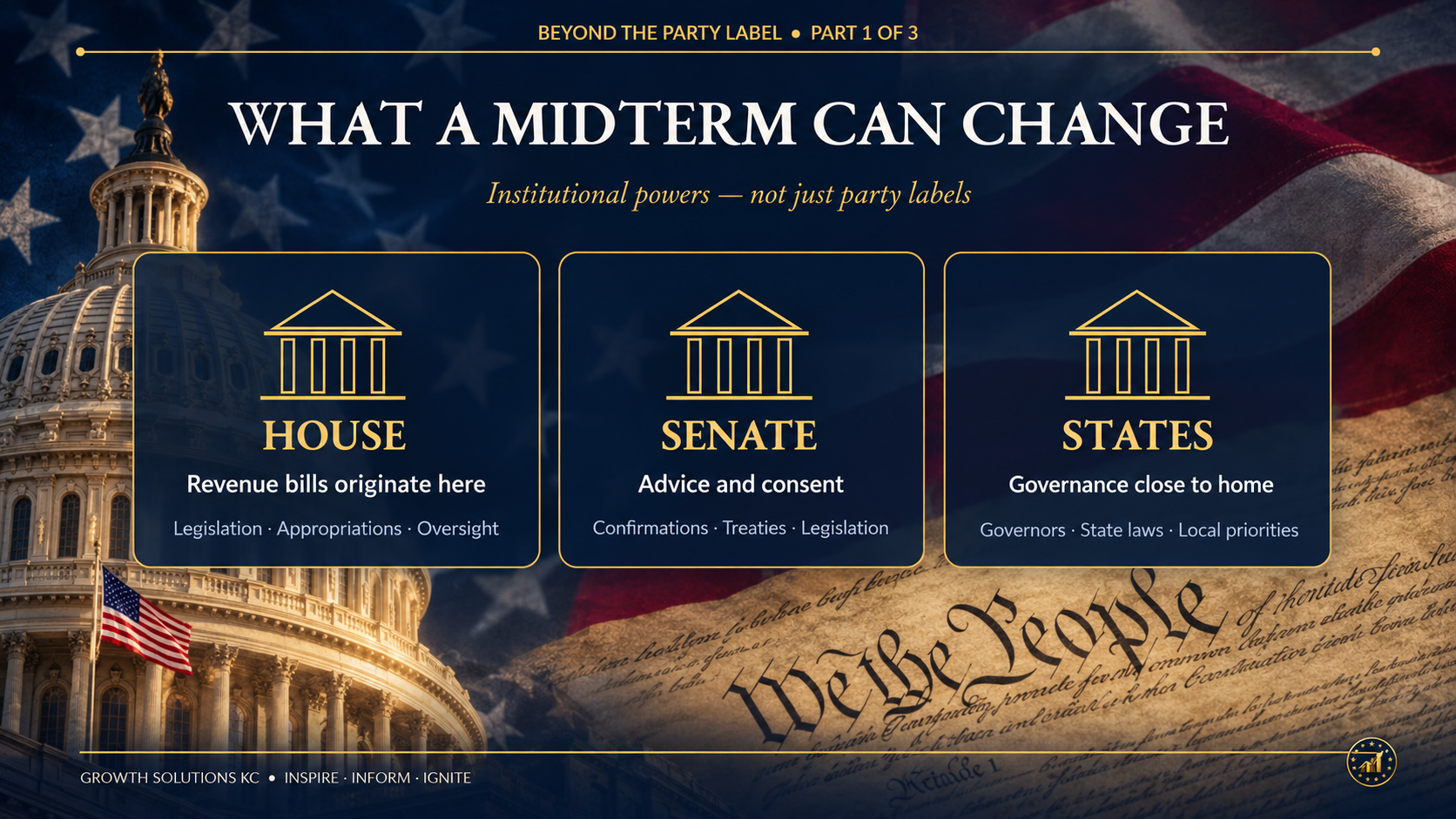
When the votes are counted, the practical consequences will flow through the channels the Founders created:
- The purse. Which congressional majorities will shape revenue legislation, appropriations, fiscal negotiations, and spending oversight for the next two years.
- Oversight. Which party chairs the committees that can subpoena documents and question executive officials.
- Confirmations. Which party controls the Senate calendar for federal judges, cabinet officers, and regulatory commissioners.
- The states. Governors and legislatures that shape taxes, education, elections, and local economies, plus ballot measures that write policy directly into state constitutions and statutes.
Whatever the outcome, the president keeps the veto, and overriding it requires two-thirds of both chambers. Divided government will likely mean more negotiation, more oversight, and less sweeping change.
Five Questions to Ask Any Candidate
Constitutional accountability must apply regardless of party. The same standards of lawful authority, divided power, fiscal responsibility, and institutional restraint should apply whether a proposal comes from a president or party we support or oppose. A constitutional republic is strengthened when citizens defend its principles consistently — not merely when their political opponents hold power.
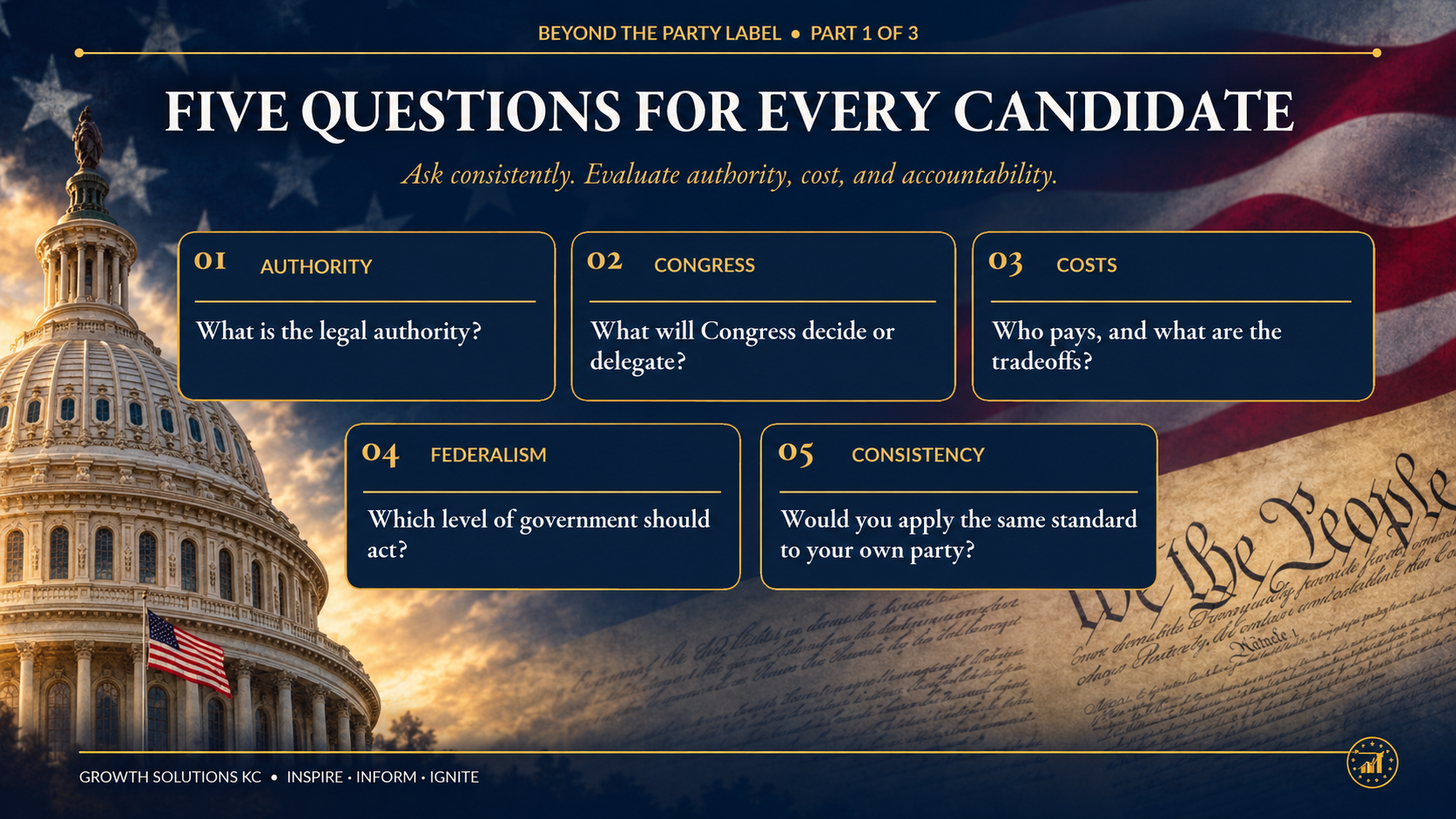
What should people do about it? Before casting a ballot, consider asking these questions of every candidate, regardless of party:
- What is the constitutional or statutory authority for this proposal? Can the candidate explain where the power comes from, what its limits are, and which level of government should exercise it?
- What decisions will Congress make, and what authority will it delegate? How will elected representatives oversee agencies, establish clear rules, and remain accountable for the results?
- What does it cost, who pays, and who decides? Every "free" program has answers to all three. A serious candidate will give them.
- Is this a federal question, or a state and local one? Many of the issues driving national anger are better decided closer to home, where citizens have more voice.
- Will you hold your own party's president to the same limits? This is the test that separates constitutional conviction from partisan convenience.
Then go further down the ballot. State legislative races, judicial retention questions, and ballot measures often affect daily life more directly than the national races that receive most of the attention.
In Part 2, we will look at the ballot measures that put these questions in front of voters most directly, including those facing Missourians and Kansans this year.
Keeping the Republic
Franklin's answer in 1787 was conditional because self-government is conditional. A republic does not keep itself. It is kept by citizens who understand why it was built, who can tell the difference between a promise and a plan, and who show up every two years to correct course.
The Founders gave us the structure: limited powers, divided authority, strong states, an independent judiciary, and a House that must return to the people every twenty-four months. What they could not give us was the will to use it.
That part has always belonged to us. Choose wisely.
— Matt Cucinotta | Growth Solutions KC | Inspire · Inform · Ignite
Sources
- Benjamin Franklin, as recorded in the notes of James McHenry, Constitutional Convention, September 1787.
- James Madison, Federalist No. 45 (1788). Avalon Project, Yale Law School.
- James Madison, Federalist No. 47 and No. 51 (1788). Avalon Project, Yale Law School.
- Federalist No. 52 (1788). Bill of Rights Institute primary source text.
- Federalist No. 58 (1788). Avalon Project, Yale Law School.
- National Conference of State Legislatures (NCSL) — October 28, 2026. NCSL reported 146 statewide ballot measures scheduled for the November 3, 2026, general election, with 19 additional measures decided earlier in the year.
Transparency Note: This article was developed with AI assistance and reviewed, edited, and finalized by Growth Solutions KC prior to publication.

Comments ()