

Nvidia and the Burden of Dominance

Understanding Expectation Risk Through the Kansas City Chiefs
Nvidia's greatest risk may not be its market cap or deteriorating fundamentals. It may be the impossibly high expectations investors have placed upon it.
Winning Becomes Ordinary
The Kansas City Chiefs have achieved something every professional sports franchise dreams about.
They have made winning look routine.
Over the past several years, the Chiefs have become the NFL's modern dynasty. Led by Patrick Mahomes, Andy Reid, and a culture built around sustained excellence, the organization has reached a level where success is no longer celebrated the same way it once was.
- A twelve-win season would be celebrated in many cities.
- A playoff appearance would energize an entire fan base.
- An AFC Championship appearance would be considered a historic achievement.
In Kansas City?
Those outcomes increasingly feel like expectations.
The standard has changed.
- When the Chiefs lose a game, sports talk radio lights up.
- When Mahomes throws an interception, analysts dissect it endlessly.
- When the team falls short of a Super Bowl victory, many commentators treat it as failure.
Yet objectively, the Chiefs remain one of the most successful organizations in professional sports.
Nvidia now faces a remarkably similar challenge.
The company continues to produce extraordinary financial results. Revenue growth remains exceptional. Profitability remains world-class. Free cash flow generation has reached levels rarely seen in corporate history. Its technological leadership remains largely unmatched.
With revenue accelerating 85% year-over-year and data center demand described as "parabolic," NVIDIA delivered one of its most consequential quarters yet — redefining the scale of the global AI infrastructure buildout.
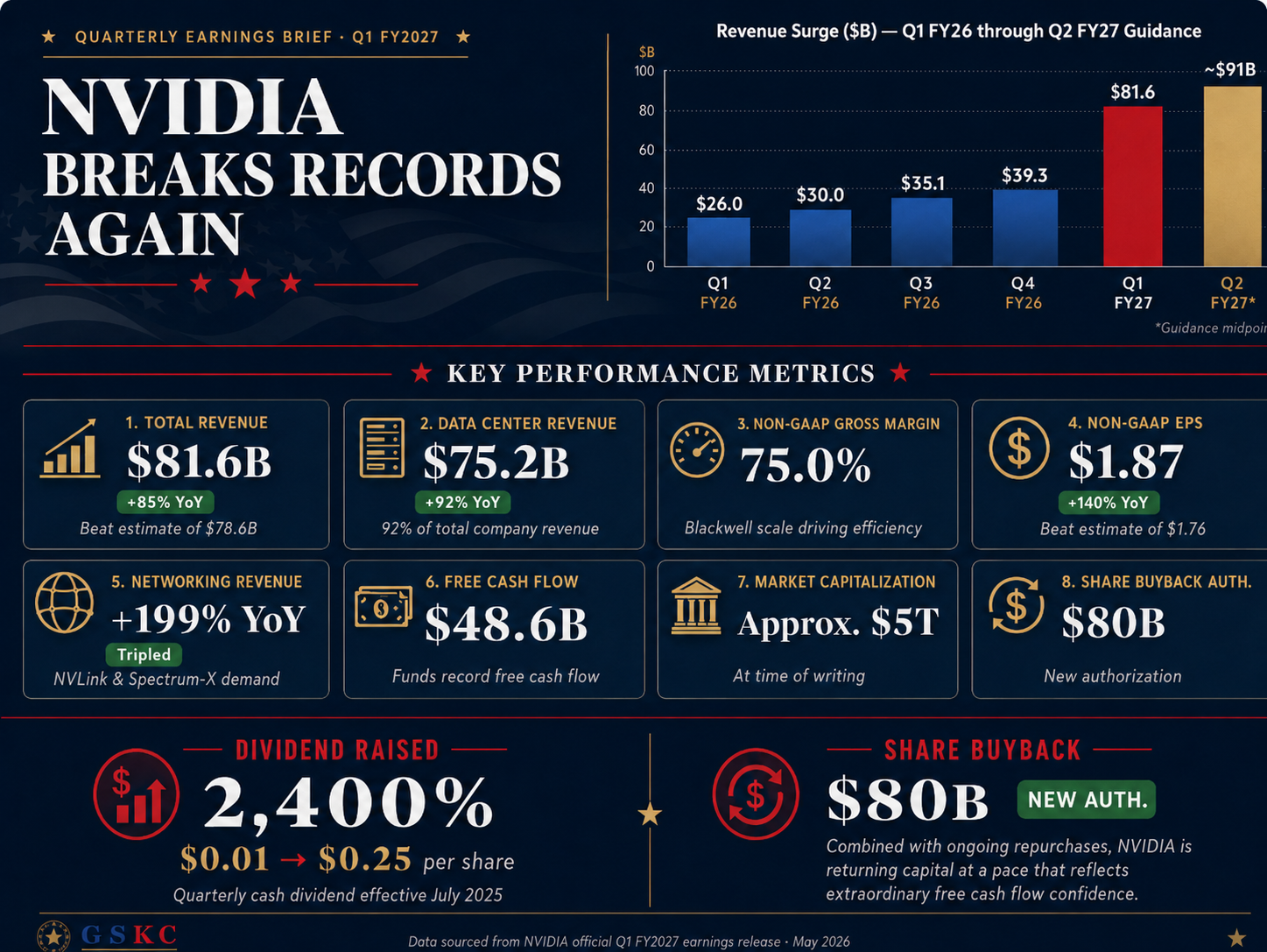
And yet, after several earnings reports that most companies would celebrate, Nvidia's stock has still struggled to sustain immediate post-earnings momentum. What changed?
The explanation is not found in the numbers alone.
The explanation is found in expectations.
The Curse of Expectations
Most people believe success makes life easier. In reality, success often creates a different problem.
Expectations.
A struggling company gets rewarded for improvement. A good company gets rewarded for strong execution. A dominant company is expected to dominate.
Success raises expectations. Sustained success raises them again. Eventually, excellence becomes the minimum requirement.
This phenomenon appears throughout society.
- Elite athletes experience it.
- Championship teams experience it.
- Successful leaders experience it.
- Market-leading companies experience it.
The standard continually rises.
Eventually, people stop asking: "Did they perform well?"
Instead, they ask: "Why weren't they even better?"
This psychological shift may be one of the most important forces currently influencing Nvidia's stock.
Nvidia Is Expected to Win
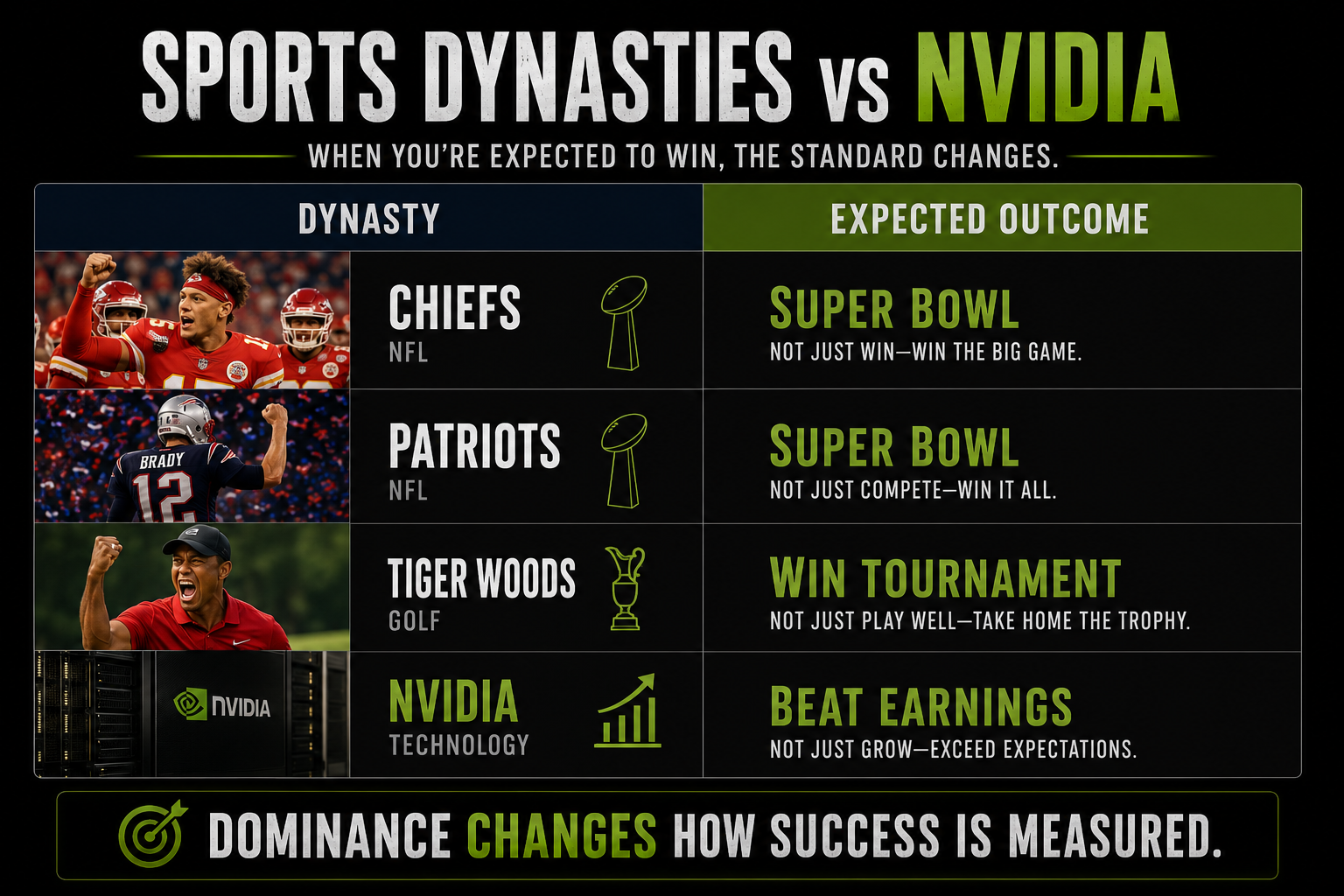
Nvidia's rise has been nothing short of historic. The company sits at the center of the artificial intelligence revolution.
Its advanced GPUs power much of the infrastructure behind large language models, generative AI platforms, cloud computing environments, and emerging AI applications.
Its technology has become foundational.
Its financial performance has reflected that reality, repeatedly beating expectations. Not once, not twice, but consistently.
Revenue growth has accelerated dramatically, margins have remained extraordinarily high, and free cash flow has surged into territory few corporations have ever achieved.
The company has generated so much cash that it recently increased shareholder returns through dividend increases and an expanded share repurchase program exceeding $100 billion in total capital return commitments.
CEO Jensen Huang has repeatedly emphasized Nvidia's unique position within the AI ecosystem. As Huang stated: "Nvidia is uniquely positioned at the center of this transformation." That statement may sound bold. But the numbers increasingly support it.
Yet despite this performance, Nvidia's stock often reacts less to absolute results and more to whether those results exceed increasingly ambitious expectations.
The market no longer asks whether Nvidia will beat estimates. The market asks by how much.
That changes everything.
Burden of Dominance: When Great Earnings Become Bad News
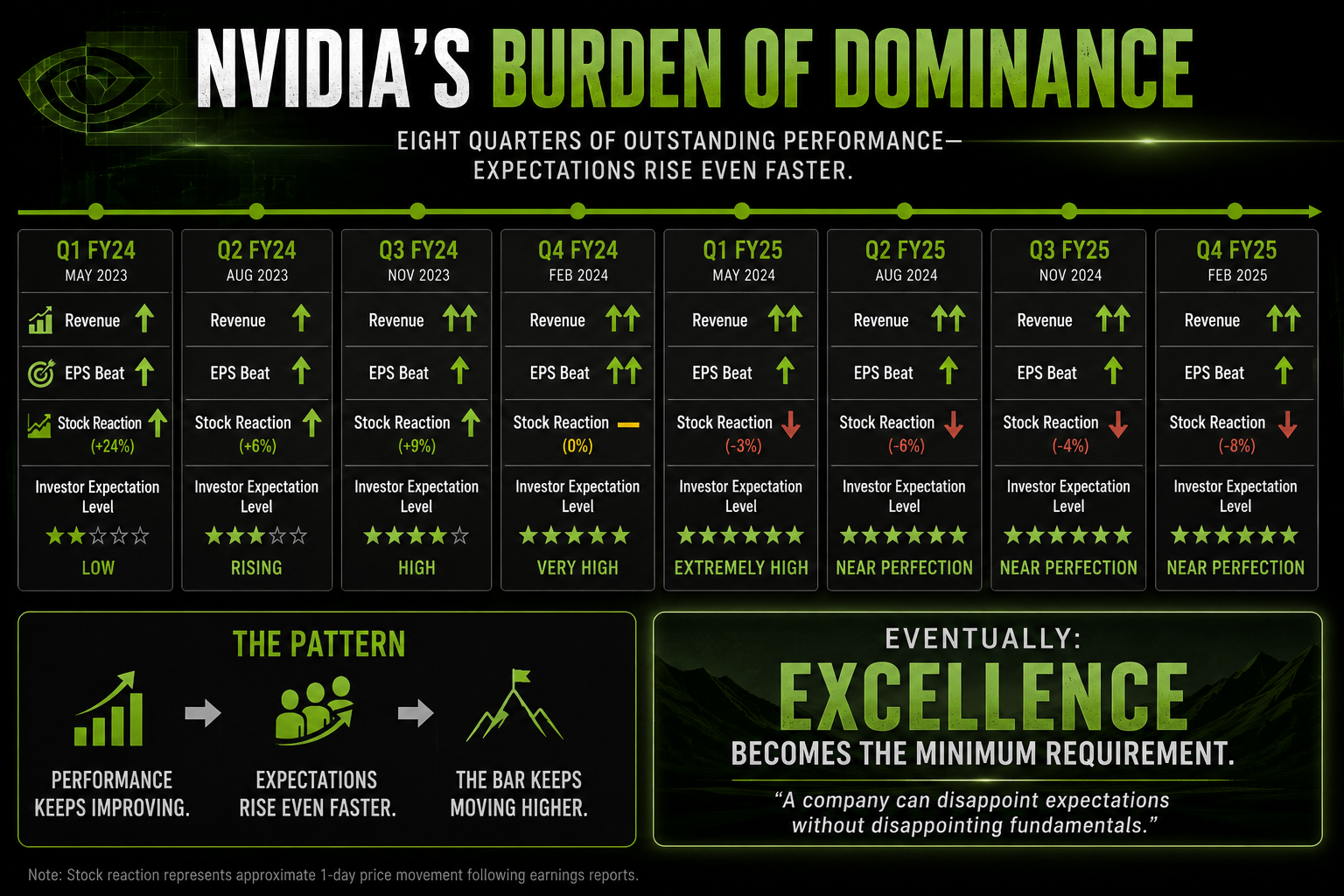
One of the most misunderstood realities of investing is that stocks do not move based on good news or bad news. They move based on news relative to expectations.
Imagine two companies.
Company A grows revenue by 15% → Analysts expected 10% → The stock rises.
Company B grows revenue by 75% → Analysts expected 85% → The stock falls.
Which company performed better?
Objectively, Company B.
Yet markets may reward Company A and punish Company B.
Why?
Because investors had already priced in perfection.
This is where Nvidia increasingly finds itself.
The company's challenge is no longer proving it can grow.
Its challenge is proving it can continue exceeding expectations that have become extraordinarily elevated.
Why Dynasties Attract Critics
Human nature creates another challenge for dominant organizations.
People admire winners.
Until they become tired of them winning.
- The New England Patriots experienced it.
- Tiger Woods experienced it.
- The New York Yankees experienced it.
- The Golden State Warriors experienced it.
- Today, the Kansas City Chiefs experience it.
Success attracts attention. Repeated success attracts scrutiny. Long-term success attracts critics.
Eventually, society begins waiting for the dynasty to fall.
- Every mistake becomes evidence.
- Every weakness becomes amplified.
- Every setback becomes a headline.
The story shifts from celebrating excellence to predicting decline.
Investors should recognize this same phenomenon exists in markets.
Many people genuinely admire Nvidia. Others spend significant time forecasting its collapse. Some concerns are legitimate. Competition exists. Valuations matter. Technology cycles change.
But some criticism stems from something far simpler.
People often grow uncomfortable when one company wins for too long.
What Happens If Nvidia Finally Misses?
Eventually, every dynasty faces adversity.
The Chiefs will not win every championship. Patrick Mahomes will not throw a touchdown on every drive.
No company beats expectations forever. At some point Nvidia will likely report a quarter that falls short of investor expectations.
The headlines will be immediate.
- Growth slowing.
- AI demand cooling.
- Competition rising.
The narrative machine will go into overdrive.
The real question investors should ask is different.
- Has the underlying thesis changed?
- Has AI adoption stopped?
- Have hyperscalers stopped investing?
- Has Nvidia lost its technological moat?
- Has demand for advanced compute disappeared?
- Has Jensen Huang suddenly forgotten how to run one of the most successful technology companies in the world?
If the answer remains no, then the stock reaction may reveal more about investor psychology than business reality.
Why Nvidia Matters Beyond Wall Street
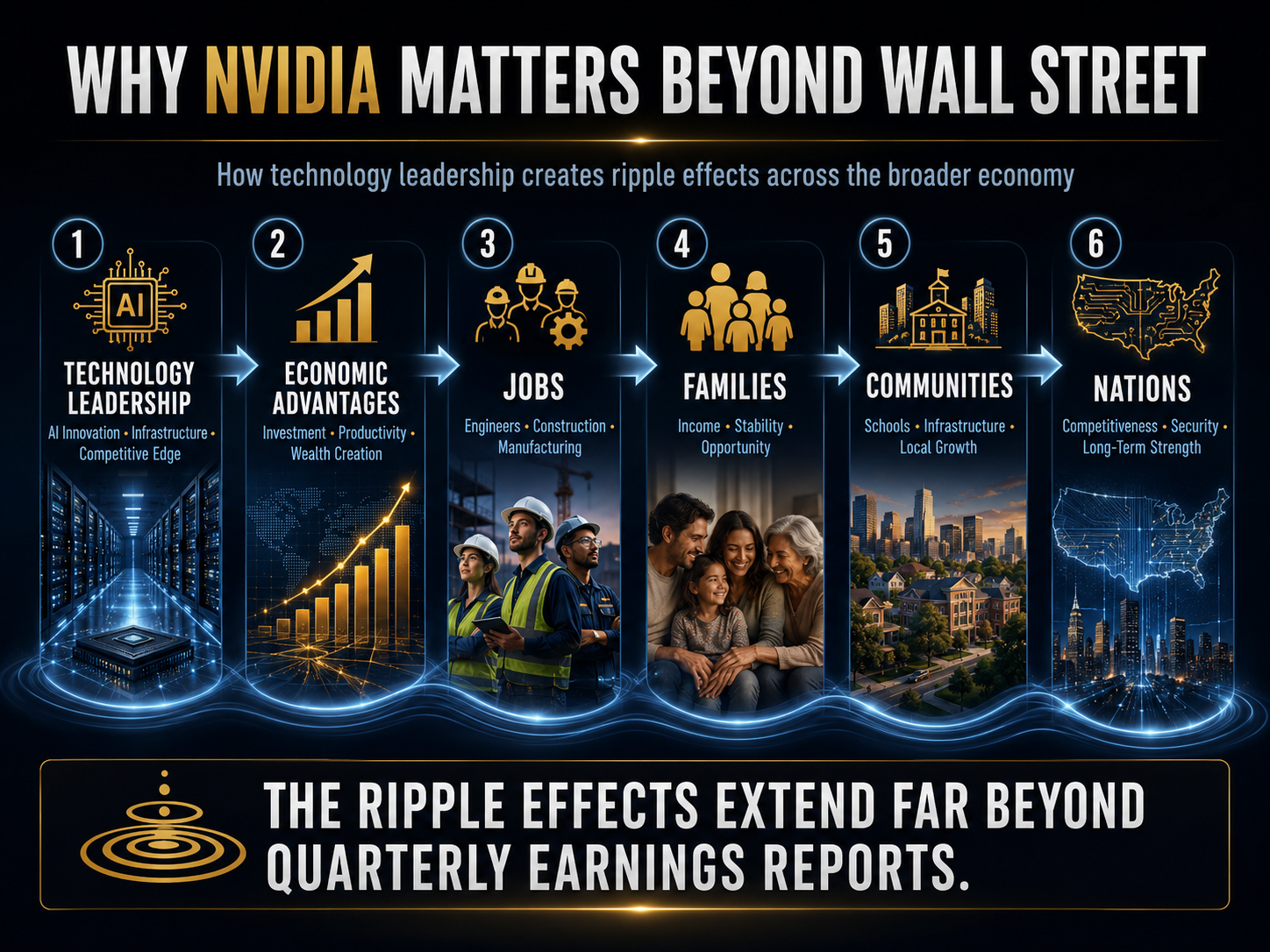
Most discussions about Nvidia focus on investors. That perspective is understandable. It is also incomplete.
Nvidia's influence extends far beyond stock charts.
- Millions of Americans own Nvidia indirectly through retirement plans, pension funds, mutual funds, and ETFs.
- The company's success contributes to household wealth creation.
- Its technologies support advances in medicine, manufacturing, logistics, scientific discovery, national defense, and productivity.
- Its research investments help maintain America's leadership position in advanced computing and artificial intelligence.
The Real Risk Investors May Be Missing
Most investors spend enormous amounts of time analyzing business risk. Far fewer spend time analyzing expectation risk.
Business risk asks: Can Nvidia continue executing?
Expectation risk asks: Can Nvidia continue exceeding expectations that have already become extraordinary?
Those are two very different questions.
Today, Nvidia may be more exposed to expectation risk than many investors realize.
The Reality Check
What Matters?
Nvidia remains one of the most dominant technology companies in the world and occupies a central role in the artificial intelligence revolution.
Why Does It Matter?
Its success affects retirement accounts, innovation, economic growth, technological leadership, and America's competitive position in the global economy.
What Happens Next?
Expectations will likely continue rising.
Future stock movements may become increasingly influenced by psychology rather than fundamentals.
Periods of volatility should be expected.
So should emotional reactions.
What Should Investors Do About It?
Separate expectations from reality.
Focus on business fundamentals rather than headlines.
Evaluate long-term trends rather than quarterly emotions.
Most importantly, remember that great dynasties are rarely judged fairly in real time.
The Burden of Dominance

The Chiefs are expected to win every Sunday.
Patrick Mahomes is expected to throw touchdown passes.
Tiger Woods was expected to win tournaments.
Nvidia is now expected to dominate artificial intelligence.
And when success becomes expected, even excellence can be mistaken for failure.
That is the burden of dominance.
~ Matt Cucinotta | Growth Solutions KC | Inspire · Inform · Ignite
Disclosure
This article is intended solely for educational and informational purposes and should not be considered investment advice. Investors should conduct their own due diligence and consult qualified financial professionals before making investment decisions. The author owns shares of Nvidia and may benefit from future changes in the company's stock price.


Comments ()