

America, China, and the False Image of Strength
Part VI — America at 250: Socialism, Capitalism, and the Choice Before Us
China can project strength because it concentrates power. The question is what that power costs the people who live under it.
China can look strong.
It builds at scale. It manufactures at scale. It plans with discipline, directs capital, controls supply chains, subsidizes strategic industries, and modernizes its military with unmistakable national purpose.
That image draws attention, especially in a frustrated America. When citizens see slow permitting, fragile supply chains, unaffordable housing, and institutions that struggle to execute, China's model can look efficient by comparison.
But the first question is not whether China is powerful.
It is what kind of power China represents.
A nation can be powerful and unfree. It can build factories while silencing dissent. It can dominate supply chains while controlling speech. It can launch rockets while restricting religion. It can grow wealthier while making its citizens more dependent on the state.
China may look strong. But strength without liberty is not the American ideal.
Americans should not confuse state power with human flourishing.
China's strength is real — and incomplete
A serious argument begins by acknowledging reality.
China is not weak. It is a major industrial, technological, and military competitor. The U.S.-China Economic and Security Review Commission's 2025 Annual Report details China's manufacturing and innovation engine, its leverage over critical supply chains, and its drive to electrify and dominate strategic industries. [1]
America should take that seriously.
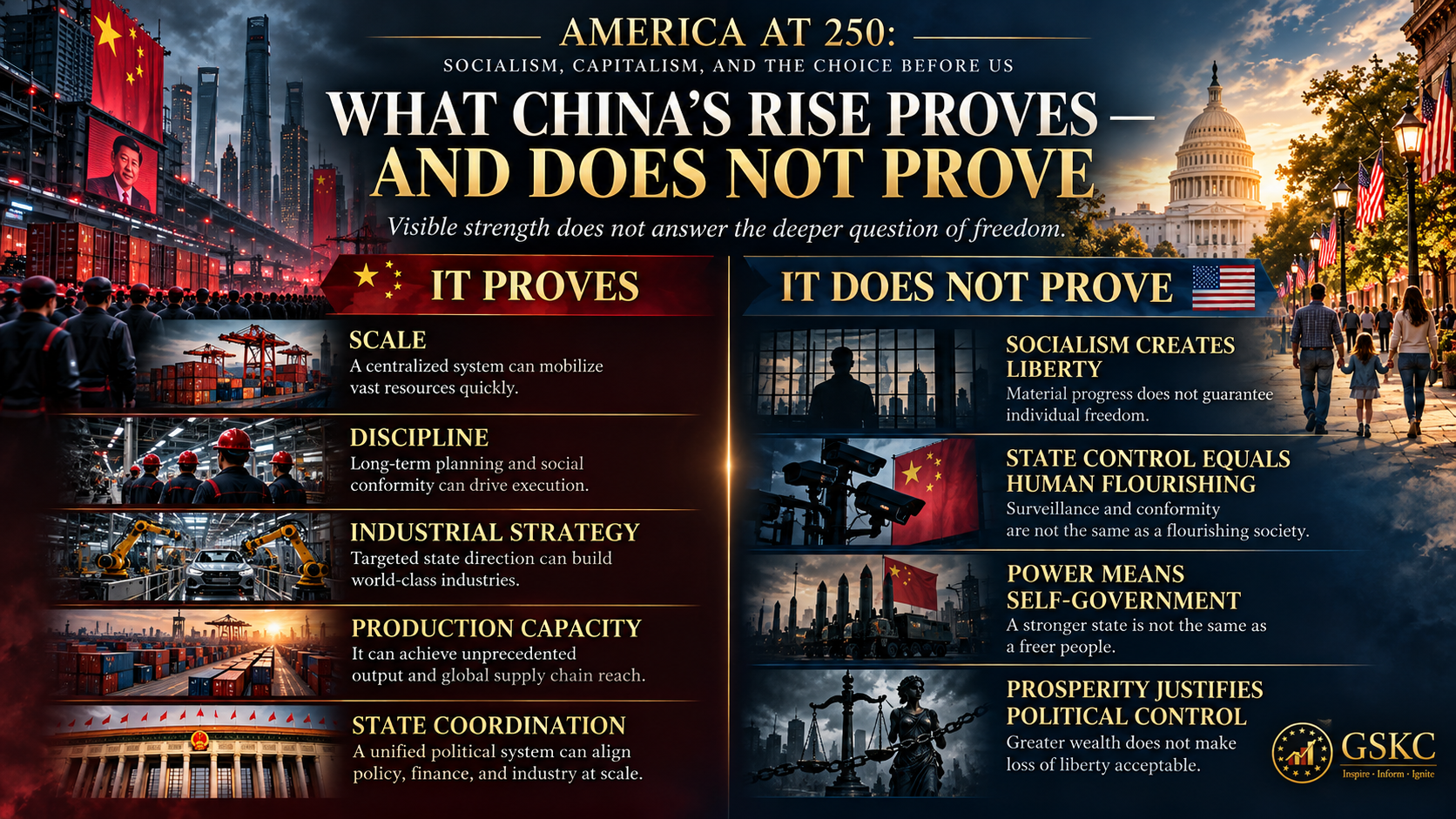
But it should also be clear about what China's rise proves. As Article 4 noted, China's economic boom came after 1978, when the country stepped back from Maoist collectivism and allowed more room for markets, trade, private initiative, and foreign investment.
China's rise proves that markets and incentives create growth.
It does not prove that authoritarian control creates liberty.
China did not become a constitutional free-enterprise republic. It became something different: an authoritarian party-state that uses market tools while keeping political control over speech, faith, property, enterprise, and civil society.
That is what this article examines. Not what China builds, but what its citizens give up.
The citizen and the state
In America's constitutional ideal, government exists to secure rights. Power is limited. Citizens can speak, worship, own, organize, and criticize government without becoming enemies of the state.
China rests on a different foundation.
Freedom House's 2026 report scores China 9 out of 100 and rates it "Not Free." It describes a ruling party that keeps tight control over the bureaucracy, media, online speech, religious practice, universities, and businesses, and a civil society devastated by a multiyear crackdown on dissent, independent organizations, and human-rights defenders. [2]
That is not ordered liberty. It is state-directed power.
The state may look strong because it has made the citizen smaller.
Speech: silence is not unity
Free speech is messy. It produces conflict, bad arguments, misinformation, and institutional discomfort. But it also lets a society expose failure, challenge corruption, and hold power accountable.
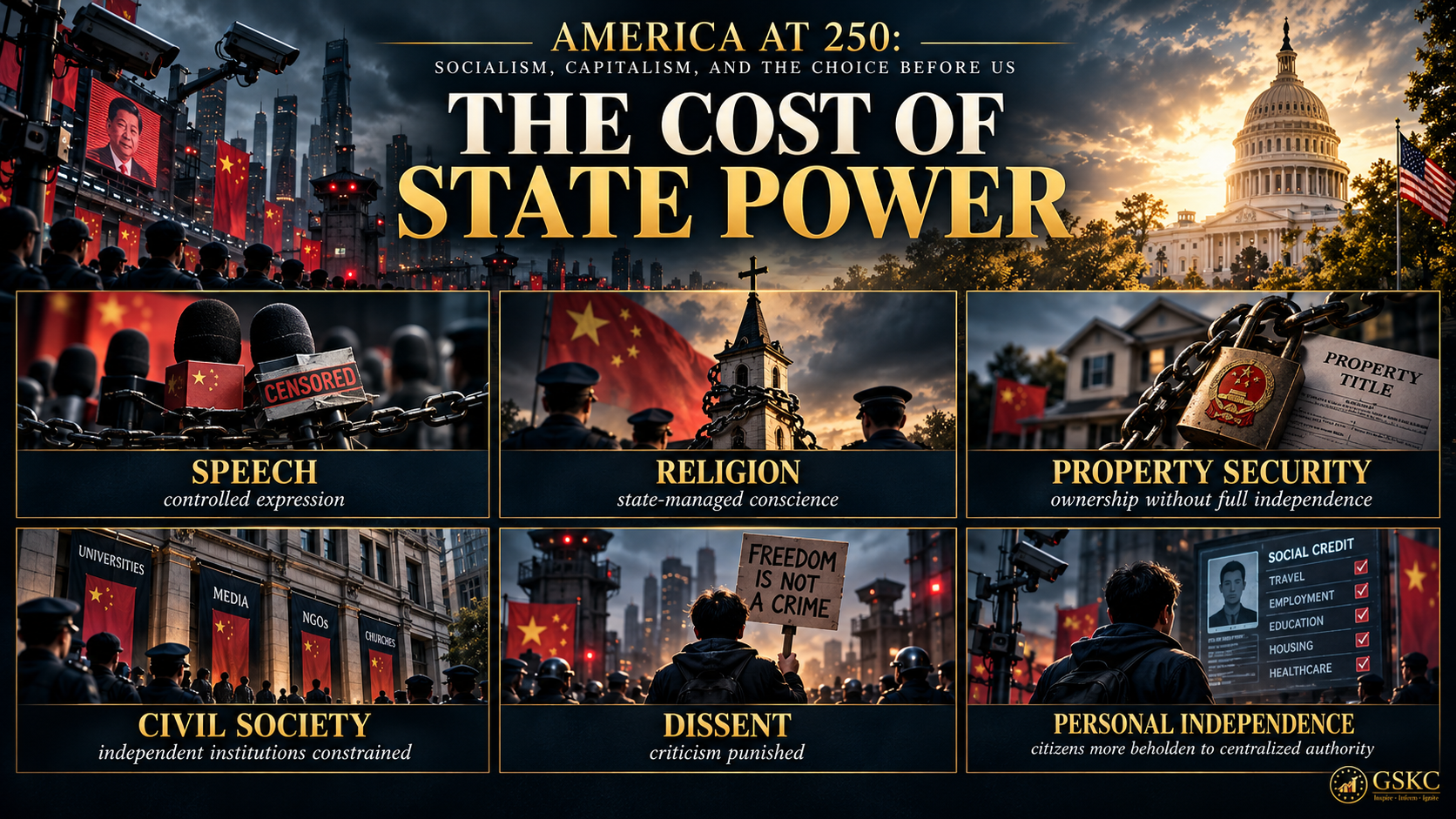
Human Rights Watch reports that Chinese authorities systematically deny freedoms of expression, association, assembly, and religion, persecute critics, and operate one of the world's most extensive systems of censorship and surveillance. [3]
Hong Kong shows how quickly those limits can arrive.
Until 2020, Hong Kong had a free press, open protest, and a strong reputation for the rule of law. That June, Beijing imposed a sweeping National Security Law. A year later, Apple Daily, the city's largest pro-democracy newspaper, was forced to close after police raids, arrests, and frozen assets. In February 2026, its founder, Jimmy Lai, was sentenced to 20 years in prison for conspiracy to collude with foreign forces and to publish seditious material. [4]
Freedoms that took generations to build were dismantled in a few years.
A country that suppresses speech may look unified from the outside. But silence is not unity. When citizens fear speaking honestly, leaders receive bad information, corruption hides, and civic courage weakens.
A free nation needs citizens who can speak — and institutions that can hear.
Religion: the state does not own conscience
A government that controls religion is not merely managing institutions. It is reaching into conscience, worship, family, and the deepest sources of human meaning.
China's constitution formally recognizes freedom of religious belief. In practice, the state requires religious groups to register with approved bodies and to align doctrine and practice with party priorities under a policy it calls the "Sinicization" of religion. The U.S. Commission on International Religious Freedom reported in 2026 that China has codified and escalated that policy through new laws, with especially severe repression of Uyghur Muslims and Tibetan Buddhists. [5]
Christians feel that pressure too. Protestants who worship in unregistered house churches, and Catholics who remain loyal to Rome outside state-approved structures, face surveillance, pressure, and periodic crackdowns. The message is consistent: faith is tolerated when it serves the party and restricted when it answers to a higher authority. [3] [5]
Religious liberty is not a side issue. It recognizes that a person is more than a subject of the state.
A society may build roads, ports, factories, and trains. But if it claims authority over the soul, it has crossed a line no free society should cross.
America does not always live up to its ideals. But the ideal itself is essential: government must not own conscience.
Property and enterprise under permission
China has property, contracts, private businesses, and entrepreneurs. Saying Chinese citizens own nothing would be inaccurate.
The issue is security.
Under Chinese law, urban land is owned by the state, and rural land is owned collectively. Citizens and companies hold land-use rights, not land itself. [6] Homes and businesses can be bought and sold, but political authority sits above the ground beneath them.
Enterprise faces the same ceiling.
In November 2020, Ant Group, the financial-technology company founded by Jack Ma, was days away from the largest stock offering in history, roughly $37 billion across the Shanghai and Hong Kong exchanges. Shortly after Ma publicly criticized China's financial regulators, authorities summoned him for "supervisory interviews," and the listing was abruptly suspended. [7] Freedom House notes that the broader crackdown on private firms, especially large technology companies, has brought the private sector more firmly under party control. [2]
The lesson was not lost on China's entrepreneurs. A business can grow, innovate, and build wealth. But it cannot cross the party.
That may produce output. It does not produce independence.
As Article 5 acknowledged, American capitalism has its own cronyism and regulatory capture. But the answer to cronyism is not to make every major economic decision more political. It is freer competition, stronger law, and institutions that protect citizens from both corporate abuse and state overreach.
Ownership that depends on permission is not independence.
Civil society: a nation's immune system
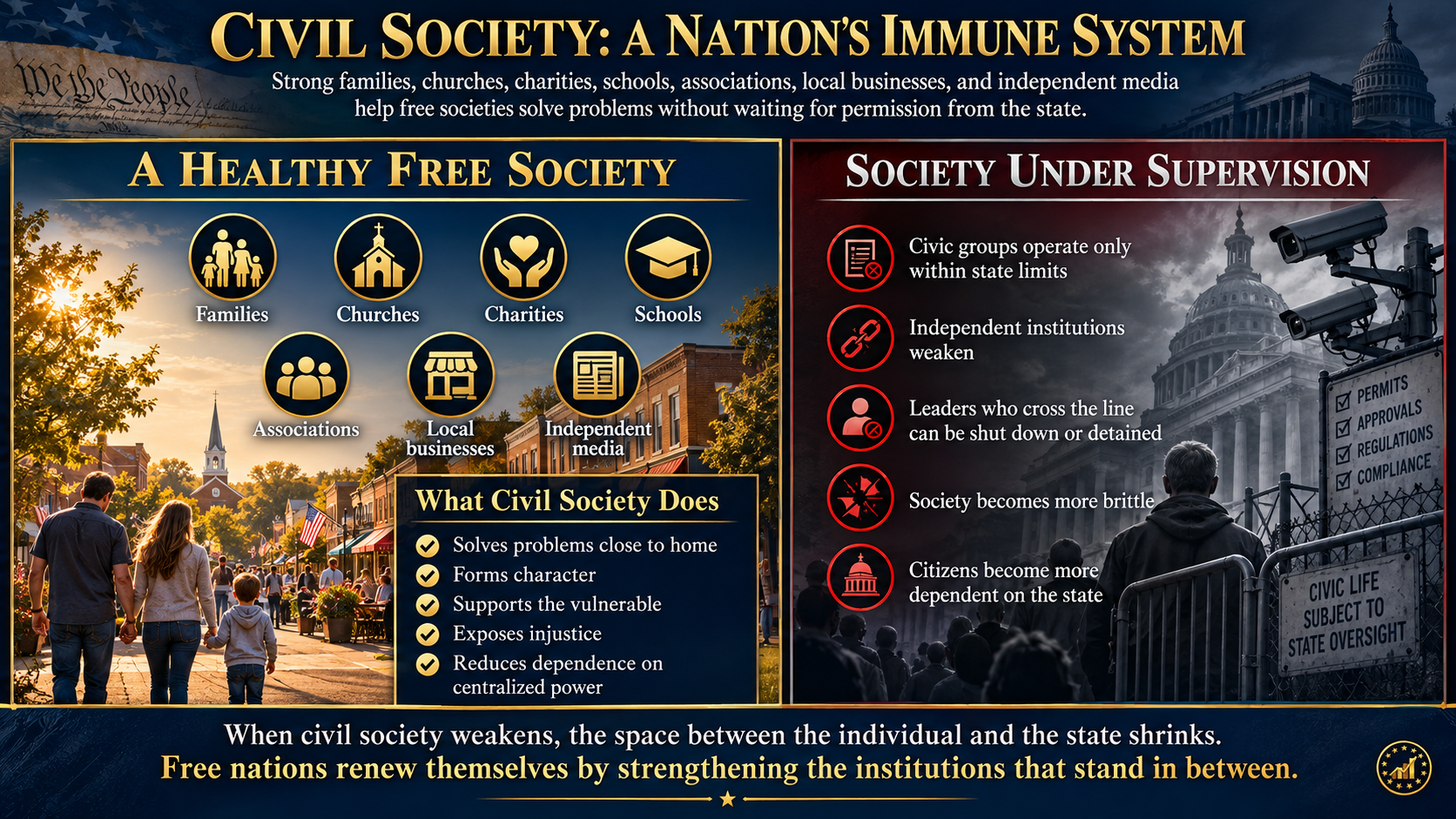
A healthy nation is not made only of individuals and government. It is made of families, churches, charities, schools, associations, local businesses, and independent media that act without waiting for permission.
Civil society helps people solve problems close to home. It forms character, supports the vulnerable, exposes injustice, and keeps life from becoming entirely political.
In China, independent charities, labor advocates, rights lawyers, and civic groups operate only inside limits the party sets. Those that cross the line are closed, and their leaders can be detained. What remains is not civil society in the American sense. It is society under supervision. [2]
When those institutions exist only under political tolerance, a nation may look orderly. But it becomes more brittle, and its citizens become more dependent.
America's civic life has weakened, and that should concern us. But the answer is not to absorb civil society into government. It is to rebuild the institutions that stand between the individual and centralized power.
Power without feedback
Authoritarian systems can be tempting because they move fast. They can approve projects, direct capital, and silence opposition without the friction of consent.
But speed is not wisdom. And the clearest proof came from Wuhan.
On December 30, 2019, Dr. Li Wenliang, a Wuhan ophthalmologist, warned former medical-school classmates in a private chat group about patients with a SARS-like illness. On January 3, 2020, local police summoned him and had him sign a statement admitting he had spread false information. [8]
He was right. The illness was COVID-19. Li contracted the virus himself and died on February 7, 2020. A later investigation by China's own national supervisory commission concluded the police reprimand had been improper. [8]
The episode revealed the danger of punishing early warnings when accurate information was most urgently needed. By then, the world had lost weeks it could not get back.
This is where Articles 3 and 5 meet. Article 3 showed how centralized systems suppress reality until failure becomes catastrophic. Article 5 showed how free societies correct mistakes through feedback. When warnings are treated as rumors and truth-tellers as threats, a system can move fast in the wrong direction.
Speed matters. But correction matters more.
But don't Chinese citizens accept the bargain?
The strongest counterargument deserves a fair hearing.
Many Chinese citizens have experienced extraordinary gains in living standards within a single lifetime. Surveys have reported high satisfaction with the central government. A long-running Harvard Ash Center study found that in 2016, more than 95 percent of respondents were relatively or highly satisfied with Beijing, though far less satisfied with local officials. [9]
That should not be dismissed. Prosperity, order, and national pride are real goods, and many people value them.
But consent cannot be measured honestly where dissent is punished. The researchers themselves note the limits of polling in a country where surveys are closely scrutinized by the government. When criticizing the state can cost a career, a business, or freedom, a high approval number is not a free verdict.
A bargain that cannot be refused is not a choice. And a government that cannot be voted out, criticized openly, or corrected from below has not earned the trust that free citizens give.
Learn without imitating
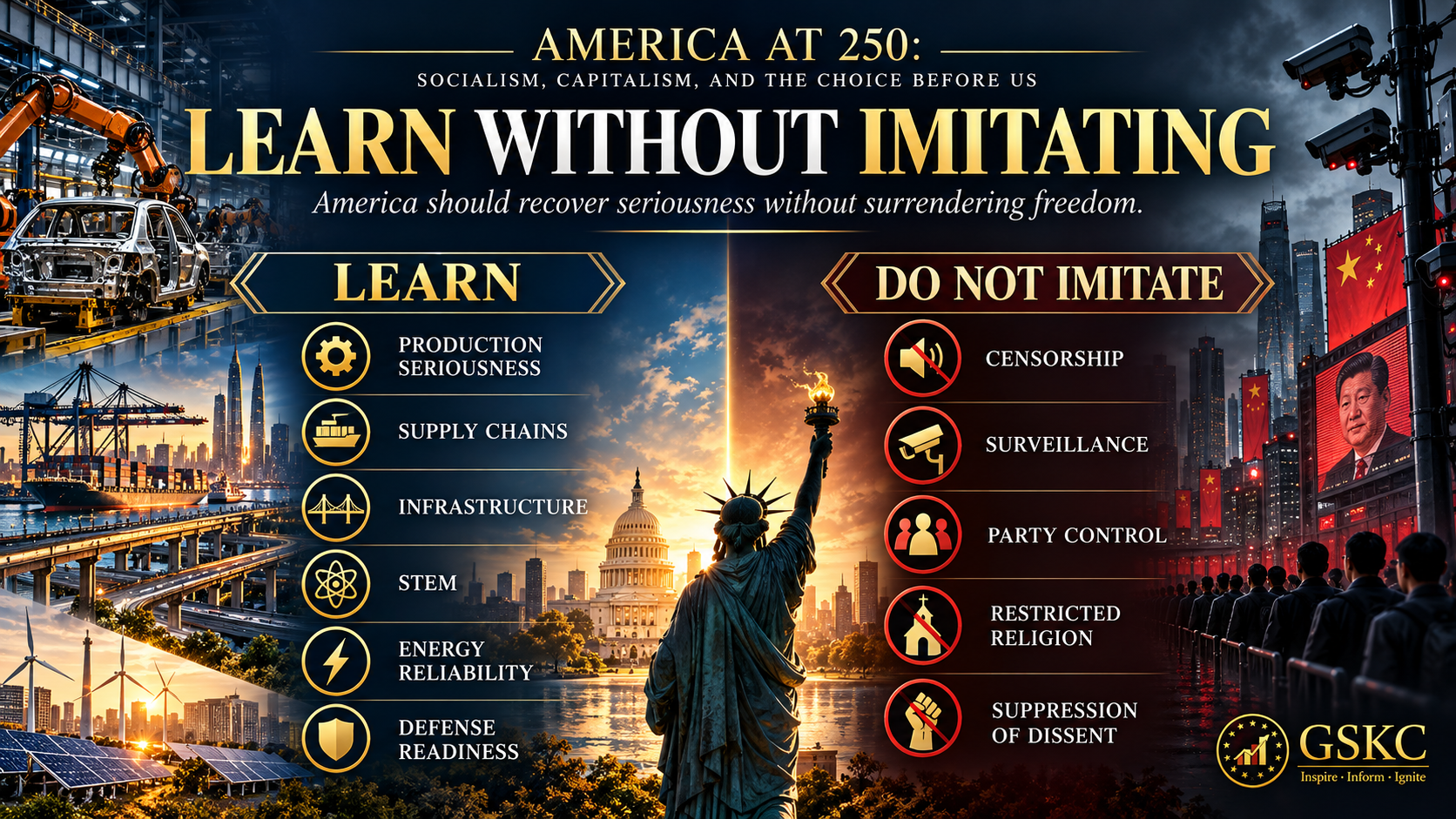
America should not ignore China's strengths. It should learn from China's seriousness about manufacturing capacity, supply chains, infrastructure, energy, technical education, defense readiness, and long-term strategy.
That means asking hard questions. Why did America let so much critical production move offshore? Why does it take so long to build? Why are supply chains for medicine, minerals, and defense so fragile?
A free society still needs competence. A constitutional republic still needs factories, engineers, energy, shipyards, and skilled workers.
America has done this before. In the Second World War, a free society became the arsenal of democracy, out-producing authoritarian rivals without surrendering its constitution. Seriousness about production and commitment to liberty are not opposites. America's history shows they can work together.
But America must not imitate censorship, surveillance, political control of enterprise, religious restriction, or party dominance over civil society. Those would not make America stronger. They would make America less American.
America does not need to become China to compete with China. It needs to become more serious about being America.
Liberty is a strategic advantage
Liberty is a moral good. It is also a strategic advantage.
America’s greatest advantage has been the combination of constitutional liberty, free enterprise, religious freedom, free speech, private property, civil society, local initiative, immigration, innovation, and national purpose.
Free people can criticize mistakes, expose corruption, start businesses, challenge incumbents, worship freely, publish, organize, invent, and build. That freedom produces disorder at times. But it also produces correction.
America's own history proves the point. Its gravest failures, from slavery to segregation, were exposed and challenged by free citizens: abolitionist preachers, newspaper editors, petitioners, lawyers, marchers, and voters. Correction came slowly and at great cost. But it came because people could speak, worship, organize, and appeal to the nation's founding principles without first asking the government's permission.
China can copy technology, build infrastructure, subsidize industries, and plan. What it cannot command is free inquiry, independent conscience, voluntary civil society, or the creativity of citizens who do not need permission to build.
Liberty is not a luxury America can afford after it becomes strong. Liberty is part of why America became strong.

Conclusion: Study China, renew America
China is a serious competitor, and its strengths should be studied honestly.
But the question is not whether China can build. It can. The question is what kind of society it builds, and what its citizens give up in exchange for the appearance of unity, speed, and control.
They give up speech.
They give up religious freedom.
They give up independent civil society.
They give up safe space for dissent.
They give up property secure enough to stand apart from political authority.
They give up the full independence of free citizens.
America should study China's seriousness without envying China's chains.
The American answer is not to imitate centralized power. It is to renew ordered liberty: free speech, religious freedom, private property, free enterprise, strong families, civil society, constitutional limits, and responsible self-government.
China may look strong. But strength without liberty is not the American ideal.
America at 250: Socialism, Capitalism, and the Choice Before Us — What future will we hand down? The story of America isn't finished. We are writing the next chapter.
— Matt Cucinotta | Growth Solutions KC | Inspire · Inform · Ignite
Source List
- U.S.-China Economic and Security Review Commission, 2025 Annual Report to Congress. Bipartisan congressional commission. Supports the discussion of China's manufacturing and innovation engine, supply-chain leverage, and strategic competition.
- Freedom House, "China: Freedom in the World 2026" (mirror via ecoi.net). Supports the 9/100 "Not Free" score, party control over institutions, the crackdown on dissent and civil society, and the private-sector crackdown.
- Human Rights Watch, "World Report 2026: China". Supports the discussion of restrictions on expression, association, assembly, and religion, and of censorship and surveillance.
- OCCRP, "Hong Kong Jails Jimmy Lai for 20 Years Under National Security Law". Supports the Jimmy Lai conviction, charges, and February 2026 sentence, and the 2021 closure of Apple Daily.
- U.S. Commission on International Religious Freedom, "China Codifies and Escalates Its Policy on the 'Sinicization of Religion'", 2026. Bipartisan federal commission. Supports the discussion of Sinicization and repression of Uyghur Muslims and Tibetan Buddhists.
- Land Administration Law of the People's Republic of China (English text), Congressional-Executive Commission on China. Primary source. Supports state ownership of urban land, collective ownership of rural land, and transferable land-use rights.
- Financier Worldwide, "Ant Group's record IPO suspended," November 5, 2020. Supports the size, exchanges, supervisory interviews, and suspension of the Ant Group IPO.
- China Law Translate, translation of the State Supervision Commission investigation report on Li Wenliang (March 2020). Official PRC report, translated. Supports the dates of Li's warning, the police admonishment, his death, and the finding that the admonishment was improper.
- Harvard Gazette, "Long-term survey reveals Chinese government satisfaction," July 2020. Supports the Ash Center survey findings (95.5 percent satisfaction with the central government in 2016) and the researchers' caveats about polling in China.



Comments ()