

The State of the Union

Where America Actually Stands at 250
AMERICA AT 250 SERIES · ARTICLE SEVEN
The previous six articles looked backward. This one stops and looks around. Where does America actually stand at 250 — not as a campaign talking point, but as an honest accounting?
This is the hardest article in the series to write, for a reason worth naming at the outset. Every other chapter has the clarity of hindsight: we know how the Civil War ended, whether the Constitution held, and what the innovations became.
The present has no such clarity. It is contested, partisan, and emotionally charged, and almost everyone describing it is selling something — a candidate, a grievance, a fundraising appeal.
So this article will try to do the one thing the current moment makes most difficult: look at the country plainly, without cheerleading and without doom. Not a scorecard. Not a verdict. An attempt at understanding.
The point is not to score the country. The point is to understand it: what happened, why it happened, what happens next, and what responsible citizens should do with that knowledge.
And throughout, the discipline is the same one this series has insisted on: more than one thing can be true at once.
A note before we start. Where this article uses numbers, they are current as of mid-2026 and drawn from nonpartisan sources. They will drift. The point is not any single figure but the shape it reveals.
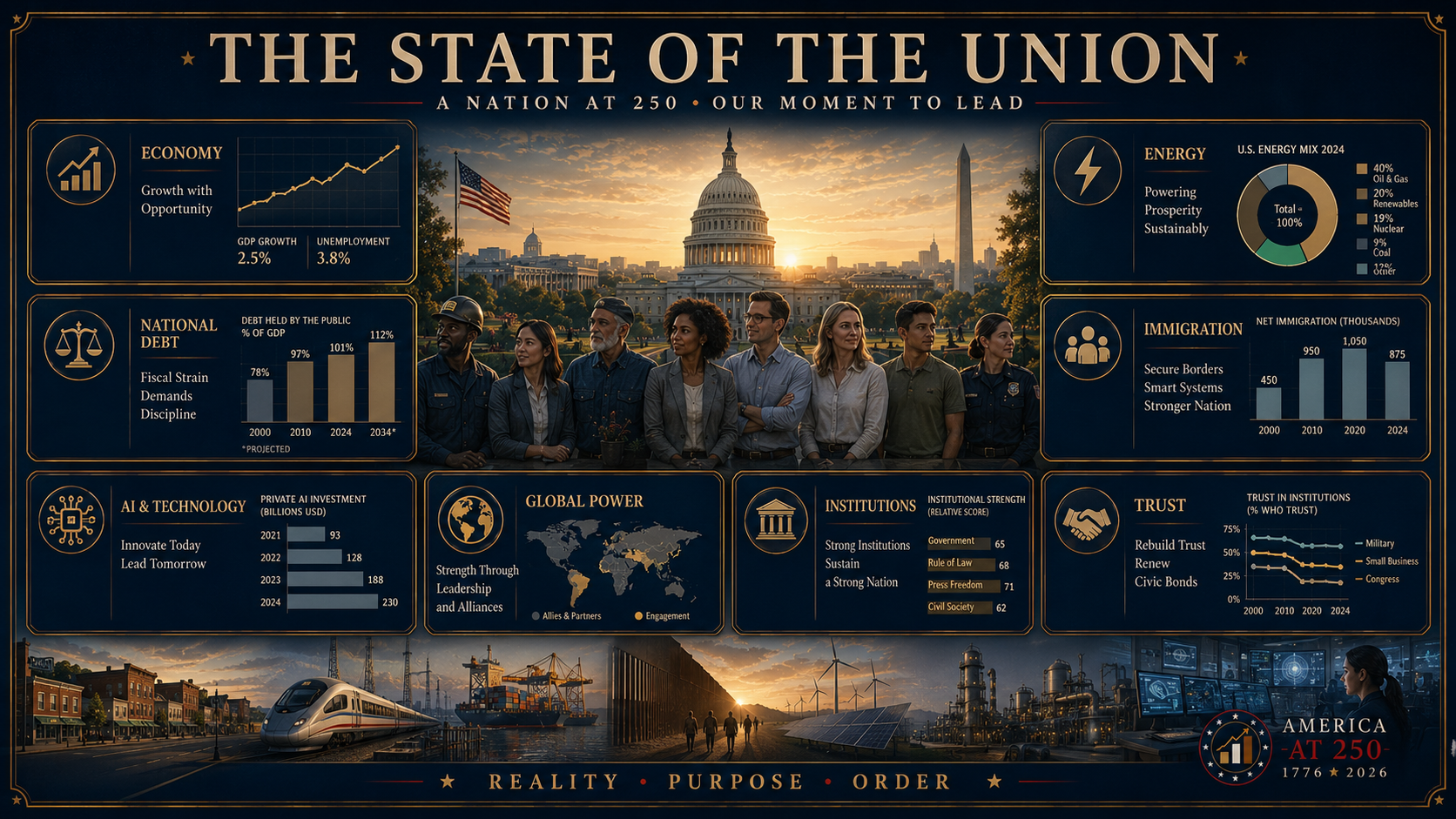
The Economy: Strong Engine, Structural Strain
What happened.
By most top-line measures, the American economy remains the envy of the world. It is the largest on earth at roughly $31 trillion in annual output, the undisputed leader in the technologies — software, semiconductors, artificial intelligence — that will define the coming decades, and home to the deepest capital markets and most innovative companies anywhere. The dollar remains the world’s reserve currency. By the metrics that measure raw economic power, America is not in decline.
Why it happened.
The institutional engine described in this series’ innovation chapter — research universities, deep capital, a culture that rewards risk — keeps producing growth. But underneath the strong headline sits a genuine structural strain: the cost of housing, healthcare, and education has climbed faster than wages for many families, producing a gap between a strong economy and a stretched household that statistics on the former don’t capture.
What’s next and what to do.
The open question is whether broad-based opportunity keeps pace with aggregate strength — whether the rising tide is felt on the ground or only in the index. Both things are true right now: America has the world’s most powerful economy, and many Americans feel they are running to stand still. Honesty requires holding both, rather than citing whichever half serves an argument.
The Fiscal Challenge: The One Number That Won’t Wait
What happened.
Here is the domain where the honest accounting turns serious. In 2026, gross federal debt approached $39 trillion, while debt held by the public hovered around the size of the entire economy — a level associated historically with moments of national emergency. Per person, the gross figure works out to roughly $114,000 for every American.
Why it happened.
This is the part that resists partisanship, and the nonpartisan budget analysts say it plainly: unlike the 1940s peak, which financed a world war, today’s debt is the product of what one watchdog called a bipartisan unwillingness to make hard choices. Both parties cut taxes or raised spending — usually both — across decades, and neither has paid for its priorities. There is no partisan villain here. There is a shared, sustained avoidance.
What’s next and what to do.
Debt does not announce a crisis on a particular morning; it slowly narrows a nation’s options, as interest payments crowd out everything else a government might want to do. The honest framing is generational: the choices deferred now become the constraints inherited later. This is the clearest example in the whole article of a problem that is no one party’s fault and will require something close to a national maturity to solve.
Immigration, Energy, and Foreign Policy: Strengths Under Strain
These three domains share a feature: in each, America holds real strengths and faces real, unresolved tensions, and in each the public conversation has become so heated that the underlying reality is hard to see.
On immigration, the country has for two and a half centuries drawn extraordinary talent and energy from around the world — it is one of the genuine engines of American renewal, woven into the innovation story directly. And simultaneously, the question of how to manage the border and the system in an orderly, lawful, humane way is real and unresolved. Both are true: immigration is a historic American strength, and a system most across the spectrum agree is not working as it should — secure, lawful, and efficient — is a real, unresolved problem. The reflexive move — treating it as either pure threat or pure virtue — obscures more than it reveals.
On energy, America is now the world’s largest producer of oil and natural gas and a major builder of new technologies — an unusual position of strength that gives it options most nations lack. The genuine tension is between energy abundance and security today and the longer transition pressures ahead. The honest read is not which side wins, but that the country has more room to maneuver here than the loudest voices admit.
On foreign policy, America remains the world’s preeminent power, with unmatched military reach and a network of alliances no rival can replicate — and it is navigating a genuinely more multipolar, contested world than the one it dominated after 1991. The strength is real; the challenge of using it wisely, in an era of renewed great-power competition, is also real.
The pattern across all three is the same, and it is the discipline this series keeps returning to: real strength and real challenge, held together, resisting the collapse into either triumph or catastrophe.
Artificial Intelligence: The Live Frontier
What happened.
America finds itself at the leading edge of the most consequential technology since the internet, and possibly since electricity. The innovation chapter explained why: the same institutional machine — federal research, university talent, venture capital — that produced every prior wave produced this one.
Why it matters and what’s next.
AI concentrates the series’ central tension into a single live example. It is simultaneously an extraordinary opportunity — for productivity, discovery, and renewed leadership — and a genuine challenge, raising hard questions about disruption, truth, and control that no one has fully answered. The question is not whether to be optimistic or alarmed. It is whether America can shape this technology in line with its values rather than merely being shaped by it — and whether the institutions that produced the breakthrough can govern it wisely.
What to do.
The citizen’s response should not be panic or passive surrender. AI should be treated as what every major technology has been: a powerful tool whose value depends on the wisdom, discipline, and purpose of the people using it. We should learn it, use it, question it, challenge it when necessary, and insist that it serve human judgment rather than replace it. Change is not the enemy. Change aligned with truth, responsibility, and human flourishing is how societies advance.
The Harder Mirror: Trust, Division, and the Temperature of the Country
Now the article turns to the domain that is hardest to quantify and most important to face — because it is the one that determines whether a free people can solve any of the above.
What happened.
The numbers are stark and not seriously disputed. Trust in the federal government sits near its lowest point in the nearly seventy years the question has been asked — only about one in five Americans say they trust it to do the right thing most of the time. An overwhelming majority — around 85% — say elected officials don’t care what people like them think. And in a finding that captures the mood precisely, only 4% of Americans say the political system is working very or extremely well.
Why it happened.
This is where the discipline of this series matters most, because the easy explanations are the partisan ones — the other side did this. The data refute that story. Dissatisfaction is broadly bipartisan: the share of Americans with unfavorable views of both major parties has climbed from single digits two decades ago to more than a quarter today. Each side’s trust in institutions rises and falls depending on who holds power, in near-mirror symmetry. This is not one party’s pathology. It is a systemic condition — and naming it as systemic, rather than scoring it as the other team’s fault, is the first honest step.
There is a deeper diagnosis here, and this series has made it before: when political identity grows stronger than civic identity, when outrage becomes more rewarding than persuasion, shared reality itself begins to fracture. A republic can survive fierce disagreement — it was built for disagreement. What it cannot easily survive is the loss of the common ground on which disagreement is conducted: the shared facts, the mutual recognition of fellow citizens as fellow citizens rather than enemies. That erosion, more than any single policy failure, is the real state-of-the-union concern.
What’s next and what to do.
And yet here the doom narrative overreaches, and honesty requires saying so. Trust has not simply evaporated; it has fragmented and become conditional — which means, unlike a thing destroyed, it can in principle be rebuilt.
The military and a nonpartisan civil service still command broad confidence. Large majorities, across the divide, say they want reform and believe the country’s problems are solvable. The appetite for something better is itself widespread. The raw material for repair exists; what’s missing is the shared will to use it.
Patriotism, Properly Understood
Which brings the accounting to its truest measure, and the one this whole series has been quietly building toward.
Ultimately, the state of the union is not defined by GDP, debt ratios, or poll numbers. These are merely indicators and tools, reflecting deeper conditions and underlying realities. The real question is whether Americans still share enough of a common identity — enough mutual trust and goodwill — to govern together and keep working toward the ideal of a more perfect union. Honestly, that bond is under strain, but it’s not broken.
This is where patriotism, rightly understood, becomes practical rather than sentimental. Not the cheap version that demands the country be called flawless, nor its mirror that can see only the country’s sins — both of which this series has rejected from its first page.
The patriotism that matters at 250 is the constructive kind: clear-eyed about the failures named honestly in these pages, genuinely proud of the achievements, and committed to the unfinished work of improvement.
It is the patriotism contained in the word more — a more perfect union — which assumes imperfection and demands effort in the same breath.
The single most important fact in this entire accounting is one the data quietly supports: across 250 years, this imperfect democracy has repeatedly found the capacity to meet its challenges and emerge more whole. It did so through civil war, the Great Depression, two World Wars, and the long struggle to extend its promise to those it had excluded. The present strain is real. So is the demonstrated, repeated, historical capacity to come through it.
What Responsible Citizenship Requires Now

So what should people do with an accounting like this?
Begin by refusing the easy story. A serious citizen does not need to pretend America is collapsing in order to demand repair, or pretend everything is fine in order to love it. The work is harder and better than that: seek what is true, defend what is good, build what is beautiful, and reject the habits that make self-government impossible.
That means lowering the temperature where we can. It means choosing honest debate over performative outrage, shared facts over convenient narratives, and common ground over permanent hostility. It means demanding better from leaders and institutions without surrendering personal responsibility. It means remembering that opponents are still neighbors, that disagreement is not hatred, and that citizenship requires more than complaint.
America remains the greatest nation on earth not because it has avoided failure, but because it has repeatedly found the courage to correct, rebuild, and improve. We are blessed to inherit a country built on principles large enough to challenge every generation: liberty, responsibility, equal dignity, ordered freedom, and the pursuit of a more perfect union.
Patriotism and improvement are not opposites. They belong together. To love America well is to tell the truth about where it stands, argue honestly about what should come next, and then take responsibility for helping build a country worthy of what we have inherited.
Where America Stands
So, where does America actually stand at 250?
It stands as a nation of extraordinary strengths and genuine strains, neither of which the honest observer is permitted to ignore.
The most powerful economy and a serious fiscal reckoning.
The world’s innovation leader and a people unsure the prosperity reaches them.
Unmatched global power and a contested new world to navigate.
And beneath it all, a civic fabric frayed by distrust and division — yet still holding, still capable of repair, still wanted by a clear majority who sense something has gone wrong and want it set right.
That is not a country solely in triumph, nor is it a country in collapse. It is a country at a characteristic American moment: thriving in many ways yet grappling real challenges of its own making, fully capable to address them, and waiting — as it has waited at every prior inflection point — to see whether its citizens will rise to the occasion.
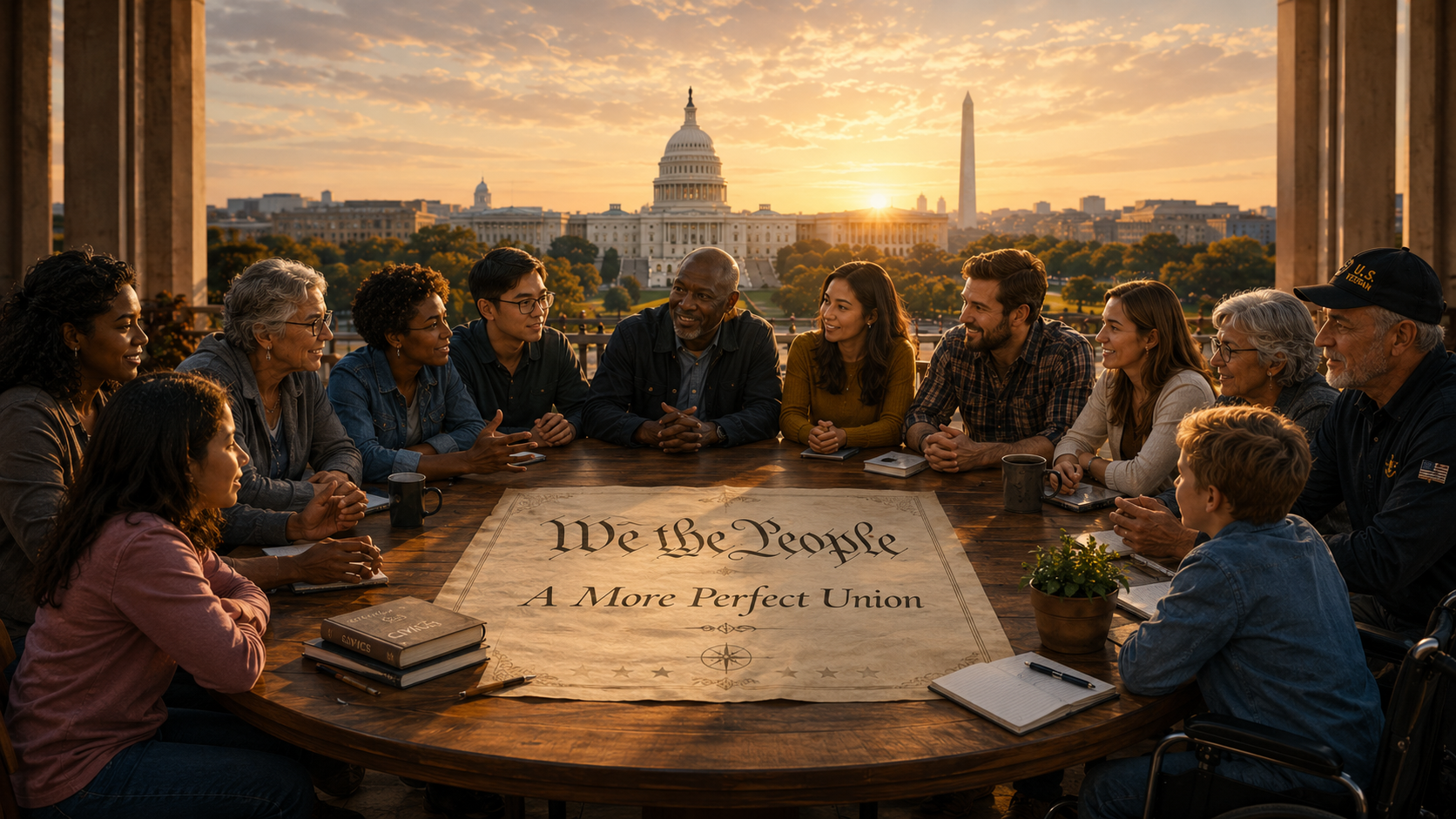
The story of America isn’t finished. We are writing the next chapter.
This is the seventh article of the Growth Solutions KC America at 250 series.
Next: Article Eight — The Meaning of Sacrifice: What the Greatest Generation Still Teaches Us
— Matt Cucinotta | Growth Solutions KC | Inspire · Inform · Ignite

Discover more installments of the America at 250 Series.


Comments ()