

The Journey West
Westward expansion was a genuine story of opportunity, mobility, and the building of a continental nation. It was also a genuine story of displacement, broken promises, and devastating cost to the people who already lived there.
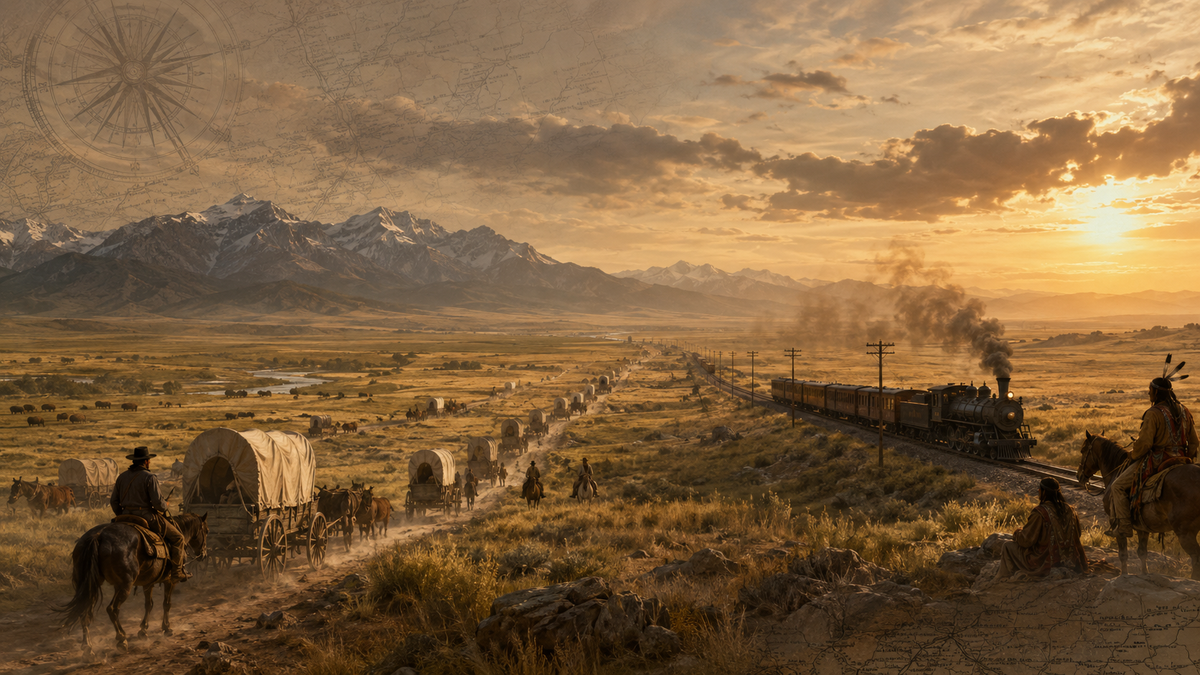
Opportunity, Expansion, and the Costs of a Continental Nation
AMERICA AT 250 SERIES · ARTICLE SIX
The Louisiana Purchase
The Louisiana Purchase is remembered as the greatest real estate bargain in history: 828,000 square miles for four cents an acre. That number is true. It is also the most revealing thing America forgets about its own expansion — because of what the arithmetic leaves out.
In 1803, the United States bought the Louisiana Territory from France for fifteen million dollars and doubled the size of the nation overnight.
Divide the price by the acreage, and you get the figure every schoolchild learns: roughly four cents an acre, the deal of the millennium.
But that calculation contains a quiet omission, and the omission is the whole story of westward expansion compressed into a single number. The four-cents figure counts only what was paid to France.
France did not live on the land. Dozens of Native nations did — and what the United States actually acquired from France was not the land itself but the right to expand into it, to negotiate or contend for it with the peoples already there. When historians have attempted to account for what the government later disbursed across that same territory over the next two centuries — through hundreds of treaties, cessions, settlements, and legal claims with Native nations — the total runs not to millions, but to billions, with some estimates reaching as high as $2.6 billion. The celebrated bargain was never four cents an acre. It only looked that way because the original calculation left out the people who were already there.
That is the assignment of this article, and the series will not flinch from it: to hold two true things at once.
Westward expansion was a genuine story of opportunity, mobility, and the building of a continental nation. It was also a genuine story of displacement, broken promises, and devastating cost to the people who already lived there.
Both are true. The mature way to mark 250 years is not to choose one and suppress the other. It is to hold both — and to understand why holding both is itself a sign of confidence rather than weakness.
The Opportunity Was Real
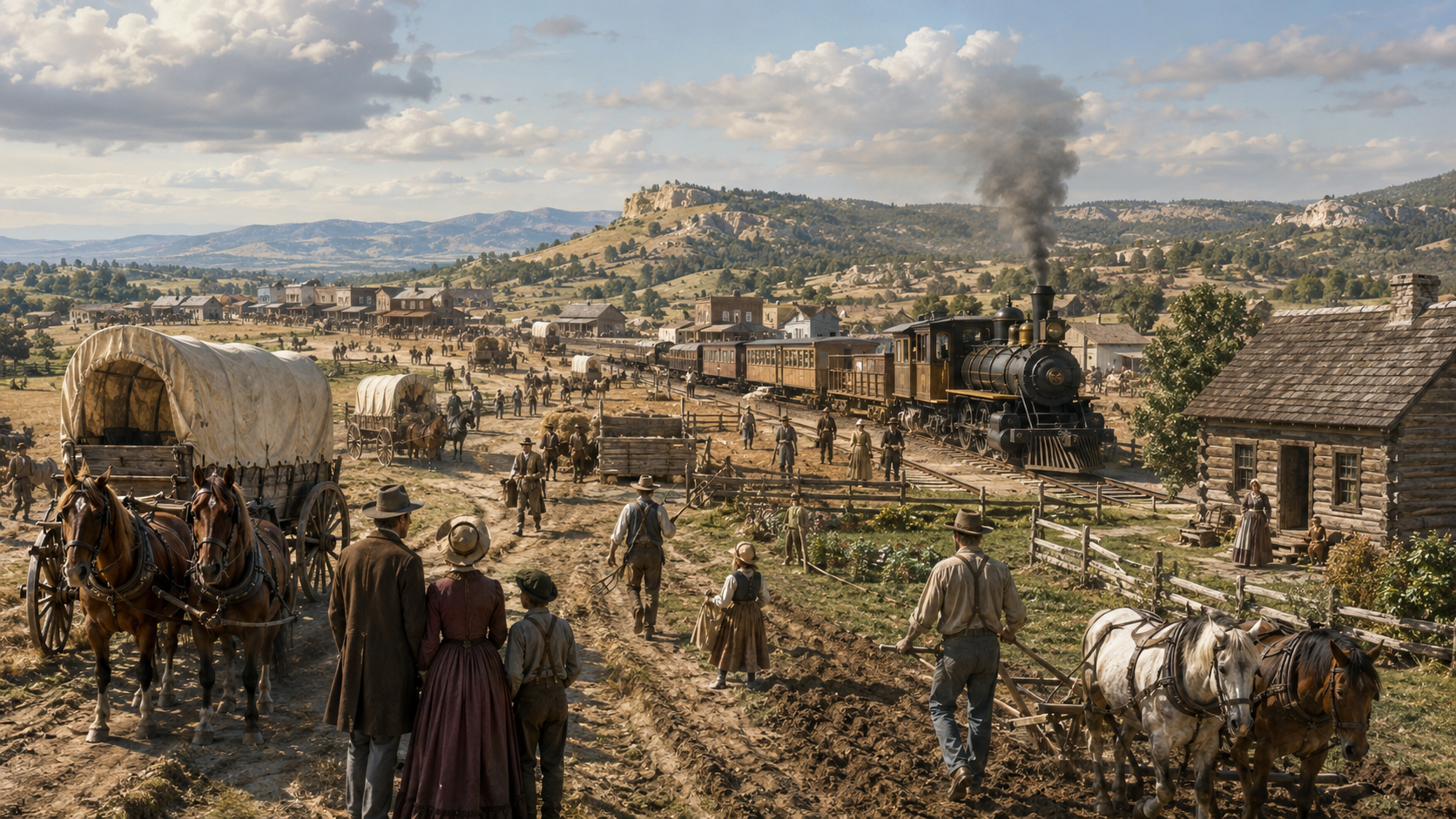
Begin with what was genuinely built, because erasing the achievement would be as dishonest as erasing the cost.
The expansion west opened the single largest engine of individual opportunity in the nineteenth-century world. The Homestead Act of 1862 made the promise concrete: any head of household — including, in principle, immigrants, women, and later freed slaves — could claim 160 acres of federal land and own it outright after five years of living on and improving it. Over the life of the program, the government transferred some 270 million acres into the hands of roughly 1.6 million families.
For a landless laborer in Europe or a freed person in the post-war South, this was access to something that had defined wealth and dignity for all of human history and had almost always been held by the few: land of one’s own.
The infrastructure followed and amplified it. The transcontinental railroad, completed in 1869, collapsed a journey that had taken months into a matter of days, knitting a continental market into being and carrying people, crops, and goods across distances that had been barriers since the founding.
Towns rose along the lines. Whole regional economies came into existence. And the same restless mobility that the automobile and the interstate would later extend was, in this era, already doing its defining American work: letting a person’s circumstances of birth fail to determine the circumstances of their life. The frontier became, in the national imagination and frequently in fact, the place you could go to begin again.
The West also changed the country’s economic engine. Railroads did more than carry settlers; they carried timber, cattle, wheat, minerals, machinery, and capital. Mines fed factories. Farms fed cities. Cattle trails, grain elevators, steel rails, telegraph wires, and railroad towns tied the frontier to the industrializing East.
The journey west was not only a migration of people. It was the construction of a continental economy.
That economic integration helped make the United States into an industrial power. But it also accelerated the pressure on Native lands, intensified conflicts over resources, and made expansion harder to slow once markets, settlers, railroads, and federal policy were all moving in the same direction.
This is not myth. It is the literal mechanism by which millions of ordinary families climbed from nothing into security, and it is woven directly into the series’ central claim — your birth is not your destiny. For an enormous number of Americans, the West was where that promise became real.
And the vision was continental from the start. The year Jefferson completed the Louisiana Purchase, he dispatched Lewis and Clark to find a route to the Pacific — and the imaginative leap of that expedition was as consequential as the territory itself: the idea that a single republic might one day stretch unbroken from the Atlantic to the Pacific. Over the following decades, that idea became geography. Oregon, California, Washington — the country reached the western ocean and became, in the phrase Americans would later sing, a nation “from sea to shining sea.”
A continental scale that had been pure aspiration in 1803 was, within a lifetime, simply the map.
The Cost Was Also Real
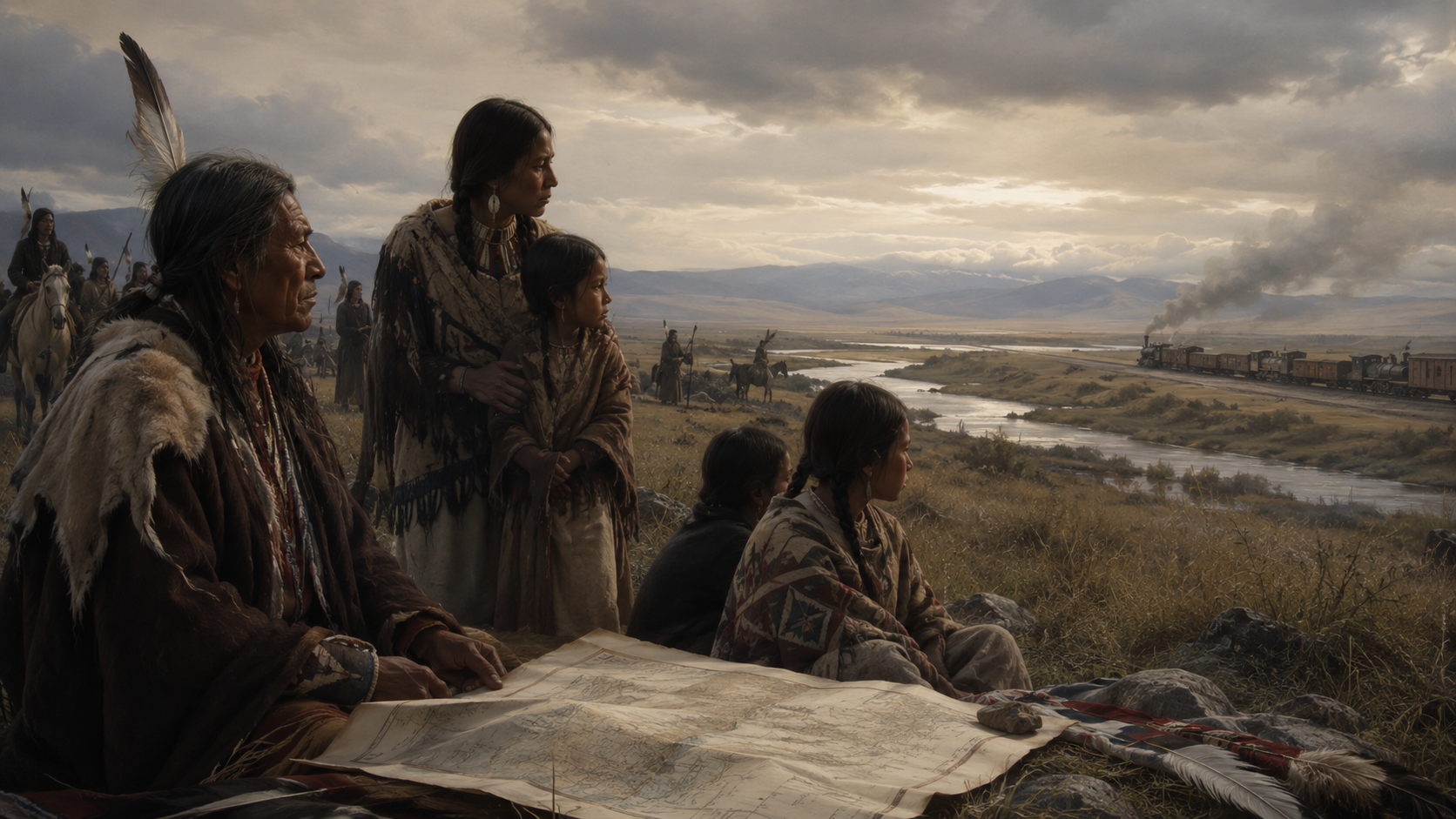
And here the honest account turns, because the same expansion that delivered that opportunity to millions delivered catastrophe to others — and the two were not separate events. They were the same event, seen from opposite ends.
Every acre a homesteader claimed as a fresh start was land where other peoples already lived. The country was not empty. It was treated as empty and then made available through removal, pressure, treaty, purchase, and force.
The settlement of the West proceeded through a long sequence of treaties signed and then broken as soon as the land became valuable, of forced removals, of military campaigns, and of a federal policy that explicitly aimed to erase Native cultures, languages, and religions and replace them with another way of life.
Nations that had occupied the continent for thousands of years were confined to a fraction of their former territory, their populations devastated by warfare, displacement, and disease. The opportunity that the frontier extended to the newcomer was, for the people already there, dispossession enforced by the full power of the state.
This is where the four-cents-an-acre figure returns with its full weight. The reason the Louisiana Purchase looked like history’s greatest bargain is precisely that the original price tag treated the land as France’s to sell, rather than as the inhabited home of peoples whose presence the arithmetic ignored.
The triumphal version of the story isn’t false so much as incomplete — and the incompleteness always falls in the same direction, editing out the same people. The full ledger, the one that runs to billions and spans two centuries of claims, is what the celebratory number was built to avoid.
Why Honesty Is the Point
It would be easier to write this article as a simple celebration, and easier still — in a different register — to write it as a simple indictment. Both are available, both are popular, and both are evasions. The harder thing, and the more honest one, is to refuse the choice.
Here is why that refusal matters, and why it belongs at the center of a series about a more perfect union. A nation confident in its own worth does not need a sanitized past. We do not need to erase relics, hide artifacts, remove statues, or flatten the historical record in order to tell the truth. Insecurity demands the airbrush; security can afford the full photograph.
The willingness to say we built something genuinely great, and we imposed a genuine injustice doing it, and both are permanently part of who we are — that willingness is not an attack on the country. It is a sign of a country mature enough to look at itself clearly. The same instinct that lets an honest person own their failures without being destroyed by them is what lets a confident nation hold its history whole.
This is also, notably, the chapter of the American story where the self-correction this series has traced is least complete. Slavery was answered constitutionally by abolition and the Reconstruction Amendments. Segregation was answered legally by the Civil Rights movement. Those corrections were incomplete and contested, but they created clear constitutional and legal milestones — paths toward resolution. The reckoning with westward expansion and its cost to Native nations is more recent, more partial, and more contested — the settlements are still being litigated, the consequences still lived. Intellectual honesty requires admitting that this is unfinished work in a way that the other corrections are not. The series does not get to wrap this one in a bow, and it shouldn’t try.
What This Still Asks of Us

So what does a citizen do with a genuinely double-edged history?
Do not collapse it into a verdict. The temptation — from every direction — is to reach a single judgment and be done: it was worth it, or it was a crime.
A continental nation of opportunity and a campaign of displacement both happened, and reducing them to one number flattens the complexity that understanding requires. The discipline this article asks for is the discipline of the entire series: to hold more than one true thing at once, to resist the comfort of the tidy story, and to let reality stay as complicated as it actually was.
That discipline is not merely about the past. The capacity to hold complexity without collapsing it — to grant that an opponent’s truth and your own can coexist, that a thing can be both an achievement and a wrong — is precisely the civic muscle a self-governing people needs most and exercises least. A country that can look honestly at the journey west, claiming neither too much nor too little, is practicing the exact habit of mind that lets a divided people reason together about anything.
The history is the training ground. The skill is the inheritance.
The West was won, and a great deal was lost in the winning. Both sentences are true, and a nation strong enough to say both in the same breath is a nation strong enough to keep building.
The story of America isn’t finished. We are writing the next chapter.
This is the sixth article of the Growth Solutions KC America at 250 series.
Next: Article Seven — The State of the Union: Where America Actually Stands at 250.
— Matt Cucinotta | Growth Solutions KC | Inspire · Inform · Ignite

Discover more installments of the America at 250 Series.
,



Comments ()