

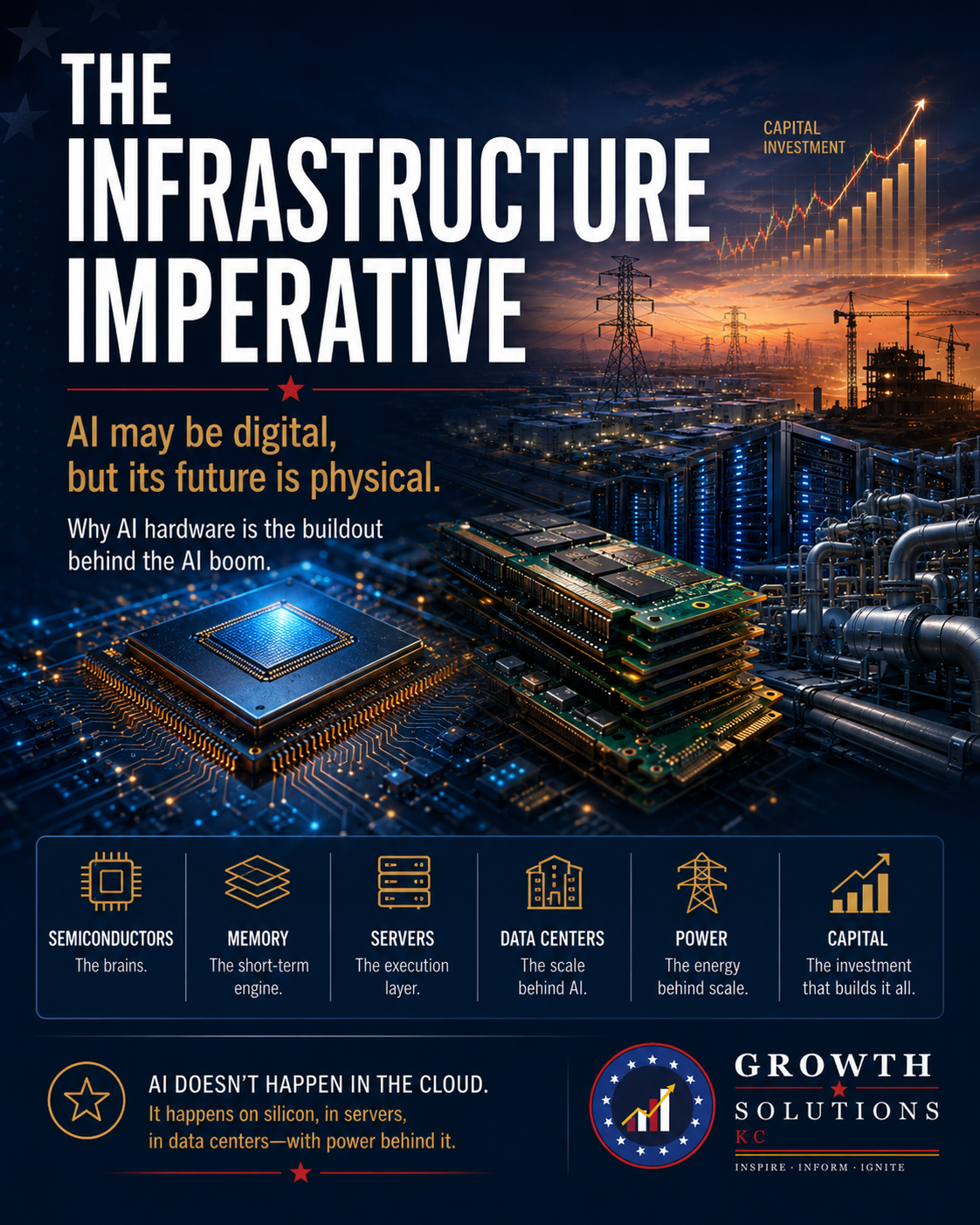
The Infrastructure Imperative

Why AI Hardware Is the Buildout Behind the AI Boom
Part 1 of the Growth Solutions KC AI Infrastructure Series
Artificial intelligence may feel weightless.
- A question typed into a chatbot.
- A summary generated in seconds.
- A medical image analyzed by software.
- A codebase reviewed by an invisible model.
- A business process automated through an app.
To the ordinary user, AI appears on a screen as language, images, answers, and speed. But behind every AI response is something intensely physical: semiconductors, memory stacks, advanced packaging, server racks, cooling systems, land, power lines, data centers, and hundreds of billions of dollars in capital investment.
That is the part of the AI story too many people miss.
Artificial intelligence is not only a software revolution. It is an infrastructure revolution. And the companies, nations, and investors that understand the physical layer of AI will understand the next decade more clearly than those who only follow the headlines.
The central question is no longer whether AI matters. It does.
The better question is this: Who controls the hardware, memory, packaging, power, and infrastructure required to make AI real?
That is the infrastructure imperative.
What Matters: AI Has Become a Hardware Race
The public conversation around AI often focuses on models.
ChatGPT. Gemini. Claude. Llama. Grok. Copilot.
Who has the best model? Who has the smartest assistant? Who has the fastest product cycle?
Those questions matter, but they sit on top of a deeper reality.
Every model depends on compute.
Training advanced AI models requires massive clusters of specialized chips. Running those models for millions or billions of users requires even more persistent compute through inference. The more AI becomes embedded into search, office software, cloud platforms, coding tools, advertising, logistics, medicine, finance, defense, and personal devices, the more demand shifts from “build the model” to “run the model everywhere, all the time.”
That changes the investment thesis.
AI is no longer just about who writes the best algorithm. It is about who can build, access, and scale the physical infrastructure required to deliver intelligence at industrial scale.
That infrastructure runs through a defined supply chain:
- GPU and custom AI chip design.
- Advanced semiconductor manufacturing.
- High-bandwidth memory.
- Advanced packaging.
- AI server assembly.
- Data center construction.
- Power generation, transmission, cooling, and grid interconnection.
In other words, AI is becoming one of the largest infrastructure buildouts of the modern technology era — comparable in significance to the internet, cloud, and mobile revolutions, but far more physically demanding at the compute layer.
The original internet required fiber, servers, networking equipment, data centers, and telecommunications investment. Cloud computing required another wave of physical buildout. Mobile computing required chips, towers, devices, batteries, and global supply chains.
AI now requires the next layer: extreme compute density, massive data centers, and power — a lot of power.

The Scale Is Historic
As of the May 2026 snapshot used in this series, the numbers behind the AI hardware buildout are no longer theoretical.
AI server revenue has been growing at extraordinary rates. AI servers represent a minority of total server shipments but command a dominant share of total server market value because AI systems are vastly more expensive, compute-dense, memory-intensive, and technically complex than traditional enterprise servers.
Hyperscaler capital expenditures have surged as Amazon, Microsoft, Google, Meta, Oracle, and other major platform companies race to secure the infrastructure needed for training and inference.
That matters because hyperscaler capex is not an abstract Wall Street metric. It is the demand signal that travels through the entire AI hardware stack.
When a hyperscaler commits capital to AI infrastructure, that decision creates demand for data center construction, power access, servers, GPUs, ASICs, high-bandwidth memory, networking equipment, liquid cooling, advanced packaging, foundry capacity, and the industrial equipment needed to produce all of it.
A dollar spent on AI infrastructure does not stop at the data center. It echoes upstream through the semiconductor supply chain.
This is why the AI hardware thesis is not simply a bet on one company. It is a structural thesis about the physical architecture behind the next era of computing.

Why It Matters: Software Cannot Scale Without Hardware
The mistake many casual observers make is assuming that AI will behave like a normal software cycle. Software can scale quickly. Infrastructure cannot.
- A new app can reach users almost instantly. A new data center cannot.
- A software update can ship overnight. A semiconductor fabrication plant cannot.
- A model can be improved by engineers. A supply chain bottleneck requires physical capacity, specialized labor, expensive equipment, permitting, power, and time.
That difference is central to the AI hardware thesis.
The demand side is moving at software speed. The supply side is constrained by industrial reality. That mismatch creates bottlenecks.
The most important bottlenecks are not always the companies with the loudest brand names. They are the companies and technologies positioned at the points where supply cannot easily respond to demand.
Today, those bottlenecks include advanced GPUs, custom AI accelerators, TSMC’s leading-edge foundry and packaging capacity, CoWoS advanced packaging, high-bandwidth memory, AI server assembly, data center power availability, and grid interconnection.
The investor who only asks, “Which AI app will win?” may miss the deeper question. The better question is: What must every AI winner buy in order to compete?
That is where the hardware thesis begins.
The Bottleneck Map
A simple way to understand the AI hardware ecosystem is to follow the workload.
First, AI models create demand for training and inference. That demand flows to chip designers such as NVIDIA, AMD, Broadcom, and hyperscaler-specific silicon efforts like Google’s TPUs or Amazon’s Trainium chips.
Those chips then require advanced manufacturing, where TSMC remains one of the most important companies in the world because leading-edge AI silicon depends on the ability to manufacture at extreme precision and scale.
But fabrication alone is not enough. Advanced AI chips also require advanced packaging — the process that allows multiple components to be connected together in ways that deliver the bandwidth, power efficiency, and performance modern AI workloads demand. That is where CoWoS and related packaging capacity become critical.
Then comes memory. High-bandwidth memory, or HBM, is not ordinary memory. It is stacked, specialized, expensive, capacity-constrained memory designed to feed data into AI processors at the speed required for modern workloads. Without enough memory bandwidth, even the best AI chips cannot perform as intended. That makes HBM one of the most critical choke points in the AI infrastructure buildout.
Finally, all of that hardware has to be assembled into servers, installed into data centers, cooled, powered, connected, and operated at scale.
This is the real AI stack. Not just models. Not just apps. Not just software.
Chips. Memory. Packaging. Servers. Data centers. Power.
That is the map.

The Hyperscaler Arms Race
The largest technology companies are not spending aggressively on AI infrastructure because it is fashionable. They are spending because the strategic cost of falling behind is enormous.
Microsoft needs AI infrastructure for Azure, Copilot, enterprise software, and its partnership ecosystem.
Google needs AI infrastructure for Gemini, search, cloud, YouTube, advertising, and internal productivity.
Amazon needs AI infrastructure for AWS, Trainium, cloud customers, logistics, and enterprise AI.
Meta needs AI infrastructure for Llama, advertising, social platforms, recommendation systems, and future AI products.
Oracle, xAI, CoreWeave, and other infrastructure players are also racing to expand compute availability.
This creates an arms race dynamic.
No major platform company wants to be the one that underinvests in the infrastructure layer of the next computing era. Even if short-term returns are uncertain, the strategic risk of being capacity-constrained is too large.
That is why hyperscaler capex is one of the most important signals to watch.
If the capex keeps flowing, demand continues through the hardware stack.
If capex guidance weakens meaningfully, the entire thesis needs to be reassessed.
The AI hardware thesis is strong, but it is not immune from reality. The first major warning sign would be a durable shift in hyperscaler spending intentions.

What This Means for Everyday Investors
The point of this series is not to tell every reader to chase the hottest AI stock.
That would be the wrong lesson. The better lesson is that ordinary investors need a better mental model. AI is not one company. AI is not one product. AI is not one ticker symbol.
AI is a multi-layer infrastructure buildout.
This does not mean every company in the AI supply chain is automatically a good investment. Valuation still matters. Competition still matters. Geopolitics still matters. Cycles still matter. Execution still matters.
But it does mean the investor who understands the supply chain is less likely to be distracted by hype and more likely to identify where structural demand meets structural scarcity. That is where long-term opportunity often lives.
For a risk-managed investor, the goal may be broad exposure to high-quality companies across the AI hardware ecosystem without overconcentrating in a single name.
For a more aggressive investor, the goal may be to identify the most constrained bottlenecks — especially memory, packaging, and custom silicon — where supply limitations may translate into pricing power and margin expansion.
Those are different approaches. They serve different risk profiles.
The important point is discipline.
Do not invest in AI because everyone is talking about AI.
Understand the infrastructure.
Understand the bottlenecks.
Understand your risk.
Then decide whether, where, and how to participate.

What Happens Next
The AI hardware buildout is likely to unfold in stages.
First comes the chip and server rush: GPUs, ASICs, HBM, advanced packaging, and data center construction.
Second comes the capacity race: more foundry capacity, more memory supply, more packaging capability, more server assembly, and more specialized infrastructure providers.
Third comes the power constraint: electricity generation, grid interconnection, nuclear partnerships, natural gas generation, transmission, cooling, and the politics of local data center development.
That third stage may become the next major bottleneck.
A data center without power is just a building.
A chip without memory is underutilized.
A model without compute is an idea.
AI without infrastructure is a promise, not a platform.
That is why energy will become central to the AI conversation.
The second phase is about hardware.
The third phase will be about power.
What People Should Do About It
For everyday readers, the first step is not buying a stock.
The first step is understanding.
For investors, it means the AI opportunity is broader than a single headline or stock. Most importantly, separate durable structure from temporary excitement. A real thesis does not require ignoring risk. A real thesis gets stronger when risks are clearly identified.
The AI hardware thesis carries real risks, including overbuilding, inflated valuations, geopolitical tensions, rapid acceleration in China, regulatory pressures, energy limitations, and potential changes in model efficiency.
But the presence of risk does not eliminate the thesis.
It clarifies the work required to evaluate it.
The next decade will be shaped not only by the smartest models, but by the companies and nations that can manufacture the chips, stack the memory, package the silicon, assemble the servers, power and cool the data centers, and scale the infrastructure.
That is the infrastructure imperative.

— Matt Cucinotta | Growth Solutions KC | Inspire · Inform · Ignite
Source note: This series is based on public company filings, earnings releases, industry research, government energy data, and Growth Solutions KC analysis. Market figures and company references will be updated as new data becomes available.
This article is for informational and educational purposes only and does not constitute personalized investment advice. Securities and sectors discussed in this series are illustrative and should be evaluated in light of each reader’s own financial situation, risk tolerance, time horizon, and professional guidance.



Comments ()