

The American Experiment: A Republic Unlike Any Other
For 250 years, generations of Americans have built, defended, improved, and renewed a nation founded on the enduring ideals of liberty, self-government, opportunity, and human dignity. Their successes, sacrifices, mistakes, and achievements form the story we inherit today.
THE AMERICA AT 250 SERIES · ARTICLE TWO
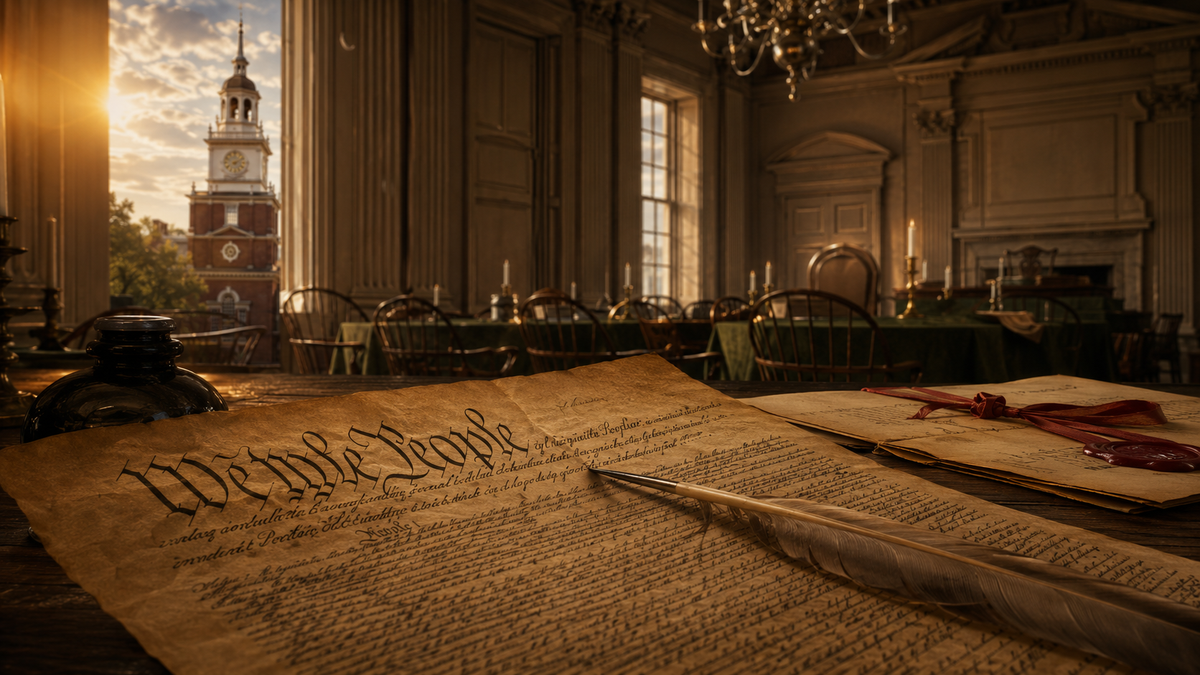
— Preamble to the United States Constitution
The American Experiment
Most constitutions do not make it to twenty. America’s constitutional framework is approaching 240 years in operation — and it was already old before many of its rivals were born.
Here is a fact that should be more startling than it is. Of all the national constitutions written across human history, the average one survived about nineteen years before it is scrapped, suspended, or rewritten. Governments draft them with great ceremony and then outgrow them, overthrow them, or quietly ignore them into irrelevance.
The United States Constitution, ratified in 1788 and in continuous operation since 1789, is the oldest written national constitution still in use anywhere on earth. The next-oldest, Norway’s, did not appear until 1814 — a full generation later. When the American framework was already governing a nation, the constitutions of nearly every country now considered an old democracy had not yet been drafted.
That endurance is not luck. It is not merely an accident of geography. It was designed.
The first article in this series argued that America is a country defined by its stated reasons. This article asks the harder question underneath it: why did the machine built to house those reasons last, when so many others fell apart?
If the Declaration of Independence stated the nation’s first principles — that human beings possess natural rights, that government exists to secure them, and that its just powers derive from the consent of the governed — the Constitution was the framework built to make those principles durable in practice.
The Declaration answered what government is for.
The Constitution answered how government must be structured if liberty is to survive power.
That is the real subject of the American experiment — and it is more interesting, and more sobering, than the fireworks suggest.
The Problem the Founders Were Actually Solving
We tend to imagine the founding as a triumphant march from the Declaration straight to the Constitution.
It was nothing of the kind.
Between them sat more than a decade of something closer to failure.
The Declaration of 1776 announced a nation. It did not build one.
The government that actually emerged from the Revolution — under the Articles of Confederation — was so weak it could barely function. It had no real executive to enforce the law, no national judiciary to interpret it, and no power to tax or to regulate commerce between the states.
It was less a government than a loose treaty among thirteen jealous sovereignties, each guarding its own authority.
When economic distress and an armed uprising of indebted farmers in Massachusetts — Shays’s Rebellion — revealed how little the central government could actually do, the alarm was real. The experiment in liberty was at genuine risk of collapsing into disorder, the very condition that throughout history had often summoned a strongman to restore order at the price of freedom.
This is the problem the framers gathered in Philadelphia to solve in the summer of 1787, and it is worth stating precisely because the whole design follows from it.
They needed a government strong enough to actually govern — to keep order, pay debts, defend the country, and hold the union together — yet limited enough that it could never become the kind of tyranny they had just fought a war to escape.
Too weak, and the republic dissolves into chaos.
Too strong, and it hardens into despotism.
Every major feature of the Constitution is an answer to that single, knife-edge question: how do you give government real power without letting it become absolute?
The Machine They Built
Their answer was not a slogan or a sentiment.
It was a structure — a set of interlocking mechanisms designed to make the abuse of power difficult by design rather than by relying on the good character of whoever happened to be in office.
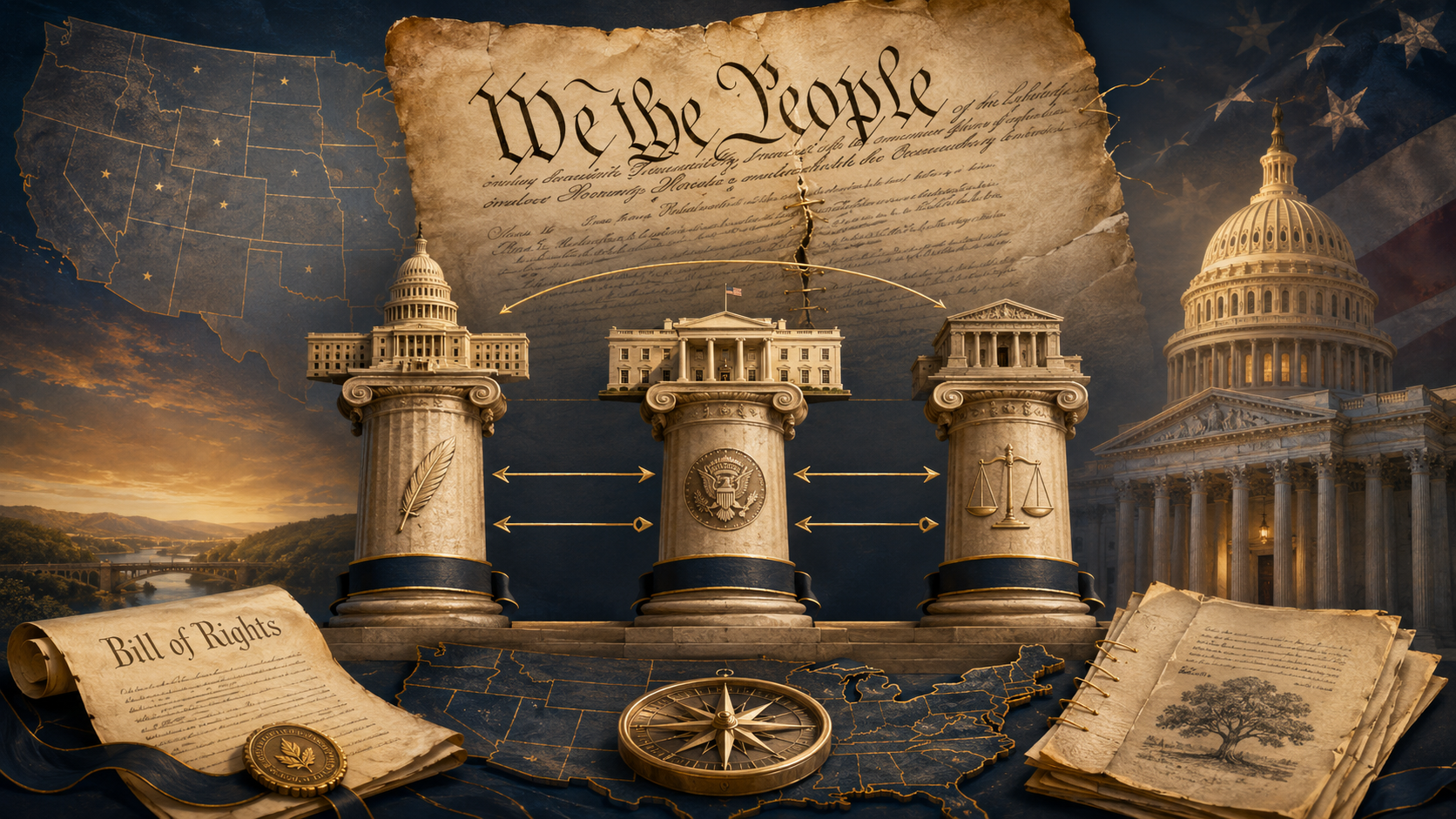
They divided power three ways: a Congress to make law, a president to execute it, and a judiciary to interpret it. No single hand would hold all of it.
Then they set those branches against one another, arming each with the means to check the others, so that ambition would counter ambition and no branch could swallow the rest.
They split authority again between the national government and the states, a system called federalism, so that power flowed in two directions rather than pooling in one capital.
They enumerated the federal government’s powers — listed them specifically — on the theory that a government told exactly what it may do is easier to hold to those limits.
And crucially, they wrote it all down.
This sounds obvious to us only because America helped make it ordinary. In 1787, it was close to revolutionary. Few nations had attempted anything quite like it: committing the powers and limits of national government to a single written charter, adopted through public ratification and treated as higher law.
The genius of putting it in writing was explained best a generation later by Chief Justice John Marshall, who observed that the powers of government are defined and limited, and that those limits “may not be mistaken or forgotten, the constitution is written.”
A written constitution turns the limits on power into something fixed and citable — a text a citizen can hold up against a government and say, you may not do that.
That is the machine. But a machine is only as durable as its capacity to be repaired.
And this is where the framers’ deepest insight lay.
The Flaw They Built In on Purpose
The founders knew they were not wise enough to get everything right.
So they did something almost unheard of among men writing the foundational law of a nation: they built in a method for their descendants to correct them.
The amendment process — deliberately difficult, requiring broad supermajorities — meant the Constitution could be changed without being overthrown.
This is the quiet hinge on which American endurance turns.
A framework that cannot adapt becomes brittle and eventually shatters. That is how many constitutions die. A framework that adapts too easily is no constitution at all, just a reflection of the current mood.
The founders threaded that needle: hard enough to change that it could not be done on a whim, possible enough to change that the nation would not always have to choose between its founding document and its own moral growth.
This was not theoretical.
The gravest failure of the founding was written into the document itself. In their pursuit of a union that included the slaveholding states, the framers made compromises with slavery that betrayed the very equality the Declaration proclaimed — counting enslaved human beings as three-fifths of a person for the purpose of representation and shielding the slave trade from federal interference for twenty years.
These were not incidental flaws. They were a profound moral contradiction stitched into the nation’s founding law, and honesty about the American experiment requires naming it plainly rather than explaining it away.
And yet — this is the point that matters — the same document that contained the compromise also contained the mechanism to undo it.
The Thirteenth, Fourteenth, and Fifteenth Amendments, ratified after a Civil War that cost more than six hundred thousand American lives, did not discard the Constitution to abolish slavery, establish birthright citizenship, guarantee equal protection, and protect voting rights.
They used the Constitution’s own machinery to amend it toward the promise it had failed to keep.
The framework was built to be corrected, and it was corrected — at terrible cost, but within the system rather than by destroying it.
The Argument That Made It Legitimate
— Preamble to the Bill of Rights
There is one more reason the experiment held, and it is easy to overlook because it looks, at first, like dysfunction.
The Constitution was fiercely argued over before it was ever adopted.
Ratification was not a foregone conclusion. A formidable opposition — the Anti-Federalists — warned that the new national government was too powerful and dangerously lacked explicit protection for individual rights.
In response, the document’s defenders made their case in the essays we now call the Federalist Papers, one of the most serious works of political thought ever produced in the service of an actual decision.
This was not theater. It was a genuine, bitter, nationwide argument over whether to adopt the thing at all.
The Anti-Federalists lost the vote — and then won something more lasting.
Their insistence on explicit guarantees produced the Bill of Rights: the first ten amendments, securing freedom of speech, religion, press, and assembly, and the protections of the accused, ratified in 1791. The losing side, through argument rather than force, permanently improved the result.
This is the part of the founding most worth carrying forward.
A constitution imposed by decree commands obedience only as long as the power behind it lasts. A constitution argued into being — debated in public, opposed in good faith, amended to answer the opposition’s strongest objections — earns a legitimacy that force can never confer.
The disagreement was not a flaw in the founding. It was one source of its strength.
The Hardest Precedent of All
A structure on paper is still only paper until someone proves it will actually be obeyed.
That proof came not from the document alone, but from a man — and from the single most important thing he chose not to do.
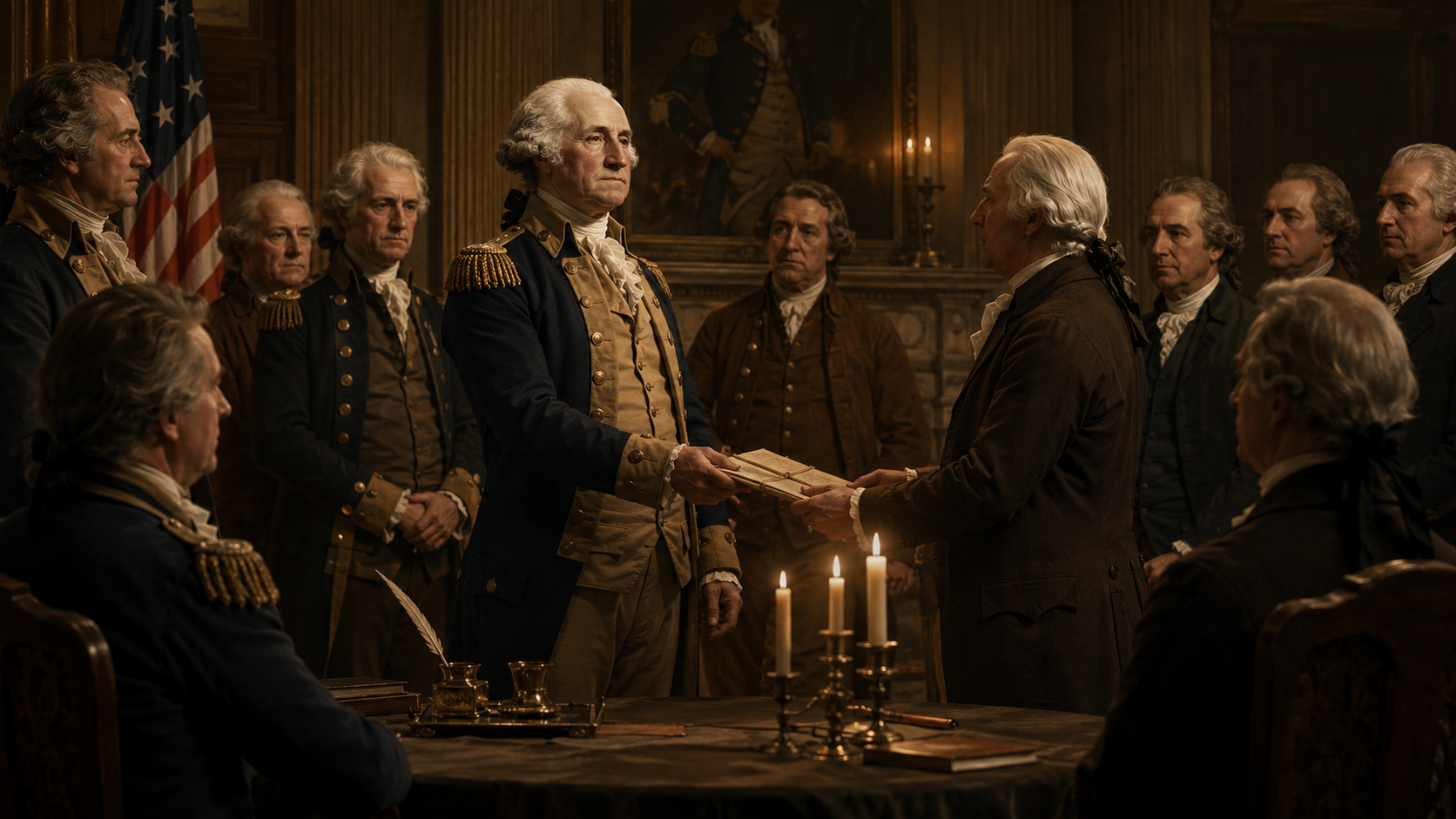
George Washington could have been king in all but name. He was the indispensable figure of the founding, and had he wished to hold power for life, few could have stopped him. Instead, after two terms as president, he went home.
The peaceful, voluntary surrender of power — a leader handing authority to his successor and simply walking away — is among the rarest and most fragile acts in the life of a republic. It is the precise point at which many young nations fail, when the first leader who tastes power refuses to relinquish it.
Washington relinquished it deliberately, establishing by his own example that in America, power transfers and does not accumulate.
The tradition he set held for nearly a century and a half, until Franklin Roosevelt broke it during the crises of the Great Depression and World War II. Only afterward was the two-term limit written formally into the Constitution through the Twenty-Second Amendment.
That single act of restraint reveals what the whole experiment depended on.
The machine of checks and balances was indispensable, but no machine runs itself. It required, and still requires, leaders willing to be bound by it — leaders who value the system above their own ambition.
The founders built the structure.
Washington proved a person could choose to honor it.
Why This Still Matters
The American experiment was never the claim that the founders were perfect men.
Some were wise. Some were courageous. Some owned other human beings.
The experiment was a wager about design.
It was the belief that a nation could be governed by consent rather than force, by law rather than personal rule, by a framework rather than a ruler.
It was the belief that government power could be strong enough to preserve order and limited enough to preserve liberty.
It was the belief that rights precede government, that power must be bound, and that the dignity of the person is not granted by the state and cannot be voted away by it.
Looking back, the wager reveals a kind of wisdom we rarely credit honestly. The framers were not merely clever. They were foresighted in a way that still deserves attention — building a structure flexible enough to bend with two and a half centuries of change they could not possibly have imagined, yet anchored to principles they understood to be permanent.
They grasped a distinction the modern age is forever tempted to forget: some things are subject to revision, and some are not. The mechanics of government can and must be amended as circumstances change.
But the deeper truths the structure was built to protect — natural rights, limited power, consent of the governed, equal citizenship, and government under law — cannot be treated as disposable whenever the current moment grows impatient with restraint.
This is the inheritance most worth guarding.
The founders made the Constitution hard to amend on purpose, not from rigidity but from humility. They understood that the will of the many, however sincere, is not always the same as what is true, and that a free people can talk itself into discarding its own foundations in a single restless generation.
To revere the framework is not to refuse all change. The amendments prove otherwise. It is to change reverently — to correct genuine error through the system’s own means, while refusing to trade enduring wisdom for the mere appetite for novelty.
The next 250 years rest less on our cleverness than on that restraint: on whether we can tell the difference between improving the republic and unmaking it.
That wager is part of the American experiment now approaching its 250th year — and it is still being tested.
Not a perfect document — a self-correcting one.
Not a finished republic — a repairable one.
The framers did not hand down a government that would run on its own. They handed down a machine that works only as long as each generation understands how it was built, why each part is there, and what it costs to keep it running.
Which means the experiment is not something that happened in Philadelphia in 1787. It is still being conducted. And we are the current test of whether it holds.
The story of America is not finished. We are writing the next chapter.
This is the second article of the Growth Solutions KC America at 250 series.
Next: Article Three — America Through Crisis: How the Union Survived
— Matt Cucinotta | Growth Solutions KC | Inspire · Inform · Ignite
Discover more installments of the America at 250 Series.


Comments ()