

Soil, Not Blood — Birthright Citizenship
Part I: What the Court Actually Ruled — and What the Fourteenth Amendment Was Actually Built to Do
AMERICA'S CHARTER, REVISITED · PART I OF II
This series does not argue that presidents can rewrite citizenship law by executive order. It points to the deeper constitutional and civic question — whether birthright citizenship should depend on mere presence or durable belonging — and deserves open debate through Congress and, if necessary, the amendment process.
On June 30, 2026, the Supreme Court decided the most consequential citizenship case in over a century — and did it in a ruling so fractured that five separate opinions were required to explain what the Constitution says about who is, and is not, an American.
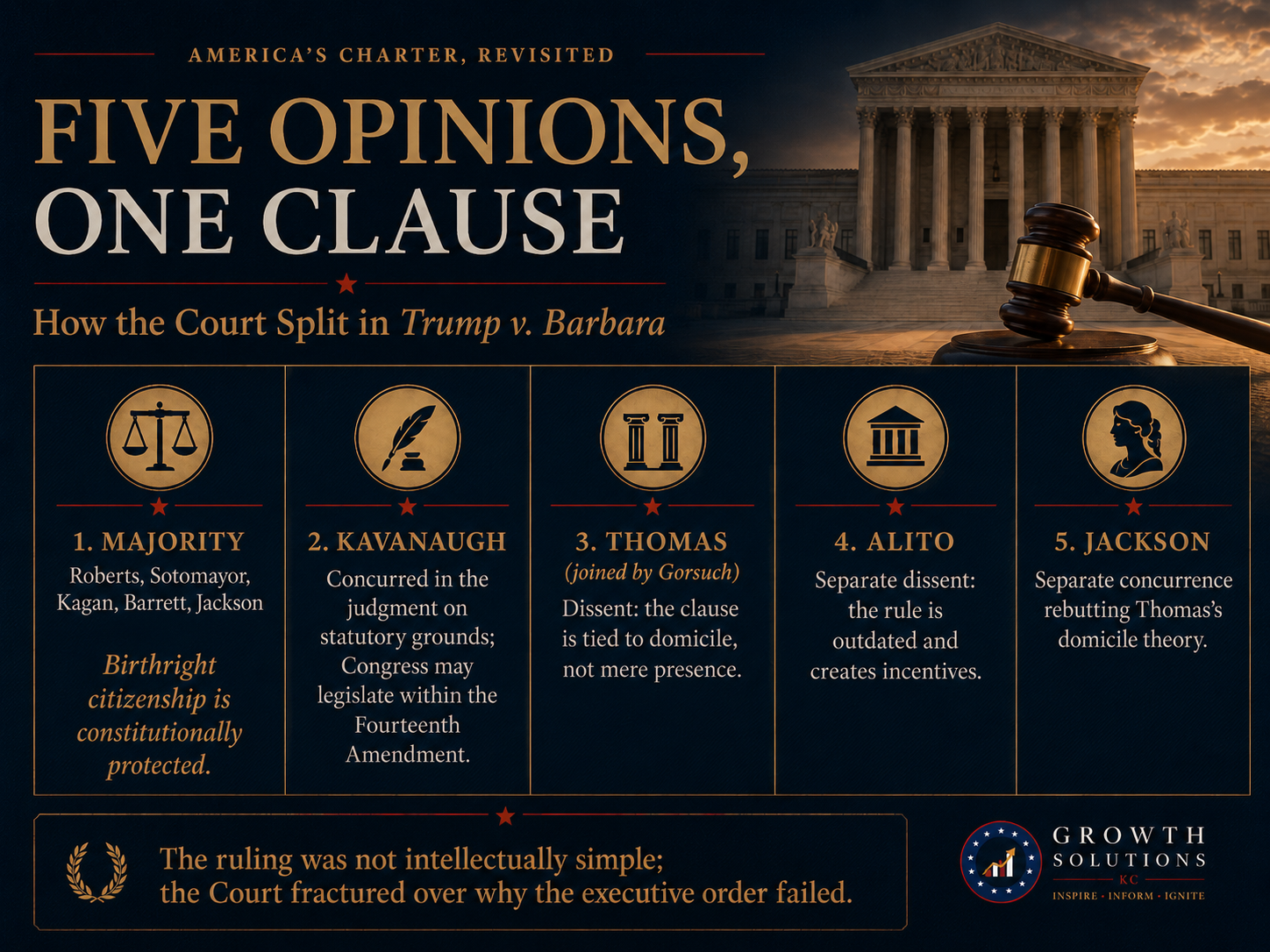
In Trump v. Barbara, a 6-3 Court struck down President Trump’s 2025 executive order seeking to end automatic citizenship for children born on U.S. soil to parents who are in the country unlawfully or on a temporary basis. Chief Justice John Roberts wrote for the majority. Four other justices wrote separately — and did not agree with one another about why.
That fracture is the real story here, more than the vote count. This is not a settled question the Court simply reaffirmed. It is a live, contested question the Court closed for now — by a margin narrower than “6-3” suggests, on reasoning even the justices in the majority’s own coalition don’t fully share.
Five Opinions, One Question
Only five justices joined Roberts’s opinion in full: Sotomayor, Kagan, Barrett, and Jackson. Justice Kavanaugh supplied the sixth vote against the executive order, but on narrower grounds — he found it unlawful under existing immigration statute, not under the Constitution itself, and wrote pointedly that Congress remains free to legislate new exceptions to birthright citizenship consistent with the Fourteenth Amendment.
The dissents are where the real argument lives.
Justice Clarence Thomas, joined by Justice Neil Gorsuch, filed a dissent running to approximately 90 pages — more than three times the length of the majority opinion. His central claim: the Citizenship Clause was written to guarantee citizenship to people domiciled in the United States, not to anyone merely present within its borders.
— JUSTICE CLARENCE THOMAS, DISSENTING
Justice Samuel Alito dissented separately, calling the ruling a serious mistake that leaves the United States committed to a rule so dated that even the United Kingdom — where it originated — abandoned it decades ago.
Justice Gorsuch, while joining Thomas, also wrote his own opinion staking out a third position entirely: he would have upheld the executive order for temporary visitors only, not for immigrants with permanent legal status.
Justice Ketanji Brown Jackson wrote a concurrence aimed squarely at Thomas, arguing his domicile theory sits uneasily with his own long-standing preference for reading the Constitution in colorblind terms.
Five justices, four separate legal theories about a single sentence in the Constitution. That is not the profile of a settled question.
What the Fourteenth Amendment Was Actually Built to Do
Start where the honest version of this story has to start: the Fourteenth Amendment exists because of Dred Scott.
In 1857, the Supreme Court ruled that people of African descent — free or enslaved — could never be citizens of the United States. The Civil War, the Emancipation Proclamation, and the Thirteenth Amendment ended slavery as a legal institution, but they did not, by themselves, answer the citizenship question Dred Scott had slammed shut.
Congress answered it twice: first through the Civil Rights Act of 1866, then, to place that guarantee beyond the reach of a future hostile Congress or Court, through the Fourteenth Amendment itself, ratified in 1868. Its purpose was direct, and on this point genuinely undisputed: to ensure that formerly enslaved people and their descendants were citizens, fully and permanently, with no legislature able to take that status away.
That is the amendment’s founding moment, and it deserves to be named plainly before anything else is argued.
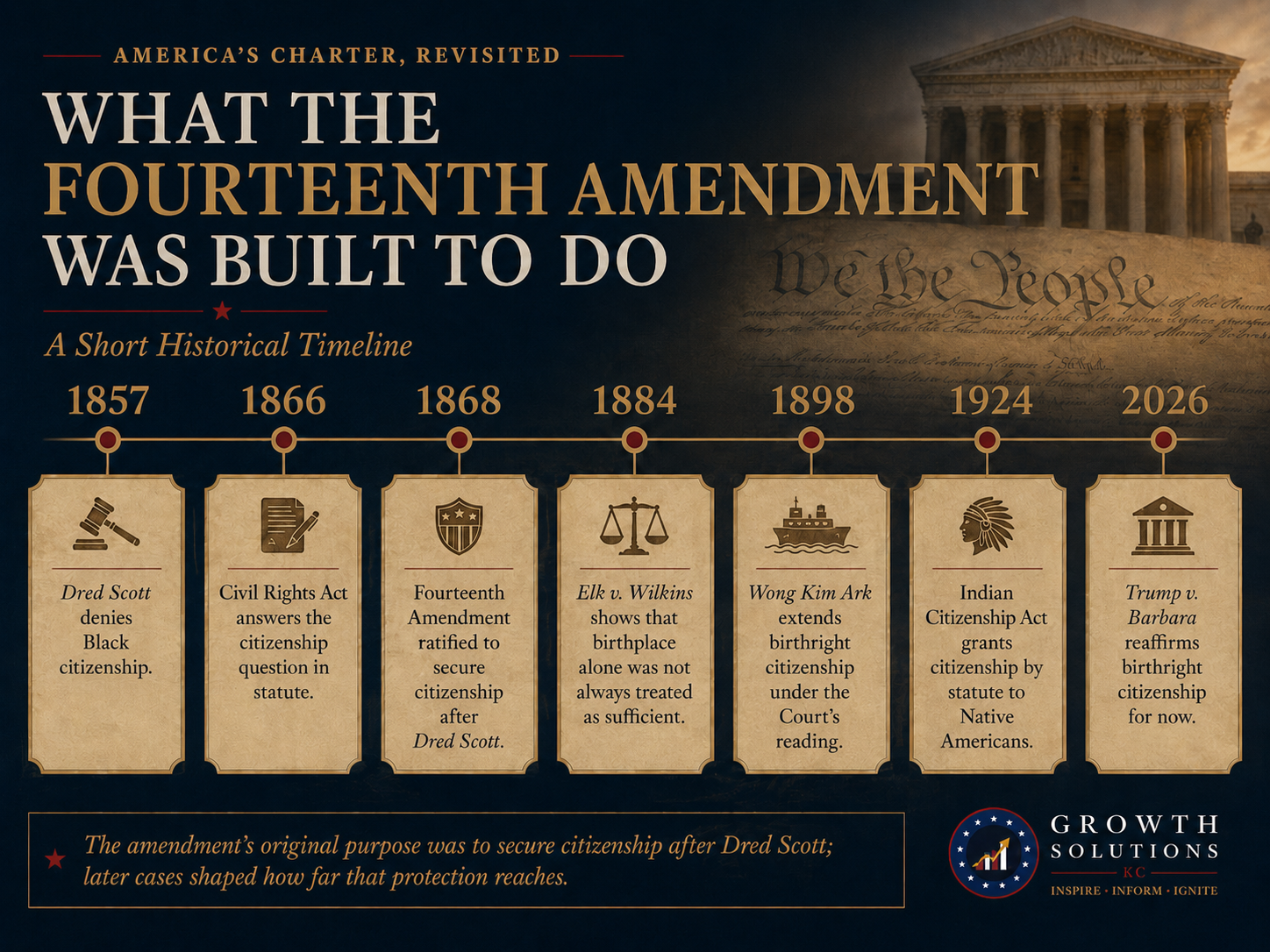
Where the honest disagreement begins is in how far beyond that founding moment the text was meant to reach. Senator Jacob Howard, the clause’s principal drafter, told the Senate in 1866 that the guarantee would exclude only the children of foreign diplomats — and would “include every other class of persons.” Read broadly, that sentence became the foundation for more than 150 years of birthright citizenship as Americans have practiced it, reaffirmed by the Supreme Court in 1898 in United States v. Wong Kim Ark, which held that a man born in San Francisco to Chinese immigrant parents — long-term legal residents of the country, though barred by law from ever naturalizing — was a citizen at birth.
Notice what that case actually involved: parents who had lived in the United States for two decades, raised a family, and built a life there. Whatever one concludes about Wong Kim Ark’s holding, it was decided on facts describing people who had made America their home — not people who crossed a border, gave birth, and left days later.
There is a second thread in the historical record worth pulling on, because it cuts in the same direction. In 1884, the Supreme Court decided Elk v. Wilkins — the case of a Native American man who left his tribe, settled in Omaha, and sought citizenship under the Fourteenth Amendment. The Court denied him. Its reasoning was not that he had failed to be born on American soil; tribal nations had lived on that soil for generations. It was that tribes were treated as separate, semi-sovereign political communities, and a person owing political allegiance to one of them was not “subject to the jurisdiction” of the United States in the full sense the Amendment required — regardless of physical presence or residency.
The precedent stands for a real proposition: physical presence on U.S. soil was not, by itself, always sufficient under the Court’s own reasoning. Allegiance to a competing sovereign mattered too. The legal distinction courts have since drawn is that tribal members owed allegiance to a governing political body inside U.S. borders, while a foreign visitor is fully subject to ordinary U.S. civil and criminal authority the moment they arrive — a genuine distinction, not a dodge. But it is worth naming plainly rather than assuming it settles the deeper question underneath both cases: whether “jurisdiction,” as the framers used the word, was meant to measure legal control in the moment, or something closer to durable belonging.
That distinction is where this year’s debate genuinely departs from history rather than simply revisiting it. Nothing in the 1866 congressional record suggests the framers of the Fourteenth Amendment contemplated a scenario in which a person could arrive with no intention of residing here, no intention of adopting its laws or its civic life, give birth within days or weeks, and secure permanent citizenship for a child as a matter of constitutional right. That was not the mischief the amendment was written to solve, and it was not remotely the world the framers were living in.
The question they were answering was whether people who were already part of the American community — who had, in every meaningful sense, become Americans — could be denied the citizenship that fact implied. It was not whether citizenship itself could be acquired the way a souvenir is: briefly, transactionally, without any of the belonging that has always been understood to accompany it.
For most of American history, earning that status — through years of residency, through raising a family here, through the deliberate choice to become an American — has been treated as a proud and formative moment, not an administrative formality settled in a single afternoon.
That is a meaningfully different question than the one Trump v. Barbara actually decided — and it is worth being honest that serious legal scholars land on both sides of it.
Thomas’s dissent makes a real argument grounded in domicile and allegiance. The majority’s answer — that presence within U.S. borders and subjection to U.S. law is itself sufficient, regardless of duration or intent — is also a real argument, with a textual pedigree stretching back to English common law.
Both cannot be dismissed as illegitimate. But they are not asking the same question, and a country marking 250 years of self-government deserves a debate honest enough to say so.
How the Rest of the World Draws This Line
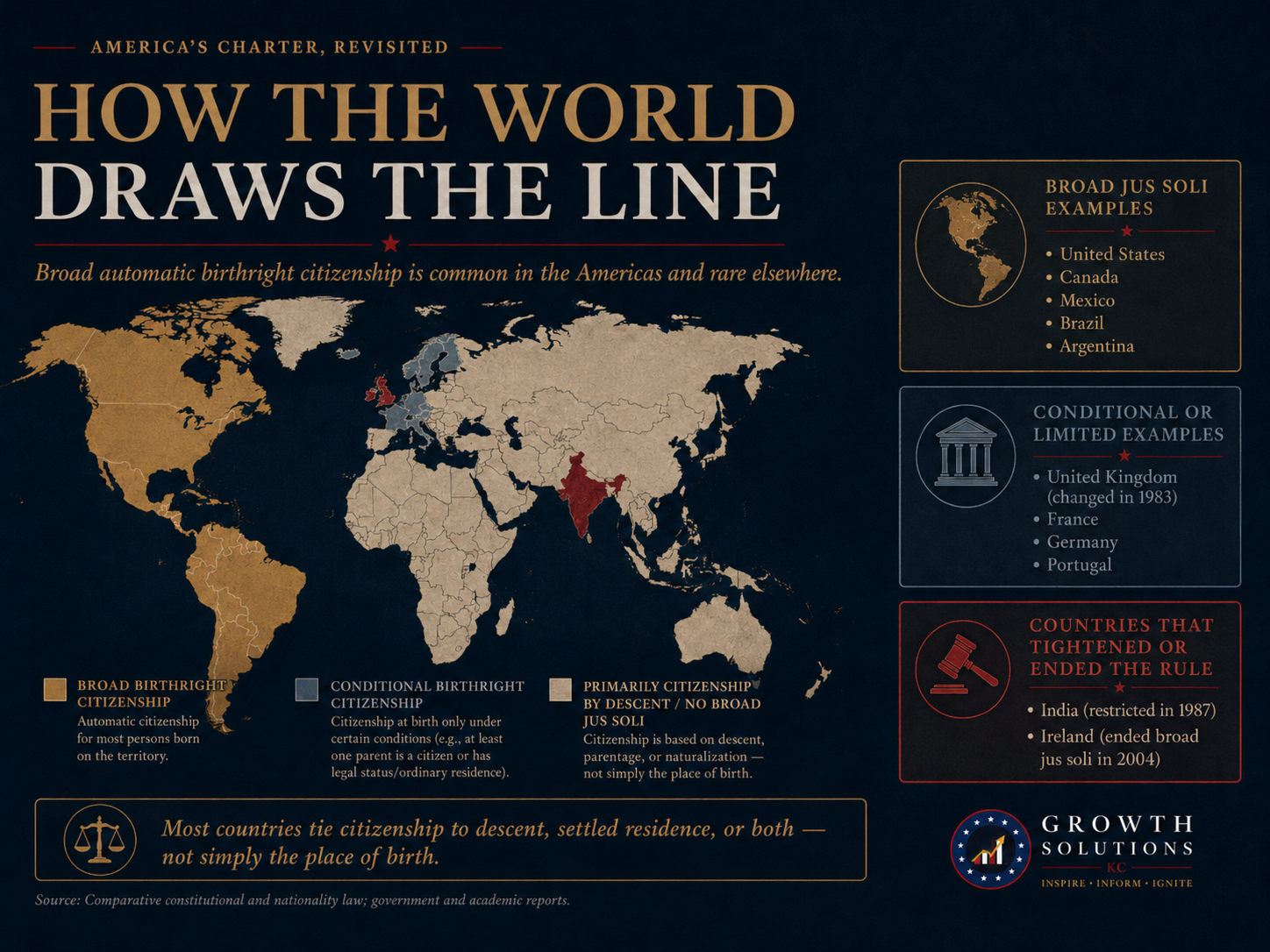
One data point worth sitting with: the United States is one of only about 33 countries on Earth that grant unconditional citizenship to virtually anyone born within its borders, regardless of how long the parents intended to stay. Nearly every one of those countries is in the Americas — a pattern rooted in 18th- and 19th-century nation-building, when newly independent countries used birthright citizenship to attract settlers and grow their populations quickly.
Almost nowhere else in the world works this way, and it is not because those countries never considered the question.
Most of Europe and Asia never adopted unconditional birthright citizenship in the first place. France and Germany, for instance, extend citizenship at birth only when a parent is already a citizen or has met a defined residency threshold — years lived in the country, not days. The logic is straightforward: citizenship should track a genuine, durable connection to the nation, not the geographic accident of where a delivery happened to occur.
A smaller group of countries had unconditional birthright citizenship and deliberately walked away from it. The United Kingdom — the common-law tradition the American rule descends from — ended automatic birthright citizenship in 1983 under the British Nationality Act 1981, replacing it with a rule requiring a parent to be a citizen or a settled resident. Ireland went further and put the question directly to its own voters: in a 2004 referendum, Irish citizens voted decisively to end unconditional jus soli, citing concerns almost identical to the ones now playing out in American courtrooms — that the practice had become a draw for people arriving with no intention of building a life in the country. India restricted its own birthright citizenship rule in 1987, in direct response to sustained illegal immigration across its border with Bangladesh.
The throughline across every one of these examples matters: each of these countries changed course through its own legislature, its own constitution, or its own ballot box — deliberately, transparently, and before the fact. None of them did it by unilateral executive order, and none of them did it in reaction to a single case working its way through the courts.
That is the honest lesson this comparison offers, and it points directly at the question Part II of this series takes up: if the United States is going to have this conversation seriously, it will have to be Congress that does the deciding, and it will have to happen in the open.
Part II: birth tourism’s real scale, the cross-aisle history of this debate, and what Congress can and cannot actually do about it.
— Matt Cucinotta | Growth Solutions KC | Inspire · Inform · Ignite


Comments ()