
SAVE America Act, Part II: Election Integrity Is More Than a Statistical Argument
Restoring Public Trust in the Ballot Box: A Three-Part Guide to the SAVE America Act
ACCURACY NOTE:
This analyzes the version of the SAVE America Act that passed the House as an amendment to S. 1383 on February 11, 2026. Earlier SAVE Act proposals differ in many ways. Requirements could change again before enactment, and the bill is not federal law as of July 25, 2026
About this series
Part I explained what the House-passed SAVE America Act actually requires and distinguished citizenship verification at registration from identity verification when voting. Part II examines the argument beneath the legislation: why election integrity cannot be reduced to a single fraud statistic, what recent voter-roll findings actually show, and how strongly Americans support verification measures. Part III will address implementation, document access, due process, and the practical responsibilities of government and citizens.
If intentional noncitizen voting is uncommon, does that make mistaken registrations, stale voter records, unlawful ballots, and database errors unimportant — or does election integrity require addressing each problem accurately?
WHY IT MATTERS
Integrity Is More Than a Statistical Argument
Opponents often respond that intentional noncitizen voting is rare. The available evidence supports describing it as uncommon. A 2026 Reuters review of federal court records identified 129 people charged under the federal prohibition since its enactment in 1996, with 73 convicted or pleading guilty. That is not necessarily a complete accounting of every state-level case, but it does not support claims of coordinated nationwide voting on a massive scale. That fact should be stated honestly. It should not end the policy discussion.2,14
Preventive security is not suppression; it is stewardship.
Security standards are not reserved for systems that fail every day. Banks authenticate customers even though most depositors are honest. Employers verify work authorization even though most applicants tell the truth. Aviation and cybersecurity protocols are designed to reduce vulnerability before a catastrophic breach occurs. The same basic principle should judge election administration: establish clear eligibility rules, verify them proportionately, correct mistakes, and protect the lawful participant.
Citizenship establishes eligibility.
Verification gives the rule practical meaning.
Intentional fraud should be prosecuted.
Administrative errors should be corrected.
Eligible citizens deserve a workable path to compliance.
Every lawful ballot deserves equal protection.
Fraud is fraud, regardless of scale — yet not every irregularity is fraud
The moral principle should be stated precisely: Fraud is fraud, whatever the amount, understanding that not every irregularity is fraud. Fraud ordinarily involves intentional deception. A database mismatch, stale address, software defect, or accidental registration may create an unlawful or inaccurate record without proving criminal intent.
The responsible standard is straightforward: intentional fraud should be prosecuted; administrative errors should be corrected; ineligible registrations, ballots, and votes should never be normalized; and eligible citizens should not be punished for a government mistake.
Scale affects the potential effect on an outcome. It does not erase the duty to prevent, identify, investigate, and remedy violations.
The True, the Good, and the Beautiful
Growth Solutions KC evaluates civic institutions through the classical transcendentals: the True, the Good, and the Beautiful.
The True requires an accurate account of who is legally eligible and a system that establishes integrity, confidence, and fairness in elections.
The Good asks whether the system fulfills its purpose — protecting lawful participation, deterring misconduct, and preserving fairness and integrity.
The Beautiful is the order of a healthy republic in which citizens can disagree yet maintain durable confidence that common rules are applied consistently and public outcomes are trustworthy.
That framework rejects two easy but unhelpful extremes. One side should not inflate every stale or illegal registration into proof of a fraudulent election. The other should not dismiss every documented failure as insignificant merely because it may or may not alter a result.
Truth is not served by exaggeration or denial.
Integrity matters. Trust matters. Honesty matters.
EVIDENCE
What Recent Voter-Roll Findings Actually Show
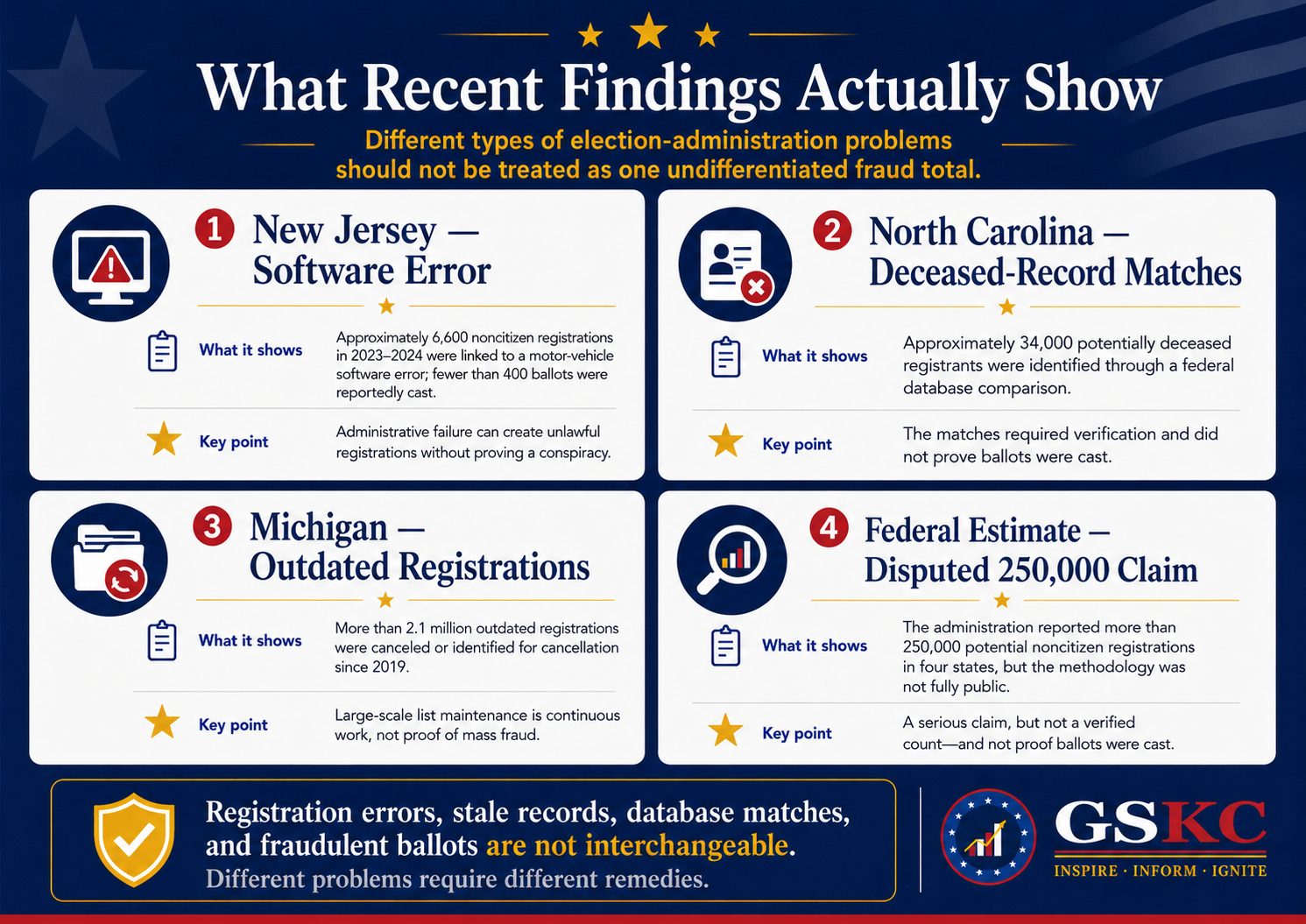
The evidence is not one-dimensional. Different audits and incidents reveal different kinds of problems: mistaken registration, delayed death-record matching, stale address records, and disputed citizenship flags. They should not be combined into one undifferentiated “fraud” total. They do, however, demonstrate that list maintenance is a continuing operational responsibility, not an abstract concern.
The New Jersey lesson: systems can fail even without a conspiracy
The strongest argument from New Jersey is not that every affected voter acted with criminal intent. It is that a government system accepted registrations it should have rejected, despite applicants identifying themselves as noncitizens. A citizenship-verification system should catch that mismatch before a registration becomes active. If it does not, accountability belongs not only to the voter but also to the agency, software vendor, and officials responsible for the process.7,8
This is precisely why the distinction between intentional fraud and administrative error is so important. Clear rules, documentary evidence, database checks, audits, and human review are not competing ideas. They are layers of responsible control.
Dead and moved voters: stale records are not the same as fraudulent votes
In April 2026, North Carolina reported identifying approximately 34,000 potentially deceased registrants through a federal database comparison. Michigan separately reported that more than 2.1 million outdated registrations had been canceled or placed into the legally required cancellation process since 2019. Together, the findings illustrate the scale and continuous nature of lawful voter-list maintenance — not proof that millions of fraudulent ballots were cast.9,10,11
The objective should be accurate rolls, not indiscriminate purges. Federal law and sound administration require safeguards. Accuracy means removing records that should no longer be active while preserving the rights of those who remain eligible.
The 250,000 Estimate
In July 2026, the administration asserted that an analysis of commercial databases had identified more than 250,000 potentially ineligible voter registrations in California, Nevada, New Jersey, and Pennsylvania. DHS subsequently released preliminary state-level estimates totaling approximately 256,000 potential noncitizen registrations: 190,832 in California, 35,152 in New Jersey, 15,903 in Nevada, and 14,576 in Pennsylvania.12
The administration had not, however, publicly released the underlying records or a detailed methodology sufficient for independent verification. Officials in several affected states disputed the estimates or said they would need to examine the supporting information before reaching conclusions.12
The figures, therefore, should not yet be presented as a verified count of noncitizens on voter rolls — and certainly not as proof that those individuals cast ballots. They should be treated as a serious claim requiring transparent evidence, state-level validation, individual review, and due process. If the registrations are confirmed to be ineligible, they should be corrected, and any unlawful voting should be investigated. At the same time, eligible citizens must be protected from improper removal. Integrity requires both vigilance and accuracy.
PUBLIC SUPPORT
A Broad Consensus — Stated Accurately
Americans show broad support for the principle of voter verification, but the numbers vary depending on the question. The most credible presentation separates support for the entire legislative package from support for individual components.
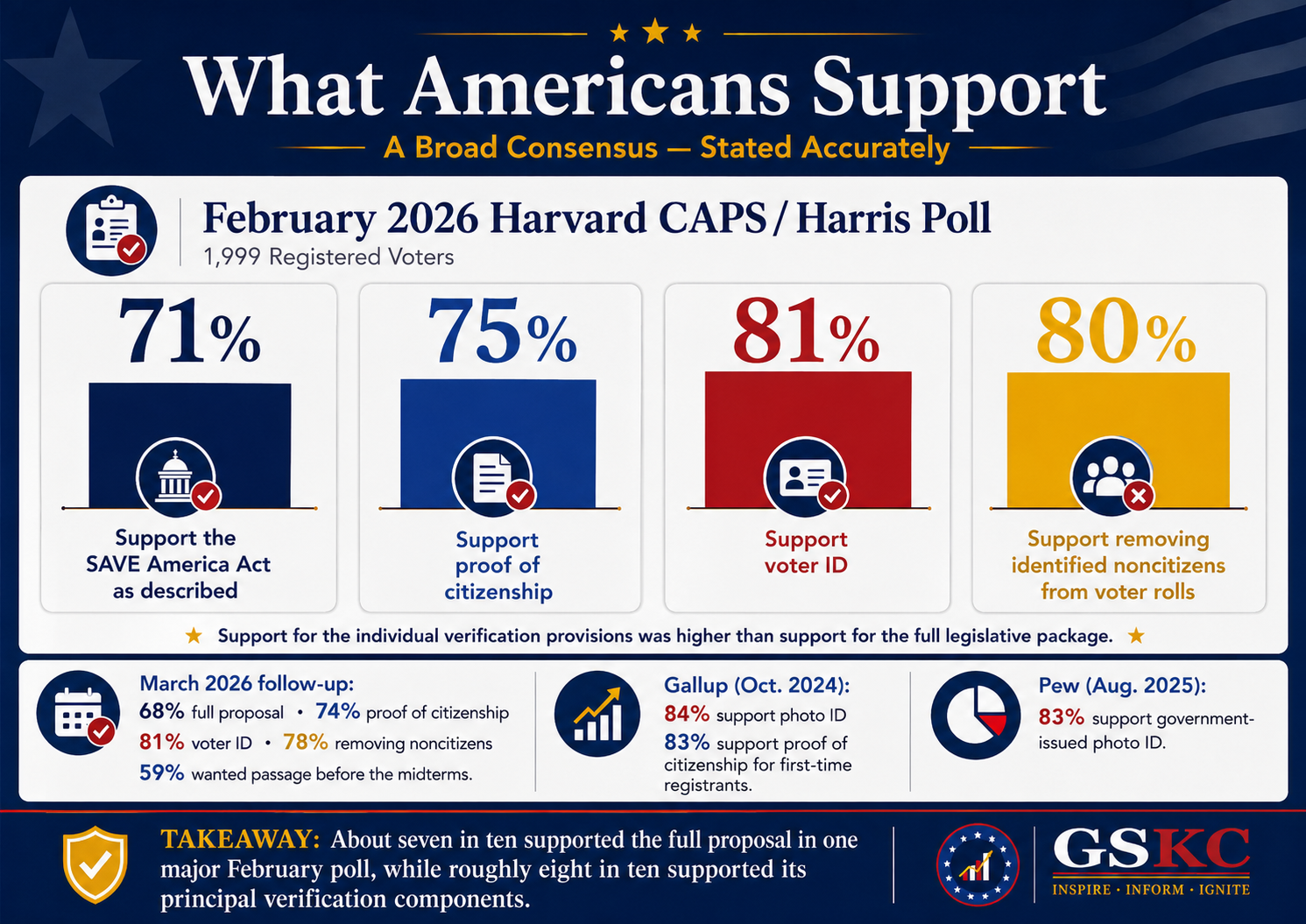
In the February 2026 Harvard CAPS/Harris survey of 1,999 registered voters, 71% supported the SAVE America Act as described.3
Support for individual requirements was higher: 75% for proof of citizenship, 81% for voter ID, and 80% for removing noncitizens from voter rolls. The full proposal drew support from 91% of Republicans, 69% of independents, and 50% of Democrats.3
A March follow-up produced similar results: 68% supported the full proposal, 74% supported proof of citizenship, 81% supported voter identification, and 78% supported removing noncitizens from voter rolls. Fifty-nine percent favored passage before the 2026 midterm elections.4
Gallup separately found 84% support for photo ID and 83% support for proof of citizenship among first-time registrants in October 2024.5
These findings demonstrate a durable appetite for verification even though support for the precise package can shift with wording and timing.
The honest headline is this: about seven in ten supported the full SAVE America Act in one major February poll, while roughly eight in ten supported its principal verification components. That is a meaningful public consensus — and it deserves a serious legislative response.
The Central Takeaway
The available evidence does not prove that American elections are controlled by widespread noncitizen fraud. It does prove that registration systems can fail, voter records can become outdated, database matches can be inaccurate, and unlawful ballots can occur.
Those realities demand neither panic nor denial. They demand precision.
A software error is not automatically a conspiracy. A stale registration is not a fraudulent ballot. A preliminary database match is not a verified noncitizen voter. But no documented problem should be ignored merely because its statistical scale appears small.
Rare does not mean irrelevant. Irregular does not automatically mean fraudulent. Integrity requires us to distinguish the two — and then investigate, correct, and report what the evidence actually shows.
Polling suggests that Americans understand the underlying principle. Approximately eight in ten support its central verification components. That consensus deserves a serious legislative response — not partisan slogans or false narratives from either side.
Verification may be justified in principle, but principle alone cannot administer an election. Part III examines the hardest implementation questions: name changes, missing records, database errors, due process, document access, and the matching responsibilities both government and citizens must assume.
— Matt Cucinotta | Growth Solutions KC | Inspire · Inform · Ignite
Scope and methodology: This article analyzes the version of the SAVE America Act passed by the House as an amendment to S. 1383 on February 11, 2026. It draws upon legislative text, official federal and state sources, primary polling, bipartisan policy analysis, and reporting available through the publication date. Because the legislative process remains active, provisions and implementation requirements may change.
References and Research Methodology
Major factual claims in this installment were checked against the House-passed legislative text, official federal and state sources, primary polling, and reporting that distinguishes verified findings from disputed allegations. Accessed July 24, 2026.
- Rules Committee Print 119-19: Text of House Amendment to S. 1383 — U.S. House of Representatives (Feb. 6, 2026). Open source Primary source for the House-passed policy text.
- 18 U.S.C. § 611: Voting by Aliens — Office of the Law Revision Counsel (Current U.S. Code). Open source Existing federal prohibition.
- February 2026 Key Results and Press Release — Harvard CAPS / Harris Poll (Feb. 25–26, 2026). Open source 1,999 registered voters; full proposal and component support.
- March 2026 Key Results — Harvard CAPS / Harris Poll (Mar. 25–26, 2026). Open source Follow-up support and timing question.
- Americans Endorse Both Early Voting and Voter Verification — Gallup (Oct. 24, 2024). Open source 84% photo ID; 83% first-time proof of citizenship.
- Majority of Americans Continue to Back Expanded Early Voting, Voting by Mail, Voter ID — Pew Research Center (Aug. 22, 2025). Open source Additional context on broad voter-ID support.
- New Jersey Software Error and Noncitizen Registrations — Associated Press (July 21, 2026). Open source Approximately 6,600 registrations; fewer than 400 ballots.
- Hundreds of Noncitizens Voted in New Jersey Due to Software Error — Reuters (July 2026). Open source Additional reporting and context.
- State Board Identifies Deceased Individuals on Voter Rolls — North Carolina State Board of Elections (Apr. 27, 2026). Open source Approximately 34,000 deceased records identified.
- Secretary Benson Announces More Than 2.1 Million Outdated Registrations Canceled or Identified — Michigan Department of State (Apr. 29, 2026). Open source Cumulative maintenance since 2019.
- Voter Registration Cancellation Procedures — Michigan Department of State (Current). Open source Moves, deaths, duplicates, and voter-requested cancellations.
- What to Know About the Administration’s 250,000 Claim — CBS News (July 2026). Open source Claim remains disputed and methodology insufficiently public.
- Modernizing Voter List Maintenance: An Evidence-Based Framework — Bipartisan Policy Center (Sept. 9, 2025). Open source Database limitations, access, integrity, and due process.
- Reporting and Research on the Rarity of Noncitizen Voting and Risks of False Matches — Reuters / election administration research (2024–2026). Open source Context: rare overall, but administrative errors and false positives remain relevant.


Comments ()