

Congress’s Unfinished Business
Part II: The Ruling Settled the Case. It Didn’t Settle the Question.
AMERICA'S CHARTER, REVISITED · PART II OF II
Part I of this series laid out what the Supreme Court actually decided in Trump v. Barbara, and what the Fourteenth Amendment was actually built to do. The short version: the Court closed the legal question for now, but the deeper question — what “subject to the jurisdiction” was always meant to require — remains exactly as contested as it was the day before the ruling came down.
That contest now moves to Congress. Not because the Court left a technical loophole, but because the honest reading of this moment is that the Constitution settles what the rule is, while the country still has to decide, in the open, whether that rule still serves the purpose it was written for.
Two things make that conversation urgent rather than academic: an industry already built around the current rule, and a legislative branch that has spent a year drafting bills nobody has passed.
An Industry the Ruling Doesn’t Touch
Whatever the Court decided about the Constitution, it decided nothing about the marketplace that has grown up around it.
Birth tourism is not a hypothetical slippery-slope argument — it is a documented, prosecuted industry, with estimates ranging from roughly 33,000 to 70,000 births attributable to temporary visitors each year, depending on whose count is used.
FAIR’s most recent investigation counted roughly 500 companies operating in China alone to facilitate the practice — arranging visas, housing, medical care, and the paperwork trail meant to survive a border officer’s questions.
This is not new. Homeland Security Investigations raided Southern California “maternity hotels” as far back as 2015. Federal prosecutors brought the first criminal indictments in 2019, naming operators who charged clients $40,000 to $80,000 for the full package — one Orange County operation alone claimed to have served more than 500 Chinese clients through 20 rented apartments. Sentencing in similar cases has continued into 2025 and 2026.
Florida has its own version of the same industry, catering primarily to Russian clients.
The Northern Mariana Islands, a U.S. territory with relaxed visa rules for certain nationalities, became its own corridor for the practice before a 2024 policy change brought births there down from its 2018 peak of 581 to just 47 by 2025.
Whatever one concludes about the broader constitutional question Part I examined, birth tourism specifically is a narrower, more concrete problem, with its own record of prosecutions, its own visa-fraud statutes already on the books, and its own history of responding to enforcement rather than litigation. It is the clearest evidence that “what Congress can do” and “what the Constitution requires” are two different conversations — and that some of this can be addressed without touching the Fourteenth Amendment at all.
— SEN. LINDSEY GRAHAM (R-SC), ON REINTRODUCING THE BIRTHRIGHT CITIZENSHIP ACT
A History Both Parties Would Rather Forget
Today’s reaction to the ruling split almost entirely along the lines you’d expect — but that unanimity is newer than it looks.
In 1993, Senator Harry Reid of Nevada — who would go on to lead Senate Democrats for over a decade — authored the Immigration Stabilization Act, which included language excluding children of parents in the country illegally from automatic citizenship under the Fourteenth Amendment. The bill never passed. It is, nonetheless, a real data point: restricting birthright citizenship was not always understood as a strictly conservative position, and treating it as one erases a debate that used to run through both parties.
Public opinion tells a similar story, if a quieter one. Pew Research’s most recent polling found real division even among people who otherwise support immigration policy broadly — support for birthright citizenship specifically, for children of parents who are in the country illegally, splits closer to even than the current political rhetoric on either side suggests, with moderate Democrats consistently breaking from the liberal wing of their own party on enforcement-adjacent questions more broadly.
Some of that gap likely traces to a genuine difference in worldview, not just policy preference — one this series has already touched on. In 1868, undertaking the journey to America was itself evidence of intent: it was slow, often dangerous, and functioned as a kind of down payment on becoming American.
The framers were not choosing between competing philosophies of arrival; they were writing for a world where arrival and intent were, for practical purposes, the same thing.
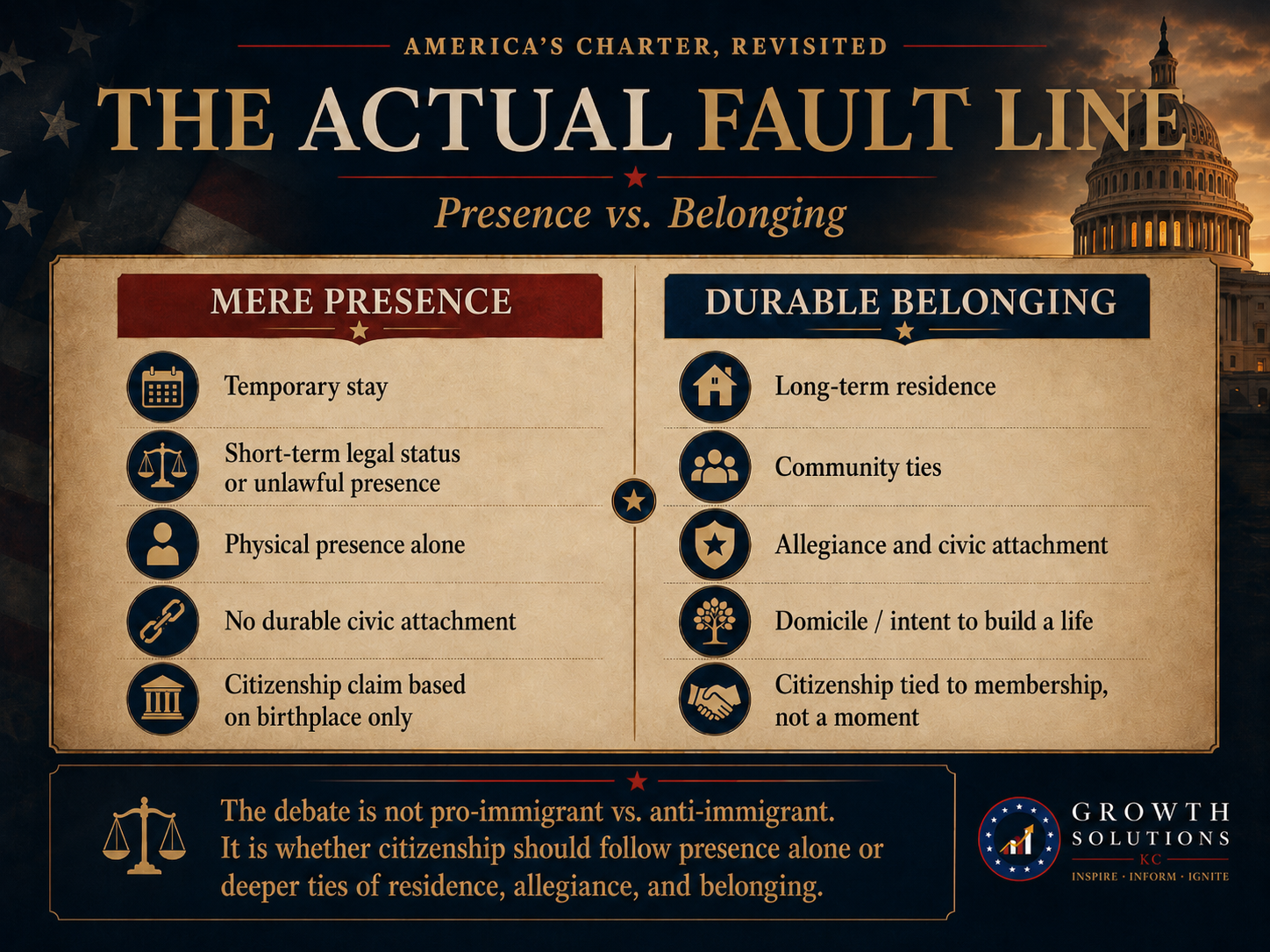
That assumption doesn’t hold as cleanly today, when a flight and a visa can separate arrival from any intention to stay. Reasonable people disagree about how much that gap should matter to the law. But it is worth naming as the actual fault line running underneath this debate — not “who supports immigrants” versus “who doesn’t,” but whether presence alone establishes belonging, or whether belonging requires something more.
The Order Overreached, Even on Its Own Terms
There is also a fair critique to make of the specific instrument at issue, distinct from the constitutional question Part I examined.
Executive Order 14160 did not target birth tourism, or illegal border crossing, specifically. Its actual text applied a status test measured strictly at the moment of birth: any child whose mother was unlawfully present, paired with a father who was not a citizen or lawful permanent resident, fell within its reach — regardless of whether that mother had lived in the United States for ten days or twenty years. The same held for the order’s second category, lawful but temporary presence: a tourist here for two weeks and a work-visa holder settled into a job and community for a decade were treated identically, so long as the father’s status matched.
That is a meaningfully broader net than the argument this series has actually made, which rests on domicile and durable intent, not a snapshot of legal paperwork.
Justice Thomas’s own dissent makes the case for citizenship tied to genuine residence and allegiance — but the executive order itself never attempted to draw that line. It made no distinction for years of residence, community ties, or assimilation; it asked only what a parent’s status said on the day of birth. A mother who arrived without authorization as a teenager and raised a family in the same American town for two decades would have been treated by the order exactly the same as someone who crossed days earlier intending to leave immediately after giving birth.
Whether a narrower order would have survived is a fair question, and an honest answer has to admit real uncertainty. The Court did not rule on a narrower version of the order — it ruled on the version Trump actually signed, and struck it down as facially unconstitutional in its entirety. Even Justice Thomas argued in dissent that the majority moved too quickly on that point specifically, suggesting some applications of the order could have been valid even if others were not, and faulting the Court for invalidating the whole of it rather than weighing it case by case.
That does not mean a narrower order would have won: the majority’s own reasoning explicitly rejected any distinction based on a parent’s domicile or duration of presence, the same reasoning it used to extend Wong Kim Ark beyond parents who had lived in the country for twenty years. But it does mean the sweeping version Trump signed foreclosed a question a narrower one might have kept open. For a document meant to reshape how the Constitution is read, that is not a small distinction.
If the goal is genuinely to align citizenship with belonging rather than mere presence — the argument this series has made — then the order’s own design worked against that goal by refusing to distinguish between the two. A narrower approach, focused specifically on unlawful entry and genuinely temporary presence, while carving out long-term undocumented residents who have, in every practical sense, become part of their communities, would have tracked the underlying argument far more honestly than the order actually signed.
That failure is not a reason to abandon the underlying question. It is a reason any future legislative attempt needs to do better than the executive order did.
What Congress Actually Owes This Debate
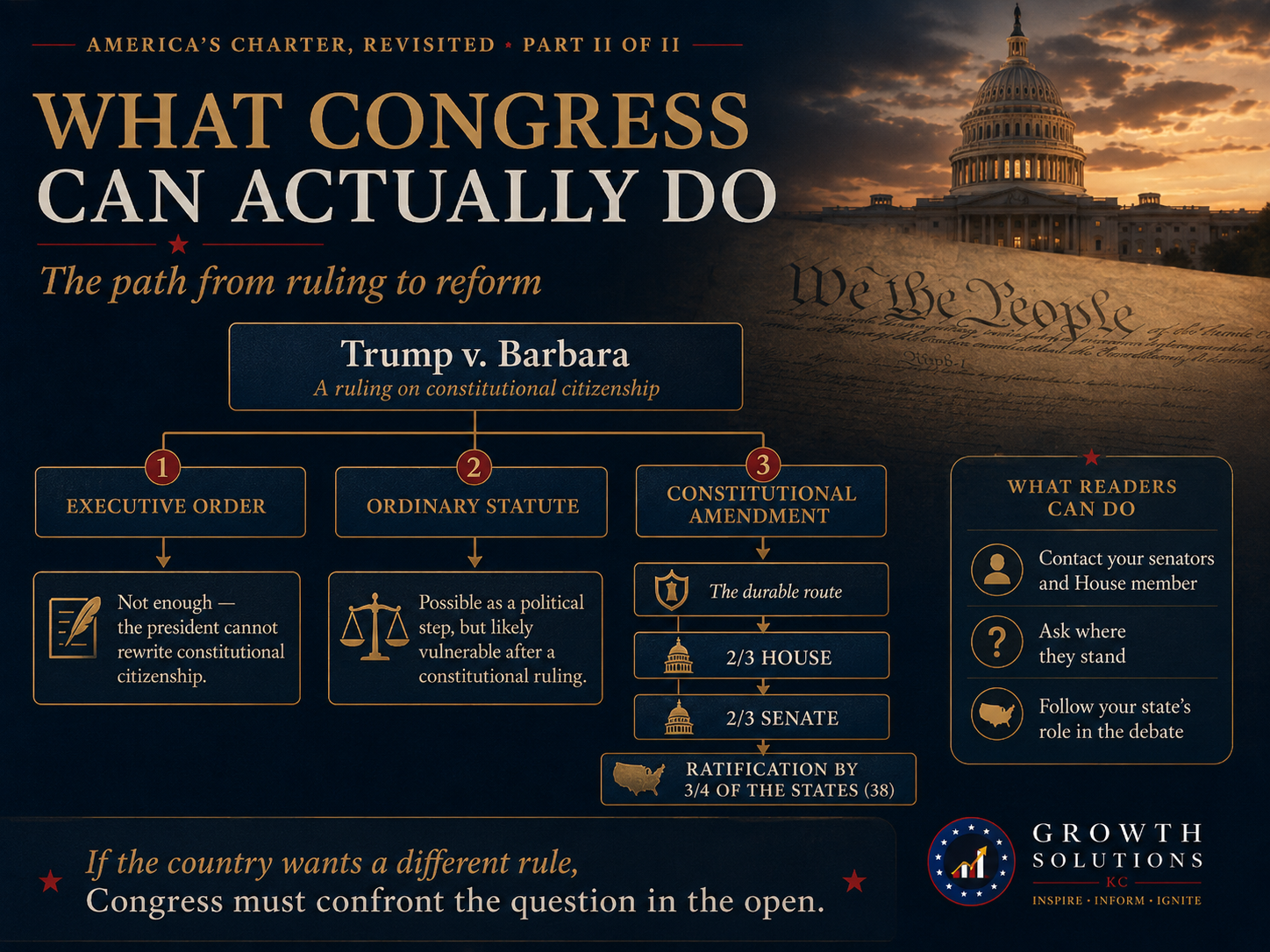
Here is the honest legal reality, stated plainly: after Trump v. Barbara, an ordinary statute almost certainly cannot do what its Republican sponsors are hoping it will do.
The reasoning matters here, not just the conclusion. Five justices decided this case on constitutional grounds — meaning the Court held that the Fourteenth Amendment itself, not merely the federal statute that echoes its language, guarantees birthright citizenship to children born to parents unlawfully or temporarily present. An ordinary act of Congress cannot override the Constitution. Only a constitutional amendment can.
That is precisely why the vote-counting dispute from Part I matters practically, not just academically. Some coverage describes this as a 6-3 decision, counting every vote that killed the executive order, including Justice Kavanaugh’s narrower, statute-based concurrence. Others — including constitutional law professor Jonathan Turley — describe it as 5-4, counting only the justices who actually joined the constitutional holding itself.
Both readings are defensible, and the disagreement between them is itself the tell: even legal experts cannot settle on how many justices actually believe birthright citizenship is untouchable by Congress. If serious scholars cannot agree on what just happened, the case for leaving this question settled by a single, closely divided opinion is weaker than the headlines suggest.
Two paths exist for Congress, and only one of them is likely to survive a future court challenge. The narrow path is legislative: bills like the stalled Birthright Citizenship Act (S. 304 / H.R. 569) would redefine “subject to the jurisdiction” in statute to exclude children of parents unlawfully or temporarily present. Both have sat in committee since January 2025 without a floor vote.
At least one senator has signaled plans to introduce new legislation built around the narrow opening left by Justice Kavanaugh’s concurrence — but that concurrence addressed the statute Congress already passed in 1952, not a hypothetical new one, and it is far from clear the current Court would treat a newly narrowed statute the same way.
The wide path is a constitutional amendment, doing directly and transparently what a statute can only attempt indirectly. That path requires two-thirds of both the House and Senate, then ratification by three-fourths of the states — thirty-eight in total. It is a genuinely difficult bar, deliberately so.
But it is also the only route that actually resolves the underlying question this series has been making the case for: not whether Congress can find a clever workaround, but whether the country is willing to have the direct, open debate the framers themselves had in 1866 — and write language that reflects what “subject to the jurisdiction” was always meant to require, rather than leaving it to nine justices to keep re-litigating by a single vote every few decades.
That is a harder task than passing a statute. It is also the only one built to last.
What To Do
If this is a debate Congress needs to have in the open, the most useful thing a reader can do is make sure it is actually being watched.
Contact your senators and House representative directly, and be specific — a message that names an actual bill lands differently than a general complaint.
If you want to see the narrow statutory approach pursued, reference the Birthright Citizenship Act (S. 304 / H.R. 569), currently stalled in committee.
If you believe that only a constitutional amendment can genuinely resolve the question, ask your senators directly whether they support opening that process.
Track your state’s position, too. State attorneys general were parties to this case, and many will remain active in related litigation and in shaping how any future statute gets enforced or challenged.
And if you take one thing from this series, let it be this: the loudest reactions to this ruling — in either direction — were not where the real argument lived.
The real argument lived in roughly ninety pages of a dissent almost nobody will read in full, in a Senate floor debate from 1866, and in a question about what a country owes to the people who show up genuinely intending to become part of it, versus the people who don’t.
That is not a question the courts can finish answering. It was never going to be. It belongs to Congress now, in the open, the way the framers themselves did their most important work.
— Matt Cucinotta | Growth Solutions KC | Inspire · Inform · Ignite


Comments ()