

Builders of a Nation: What Each Generation’s Leaders Taught Us
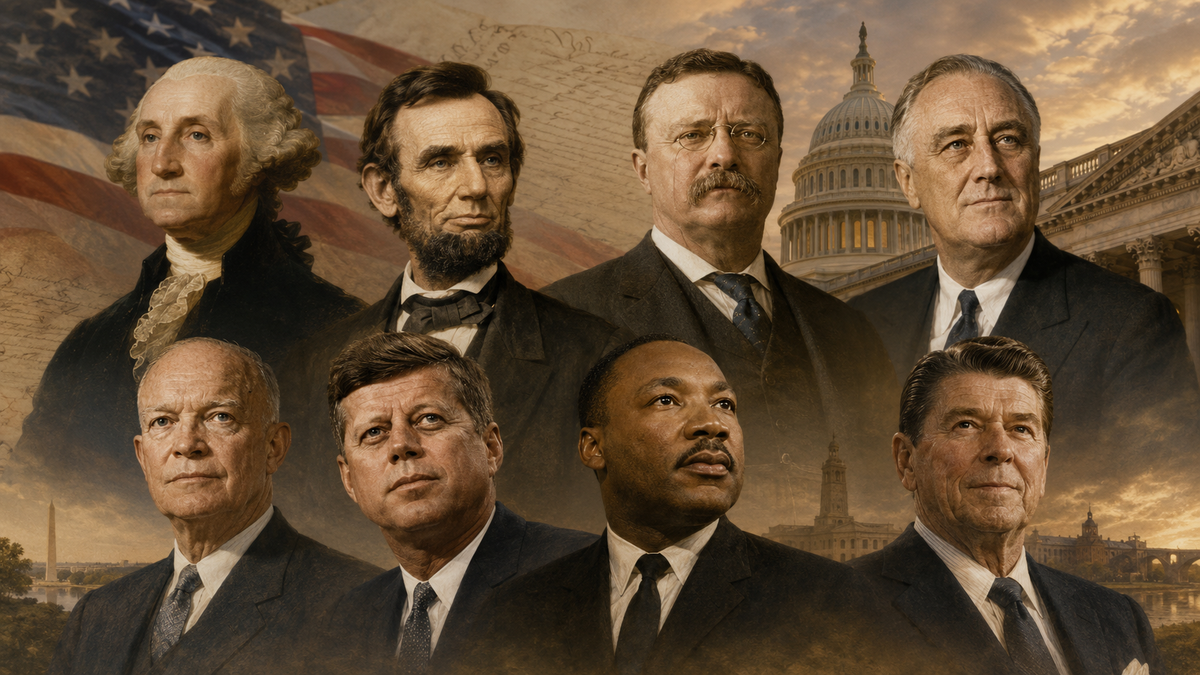
The Leaders Who Shaped the American Story.
THE AMERICA AT 250 SERIES · ARTICLE FOUR
What Each Generation’s Leaders Taught Us
If America’s greatness lies not in perfection but in continual striving, then its leaders are the ones who carried that striving through crisis.
This is not a ranking of great men. It is an inventory of hard‑won lessons — a leadership curriculum the nation wrote in real time, one crisis at a time.
The previous articles traced a structure: a founding argument, a self‑correcting framework, a union that survived its gravest test. But a structure is inert. It does not act. At every decisive moment in the American story, the framework’s survival came down to particular people making critical choices under pressure — and frequently, to the choices they declined to make.
So this article asks a different question than “who were the great leaders?” It asks:
What did each era’s defining challenge teach the nation about leadership itself?
The answer turns out to be remarkably consistent across two and a half centuries and eight very different figures. Strip away the personalities and the politics, and the same lesson keeps surfacing in different forms: leadership in the American story has most often meant service under pressure — holding the central purpose steady while adapting everything else to circumstance.
These are not biographies. These are eight lessons, and the thread that connects them. They were chosen not because they exhaust the list of American leadership, but because each represents a distinct test in the nation’s development: founding, union, industrialization, depression, global power, nuclear danger, civil rights, and renewed confidence.
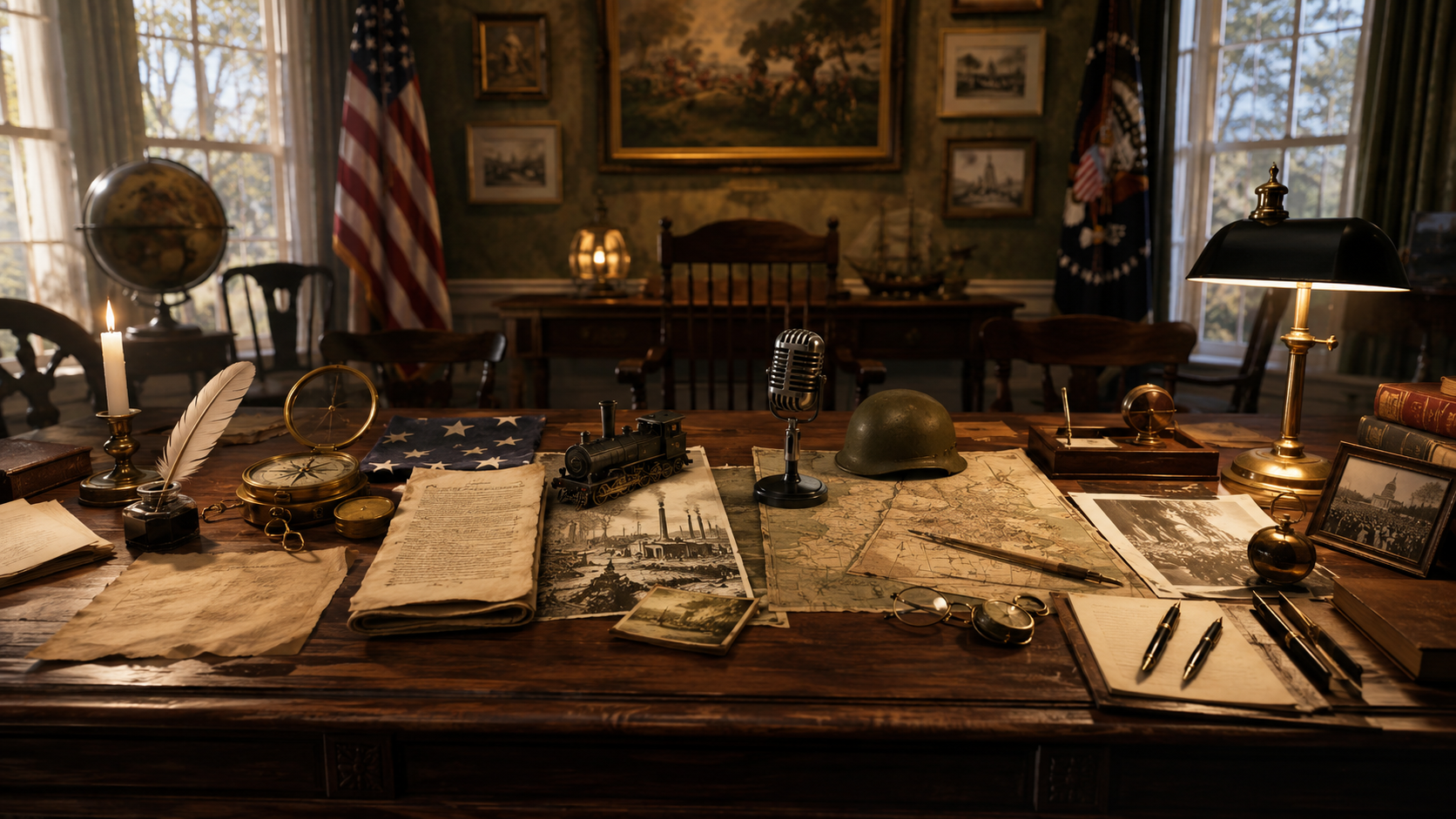
Washington: Restraint Is a Form of Strength
The first lesson is the one most foreign to ordinary ambition. Washington’s defining act was not something he did but a thing he refused.
Having led the Revolution and then defined a presidency that existed only on paper, he could have held power indefinitely; in a nation that had just overthrown a king, few could have stopped him. Instead, after two terms, he went home.
That single decision — the voluntary surrender of power — established the precedent on which every peaceful transfer since has rested. The lesson is permanent and counterintuitive: in a republic, the greatest demonstration of a leader’s strength can be the power he chooses not to keep. Leadership as service, not as self.
Washington proved that the survival of a republic depends not on the brilliance of its founders but on their willingness to limit themselves.
His legacy is the template he left behind — a model of power restrained, ambition governed, and institutions placed above the individual.
Lincoln: Fix the Objective, Flex the Means
Lincoln teaches the discipline of holding one thing unwavering while bending on everything else. His central objective — preserving the Union — never wavered.
But his means were relentlessly adaptive: he maneuvered so the Confederacy fired the first shot, cycled through generals until he found ones who would win, and expanded the war’s very purpose with the Emancipation Proclamation, turning a fight to preserve the Union into a fight for human freedom.
The lesson is that moral clarity and strategic flexibility are not opposites. A leader can be utterly fixed on the end and endlessly pragmatic about the path. The honest qualification matters too: Lincoln’s moral vision deepened during the war rather than arriving complete, and his wartime measures strained civil liberties. Even the best leadership operates with imperfect hands.
His legacy is the demonstration that clarity of purpose can coexist with flexibility of method — a combination that preserved the nation and redefined its meaning.
Theodore Roosevelt: Balance, Not War, Between Markets and Government
Roosevelt confronted a problem we would recognize instantly: an economy transformed into an industrial powerhouse, but with wealth and power so concentrated in monopoly trusts that both fair markets and democracy itself were threatened. His answer was neither to dismantle big business nor to let it run unchecked, but to referee it — reviving antitrust enforcement, winning new regulatory powers, and establishing the first real consumer protections.
The lesson is that markets and government need not be enemies one must choose between; they are forces to be balanced in service of the public good. Roosevelt cast the presidency as the mediator.
The honest note: his trust‑busting reputation outran his actual record, and critics charged him with both overreach and inconsistency — a reminder that a leader’s legend and a leader’s ledger are rarely identical.
FDR: Communication Is Governance
Franklin Roosevelt inherited a nation paralyzed by fear — a quarter of the workforce unemployed, banks collapsing, and abroad, dictatorships rising to exploit exactly that kind of despair.
His most important early task was not a policy. It was psychological: restoring a frightened public’s capacity to think rather than panic. Through the Fireside Chats, he spoke to Americans in plain, calm, conversational language, turning the radio into an instrument of democratic confidence at the very moment other nations were turning the same technology toward demagoguery.
The lesson is that in a crisis, communication is not separate from governing — it is governing. A leader’s first job can be to steady the public mind. And the necessary honest accounting: the same president who told Americans they had nothing to fear but fear itself also ordered the internment of Japanese Americans — a grave injustice that belongs in any truthful reckoning of his leadership.
His final test came in war. Roosevelt’s leadership through World War II — from Lend‑Lease to the Arsenal of Democracy — mobilized a nation on an industrial scale. His wartime decisions were among the hardest any leader has faced — a reminder that crisis often hands only tragic options, not clean ones.
Eisenhower: Power Must Be Sustainable to Be Useful
Eisenhower’s challenge was endurance: how to wage a Cold War that might last decades without bankrupting the country or stumbling into nuclear catastrophe. A five‑star general who had seen war up close, he was disciplined precisely where others wanted drama — ending the Korean War, restraining defense spending against enormous pressure to expand it, building the Interstate Highway System, and deliberately avoiding the reckless options his advisers urged.
The lesson is that strength, to be useful, must be sustainable — that strategy abroad depends on a sound economy and stable institutions at home, and that restraint can be more disciplined than action. He proved it on the way out the door, warning the nation against the unchecked power of the “military‑industrial complex” he himself had commanded. The honest note: on civil rights, his personal caution lagged the moral urgency of the moment, even as he ultimately sent troops to enforce the law at Little Rock.
His legacy is the reminder that durable strength is built not on spectacle, but on steadiness.
Kennedy: Interrogate Every Assumption When the Stakes Are Highest
Kennedy’s defining test lasted thirteen days. During the Cuban Missile Crisis, with advisers pressing for an immediate airstrike that could have triggered nuclear war, he did something rare under maximum pressure: he questioned the assumptions behind the aggressive option.
Chastened by the earlier failure at the Bay of Pigs, he had learned to challenge his own experts, and he chose a calibrated naval quarantine that bought time for the diplomacy that ended the crisis.
The lesson is that at the highest stakes, the most aggressive option is not the bravest one — interrogating every assumption is. Kennedy paired that caution at the nuclear edge with audacity in safer domains, committing the nation to reach the moon and channeling Cold War rivalry into peaceful achievement. Boldness and restraint were not in conflict; he calibrated what the moment required.
Kennedy paired crisis management with a call to civic responsibility — from the Peace Corps to the moonshot — arguing that national strength required citizen participation, not just presidential action. He treated public imagination as a strategic asset.
King: Moral Authority Is a Strategic Force
The American story also proves that leadership does not always come from office.
Martin Luther King Jr. is the essential figure in this sequence precisely because he held no office. His power was not institutional — and that is the entire point. He compelled a nation to close the gap between the Declaration’s promise of equality and the reality of legal segregation, and he did it without the violence that would have shattered his moral case.
His genius was strategic nonviolence: disciplined, meticulously planned campaigns that met brutality with dignity and, through television, turned the nation’s conscience into an irresistible force.
These were not just words — they were the strategic architecture of a movement.
Crucially, he did not appeal to ideas foreign to America — he held up America’s own founding promise and demanded the country honor it.
This is the purest embodiment of the “more perfect union”: America corrected by Americans invoking America’s own stated ideals. The lesson is that moral authority, wielded with discipline, can move a nation further than force — and that leadership and power are not the same thing.
King’s legacy is the proof that disciplined moral authority can realign a nation’s conscience and move its laws closer to its ideals.
Reagan: Conviction and Negotiation Are Complements
Reagan’s challenge was a crisis of confidence — economic malaise at home, a Cold War the Soviets seemed to be winning abroad — followed by the delicate task of managing that struggle’s endgame.
He is often remembered for one half of his approach: ideological firmness and a military buildup meant to strain a faltering Soviet economy. But the decisive move was the other half — his willingness, when he saw a genuine partner in Gorbachev, to sit down and negotiate arms reductions across four summits.
The lesson is that strength and diplomacy are not contradictions but complements: firmness of principle paired with the flexibility to seize an opening for peace.
The honest accounting: Reagan’s economic legacy remains debated — strong growth paired with rising deficits — and historians still differ on how much U.S. pressure versus internal Soviet collapse ended the Cold War. Reagan and Gorbachev themselves framed the result as a victory for the world rather than for one side.
Reagan’s deeper legacy was not only policy but posture — a restoration of national confidence rooted in conviction, clarity, and an unembarrassed belief in America’s promise. He reminded a weary nation that optimism can be a strategic asset, and that leadership sometimes begins by lifting a country’s spirit.
What the Whole Curriculum Teaches: The Pattern Beneath the Personalities
Read across all eight, the personalities recede, and a single pattern stands out.

These were men of different parties, temperaments, and centuries, facing wildly different tests — a fragile new office, a civil war, monopoly power, economic terror, a nuclear standoff, legal segregation, an empire’s slow collapse. Yet the leadership each is remembered for amounts to the same discipline:
hold the main thing steady, and adapt the means without betraying the end.
Hold the main thing steady, and adapt the means without betraying the end. That is the whole curriculum — eight figures, one lesson, two and a half centuries.
Washington held to self‑government and surrendered power to prove it. Lincoln held to the Union and remade its purpose to save it. FDR held the nation together through economic collapse and global war, proving that unity itself can be a strategic asset. King held to the founding promise and used the nation’s own ideals to redeem it. Kennedy and Reagan, in different eras, revived national purpose and confidence, reminding Americans that belief in the country’s future is itself a form of leadership. In nearly every case, the leader’s real task was to carry the country through a test of whether its founding ideals could survive contact with reality — and to keep faith with those ideals while bending on everything else.
There is one more pattern worth naming because it runs counter to the grain of how we usually talk about leadership. The most consequential acts on this list were frequently acts of restraint: the power Washington didn’t keep, the airstrike Kennedy didn’t order, the defense spending Eisenhower didn’t authorize, the violence King refused to permit. We tend to imagine leadership as bold action. The American record suggests that wisdom about what not to do has mattered just as much — and is far rarer.
That is the inheritance this article hands forward. The qualities that built and preserved the republic — restraint, fixed purpose, moral courage, the discipline to question oneself — were never the property of presidents alone.
They are the same qualities the republic will require from its citizens in the chapters still to come.
The builders proved what the framework made possible. Whether it keeps being built is the question the rest of this series turns to.
The story of America isn’t finished. We are writing the next chapter.
This is the fourth article of the Growth Solutions KC America at 250 series.
Next: Article Five — The Century of Innovation: How America Kept Reinventing the Future.
— Matt Cucinotta | Growth Solutions KC | Inspire · Inform · Ignite

Discover more installments of the America at 250 Series.


Comments ()