

America at 250: Why This Anniversary Matters
America at 250 is not simply a celebration of the past. It is an opportunity to understand how we arrived here, what challenges we face, and what responsibilities we share in shaping the next chapter of the American story.
THE AMERICA AT 250 SERIES · ARTICLE ONE
We hold these truths to be self-evident, that all men are created equal, that they are endowed by their Creator with certain unalienable Rights, that among these are Life, Liberty and the pursuit of Happiness.
And for the support of this Declaration, with a firm reliance on the protection of divine Providence, we mutually pledge to each other our Lives, our Fortunes and our sacred Honor.
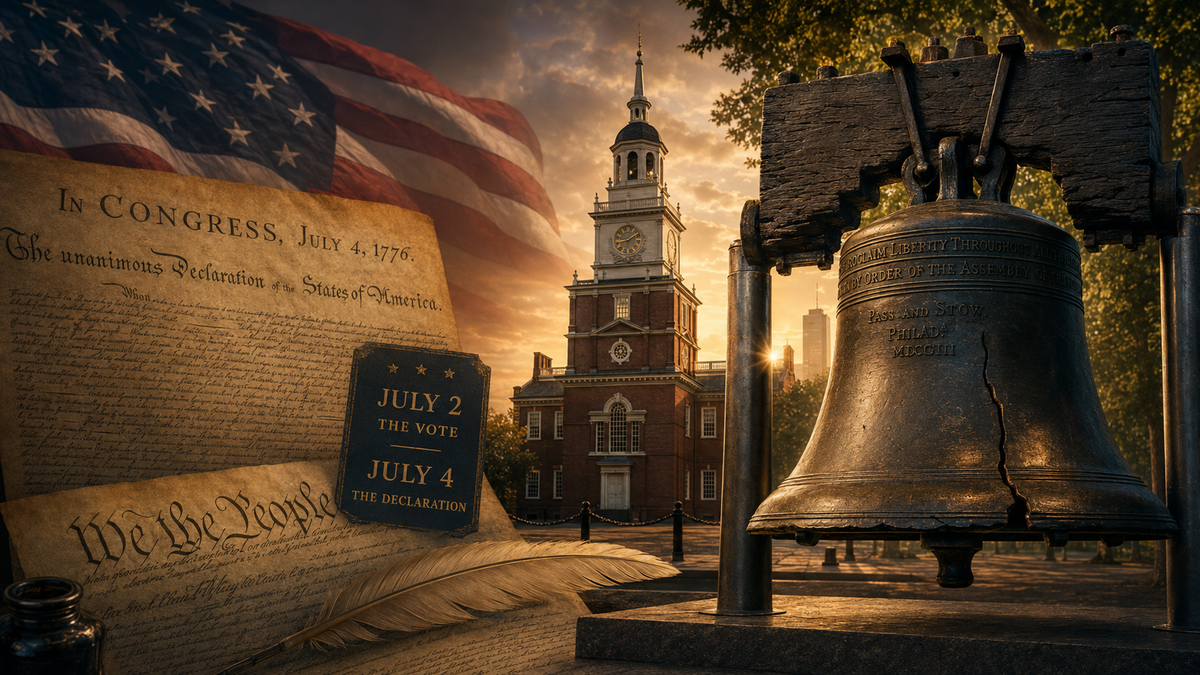
On the day America actually voted for independence, the calendar read July 2 — we celebrate July 4th.
We do not celebrate incorrectly. We celebrate the date America adopted the words explaining its independence, not the date Congress first voted for it. Not by much — by two days — but the gap is worth pausing on, because it tells you something about how this country remembers itself.
On July 2, 1776, in the Pennsylvania State House in Philadelphia, the Second Continental Congress voted to sever the thirteen colonies from Great Britain. Twelve delegations said yes; New York, awaiting instructions from home, abstained. It was the vote that mattered — the irreversible one, the one that turned a tax dispute into treason and a collection of colonies into something that did not yet have a name. John Adams was certain of its weight. Writing to his wife Abigail the next day, he predicted that July 2 “will be celebrated, by succeeding Generations, as the great anniversary Festival,” marked with parades, bonfires, and illuminations from one end of the continent to the other.
He was right about everything except the date. What the country chose to commemorate was not the day it decided to be free, but July 4 — the day it agreed on the words explaining why.
The vote was the act. The Declaration was the argument. And America, tellingly, remembers the argument.
That instinct is the whole reason this anniversary matters.
A Nation That Remembers Its Reasons
Most nations trace their origins to blood, soil, or sovereign — a tribe, a territory, a king. America traces its to a sentence. The colonies did not merely announce that they were leaving; they published a careful, public justification for why a free people may do so, grounded in a claim that human beings possess rights no government grants and none may rightly take.
The Declaration was, in the truest sense, an argument addressed to “the opinions of mankind.”
This is why the country fixed on July 4 rather than July 2. A revolution defined by a vote is just a transfer of power. A revolution defined by a written justification is a set of ideas — and ideas can be inherited, debated, betrayed, and reclaimed in a way that a single day’s tally cannot. By choosing to commemorate the explanation over the act, Americans unknowingly set the terms for everything that followed: this would be a country perpetually measured against its own stated reasons.
It is worth being honest about the room those ideas were written in. The men who declared that all are created equal did not extend that equality to all — most starkly, to the enslaved, whose freedom the Declaration’s logic demanded and its authors withheld. That contradiction was not hidden then and should not be softened now.
But notice what the words did anyway: they set a standard the nation could later be held to, including by the people it had excluded. Within a decade, Rhode Island’s gradual-abolition law would invoke the Declaration’s own promise of “Life, Liberty, and the Pursuit of Happiness” against the institution the founders had tolerated.
The argument, once written down, outran the men who wrote it. That is the recurring pattern of the American story, and it begins right there in that room.
Why Anniversaries Matter at All
There is a temptation to treat a 250th birthday as bookkeeping — a large round number, an occasion for sales and fireworks, a date that arrives and passes. But anniversaries are not for the dead. They are for the living. A nation marks its origins for the same reason a family keeps photographs and tells the same stories at every gathering: to remember who it is, where it came from, and what it owes.
What makes 250 different from an ordinary year is scale. It is long enough to see the whole shape of a thing — not a single administration or crisis or boom, but the full arc. And the arc is what a single year can never show you.
Consider what was actually built in that span. A republic that began as thirteen agricultural colonies clinging to the Atlantic seaboard, with roughly 2.5 million people in the colonies in 1776, no navy, no treasury, and a government so weak it could not collect a tax, grew into a continental nation of more than three hundred forty million people, the largest economy on earth, and a constitutional republic governed by one of the world’s oldest written national constitutions still in use.
Across those 250 years, the country preserved the Union and abolished slavery through a Civil War that cost more than six hundred thousand American lives. It extended the vote it had once hoarded, built the telegraph and the telephone and the assembly line and the internet, defeated fascism abroad, and put human beings on the moon.
It also failed — repeatedly, and sometimes catastrophically — and then, more often than not, hauled itself back toward the promise it had written down. None of that is visible in any single year. It is visible only across the whole.
That is what an anniversary like this offers: the rare chance to step back far enough to see the shape of the thing in its entirety.
The Republic Is Not Inherited Automatically
Here is the part that is easy to miss in the fireworks. None of what was built arrived on its own, and none of it stays without tending.
A republic is not a monument, finished and durable, that each generation simply receives intact. It is closer to a working farm — productive only as long as someone keeps working it, and capable of going to seed in a single inattentive generation.
The founders understood this with unusual clarity, because they had no guarantee their experiment would last. Benjamin Franklin, asked as he left the Constitutional Convention whether the country had a republic or a monarchy, is said to have answered: “A republic, if you can keep it.” The conditional was the entire point. The keeping was left to those who came after.
Every generation since has been handed the same conditional, and has had to answer it. The generation that abolished slavery answered it. The generation that stormed the beaches of Normandy answered it. The generation that marched from Selma answered it — not by inheriting the Declaration’s promise, but by insisting the country finally honor it.
In each case, ordinary people decided that the inheritance was theirs to maintain, not merely to enjoy.
Which brings the conditional to us. The 250th anniversary is not a receipt for work completed by people now dead. It is a question, addressed to the living, in exactly the form Franklin posed it. The republic was kept for two and a half centuries because, in each generation, enough people understood that keeping it was their job.
The fireworks on the Fourth are the celebration. Whether the next fifty years are worth celebrating is the assignment.
What This Anniversary Asks
So, this is why the date matters — and why we were right, in the end, to commemorate the argument rather than the vote.
A country that remembered only the act of breaking away would have nothing to do on its birthday but congratulate itself.
A country that remembers its reasons has something harder and better to do — measure itself against them.
That is what the next 250 years will require, and it is what this series sets out to make possible — to understand the founding well enough to steward it, to face the failures honestly enough to keep correcting them, and to see the whole arc clearly enough to add to it wisely.
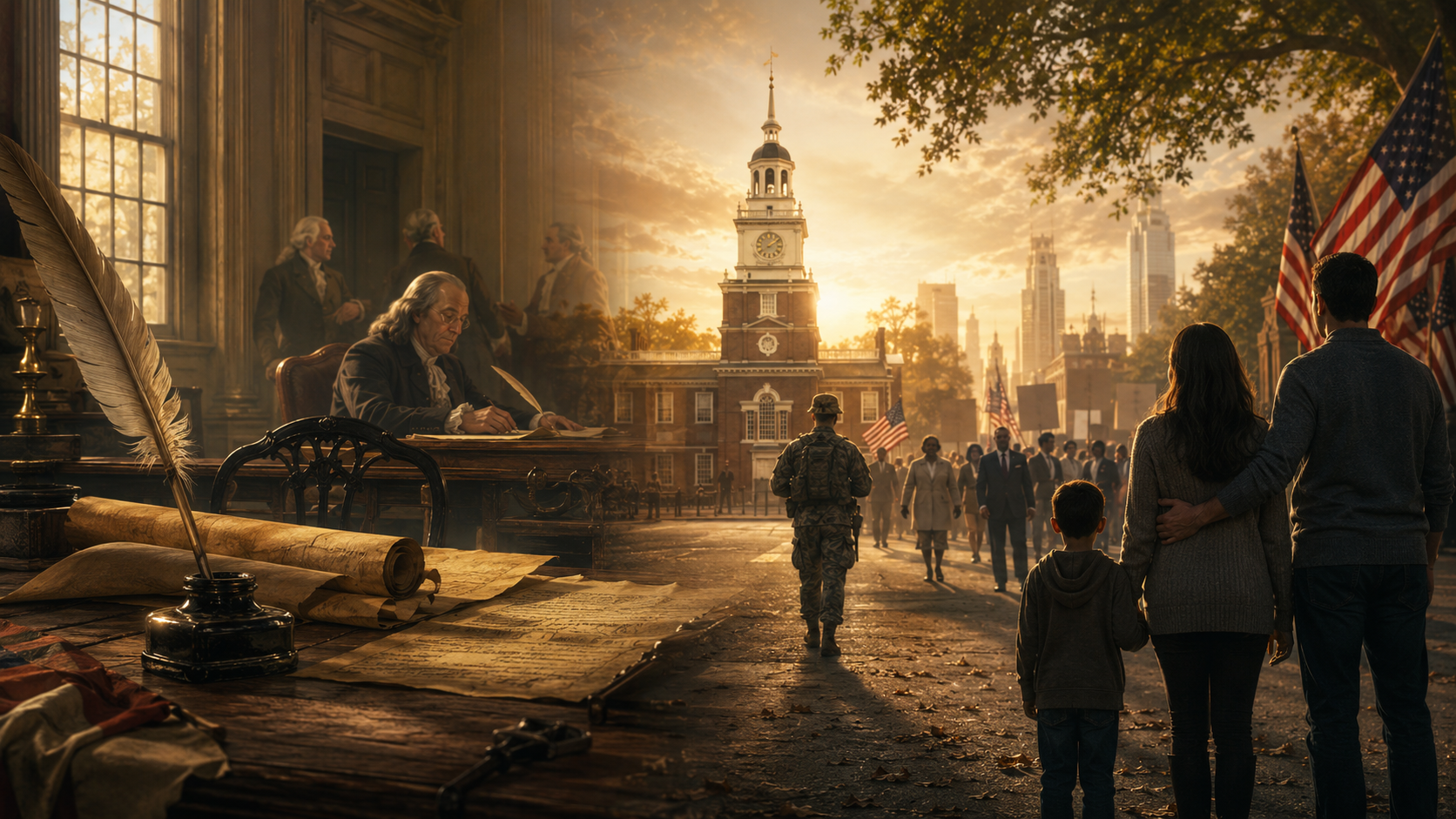
The men in that Philadelphia room did not hand down a finished country. They handed down an unfinished argument and the tools to keep making it.
There is no better emblem of that inheritance than the bell that hung in the tower above them. It was cast in 1751, a generation before independence, to mark the fiftieth anniversary of Pennsylvania’s founding charter — and the verse its commissioners chose, from Leviticus, spoke of a jubilee year in which debts are forgiven and the enslaved set free: Proclaim liberty throughout all the land unto all the inhabitants thereof. It cracked almost the moment it arrived, and cracked again across the generations, until it could no longer ring.
And here is the part worth carrying out of this first article.
The founders did not name it the Liberty Bell.
The abolitionists did — in the 1830s, seizing on that inscription to indict a country that had proclaimed liberty for all the inhabitants while holding a sixth of them in bondage.
They took the nation’s own bell, and the founders' own words — the promise of equality — and used them to demand that America finally mean what it had proclaimed. The argument, once again, outran the men who made it.
That is the American story in a single object: a flawed and literally cracked vessel, inscribed with a promise larger than the people who made it, handed down through the generations to anyone willing to take up its words and insist the country live by them.
Two and a half centuries on, the bell still hangs silent in Philadelphia. But its inscription was never really addressed to 1776. It was addressed to whoever came next.
That is now us.
The story of America isn’t finished. We are writing the next chapter.
This is Article One of the Growth Solutions KC America at 250 series.
Next: Article Two — The American Experiment: A Republic Unlike Any Other.
— Matt Cucinotta | Growth Solutions KC | Inspire · Inform · Ignite


Comments ()