

A More Perfect Union: Why America at 250 Is a Story Still Being Written
As we commemorate America's 250th anniversary, we do more than look backward. We examine the principles that shaped the nation, the events that tested it, the innovations that transformed it, and the citizens who carried it forward through times of triumph and uncertainty.
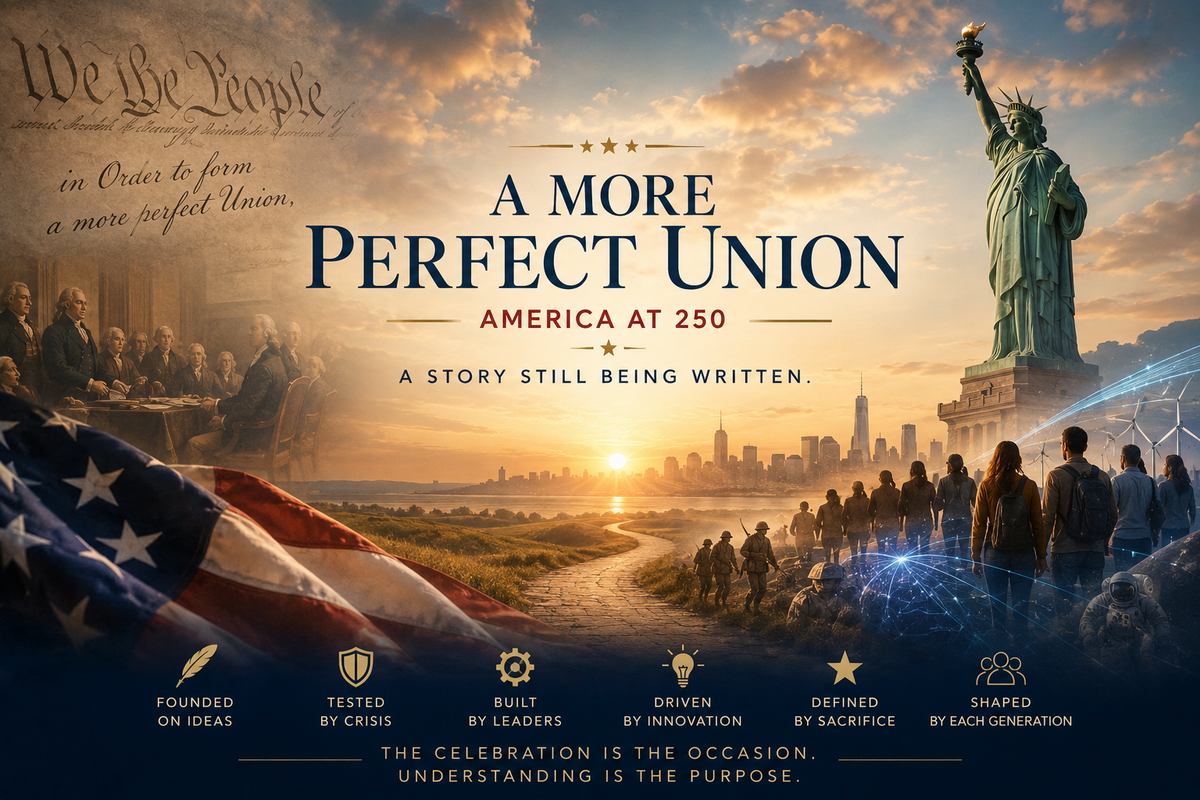
AMERICA AT 250 SERIES · OPENING ESSAY
America is not a perfect nation.
America is a nation built upon the enduring pursuit of a more perfect union — and that distinction is the whole story.
One of the oldest mistakes in American debate is that both sides keep arguing against a sentence the Founders never wrote.
Critics point to the nation's failures and conclude the promise was a lie. Defenders point to the nation's greatness while dismissing the failures. Both are answering a claim that does not exist.
The Founders did not write, "We have formed a perfect Union."
They wrote, "in Order to form a more perfect Union."
That single word — more — carries an extraordinary amount of weight. It recognizes human, institutional, and national imperfections. While, at the same time, affirming something hopeful: that improvement, progress, self-government, and renewal are all possible.
The Founders were not attempting to build heaven on earth. They were building a framework through which free people could continually improve themselves, their communities, and their country.
As America approaches its 250th anniversary, that one word is the right place to begin — because it reframes what this milestone is actually for.
The Occasion and the Purpose Are Not the Same Thing
A 250th birthday invites two easy responses, and both fall short.
The first is a celebration that asks nothing of us — fireworks, flags, and a tidy story in which America has always been good and always been right.
The second is its mirror image — a recitation of every national sin, in which the founding was fraudulent and the whole enterprise suspect.
One flatters the country. The other indicts it. Neither helps a citizen understand it — and neither prepares us for the responsibilities ahead.
There is a third way, and it is the harder and more honest one.
The celebration is the occasion. Understanding is the purpose.
The anniversary is a reason to look — but the value is in what we actually see when we do.
A Documentary Journey Through the American Story
Over the coming weeks, we will trace the American story from its founding principles to its modern challenges. We will examine the ideas that launched the republic, the crises that threatened it, the leaders who shaped it, the innovations that transformed it, and the responsibilities that now rest with us.
Not because the past deserves blind admiration. Not because the present deserves blind criticism. But because a self‑governing people must understand the system they inherit.
And understanding remains one of the first responsibilities of citizenship.
This series will explore the founding, the constitutional framework that has endured for well over two centuries, the great crises that tested the nation, the innovations that repeatedly reinvented the future, the opportunities and complexities of expansion, the realities facing America today, and the choices that will shape the next 250 years.
The goal is not nostalgia. It is clarity.
The kind that leaves a reader better able to understand their country, their community, and their role within both.
The Claim That Survives the Evidence
Here is the central thesis of this series:
Your birth is not your destiny — and America's greatness lies not in having perfected that promise, but in continually striving toward it.
Notice why that claim is stronger than the simpler version. "America has never failed" collapses the moment you open a history book.
"America continually strives to improve," does the opposite — it becomes stronger the more honestly you examine the record.
The failures are important. The corrections are significant. The struggles shape us.
A nation that never stumbled would have little to teach about resilience. A nation that stumbled, corrected course, and repeatedly fought to move closer to its ideals possesses a different kind of greatness — one that is earned rather than assumed.
This is what allows two truths to exist simultaneously: America is not perfect. America is still exceptional.
Those ideas are not in conflict.
The exceptional part is not a spotless past — it is the founding ideal that a person’s future is not determined by the circumstances of their birth, paired with a demonstrated capacity to keep closing the gap between that ideal and the lived reality.
The idea of self-determination is a common theme throughout American history, represented by a recurring figure: the individual whose birth does not dictate their future. This includes the immigrant arriving with nothing, the homesteader heading west, the factory worker whose children become professionals, the entrepreneur starting a business in a garage, the first-generation college student, and the inventor creating something that changes the world.
Each is a different proof of the same proposition.
What This Asks of Us
If the promise is real but unfinished, then every generation inherits the same responsibility:
- Preserve what is good.
- Improve what is imperfect.
- Leave the nation stronger than it was found.
Every generation inherits America. No generation owns it.
Ownership implies entitlement; inheritance implies responsibility.
That responsibility is not ceremonial. It is the mechanism by which a republic survives. The Constitution's vision of a more perfect union was never self-executing. It advanced only when citizens accepted stewardship of the institutions, freedoms, and responsibilities entrusted to them.
The responsibility now belongs to us.
Not as an abstraction.
As an inheritance.
The story of America is not a finished document to be admired behind glass.
It is an unfinished one. And the pen has been handed down.
The Journey Ahead

For 250 years, America has struggled, succeeded, failed, adapted, innovated, corrected course, and moved forward. The American story is not one of perfection achieved. It is one of progress pursued.
Generation after generation taking up the work of liberty and self-government and carrying it a little farther.
By the time this series reaches the Fourth of July, the goal is for the celebration to feel earned rather than merely festive — for readers to have completed a journey through where America came from, what it built, where it fell short, where it stands today, and what its citizens owe the chapter still to come.
We do not celebrate because our history is flawless.
We celebrate because the American experiment endures — still striving, still improving, and still pursuing the promise of a more perfect union.
The celebration is the occasion. Understanding is the purpose.
This is the first installment of the Growth Solutions KC 12-part America at 250 series. Next: Article one — America at 250: Why This Anniversary Matters.
— Matt Cucinotta | Growth Solutions KC | Inspire · Inform · Ignite



Comments ()